Hello there,
My name's Francesca Harrell and I'm so happy to have you here with me today.
If we've never met before,
I'm a British storyteller and I read cozy,
Whimsical,
Low-stakes stories to help you sleep.
How are you today?
Today's sleep story involves a visit to a cottage greenhouse where we find an old guide to herbs written by Lady Rosalind Northcote.
She was an expert on British flora and botany and when I read some of the passages in here,
It really took me straight into the English countryside.
She breaks down which herbs are used now in the modern era of the turn of the 20th century,
Herbs from the past and herbs for different uses such as perfumes,
Magic and medicine.
I just love reading books like this.
If we don't,
They will get forgotten.
My hope is that reading them to you like this gives them a new lease of life.
Now this is a combination of an original story that features some passages from this old book and you'll hear gentle,
Ambient music in the background.
By the way,
It's okay if you don't fall asleep right away.
My hope is that you can at least sit back and relax as we learn more about some of the herbs I've hand-picked,
Pun intended,
From this book.
Make sure you get nice and comfy,
Have a sip of water if you need one and then come with me as we learn about herbs from the Book of Herbs.
You've been staying at the cottage for a few days now and it's already feeling homely as you're getting used to the odd creaks and groans of the place.
It's a proper old home with low ceilings,
Worn flagstone floors and even one of those old-fashioned agar ranges.
The joy of boiling the little kettle on the top for your tea and doing your bacon on it in the morning is just wonderful.
How lucky you feel,
Even if it's only for a few days.
Tonight though you can't sleep.
You've been lying in the dark for 20 minutes listening to the house breathe and it's not that it's unsettling,
It's just a bit unfamiliar.
So you get up,
You pull on your big soft cardi and pad downstairs in your socks into the kitchen.
You can smell the beeswax polish of the table and a little bit of the savoury pepperiness of the soup you made earlier.
You feel the kettle,
You put it on and while you wait for it to boil you notice the key.
It's hanging on a little hook by the back door next to a scrawled note you hadn't paid much attention to before.
Greenhouse key,
Help yourself to the herbs,
Mind the latch.
You hadn't gone in just yet,
The weather had been a bit dismal and you had fancied staying in by the wood burner as much as possible,
Not doing much,
Just rotating hot drinks,
Comforting meals and making a good dent in the puzzle you started.
You look out of the kitchen window,
The rain has stopped,
The garden is still and dark and wet.
It looks chilly still but through the long stemmed hollyhocks and lupins a dim light catches your eye.
Is it a neighbour's house you wonder?
No,
The nearest cottage isn't that far away but it's on the other side of where the kitchen window is.
You squint and make out the greenhouse.
Yes,
There's a lamp on in there,
How long has that been on?
You finish making your tea,
You take the key and decide to investigate for yourself.
The path to the greenhouse is damp underfoot,
The sprigs of grass that poke through the gaps in the stepping stones cold through your socks and you think I should have put shoes on but you're already here.
Lifting the latch it does stick a bit just as the note said and you step inside.
The warmth is immediate like a wall of coziness or like when you sink into a hot bath after being out in the cold.
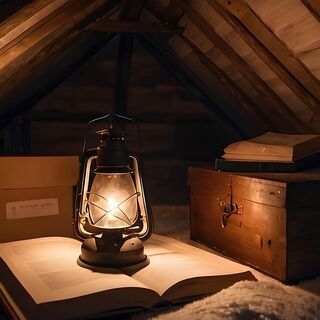
In here it smells of damp earth and greenery and it turns out it was a little lantern after all.
Thankfully just one of those little electric ones made to look like a kerosene lamp so it's perfectly safe.
But where has that warmth come from?
It should be as chilly as the garden in here but it's as if you're sitting right next to the roaring fire inside the cottage.
You stand for a moment just letting yourself arrive and take in your surroundings.
It's a familiar feeling though you've never been in here before.
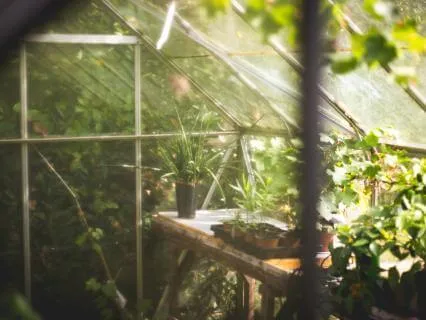
Along the shelves herbs grow in terracotta pots spilling over the edges reaching toward the glass.
Bundles hang drying from the iron frames above your head.
There is a low wooden stall in the corner and on the potting bench beside it something you almost miss.
A book lying open its spine cracked from years of use.
Someone has been reading it.
You set down your tea pick up the book and find yourself a place to sit.
The Book of Herbs it says by Lady Rosalind Northcote.
You flip to the beginning and read a few lines of introduction but then you find yourself just letting it fall open where it wants to.
To a page on balm.
The lemon scent of balm the author writes makes it almost the most delicious of all herbs.
You look up and sure enough there it is in a pot on the shelf right in front of you.
Its leaves broad and crinkled.
You lean forward and pinch one leaf gently and the scent that rises is extraordinary.
Clean and lemon bright and sweet all at once and very alive for a plant in the middle of the night.
Shakespeare wrote about it.
There was once a cordial called Carmelite water made from its spirit said to restore and revive.
You didn't know any of this.
You think all of the things in the world you don't yet know and find it a comforting thought rather than an overwhelming one.
You flip forward a few pages and land on thyme.
You smile.
You cook with thyme.
You know thyme but you didn't know that among the ancient Greeks it stood for graceful elegance or that it was an emblem of activity worn by young men to show their spirit or that there are old Devonshire songs about it.
Sweet slightly melancholy things about lost gardens and stolen time.
You look around the greenhouse and spot it near the door.
A pot of it low and dense and silver grey.
Exactly where a draft might creep in.
It's a hardy little thing.
Beneath your feet you read time that for all your bruising smells more sweet.
You set your socked foot very gently against the edge of the pot and a scent that's faint and warm and herby lifts into the air.
You laugh quietly at yourself.
You let the book fall open again to lavender.
You don't need to look for it.
A great big bundle hangs directly above your head tied with old twine.
Its flowers long since faded from purple to a dusty silver.
This book tells you that Isaac Walton who wrote The Complete Angler about fishing of all things described his favourite inn as having a cleanly room lavender in the windows.
That was his whole vision of a good place to rest.
Clean and smelling of lavender.
You think he was right.
You reach up and press your palm gently to the bundle above you.
A little dust and sweetness drifts down.
You breathe it in slowly.
Your jaw unclenches.
You hadn't noticed it was clenched.
The next page you land on is borage and you look up to find it growing in the shadowy back corner.
A straggling,
Cheerful looking plant with five-pointed flowers the exact blue of a clear winter sky.
Impossible blue really for something growing in a pot indoors.
I,
Borage,
Give courage.
The book quotes.
It was said to drive away melancholy,
To exhilarate the spirits.
You read a bit about a Tuscan cradle song in which Borage is accused of frightening a baby and the author's brisk dismissal of this.
The evidence is absolutely unsupported by any tradition and he considers it worthless.
You like her very much,
Lady Rosalind Northcote.
You feel as though you can hear her voice as you read.
You look at the little blue flowers for a while.
You feel,
In a quiet sort of way,
Quite cheerful.
You find mint on the middle shelf,
Sprawling out of its pot with the confidence of something that knows it cannot really be contained.
The book says it was once called Erba Santa Maria in Italy,
The herb of Holy Mary,
And Frauenmünze in Germany,
The woman's herb.
It was strewn in churches,
Gathered from meadows in armfuls.
There is a warmth to the way this book talks about plants,
Not just in their uses but their histories,
The hands that grew them,
The poems they found their way into.
You snap a small leaf off and hold it to your nose.
The sharp clean coolness of it clears your whole head in one breath.
A few pages on you find sage and here is the pot of it,
Silvery and soft,
The leaves like little padded envelopes.
You run a finger along one and the whole greenhouse smells different for a moment,
Warmer and more woody.
The book tells you it is a sympathetic plant,
One that feels the fortunes of its owner.
When a Buckinghamshire farmer was doing badly his sage withered.
When things improved so did the sage and the Medical School of Salerno once asked,
How can a man die who grows sage in his garden?
You look at this sturdy woody plant and think it does have a certain authority about it.
It feels as though it's been here a long time.
He that would live for a must eat sage in May,
You read.
You page back and forth now,
The book comfortable in your lap,
Finding things and then looking up to match them to what's growing.
Chamomile,
There near the window,
Small daisy faces turn toward the lamp.
The book says its name comes from the Greek for earth apples because its scent is something like ripe apples,
Which you test by leaning in close and finding it to be entirely true.
It was planted in garden walkways so that the more it is trodden upon,
The better it thrives.
A small persistent thing that needs a little gentle pressure to show its full strength.
And then rosemary,
The big untidy bush at the far end,
Taking up more than its fair share of the bench,
Growing as if it has absolutely no intention of stopping.
Here's rosemary for you,
That's for remembrance,
The book quotes Ophelia.
It was used at weddings and at funerals both because,
The book says this so simply,
Love and memory have always been understood to be the same thing.
To truly love someone is to carry them with you.
You breathe in its sharp,
Clean,
Piney smell and think about the people you love.
Near the end of the shelf you find sweet Sicily,
Feathery and tall,
Smelling faintly of anise,
Valued for its mildness in old cottage gardens.
The book calls it one of the gentler herbs,
Good for old and young alike,
Good for those who need something that doesn't demand too much.
The pot is in a corner you almost missed,
The plant leaning slightly toward the lamp.
It looks like something from a medieval manuscript.
It looks,
You think,
Exactly like it belongs in a story.
You realise you've been here nearly an hour.
The book slips a little in your lap,
Your tea is long gone,
The lamp hums.
Outside the greenhouse glass,
The garden is beginning,
Only barely,
To lighten.
That pre-dawn grey that isn't properly light yet,
But it's the first absence of deep darkness.
You feel suddenly and completely tired.
Not the brittle kind of tiredness you went to bed with earlier,
But the kind that comes from a quiet mind and an hour well spent.
You put the book back on the potting bench,
Spine up,
Marking your place.
You'll come back to it tomorrow,
In the daylight.
Bring it outside maybe,
And read in the garden,
And look up what's growing there as well.
You lift the sticky latch and step out into the cool damp air.
The grass is silver.
The sky is a deep,
Soft blue.
A blackbird is awake somewhere,
Trying out a few notes in the quiet.
You go inside.
You take off your cardigan and lie down.
As your mind begins to glide into sleep,
You think back to the greenhouse and all the herbs breathing gently in the dark.
The balm and the thyme,
The lavender and its dusty sweetness,
The brave blue borage,
The mint,
The sage,
The chamomile with its apple scent,
Sweet sicily leaning toward the light,
The rosemary.
All of them there,
All of them quiet,
Just like you now.