Velines,
The Lithuanian celebration of the dead.
After the fall equinox,
The time of the Veles begins.
It lasts until the end of October or beginning of November.
Velines or Ilkes are the most important holidays for remembering and paying homage to the departed ancestors.
During this time not only the immediate family is remembered,
But also the more distant ancestors.
It is to those great ancestors that we give thanks for all that we possess today.
According to Christian doctrine,
The dead and the living are separated and do not commune.
Lithuanian folk believes all things differently.
During the times of Kuchios,
Christmas Eve,
And Velines,
The dead would gather and feast alongside the living,
Partaking of different dishes.
The ancestral dead are the links between living human beings and nature's cycle of rebirth through death.
The dead leave for another world.
It is not far away,
But relatively close by.
The dead often return and melt with the forces and forms of nature.
All calendar feasts include the honouring of the departed,
Through offerings,
Prayer,
And communal feasting.
The herd joins the family,
The community and symbolizes the permanency of life.
It links the ancestors and gods with their descendants.
It was believed that many Veles lived near the herd.
Thus a home's heart joined all family's members,
Both living and dead.
It was at this time that the graves were visited,
Decorated and honoured,
Especially the ancient mound graves.
It was written that in the 15th century,
This fall feast took place in the wooded groves.
After the harvest had been gathered,
People would bring food,
Drink and feast for holidays.
For days.
Each would have their own fire for the making of offerings to the gods and the ancestors.
Towards the end of October,
Adults and children would gather in one home.
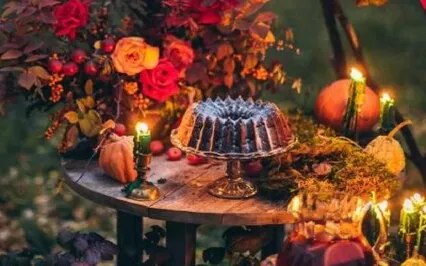
They would arrange straw on a table and cover this with a tablecloth,
And then place several loaves of bread and pitcher of ale on the corner.
Other food would then be placed on the table and prayers and offerings would be made.
Some grain and dollops of beer would be offered the herd fire,
Sprinkled on the ground and in the corners of the house.
The most important dwelling place for ancestors was.
Ritual prayers would be set during this ceremony.
After the graves have been visited,
A family dinner is held.
Before eating,
The head of the household would hold up a cow sauce.
Offering cup reserved for this occasion.
More anciently,
A cow cole,
A skullcup,
Was placed within it.
Various grains,
Flour and salt.
The contents would be poured into the herd fire with the words,
For all our friends.
A drinking-horn would then be passed around the table with appropriate toasts and the dinner would begin.
After the feast,
Dinos for velines would be sang,
Along with the war and harvest songs.
If there was someone who was particularly honored,
An empty place was left for them at the table,
Complete with a cup,
Plate and a towel.
Mussels from each dish were symbolically offered and placed in the plate.
During the velines' meal,
Candles or small torches were burned.
By candlelight,
All family members would gather in silence.
While the eldest person would pray thus.
Shades of the dead,
Who still remember this house.
Honored ancestors,
Grandfather,
Grandmother,
Father and mother,
The dead are named.
Who are worthy of eternal remembrance.
And all our relatives and children,
Whom death has taken from us.
We invite you to this annual feast,
May it glisten to you,
Honored ancestors,
As our sweet are memories of you.
Little tables for the dead are prepared on graves and elsewhere in rows.
Candles and food offerings are arranged there.
Many are the variations in the way in which velines is celebrated.
There is a human need to remember those who have gone before us,
To honor the ancestors who are so bound with our identity.