When we study creation myths from ancient cultures and civilizations,
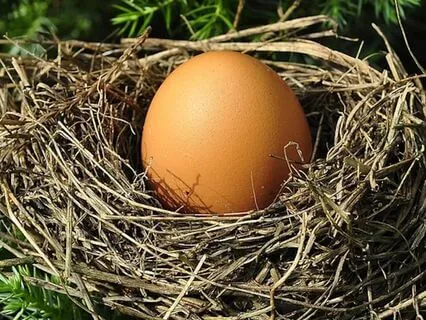
The cosmic egg is one of the most popular motives.
The egg is representation of the universe,
The primordial sea or some primordial being that comes into existence by hatching.
While the birds had great spiritual significance among many Uralic people,
In the Proto-Uralic creation myth,
The world was created by a water bird who dived into the primordial sea,
Bringing pieces of land in its beak to the surface.
The Finnish creation myth is based on the Proto-Uralic myth.
In Kalevala,
The Finnish national epic,
Water bird hatched an egg into the legs of Ilmatar,
The goddess of air.
In original Finnish folktales,
The water bird hatched its egg into the legs of Väinämöinen,
The shaman.
In these myths,
A water bird is described to be a blue duck,
An eagle or a loon.
Myths about the water birds as the creators is one of the oldest earth diver myths.
Quote from Kalevala,
The song of creation by Elias Lönnrot in 1835.
And became the earth below,
And its upper half transmuted.
And became the sky above,
From the yolk the sun was made.
Light of the day to shine above us,
From the white the moon was formed.
Light of night to gleam above us,
All the colored brighter bits,
Rose to be the stars of heaven,
And the darkest crumbs changed into clouds,
And cloudless in the sky.
In Norse myths,
The cosmic egg is equivalent to the rune Hagalaz,
Which symbolizes the ancient Sazen,
The void that existed even before god Odin willed himself to be.
Eggs were an important part of nutrition in ancient times,
Especially in northern parts of the world,
Where winter was long and cold,
And eggs were nowhere to be found.
In Magic Rite Seer,
The Seidir took the egg and in their imagination fertilized it with the desired outcome.
The egg was cracked to release what was built up inside,
And the desired energy manifested into being.
For the ancient Chinese,
The universe was contained in an egg.
Outside this egg was nothing but void.
From this material inside the egg grew god Pangu.
He slept inside the egg for eighteen thousand years,
Growing into a giant.
The egg broke into halves.
The upper side became the sky,
And the lower side became the earth.
As the god grew taller,
The earth and the sky grew larger and became further away from each other.
When the god died,
His body parts became different parts of the earth.
His arms and legs became mountains,
His veins turned into rivers,
His voice became the thunder,
And his breath became the wind.
In the Cook Islands,
There is a legend that has similarities to the idea of the cosmic egg.
Deep in the Awaiki,
The underworld,
There was a place that resembled a hollow coconut shell.
There in the deepest depths was the primordial mother,
Kadeswarima the Takere.
Her domain was described to be so narrow that her knees touched her chin.
She created the first man called Awatea.
He was a hybrid,
A merman,
Half man,
Half fish.
Awatea was the god of light and Warima the Takere sent him to the land of men to bring them light.
It was told that his eyes were the sun and the moon.
Some of the first literal mentions of the cosmic egg comes from Sanskrit text.
Sanskrit term for the cosmic egg is Brahmanda,
Which is derived from two words,
Brahma,
Who is the creator god in Hindu mythology,
And Anda,
Meaning egg.
In Vedic myths,
The cosmic egg is seen as the beginning of the universe,
And it is called Hiranyakarpa,
Which literally means golden fetus or golden womb.
Egg floated in the emptiness and broke into two halves,
Which formed Tiaus,
The sky,
And Prithvi,
The earth.
There are several creation stories found in Egyptian mythology.
One of the myths is about Octoad.
It was the state of the world before the gods were created.
One of the forms of Octoad was the cosmic egg,
Where all the deities and spirits were born.
In the state called the first occasion,
Sun god Rauru hatched from the egg,
Bringing all life with him.
We also find a similar myth from Greek mythology.
According to the Orphic myths,
Hermaphrodite god Pharnes was born from the cosmic egg and created all the other gods.
World egg was hatched by the titans,
Kronos,
The titan of time,
And Analke,
The titan of necessity.
These were some of the symbolism connected to the cosmic egg that we can find all around the world.
Thank you for listening.