Hi,
Beautiful people.
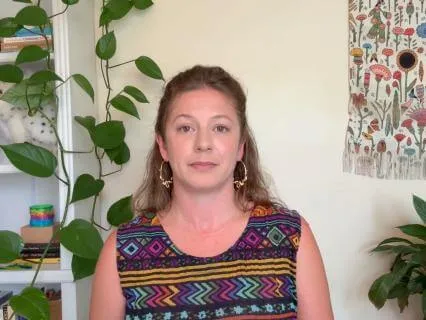
Glad to be back today to share the second breathing practice in my series on somatic skills for breathing.
In this series,
I'm introducing tools where you can use your breath to directly affect.
How you feel in your body,
Create immediate physiological changes in your nervous system.
So the breathing practice we'll be exploring today is from the yoga tradition.
It's known as Sama Vritti Pranayama.
In Sanskrit,
Sama translates to equal.
Briti translates to mental fluctuations,
So the fluctuations and the distractions and the movements of the mind.
And pranayama just translates to breath or breath work.
So the literal translation of this breathing practice into English is equal mental fluctuation breathing.
So the effect of this ancient breathing practice on the nervous system is that it really supports a sense of calming of anxious thoughts.
It brings us out of the internal state of worry.
It helps to balance and harmonize the energy and the prana or the energy flow throughout the entire physical body so that we can feel a greater sense of calm.
Coherence,
Resonance within our nervous system.
It's a wonderful practice if you tend to be an overthinker,
If you have trouble falling asleep at night because your brain is going,
Going,
Going.
If you tend to worry a lot about things or if you're just dealing with chronic stress,
It's of course always wonderful just as a way to support your body to feel more resourced and settled.
So I'm going to briefly introduce the breathing practice,
Offer a few disclaimers for folks who might want to practice a little bit differently based on your own bodies.
And then I will start to demonstrate the breathing practice.
Invite you to join in with me as I count off.
Certain number of numbers for each inhale and exhale.
So we'll go through a practical experience of this together.
Just to introduce this breathing practice,
You might know this practice or have heard of it as equal parts breathing or box breathing,
Which is commonly known as in the therapeutic and the yoga worlds in the United States.
So the way that we're going to do this breathing practice is we will be bringing an equal ratio to the inhale,
The exhale,
And a series of breath retentions in between the inhale and exhale.
So just briefly,
As an example,
We will start out by inhaling for four seconds.
You will hold the breath gently at the top of the inhale for four seconds.
We will exhale for four seconds and then we will hold the breath at the bottom of the exhale for another four seconds.
And then we just continue.
Softly,
Rhythmically.
Finding that.
Inner sense of balance and ease through counting equal ratios between inhales,
Exhales,
And breath retention.
I'll start demonstrating the practice with a count of four seconds,
But know that as you continue to practice this,
It's likely you'll want to experiment with different counts.
So probably lengthening the count slightly as you become more comfortable and your body starts to relax more.
You might be able to do a count of five,
Six,
Seven,
Eight.
But a quick disclaimer on that is we never want to hold the breath.
To the point of strain in the body because that starts to stress the body out again and we're not trying to do that.
So if you notice you're lengthening the ratio on your own and you're holding your breath and you're starting to feel dizzy,
Lightheaded,
Stressed,
Strained inside.
Just let go of the breath retention part of this practice.
It's also.
Not always safe for everyone to hold their breath.
So if you have Had trauma around your breathing or any major trauma in your body,
Holding your breath may activate your sympathetic nervous system to a point of overwhelm.
So you just want to be cautious as you play around with the practice and just notice what effect it's having on your nervous system.
So you can decide if you want to continue on or not.
If you do feel yourself doing this breathing practice and you start to feel lightheaded or dizzy or uncomfortable,
Just stop the breathing practice.
Let your breath return to its natural rhythm.
And your body will make its way back to regulation from the inside out.
Other people who should not hold their breath for this practice are people who are pregnant,
As well as anyone with cardiovascular heart or heart issues,
Blood pressure issues.
Lung,
Ear,
Or eye issues.
So breath retention is not indicated for you.
And I would just invite you to play with inhaling and exhaling up and down at the exact same count without holding the breath in between.
All right,
I'm going to demonstrate a few rounds of this.
I won't be talking,
I'll be counting internally as I'm breathing,
Holding,
Exhaling,
Holding.
And then after just showing you what it looks like for a few rounds.
I'm going to start counting off and guide you through several rounds of this practice just so you can get the hang of it.
And then you can go enjoy practicing it on your own anytime you need to come out of a worried or overly active mental state.
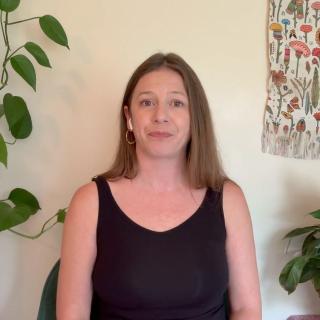
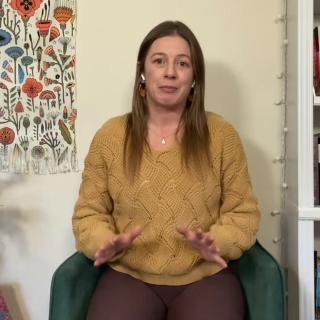
So here's what the breath practice looks like with approximately a four count.
And this time I'll draw the box as I'm doing the breath,
Because I realize you probably can't tell if I'm breathing and how I'm breathing.
So it starts out with that inhale for four.
Hold for a few more.
Exhale forward.
Won't perform.
Inhale four.
Hold or.
Exhale,
Four.
And four.
That's what it looks like.
It's kind of hard to talk you through this and demonstrate at the same time.
So now that you have an idea of what it looks like,
I'm going to just start to count off for you.
I invite you to feel kind of comfortable seat to be in.
You can also do this practice laying down.
Let things relax a little bit to whatever degree is possible and then soften your gaze,
Close your eyes if that's comfortable.
And we will begin for several rounds here.
Whenever you feel ready,
Inhale to release.
Three.
Hold 2.
Exhale.
Hold,
Two,
Three.
Inhale.
To Three.
Too.
Three.
Exhale to release.
Three.
Forward.
Two.
Three.
Inhale.
Too.
Three.
Hold.
Two.
Three.
Exhale.
Two.
Pretty.
20 minutes.
To We.
In hell.
And continue at your own pace for as long as you'd like.
Pausing every once in a while to notice how you're feeling,
What's happening in your body.
And you might take a little time after you complete the breathing exercise just to observe.
If your mind feels a little bit quieter and a little bit slower after this practice.
Thank you so much for joining in,
As always,
And I'll see you next week.