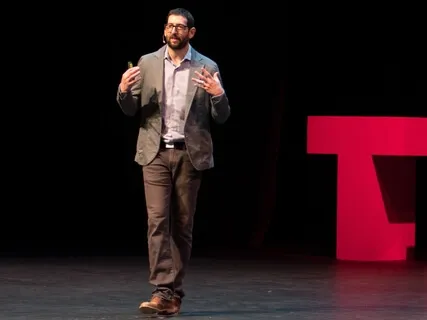
Translator's Note Thank you.
We are all born with a brain that has 86 billion neurons.
And throughout our life,
We make relatively few new neurons.
In fact,
We lose about 2 billion neurons throughout the course of our lifetime.
So you may wonder,
If we're losing billions of neurons,
And we're not making a lot of new neurons,
What's changing in the brain to support all those mental habits and behaviors that make up our self-identity?
Well,
The answer is activity-dependent plasticity.
This is the function by which the brain is continually modified through the 150 trillion cell-to-cell synaptic connections that are made in response to your everyday experiences.
One main point that I hope you take home today is that not only are they contributing to your self-identity,
But they are continually changing your brain.
And they are strongly influencing your health and longevity.
I hope to also demonstrate that a systematic form of mental training involving meditation can potentially transform yourself and your mental habits in a positive way.
In 2002,
I was a graduate student in cognitive neurosciences.
That was me.
I was studying the brains of rats to better understand the neural circuitry of learning and memory.
And activity-dependent plasticity was a really important concept for studying memory,
But I was interested in how that concept could be applied towards a neuroscientific understanding of the self through the lens of meditation and mindful awareness.
Now,
Mindful awareness can be simply thought of as a way of paying attention in a way that is continually watchful and discerning for what is arising and passing in our minds and in the external world.
Now,
When I was in graduate school,
There was barely any science of mindfulness.
In fact,
Before the year 2000,
There was the grand total of 39 peer-reviewed scientific articles on the topic.
So for good reason maybe,
My mentor sat me down one day and said,
Dave,
You will not be successful in academia by focusing on meditation.
Forget about all that Zen stuff.
And I walked out of his office feeling rather disappointed,
Discouraged.
But it did not deter me from this calling.
Fast forward 10 years,
I was a faculty member at Harvard Medical School studying meditation in a neuroimaging laboratory.
And about that time,
I was invited to present my research directly to the Dalai Lama,
Along with five other emerging leaders in the field from around the world.
Thank you.
That's very kind.
Yes,
This was really an amazing opportunity.
And the advice he gave the six of us is something I will never forget from my lifetime.
He said,
Pointing his finger at each one of us,
You each have the great responsibility for helping to build a happy,
Peaceful world.
Millions of people want a happy,
Peaceful world,
But are lacking the knowledge of how to do so.
Through caring experiment,
Month by month,
Year by year,
You will gain evidence to convince others.
I will watch you,
Whether you are really helping to build a happy,
Peaceful world or not.
He then jokingly threatened,
Hopefully,
That he would be one of the best scientists in the world.
That he would be watching from beyond the grave,
And that even if he were in hell,
He would come back as a demon and hunt us down to make sure we were doing this work.
No joke.
Well,
Hopefully.
Now,
When the Dalai Lama points his finger at you and threatens you in that way,
Or challenges you,
Really,
You can't really say no.
So,
Aside from providing a sense of purpose and meaning for me,
That experience really provided a pretty solid research career plan for the next 30 years.
So,
Fast forward to 2016,
I was provided the opportunity to come here to Nashville,
To Vanderbilt University,
To direct research at the Osher Center for Integrated Medicine.
So,
My interest in the self through the lens of meditation comes back full circle to today,
Where I have the resources and the support to do the science I originally intended to do back in graduate school.
I'm currently leading a team of scientists to continue mapping the meditative brain,
Or meditative mind,
And to better understand what a flourishing mind,
Brain,
And body looks like from the neurobiological,
The psychological,
And social levels.
So,
As we contemplate the self together today,
I want you,
Well,
I invite you,
To think about how all of your life experiences,
Even the guy all the way up there,
Have led to who you've become today,
And to explore how all of your thoughts and emotions that you're having right now,
Today,
May lead to who you become tomorrow.
The Dhammapada,
One of the greatest known collections of the Buddha,
Describes,
Our life is shaped by our mind,
For we become what we think.
The basic idea here is from birth to the present day,
Our self,
Our experience of being someone,
Our wants,
Our fears,
Our desires,
Our hopes,
Our values,
Our expectations,
Our whole self-identity is continually constructed by a string of moment-to-moment processes of selfing.
And these moments can be further broken down into processes of perception,
Sensory awareness,
And evaluation,
All of which happen on a time scale of half a second,
500 milliseconds.
And through neurophysiological research,
It's been found that the brain stem and the subcortical regions are helping to filter out information that is irrelevant to you,
And to prepare your mind for action.
Now this part of our mental experience is all happening without conscious awareness.
In the second half of each moment,
Our primary sensory cortices,
Located throughout the outer surface of our brain,
Is integrating information coming from perception and awareness,
And preparing inferences and predictions to inform our behavior.
And only by the end of each moment,
Around 300 to 500 milliseconds,
Does awareness arise,
And then we begin to evaluate what it is we're experiencing.
And that evaluation takes place in aspects of our prefrontal cortex.
So this string of moments is sustaining our mental habits and dispositions that are self-conditioning and self-perpetuating through repetition.
It's continually informing our present state of awareness,
And coloring our memories for the past,
And making predictions for the future.
And this basic idea here really supports the idea that this little guy here has had about 3 billion moments in 42 years to become the guy who's standing before you today.
And somewhere along this string of moments,
I developed a bad habit.
Maybe you can relate.
When I was 8 years old,
My mother gave me a punching bag to deal with my anger and frustration.
Thank you,
Mom.
This was effective on the short term.
I would go down to my basement and hit that bag every time I got angry or frustrated.
And eventually,
As you can imagine,
That punching bag broke and got thrown out with the trash.
But the conditioning did not go away.
I never hit any people,
But I continued to hit walls and doors and windows.
I even have a scar on my hand to go with it.
A little over a decade later,
When I was 20 years old,
My sophomore year of college,
I had the opportunity to go on a meditation retreat,
A 10-day silent meditation retreat,
First time.
Not because of my anger,
But more so for my curiosity about Buddhism and my interest in studying the mind.
This was a profound experience for me on multiple levels.
For one,
It provided a signpost in my life of how I could change my mind.
It also provided a mindfulness-based skill of meta-awareness of my mental habits.
Meta-awareness refers to an awareness of where our attention is and where it's going at any moment.
And when we practice using a mindfulness-based approach,
It acts as a wedge to open up our minds and provide insight into the mental habits that are arising again and again.
And for my anger,
It provided awareness to all the triggers and impulses and feelings and thoughts that are associated with my anger.
And the state of mindfulness is often described as that wedge of meta-awareness,
And if inserted deeply enough into our minds,
As described by Buddhist scholar Andy Olensky,
It will open our minds up to wisdom.
And wisdom is subtly different from awareness,
In the sense that it can be described as the direct experience with our mental habits.
For my anger,
It was the body awareness,
The sensory awareness of my body.
It was the tightness,
The clenched fists,
The impulse of readiness to move,
The sense of being aware of my body.
It was the clenched fists,
The impulse of readiness to act.
That was my anger.
The idea here is that when we practice mindfulness,
The awareness and the wisdom work together,
Helping to reduce the time spent in judgment and evaluation,
To be situated in the present moment with our sensory awareness,
And to allow the emotions like anger to arise and pass without the impulse to act.
Now,
Aside from anger,
There are other thoughts and emotions that can have negative impacts on our health and well-being.
Anxiety,
Fear,
Worry,
And sadness all have the tendency to be destructive mental habits and dispositions,
But only when they are happening with great frequency,
When they put the people around you,
Including yourself,
At risk for injury,
Or they interfere with your social functioning.
It turns out that these three dispositions specifically have the most extensive scientific data to support their role as risk factors for the onset of clinical levels of depression,
Anxiety,
Cardiovascular disease,
And have even been shown to increase the rate of cellular aging at the level of your DNA.
One study by the Centers for Disease Control found that an angry disposition increases your chances,
Your risk of dying prematurely of a heart attack by two and a half times.
And there's a whole number of studies showing that these three dispositions and the associated chronic stress can have negative effects on your immune system functioning,
On sensitization of pain pathways,
And atrophy,
Shrinking of the brain regions responsible for regulating these negative emotions.
So it becomes this really bad cycle because if you don't have the ability to regulate the emotions,
Well,
It's going to be much harder to regulate them in the future.
So one of my studies that I wanted to share with you today introduced mindfulness training to a group of women diagnosed with fibromyalgia.
Fibromyalgia is a chronic pain disorder associated with widespread muscular tenderness and chronic fatigue,
As well as a host of other clinical symptoms.
And we found that these patients had a high level of anxiety and fear associated with their pain.
And when we gave them mindfulness training,
We found that there was dramatic improvement in all their clinical symptoms.
So that was good.
But we were interested in what the mechanism was that may be contributing to this clinical improvement.
So we gave these patients a behavioral task that assessed how they paid attention to pain-related words at the non-conscious perceptual level and the more conscious evaluative level of processing.
And we could do this by varying the duration of time that we showed them the words.
When we showed them the words for 100 milliseconds,
They did not have a lot of time to process the words consciously,
But we could observe whether or not they looked towards or away from the words.
At 500 milliseconds,
They did have time to process the words consciously,
And we could observe whether they got stuck thinking and ruminating upon the words.
So we found two major differences between the groups that got exposed to mindfulness training and those who did not.
Those who were untrained avoided those pain-related words at the non-conscious perceptual level,
And those who were trained in mindfulness looked towards the words,
Suggesting that they had less fear and avoidance and more approach-related behavior towards their pain.
And remember,
This is a stage of processing that they didn't have any awareness that they were doing this.
The untrained group also had a tendency to ruminate or get stuck at the later stages of processing,
Whereas those trained in mindfulness were able to see the word,
Let it go,
And complete the task more readily.
So these results demonstrate that mindfulness training has the ability to improve our mental habits of attention at both the conscious and non-conscious levels.
When we do neuroimaging,
We take a modern neuroimaging and a first-person introspective methods approach in our lab and in others,
And we can call this a neurophenomenological approach to mapping the meditative mind.
And this identifies the brain networks and systems of functioning that are supporting mindfulness training and the way that we can use this to measure the mental health of the brain.
The brain networks and systems of functioning that are supporting mindfulness-based practices.
Now I said before that there weren't many studies on mindfulness before the year 2000.
Well,
Since 2000,
There have been up to close to 4,
000 studies on the topic.
And of those 4,
000 studies,
21 have looked at changes in brain structure,
And 80 have looked at brain function in a cross-section of novices who have been trained for the short term,
And expert meditators.
And although there have been some reported differences between styles of meditation practice and between novices and experts,
I want to bring to your attention the most common and most consistent findings that are found across all the studies in four brain regions,
To make it easy,
That are changing in brain structure and function.
The frontal polar cortex is the most anterior part of our brain,
Right behind your foreheads.
It is also thought to be the most highly evolved part of the human brain,
And responsible for supporting meta-awareness.
And in conjunction with the dorsal anterior cingulate cortex and the anterior insula,
These three regions work together in a complex attentional network referred to as the frontal parietal control network,
To allow yourself to be continuously aware of your body's sensations,
And to flexibly switch between internal mental processing and thinking in the outside world.
Okay?
Another,
And so one really interesting finding here is that we find in our lab that the more one meditates,
The more activity one gets in this network of brain regions.
And other labs have found that the more one meditates,
The more protected these regions are from the normal age-related atrophy that we all get.
Unfortunately,
All our brains are shrinking in size after age 20.
Sorry.
But if you meditate,
You protect them.
And one other region that you see decreases in activation is the posterior cingulate cortex,
Or PCC.
That's a major node in a larger functional network associated with self-reflection and rumination.
So meeting the challenge set forth by the Dalai Lama,
The science is beginning to emerge to support a role for mindfulness and meditation,
In improving meta-awareness and decreasing an emphasis on ruminative types of processing,
Especially in the context of high cognitive demand,
And also to transform the brain and our mental habits.
So,
We've learned that every thought and emotion is leading to transforming our brain,
Literally,
Re-sculpting our brain at every moment.
And although we do not have any control of what has happened in the past,
We have the power in this moment and going forward to choose how you pay attention to your thoughts and emotions.
Every moment then becomes an opportunity for you to change the way we perceive the world and ease the burden by which there is potential for destructive emotions like anxiety,
Anger,
And sadness.
So I leave you with the question,
What will you fill your mind with?
Thank you.