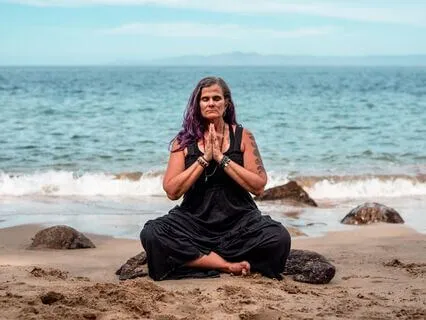
Welcome to our meditation time,
And welcome to this beautiful moment of pause inspired by Yoga Sutra 1-5.
I invite you to get comfortable,
Soften your gaze,
Or close your eyes.
And as you turn your attention to your breath,
Settle into a really nourishing pace of inhales and exhales,
A pace that feels right for you and that feels right for this moment.
As we draw inspiration today from Yoga Sutra 1-5,
This is where Patanjali teaches us that all of our thoughts can be divided into two simple categories,
Thoughts that are painful and thoughts that are painless.
None of us intentionally set out to seek things that cause us pain,
But with this sutra,
Patanjali is asking us to understand that in fact,
Many of our own thoughts actually are the source of our pain.
So our practice together today is about trying to better understand and see what Patanjali was teaching us so very long ago.
Imagine this,
You're driving your car down the road,
And all of a sudden you see smoke coming out from the hood.
You don't have to have any knowledge about the inner workings of auto mechanics to know something's not right.
But if you were to stop and open the car's hood and try to fix the issue without any knowledge of its inner working system,
You might find a temporary solution,
But you would not actually get to the root of what caused the problem in the first place.
You would never keep driving your car if you knew that something might cause you to be unsafe.
So you consult the expert.
This same idea is what Patanjali was teaching us in Yoga Sutra 1-5.
It's not enough to know that there is pain in our thoughts.
We have to get to the root of what's causing it.
We know we must take the car to the mechanic to understand what's causing the smoke,
What's causing a sense of us not being safe.
But this Yoga Sutra asks us to do the same thing,
But with our thoughts.
It asks us to sit with the thoughts that make us uncomfortable.
The thoughts that cause the area around our heart to feel a little tight,
Or the area around our jaw to tense up.
These are our warning signs,
Just like the smoke coming from outside of the hood.
When we notice our own warning signs,
That's the first step to recognizing there is pain.
Yoga Sutra 1-2 assured us that Yoga Citta Vritti Nirodha.
This practice can calm the fluctuations of our mind.
But in order for that to happen,
In this sutra he tells us,
We have to understand what's causing the fluctuations.
So now let's just sit for a moment.
Notice what comes up.
See what sensations that you feel.
Notice if there's any metaphorical smoke coming out from your hood.
Just watch the thoughts.
Watch the fluctuations for just these next few moments.
This teaching that Patanjali gave us so long ago,
This idea of our thoughts being either painful or painless,
Comes with a very simple code to begin to categorize them.
The painful ones,
He tells us,
Are always associated with something selfish,
Something connected to our ego,
Something we think we deserve,
Or something that has inconvenienced or frustrated us.
Maybe these thoughts come from an old habit or a conditioned way of being that we've learned over time.
Maybe they come from a physical sensation that we're feeling.
But what ties them all together in the painful category is that they're all connected to selfishness.
We want something.
We think we should have it.
We're angry that we don't.
Even down to the small things like not catching the green light in traffic.
And then we wonder why we can't seem to find peace.
The painless thoughts that he teaches us are originating from selflessness.
They're not at all about our ego.
They're not at all about something that we want or think we deserve or how we think someone should treat us.
They truly are thoughts that cultivate and nurture peace.
Remember the last time that you walked outside and you noticed how blue the sky was?
Or how gentle the wind felt blowing across your face?
Or how the birds sounded as they were singing on the branches?
In that moment,
Without even realizing it,
The muscles in your body began to soften.
Your shoulders began to relax.
As you stand there in the presence of this amazing nature,
All you have within you in that moment is wonder.
Even the breath becomes a whisper.
Part of our practice is that we actually need to practice thinking about the painless thoughts more often,
Which means we need to put ourselves in situations to focus on them.
Put ourselves in spaces where we can notice the blue sky,
Feel the cool breeze,
Listen to the birds.
Once you get your car fixed and you understand the thing that caused the problem,
Chances are you'll do whatever it takes to keep your car driving safely.
You'll change the oil more regularly.
You'll watch the fluid levels.
You'll even check your tire pressure.
You'll do all the things to keep yourself from experiencing pain the next time that you drive your car.
And if we're willing to take that much care with our car,
Couldn't we do at least that much with these beautiful minds that we've each been given?
When the painful thoughts come,
Ask ourselves,
Why did I go there?
Why did I think that?
Why did I let that bother me?
Why did I actually create my own fluctuation,
My own disturbance?
And then over time,
We begin to realize that this meditation practice is akin to changing the oil in the car to lessen the chance of future pain.
Because in these moments,
We're consistently filling ourselves up with stillness,
With compassion,
With selflessness,
With peace.
So as we pause and allow the essence of Yoga Sutra 1-5 to sit with us,
Let's begin practicing the painless thoughts.
Let's practice filling ourselves up with images of stillness,
Of blue skies,
Of calm breezes,
Of beautiful birds.
And with one gentle breath at a time,
Let's practice what it means to have painless thoughts,
Bringing awareness back to this moment.
Let's take a few breaths together.
Breathing in full awareness of each thought that we have.
Breathing out,
Restoring peace,
Calm,
And ease.
Breathing in full awareness of each thought.
Breathing out,
Restoring peace,
Calm,
And ease.
Breathing in awareness.
Breathing out peace,
Calm,
Ease.
Breathing in.
Breathing out awareness,
Peace,
Calm,
Ease.
Namaste.