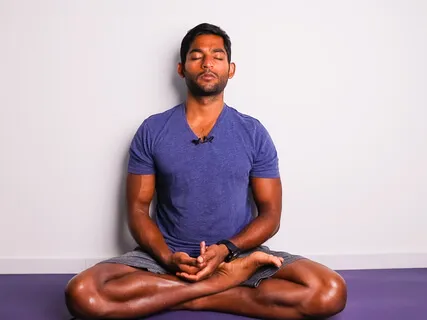
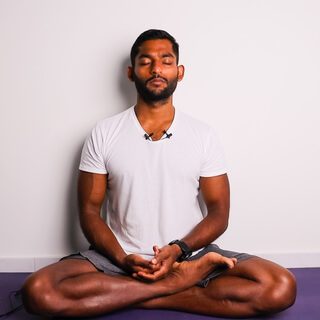
Namaste and a very warm welcome to all of you in this daily live meditation session with me,
Dehansi.
We're going through Yoga Sutras of Patanjali,
So my salutations to the knowledge of yoga,
To Patanjali for opening up this knowledge to us and for these moments where we can sit in meditation,
Contemplate about these sutras and apply these sutras to our life to improve our life to have a better experience of what we call as life.
In the last sessions,
What we are going through is different types of Samadhis.
It is a bit technical to understand,
But once you grasp what these different meditative states are,
What these different states of concentration,
States of mind are,
Which we call as Samadhi,
They have implications in our life where we can see in which state we are and what we need to do to proceed further on our spiritual journey and also in our life to improve the experiences.
As an example,
We are right now,
So far we have discussed four different states of Samadhi or four different types of Samadhi.
In other words,
Four different types of concentrations of the mind,
How the mind is concentrated.
Once again,
Remember that the movement of yoga is from randomness,
From mind being all over the place,
To being concentrated at one point and then to being concentrated at no object.
There is still concentration,
But without the object.
With this background,
There are four different Samadhis that we have discussed.
The Vitharka Samadhi,
Which is the state of concentration of mind where there is reasoning,
Where the concentration is all about the reasoning,
About the logic,
Where you are constantly all the time involved with one reasoning,
With one logic.
This is a state in meditation as well,
But you can identify yourself in this state in your daily life as well.
While you are very much concentrated on your studies or on your work,
You are very much involved in the reasoning,
In the logic.
Your mind is fully concentrated in the logic,
In the reasoning.
That's the Savitarka Samadhi.
That's the mapping of the Samadhi in daily life.
The more you practice meditation,
Savitarka Samadhi,
The more you are concentrating on the reasoning,
The more you become better actually at what you do in your daily life,
Which requires logic,
Which requires reasoning.
If you are a scientist or if you are any kind of person whose life,
Whose work,
Whose way through things is very much dependent on how strong the logic is,
How strong the reasoning is,
That's where the Savitarka Samadhi helps.
So if you practice meditation with this reasoning as your point of concentration,
It helps you in life with that.
But that is not enough.
If you just stay with that,
You will only remain caught up in logic,
Only remain caught up in reasoning.
So Patanjali gives the opposite of it.
He first of all gives you the object where you can concentrate,
Where you can identify yourself also how you use that in your daily life.
But then he takes that object away.
He says,
Move from Savitarka to Nirvitarka Samadhi,
Which is the second Samadhi that we discussed,
Where there is no logic,
There's no reasoning.
So your mind is concentrated,
But it is expanded.
It goes beyond your own logic,
Beyond your own reasoning.
Why is that important?
When you are practicing this state,
When you are in this state,
You're open to more things in life.
When you experience life,
You're not stuck with your own logic.
You're not stuck with your own narrow view of things,
Narrow logic,
Narrow reasoning,
And trying to only interpret life in that narrow logic,
Narrow reasoning.
You're more open because you've put your reasoning aside,
You've put your logic aside,
You're open to what new has to offer.
And that is Nirvitarka Samadhi.
The more you practice this Samadhi,
The more you practice concentration,
While in meditation move away from the object to objectlessness.
This movement,
As I described,
From randomness of the mind to the object to the objectlessness,
The more you move towards objectlessness,
The more open your consciousness is,
The more open your mind is to learn something new,
To experience something new.
Then the third type of Samadhi,
The third type of concentration of mind that we have discussed so far is Savicara,
With thought,
With contemplation.
This again is a state which may be helpful in our worldly life because the world that we live in is a world of thought,
Is a world of contemplation,
Is a world put together with thoughts and views of different people and agreeing on those thoughts,
Agreeing on those views.
So you need to have a strong thought,
You need to have a strong contemplation.
So the more you practice Savicara Samadhi,
Where you bring all your energy,
All your mind,
All your concentration to one thought,
To one contemplation,
The more deeper you can understand,
The more deeper you can penetrate with the thought,
That makes philosophers of life.
If you are wishing to have an original thought and not just the thought of somebody else and just living by secondary thoughts,
If you want to have your original thought,
If you want to have your original contemplation,
You have to have Savicara Samadhi,
You have to practice that concentration which allows your mind to be concentrated on one thought and allow it to penetrate any subject that you would like to penetrate.
But again,
Patanjali says,
He gives you the object and then he takes the object away because he says,
Don't get stuck with the object,
Yes you can have some benefits of the object but you have to move from Savicara to Nirvachara which is the fourth state of Samadhi where he says,
Also all thoughts,
All contemplations must go away.
If you are caught up in thoughts,
If you are caught up in contemplations,
Yes you may feel that you have understood things but you will miss much,
You will miss the truth,
You will miss many important things and more importantly you will never have peace of mind,
You will never have inner peace,
You will never have taste of silence,
Taste of bliss.
So if you are caught up always with the object,
There are benefits to it but you have to move from the object to the objectlessness.
The more you move towards objectlessness in your concentration of mind,
In your Samadhi,
In your meditation,
The more you see,
You open up to new things,
You open up to freedom,
You open up to inner peace,
Inner silence,
Inner bliss.
Let us see what Patanjali has to say next to these four types of Samadhis that we have discussed so far.
Patanjali says,
The eva sabija samadhi.
These concentrations are with seed.
In a very short sentence,
He said something very significant.
He said all these concentrations that we have done so far,
They are all with seed.
What is a seed and why is he pointing us to think about these Samadhis as having a seed and what does that actually mean?
Where is he taking us further from here?
He is saying that all these four types of Samadhis that we have discussed are with seed.
There are several interpretations of the seed done in yogic philosophy.
In the typical yogic philosophy,
The seed is understood as the seed of rebirth,
The birth and death and the concept of reincarnation comes in,
The concept of that we are constantly just in this cycle of birth and death and the seed of birth and death still remains when we are in these four different types of concentrations.
We are not liberated.
There is,
Yes,
There is positive movement and there is more openness of consciousness,
There is more purity of consciousness but the problem has not yet ended.
The source of misery,
The seed which is the rebirth which has not yet ended.
So nirvana has not yet reached with these four Samadhis.
We cannot reach nirvana.
We cannot reach moksha with these four Samadhis.
But the way I understand it is that it does not matter if we believe in birth,
Rebirth and the cycle of birth and death or not.
Just if we observe our life,
We see that the seed represents cycle.
The seed represents cyclic nature of things because from the seed a full tree grows,
Fruits,
Flowers,
Everything grows out of it and then again seeds and then again a tree.
So there is a cycle of manifestation which can be understood as trapped in a seed,
Captured in a seed.
A seed represents the cycle of nature,
The cycle of anything that we are experiencing in life.
Because if you carefully observe any experience in life,
Good times,
Bad times,
Any experience of life is cyclic in nature and these cycles they happen one after the other.
If they are longer,
We never recognize them.
If they are happening shorter,
We keep on recognizing them as well.
You may have seen,
Maybe a more provocative example would be people who are falling in love with the same person again and again and then realizing that that person is not the right person for them.
Then again they fall for the same type of person once again.
So they are always caught up in the same cycle,
The same pattern,
The same mind that is constantly repeating itself.
And what Patanjali here is saying is that with these four types of samadhis,
With these four types of concentrations of the mind,
You will never come out of the cycles.
You have positive experiences but you must come out of the cycles.
And to come out of the cycles you have to have a samadhi which is seedless,
Even higher,
One level higher concentration than what we had experienced so far.
We will discuss more as we proceed with our sessions on these Yoga Sutras.
For now let us move into silence,
Let us move into meditation and practice once again this movement from object to objectlessness.
From reasoning to a state of no reasoning,
No logic where you for few moments leave all the logic,
All the reasoning away from thought,
From contemplation to no thought,
No contemplation.
We will chant AUM a few times to bring us,
To bring our energies to one-pointedness to one object that is AUM.
Today we will not meditate on the reasoning or the thought directly but we will meditate on the sound of AUM that brings all our energy,
All our awareness,
All our mind to one object that is the sound of AUM and from there on it is so easy to move into the objectlessness by simply following the silence that happens after AUM.
If you like you may chant AUM together with me or you simply listen and flow along with the vibrations,
With the reverberations of the sound of AUM.
Take a posture that is comfortable for you with your back upright,
Hands and legs rested,
Your breath flowing in and out naturally and with every breath allowing your body to rest and your mind to be in this present moment.
Now we will chant AUM.
Inhale.
AUM.
Bring your mind,
Your energies from all different directions to the sound of AUM.
AUM.
Let all your reasoning,
Your thoughts,
Contemplations,
All merge with the sound of AUM as you chant along with me.
AUM.
Pour your mind fully into the sound and vibrations of AUM.
AUM.
Notice the silence,
The objectlessness,
The emptiness.
The inner space that becomes clearer after the vibrations of AUM.
AUM.
AUM.
Become aware of the silence.
Let go of your mind completely in the chant of AUM.
AUM.
In these silent moments,
Allow your energies to reorganize,
Your mind to move away from all objects into objectlessness.
Space that is only awareness.
Space that is absolutely silent.
Still centered.
Stay in the silence.
AUM.
AUM.
AUM.
AUM.
If objects appear in your mind,
Let them appear and disappear.
Let thoughts rise and fall.
You remain at a distance.
You remain silent,
Aware.
AUM.
AUM.
AUM.
You don't have to do anything.
Allow everything to happen on its own.
AUM.
AUM.
AUM.
Don't even have to hold the state.
Let it become stable on its own and you simply experience the silent awareness.
AUM.
AUM.
AUM.
AUM.
AUM.
If you wish to sit longer,
You may keep your eyes closed and go deeper in these moments of silence with awareness.
Very gently and slowly,
You may open your eyes,
Maintaining this stability,
This fresh awareness of the moment,
Of yourself and take this to your daily life.
I will see you tomorrow at 7 a.
M.
Central European Time.
Namaste.