Bringing olden ways to modern days,
For Wiccans,
Witches,
Pagans,
And all who honor a nature-based path.
This is Desert Magic with Crow Moon.
Merry Meet,
And welcome once again to another episode of Desert Magic,
Coming to you from the beautiful and magical desert of Southern Arizona.
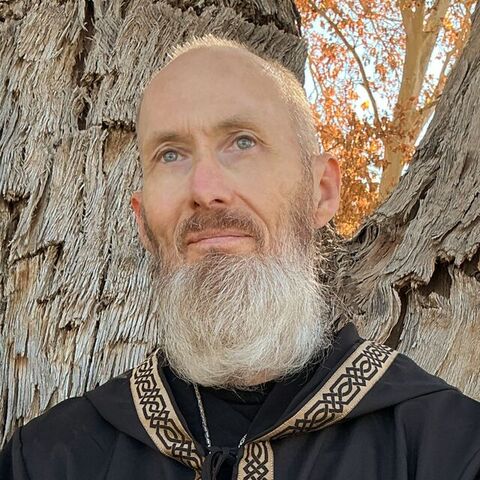
My name is Crow Moon,
And I'm your host.
November 16th is recognized as the Thracian Night of Hecate.
This is an important day in paganism,
As the Greek goddess of the Wise Women,
Or Wise Ones,
Those who later became known as witches,
Is celebrated today.
She is also the goddess of the Crossroads,
Which makes a celebration for her during the month of November quite appropriate,
As we find ourselves now standing at Winter's Gate.
Hecate is the goddess of witchcraft and the night.
She is associated with the moon,
The underworld,
And the spirit realm,
And,
Accordingly,
Ghosts.
For these reasons,
She is often called upon by many as they embark upon self-discovery through shadow work.
Another reason for this is that,
Although she is heavily associated with what many would term the dark side of things,
She is still considered by many to be one of empathy.
According to legend,
She used her ability to travel between realms in order to assist Demeter in her search for her daughter,
Persephone.
Our perception of darkness,
More specifically,
What might be lurking in the shadows,
Is often beset with some level of apprehension,
If not a measurable degree of fear,
Because uncertainty tends to evoke such in many of us.
Consequently,
We will shy away from performing any sort of shadow work due to what the term alone seems to imply.
We're not anxious to have others peer into our personal shadows,
And such can be almost equally as uncomfortable when we choose to do so ourselves.
But,
The practice of shadow work is anything but a grim science.
It could be something as simple as taking inventory of the things that make us fearful,
In order to determine for ourselves why that fear exists in the first place,
Not with the purpose of,
Or intent,
To beat ourselves up for having a certain fear in the first place.
If anything,
It's an exercise in self-discovery that is motivated by a desire for self-betterment.
The end result can be quite healing,
But the initial steps can bring with them some discomfort.
In this sense,
Shadow work is somewhat akin to scrying.
In my scrying workshops,
I always advise participants against going into a scrying session with any preconceived notion as to what the answers might be.
During the practice of scrying,
It's been my experience that those of the spirit realm are not inclined to sugarcoat their answers.
We are wise to have the same expectation when delving further into ourselves while practicing shadow work.
The practice of shadow work is basically taking inventory of what we've tucked away in the shadows,
So to speak.
This discovery invites us to recognize aspects of ourselves that we have banished for whatever reason,
Or those things we've simply forgotten about.
It's important to note that not all of these aspects are necessarily negative.
Further,
Shadow work isn't about making lists of our faults and dwelling on them,
Or putting a spotlight on our perceived shortcomings as part of a guilt-ridden ritual of self-sabotage.
It's anything but that.
More than anything,
Shadow work is recognizing all of our aspects and the part they play in our very fabric of being as part of our journey to wholeness and self-acceptance.
For example,
By asking ourselves why we have the reaction we do to certain stimuli and taking an honest assessment of those answers,
We will likely find it easier to shape that reaction into one that is more pleasing to us and more constructive.
Doing so also paves the way for our internal voice and instincts to come through more effortlessly and be heard by us with greater clarity.
Another reason why Hecate is called upon for such workings is that she is also known as the goddess and keeper of the keys.
The key symbolizes one's ability to open pathways,
Which includes spiritual portals.
It can also unlock that which has been suppressed,
As well as hidden truths.
In this way,
Hecate,
As I mentioned with regard to the spirit realm when scrying,
Will not lend her aid to us by sugarcoating things.
She will also not coax or prompt us to explore anything if we do not wish to do so.
Rather,
She waits patiently,
Standing with keys in one hand and the other holding a torch.
The torch is meant to bring light to dark and uncomfortable places,
Easing the journey itself.
The torch also symbolizes insight and truth.
Any key itself is a magical tool beyond what most realize.
Keys open doors and locks,
But their power doesn't end there.
With the mere possession of a key comes not only power,
But a certain level of authority.
When we hold a key to something,
Either literally or metaphorically,
That alone is somewhat empowering.
We don't give a key to our home to just anyone,
If we even do so at all.
Should we choose to do so,
We are placing a high level of confidence and trust in that individual.
If we associate this symbolism with the concept of shadow work,
The process shifts from a working laden with apprehension to a form of exploration in which we are the ones in charge.
We have complete authority over the situation,
And,
When we wish,
We can open a certain door.
Likewise,
We can later choose to close it.
Furthermore,
We are in a more empowered position when we discover what is behind the door.
We can choose to rearrange things,
Add to them,
Or remove them altogether.
So when we look within with the realization that we are the key holder,
The process can become less dark to us.
Doing any type of inner work is no different,
Really,
Than opening a door to our home.
In both cases,
We are generally aware of what's inside.
And,
In both cases,
There are certain things behind the door that aren't at the forefront of our minds at all times.
In the case of returning home,
We might see a familiar bookshelf as a whole,
Without actively recalling each of the books upon it.
Shadow work is quite similar to this example.
As with the bookshelf,
We never really forget that we have certain books.
They're just not the constant focus of our awareness.
The same can be said for the reasons why that book was chosen by us to be part of our personal library.
Perhaps the book meant something to us at one point in time,
But no longer holds that same value for us.
Perhaps we find that it is even more valuable to us now.
Upon rediscovering that book,
We might find ourselves compelled to keep it,
Share it with someone else,
Or discard it altogether.
The choice is ours.
The choice is ours because it's our book.
It's part of our bookshelf,
And it's in our home.
Most importantly,
We are the keeper of the key,
So we are wise to place a high degree of confidence and trust in ourselves.
Just like Hecate,
We are very much in charge of things.
That said,
Sometimes it can be helpful to have someone assist us by either lighting our way a bit or pointing out to us that all we need to do is reach for the keys.
The keys are ours.
Even if you don't choose to recognize Hecate as a goddess,
Almost anyone can benefit from her symbolism.
She is a reminder to all of us that darkness is something that is not necessarily to be feared.
Within the darkness,
Some things can indeed be hidden.
Most things,
However,
Can be more accurately described as unseen.
Regardless,
Few of these things are inherently bad.
Some might be unfamiliar,
But none of them are to be feared,
Really.
Fear does not serve our highest good,
And it almost always does nothing more than create obstacles to our peace.
But should something make us become truly fearful,
We as keyholders have the power to overcome it,
To unapologetically blaze a trail straight through it.
So as we pause to recognize Hecate during the month of November,
Do so with the realization that the torch and the keys are always within our reach.
Until next time,
The crow flies from me to thee to send the message,
Blessed Be.