Before we begin let your body soften wherever you are.
Allow the surface beneath you to support your weight.
There's nowhere you need to go.
Nothing you need to solve.
Let your breathing become easy,
Slow,
Unforced.
Do you know about the ancient Japanese art of kintsugi?
It involves repairing broken pottery with gold,
Turning cracks into beautiful features.
The repaired object isn't considered ruined but transformed,
Often even more beautiful than it was before.
Kintsugi is a reminder that what's been broken can be made whole again and that healing doesn't erase what happened but can turn it into something quietly magnificent.
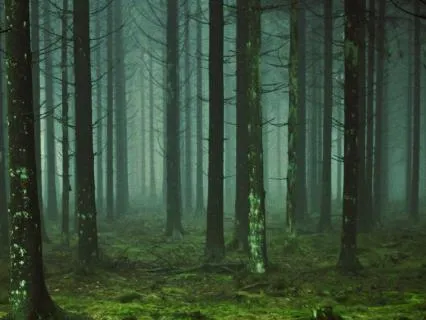
And tonight imagine yourself walking slowly through an ancient Japanese forest.
The air is cool and clean.
Tall cedar trees rise quietly around you.
Their trunks dark with age.
Their branches high above filtering the light into soft green shadows.
Slender bamboo grows among them swaying softly.
The path under your feet is narrow,
Lined with small stepping stones worn down by countless seasons and quiet footsteps.
Everything here feels unhurried.
Somewhere,
Far away,
Temple bells sound once.
Faint and softened by trees as though the forest itself is holding the echo.
You walk without needing to arrive anywhere.
Just walking,
Breathing,
Letting the forest hold you.
The deeper you go,
The more the world seems to quiet.
The air smells of earth and pine and moss.
And slowly,
Without even realizing it,
The stepping stones begin to thin.
The path becomes less defined.
The trail softens.
You notice this but you don't try to correct it.
You're no longer trying to navigate.
You're no longer searching for direction.
You're simply here.
And the forest begins to take over the sense of where you're going.
It leads you forward without effort,
As though it knows,
As though it's always known.
Somewhere,
Deeper still,
You sense the presence of an old shrine hidden among the trees.
Unseen,
But a quiet sacredness resting in the woods.
And perhaps you've come here carrying something unspoken.
Something you haven't fully examined.
Something that's quietly shaped you.
Eventually,
The forest opens.
Ahead,
You notice a clearing.
A wide,
Gentle space where the light falls differently.
And as you step closer,
You see something extraordinary.
The ground is covered in moss.
Not just a little moss,
But a vast swath of it.
Dense.
Thick.
So impossibly soft,
It looks like you could silence anything that touches it.
The moss stretches across the clearing like a living sea.
Untouched and ancient,
As though it's been waiting here for centuries.
Patient.
Undisturbed.
The air feels hushed in this place.
Even sound seems muffled,
Absorbed by the softness of the earth.
You walk toward it slowly,
Drawn in.
You crouch near the edge.
Your hand hovers just above the surface.
It looks as though it would yield to the slightest touch.
And then,
In one small patch where sunlight filters down,
You see something white.
A pale gleam.
At first,
You think it might be a stone.
Smooth.
Unusual.
But when you lean closer,
You see it clearly.
It's porcelain.
A small cup,
Broken into three pieces.
The porcelain is the colour of winter light,
Softened by time.
Its edges are worn,
Not sharp,
As though the forest has been slowly smoothing it for years.
Perhaps hundreds of years.
It looks ancient.
But finely made.
The pieces are embedded in the moss.
Time has grown around them.
The clearing has kept them.
The forest has protected them.
You study them quietly.
Something about them feels familiar.
As though they've been waiting.
You carefully lift one piece.
Then another.
Then another.
They're cool in your palm.
Light.
Fragile.
You can see where they once fit together.
You gather them gently and place them safely in your pocket.
And you stand again.
And when you turn,
The forest guides you back,
Step by step.
Until,
Eventually,
You return to the town.
Time passes.
Days.
Weeks.
Until,
One evening,
You enter an old workshop.
Warm lamplight glows against lacquered wooden surfaces.
Shelves,
Lined with bowls and cups,
Catch the golden light.
The air carries the faint scent of cedar.
Incense.
Everything here feels intentional.
A craftsman sits at a low table.
When you place the broken pieces before him,
He looks at them quietly.
And then he looks at you.
And in that glance,
There's understanding.
Not curiosity.
Not judgment.
Just recognition.
He sees the fractures.
And he sees their possibility.
He begins the art of kintsugi.
He works slowly.
The gold doesn't rush.
It follows each fracture patiently.
It lingers where the breaks were deepest.
A fine gold powder catches the lamplight as he mixes it.
It floats briefly in the air and then settles.
Like light made visible piece by piece.
The cup returns to itself.
But not as it was.
The fractures are filled with a precious substance.
The broken lines are illuminated.
And as you watch,
You begin to understand.
This isn't only about porcelain.
This is about life.
Life breaks us in ways we never expect.
In places we don't speak of.
And yet.
.
.
The broken places aren't the end.
They're openings.
Places where something new can enter.
The gold doesn't erase the crack.
It strengthens it.
It transforms it.
What was once plain porcelain becomes something magnificent.
A vessel traced with gold.
A story made visible.
When he places the finished cup in your hands,
It feels different.
Strong.
Alive with light.
And as you hold it,
You feel it.
How the most fragile places can become the most beautiful.
How life doesn't always repair us by erasing the cracks.
But by filling them with something new.
Something bright.
Something lasting.
And slowly,
You find yourself once again in the forest.
The moss.
The cedars.
The cup.
Rests safely beside you now.
Complete.
Luminous.
And you can let yourself rest here.
With nothing to hold.
Nothing to fix.
Nothing to mend.
Just breathing.
As sleep begins to find you.