Well,
This is a real treat.
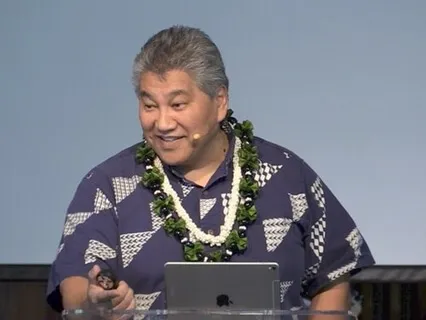
I'm Cindy Palos and this is the Peace Projects and I am so honored to have a man.
Actually,
This is the first time we've seen each other face.
We've seen pictures,
But it's so nice to connect with you,
Ramsey Tom.
And Ramsey Tom was recognized as the Peace Day Hawaii Peace Maker of the Year in recognition of a lifetime of career advocating,
I love this word,
The spirit of Aloha.
Around the world in fields of ecology,
Business communications,
Economic development,
And Hawaiian culture,
You're recognized locally,
Nationally and internationally for your transformational leadership and sustainability culture,
And peace based value integration into contemporary business models.
And as an advocate of team building strategic partnerships,
Community brilliance and creative thinking,
And a couple of my really dear friends said you just have to talk to Ramsey.
So well,
You know,
It's really an honor to meet you because I've been on the island for a while,
But you are an island based teacher and you understand from the very roots,
What some people interpret.
So I thought today we would talk about your living and understanding of a couple of keywords that we all can live and learn from for peace.
One is Aloha,
And the other is Ho'oponopono.
And we are obviously also in the time right now,
A Makaheke.
And these are elements that are so key and important that when we're in harmony,
And in tune,
And in peace with,
It seems like everything goes a lot easier.
Sometimes we just have to get out of the way.
So true.
It's so true.
So the word Aloha is often misinterpreted and misunderstood,
I think.
And I think if we just understood and lived the word Aloha,
Truly,
Everything would change in the world.
I totally agree.
You know,
It's,
First of all,
Thank you for having me on today and for this connection.
I'm looking forward to it so much.
Especially now because,
You know,
There seems to be so much dissonance in the air,
Which is contradictory to the whole notion of resonance and vibration.
How do we vibrate at the same level?
And you use the perfect word,
Which is harmony.
And I really think Aloha is and embodies all that when you really get down to the fine understanding and living of Aloha as a way.
And not just the word.
And unfortunately,
As he suggested,
I think the word has become a distraction because it's applied to marketing,
Right?
Where the Aloha State and there,
It's the Aloha Sushi,
And yet everyone names their product or something Aloha,
But what doesn't make the connection is the behavior,
The practice,
The demonstration.
I borrow from something the queen,
Lily Okalani said,
And she says,
You know,
And I'm going to paraphrase it,
Basically,
She's saying,
Aloha is to see without,
To see without looking,
And to feel without touching.
So she's saying it's an inside job.
And she also says that to know the unknowable,
That is Aloha.
So that requires us to be in a different frame of reference,
To be Aloha,
And not just to speak Aloha,
Right,
To see it.
So there's a,
I guess,
An integrity that's required,
Or it actually brings out integrity.
So my words and my actions are consistent.
My beliefs,
Right,
My principles,
They're all in alignment,
Alignment with what?
With divine,
With the universe,
With the things around me.
And so when you're operating an Aloha or with Aloha,
How can there be anything but peace?
Because the fundamental principle of Aloha is to give and to receive,
Whereas many of us have lived in a world that operates on the axiom of give and take.
And we tend to have been taking more than we've been giving.
And we've misinterpreted the receiving as just taking,
Right?
Oh,
They're going to give it to me,
And I'll just keep taking it.
So underlying Aloha is a reciprocity agreement.
It's fundamental,
It says,
We're always going to leave someone and a place better than when we found it.
And in doing so,
I become better as well.
And it says,
Cindy,
In three minutes,
Three hours,
Three days,
Whatever that time is we spend together,
I commit to you that I'm not going to damage the air between us,
Right?
Your air is my air,
My air is yours.
And anything that I do to damage that for you,
I damage for me.
And so Aloha is that underlying principle that what we do to and with others,
We do to ourselves.
And it goes back to those golden rules and those concepts we've all heard is that to treat others as you would treat yourself,
Or you'd like to be treated.
And so I think that's an underlying concept.
But it's more than just the word that says hello or goodbye.
And I like to tell my students that if you can't make the commitment,
The commitment I just said,
Of honoring that space,
Then don't use the word Aloha,
Just say hello.
Just say hi.
Because there's no commitment in those greetings.
That's all they are greetings.
But when we subscribe to Aloha,
And we start saying that,
We're subscribing to commitment,
We're telling others you could trust me,
Right?
I can trust you.
And it is that trust,
I think,
That begins to seed the harmony that we're looking for,
In what we have defined as peace.
I love the the true essence of Ha and you brought up so much the power of the air and the breath.
And of course,
The Aquarians,
I have a greeting that's not understood by a lot of people when you actually put your heads together and breathe each other's breath.
How can you not be in harmony when you have your spirit,
Your essence in your mind touching,
And you're breathing each other's breath,
Which takes away also,
The openness and vulnerability of sharing who you are with someone else.
Maybe you could talk a little bit about that power,
That Ha,
That breath and that spirit of it.
Yeah,
So when you look at Hawaiian language,
First of all,
I think that's where it's rooted,
Is that everything is spirit.
Every sound that you utter is tied to spirit.
The original spirits,
The original relatives,
The first spirits were the elements of A,
E,
O,
And U.
These are the elements of fire,
Air,
Earth,
Water,
And man,
The spirit of man.
And so anytime we utter a term in Hawaiian with intention,
You're calling upon those spirits,
You're animating,
You know,
That type of thing.
So when you say aloha,
Or aloha,
We're drawing upon two large root words of alo and ha.
Alo means to be in the presence,
To be in the face,
To be face to face,
To be connected.
The second grade,
Ha,
Which is also in the word ha wa'i,
Ha is the life giving breath that comes from the divine.
And if you don't breathe,
You're not alive.
So you could define breath as spirit.
And that spirit and the life comes from God.
So when you say aloha,
You are really saying to be in the face and the spirit of the divine breath of God,
To be in the presence of God,
The God in you,
The God in me,
Right,
The divine in you,
The divine in me.
And in that unification,
We are now in the divine,
And we have become connected to all things around us.
Therefore,
That term aloha is a very special and sacred word,
Because you are entering a place that is sacred.
This is the term that we've heard many teachers talk about the temple when we live in this temple,
Right,
Of aloha,
Because you're inhaling and bringing that with you.
So that exchange of ha,
That breath,
The honi'ihu as we call it.
Imagine when you face to face with someone like that,
What kind of trust that requires,
You know,
Whereas in other places,
We may reach out with a hand and offer a shake,
You know,
Hai.
And that was to sign a peace as well,
Supposedly,
You know,
I don't have a sword in my hands of that shake.
And that will give you some indication that I'm a safe person.
But to be nose to nose,
Face to face,
In one another's breath,
That requires a lot of trust,
A lot of openness.
So yeah,
So it comes down to that.
But of course,
And unfortunately,
Now,
In the time of COVID-19,
We can't do either,
We can't shake hands,
We can't breathe each other's breath,
You know,
This direct relatives,
Family that live with us,
But you know,
We've kind of come to a gashao about and,
And it's,
There is this separation,
We're finding an as a person who does blessings and a person who is of spirit and a teacher.
How do you adjust to this different energy for the sake of what we have to go through right now for COVID-19?
Yeah,
I think it's understanding that we are all of one spirit anyway.
Right?
And then in many ways,
These practices have been a way for us to manifest,
To see,
Because as central beings,
We need that touch,
Smell,
Touch,
Taste,
All those things,
Right,
Those senses become an important part.
What I found and what I'm finding is that COVID,
As much as we're trying to flatten its curve,
It's flattened ours,
Right?
And so what it's really requiring us to look at,
Literally,
Is the essence behind all of the protocols,
Right?
It's asking us to go beyond the physical things that have defined us.
So no longer rely on the externalities,
But really begin to touch base with the internal because when you're wearing a mask,
Right,
You have to begin to pick other things up in order to determine distinguishing,
Right,
What's going on,
Because we've used our eyes to be the barometer of decision making,
Discernment.
But when you're wearing a mask,
That's very difficult.
So now your eyes have to serve a different purpose,
And you have to see other things.
And more importantly,
You have to feel different things.
So Aloha is a feeling as much as it is anything else.
So now with the masks and with the distancing,
I like to say social distancing causes the heart to grow fonder.
Is that now it requires me to really reach out beyond the physical and really begin to use Na'au,
Right?
My gut,
The intestinal fortitude of recognizing that we are connected.
And so the resonance is a little different now.
It requires us to be a lot more authentic.
Because now,
That's when the skin happens,
You know,
You start feeling the hairs and tingling.
I believe these are all things that we have set aside.
Right?
We are no longer operating from that sense of ability,
But we've become dependent upon what we see.
Everything is about what we see.
We've defined ourselves by what we see.
We give other people credit for what they look like,
Etc.
So I think in many ways,
COVID has required us to look in again,
And to start embracing where we came from,
Which is the family of we,
And not the tribe of me.
Right?
You can sense a smile,
Even if you can't see someone's lips,
You can sense that someone is smiling.
There's an energy field.
There's an energy field and a smile.
There's an energy field that everyone has,
You know,
And you as a teacher,
And a kumu.
When you do a blessing,
You walk in a room and you sense the energy field.
You have to,
Right?
That's correct.
Yeah.
And you have to really be open.
That's where ho'oponopono comes in,
Because you have to clean yourself first,
Right?
You have to be clean.
To think that I'm a nervous wreck and my hands are shaking that I'm going to give someone else a sense of calm by touching them.
So what we bring into the room is as much as what we're going to get back from the room.
You know,
I had a student tell me once,
You know,
Kumu,
I went to this place,
But I didn't find any aloha there.
And I asked her,
I said,
Well,
Did you take any with you?
And she looked at me,
She said,
What?
I said,
Yeah,
You have to bring it with you.
If you hope to find it in places that you've never been.
And that's what attracts it's that attraction.
It's that,
Again,
That reciprocity agreement.
So it is important to be able to do that.
And once you see that,
You know,
You're going to do that.
And once you sense that,
Once you sense that vibration,
Is to be able to respond to it also with a lot,
And not with fear,
Angering or anxiety.
And unfortunately,
There's a lot of that in the world today.
Yes,
Absolutely true.
So you brought up a whole con o fono.
And,
And it as a teacher,
And someone who's taught this for a while,
You're seeing around the world now,
Especially in some of the New Age people,
I'm seeing so many people say and say that they're teachers of it.
And then once or twice,
I've gone to their sites,
And it's like,
I don't sense that they really understand it.
And it's kind of been commercialized into an easy,
A few words.
Can we just talk about the real power of whole upon upon,
Or not that it's not just saying a few words,
That there's a much deeper,
Deeper meaning and value and exchange that comes in whole upon upon Yeah,
And if and to be clear,
If we're talking about the whole upon upon all that is now going worldwide,
Like you said,
Right?
That is rooted in some of the original teachings of anti mornan,
A llama who said,
Yona,
Who is Michael Poona,
And Olo Heye teacher.
And unfortunately,
In the world we live in today,
Everyone is looking for a singularity,
You know,
A shortcut.
And that shortcut,
Unfortunately,
Has taken some of her teaching and has reduced it to a mantra of four statements.
And so people have subscribed to the four statements.
And if it works,
And it's great,
But I'm finding that it's not because it's not whole upon upon as anti morna taught it.
And from the Hawaiian culture perspective,
It's nowhere close to what whole upon upon is,
As a process of forgiveness and cleansing.
It's a cleansing process.
And so it would be much like me walking into the kitchen and finding a mess on the floor and turning to the mess on the floor and says,
I love you.
And thank you for being here.
Please forgive me for dropping you there.
And you know,
Forget,
I'll forgive you.
And then leave the room and expect it to walk out the door,
Right?
Whether it's a spiritual mess,
A mental mess,
Or physical mess.
The words in my mind are in my mind,
Right?
There are really in many cases,
They become a distraction.
What's missing is the cleansing,
To actually do the work of cleansing and removing the memories or asking divinity to remove the memories,
And that are the obstacles to our moving forward,
Right?
It is in that process.
And unfortunately,
Anti-Morna,
Well fortunate anti-Morna created a process to allow people regardless of origin to do that,
But it still requires some work.
And she simplified the process.
But now others have simplified it even more.
You know,
It's like rather than growing an apple tree,
Waiting for the apples,
I'd rather go to the store and get the apple extract.
No,
Maybe I'll just get the apple incense instead.
And I'll just smell it and I've actually had an apple.
Right?
In essence,
That's what we've done.
We've slowly begin to extract.
And again,
I think that's just an expression of who and what we've become as a community that is so intent on being something that we aren't,
Which is everyone wants to be now the next whole pono pono teacher.
All these people trying to teach something,
They can't even say the word properly.
I heard a meditation the other day.
And she said,
And so now we're going to do hono pono pono.
As a hono pono pono,
You know,
I mean,
It would be nice that they actually say the word properly,
Then maybe understand it and express it.
But to that point,
That's why it requires those of us who are,
Have kuleana to be able to share the process,
As well as these philosophies and principles,
Again,
With aloha in the proper way.
And we're not pointing fingers at the wrong way.
I'm just going to say for those that have asked me says,
That practice is not what anti-mono taught,
And is not the whole pono pono of our kupuna,
Our ancestors.
It is the practice or the what's come out of someone else's mind.
So with that said,
If it works for you to cleanse and move things forward,
That's great.
The final arbiter is always you and God.
I'm not gonna say it works or not for you.
But if you're asking from a culture principle and the principle of,
And the process,
Then it is nowhere close to the principles,
Philosophy,
And the values that are the essence of old pono pono,
As we know it.
The fruit is falling too far from the tree.
Can you talk about that cleansing process because that is so important.
It also is something tying it into peace.
We're going through a lot of division in the world right now.
There's a lot of intensity and division and separation.
Again,
It'd be nice to be able to just say four statements and have everything be better,
And it's a start.
But to really bridge the gap and to make peace with someone else,
Who you don't really feel at peace with,
And you don't really understand is quite a process,
Isn't it?
It is because it is it's always still a reflection of us,
Right?
So the discord,
The dissonance that you're feeling,
An emphasis on what you're feeling,
Reminds us that where is that occurring?
It's happening in us.
Yes,
The other person is triggering that.
But we are still in the presence and we've made ourselves available.
We've opened ourselves up to that trigger.
And as a result of that,
We are contributing to that as much as it's contributing to us.
And so when we start defining ourselves and our experiences by those external inputs,
Those triggers,
Then we are technically becoming victims of those external triggers.
So when we live in a world of externalities,
And look to that for definition,
Right?
Then clearly we will be reactive and more connected,
Dependent,
Codependent,
If you would,
On the world around us,
Rather than the world within us.
So Adimorna would say,
If you're seeing problems in the world,
The first place to look for the source of that problem is within you.
Because if it's not seated within you,
Then you wouldn't even begin to perceive the problem outside of you.
It is somehow tugged upon you to look for the source of that problem.
It is somehow tugged upon you.
It is touched something within you that has allowed you to sense its presence in a way that it bothers you.
Right?
Now,
That's not to say that there aren't people who are evil,
That evil doesn't exist,
Or that there isn't anger in the world.
But the question is,
What is it about us that continues to draw us to it and it to us?
Right?
There's almost a sense of arrogance to think that,
Oh,
Yeah,
I can fix this.
Right?
It's acknowledging that what is my contribution to this dissonance?
And how do I then remove that?
So that wherever this energy needs to go,
It can go.
But as long as I keep putting my hand on the pond to try to calm the ripples,
I just continue to add more ripples.
Right?
And so each of us has an opportunity to deal with that in the confines of our own temples.
And I believe Aloha is the spirit by which we can do that.
Hoʻoponopono is the process to do that.
But it's rooted in Aloha.
And Aloha is about pono,
Doing the right thing at the right time,
And finding that harmony,
That rhythm and that balance.
And it is within rhythm,
Balance and harmony,
That peace then evolves.
Those are the elements of peace.
Well,
I really want to do another whole probably show with you because you've also worked in tourism.
And I've since that the island has gone through many changes without visitors.
Tourism has been way,
Way down and it's starting to come back.
I was watching Governor Ige talk about the Japanese tourists coming back in and I read some of the comments and I came going,
This is me reading in my interpretation.
But I saw things saying that people really didn't want these people coming back to the island.
And I maybe you've seen this because you work with tourism and you've seen this.
An attitude has switched a bit of that I'm seeing a lot of people on the island saying we don't want people we don't visitors,
We don't want tourism.
And I'm going well,
How do you deal with this?
You know,
When people are saying things that really don't show aloha and going back with myself,
I guess my surprise is seeing that and how do I deal with that myself?
How would you deal with that because you worked in this field?
Yeah,
I would say if we start looking at it from its original creation of hospitality,
It's all based rooted in hospitality.
The industry,
The practices we call tourism,
The practices we call tourism are very different than that practice of hospitality.
We tend to make them the same.
But as hosts,
We always find ways of inviting people to our home.
But our visitors that come to stay with us are also either relatives or friends who have an idea of who we are.
So consequently,
When you have that relationship,
You're also more respectful of one another.
Right?
The commercialization of aloha and commercialization of tourism,
Which tends to be much more spectator sport than engagement.
Right?
But you think about it,
Right?
Where the consumer has been taught that whatever customs they have are the ones that will guide the practice of the visitation.
So when they come to my home or to our house,
They want their customs to be addressed rather than the local customs.
That's what tourism has become,
Where the consumer is always right.
The customer has become accustomed to customize experiences based on their customs,
Not our own.
Somehow we need to teach people how to treat us.
And unfortunately,
This is where marketing has created the product versus the product creating the market.
We have elevated this expectation and placed upon aloha an expectation that perhaps not be there.
Because aloha is also meaning to tell someone I'm sorry,
I'm sick right now for your benefit and mine.
We shouldn't honey.
Right?
I still aloha you I still love you.
I still care for you.
But that care is reciprocal.
I asked you to care for me as much as I care for you.
And yet when your disrespect of what is important to me overrides what is important to me.
That's when the law says,
Okay,
Aloha also means to protect.
It says no,
I'm sorry,
Here are the boundaries.
And with aloha,
I'm asking you to take some time,
Allow us to heal,
Allow us to be safe,
So that I can create a safe environment for you.
So that we can have a good relationship and a good experience.
So I think it's rooted in that,
But we're not finding the right words or the tone.
The demeanor has shifted,
We've just become meaner.
That's a great term.
I've got to remember that.
Right.
Yeah.
Our demeanor is critical.
And unfortunately,
When someone is in a situation where they're not hearing you,
And I think you can take any child who is trying to get their message across,
They become very animated,
Very loud.
And if they have to,
They'll throw a tantrum to get the necessary attention.
And so the marketing world,
Those who would use this place or any place like it,
And are concerned about their commercial upside,
Begin to ignore those other things,
You create this tension.
And I think that's where the tension is.
I think everyone here would like to see the economy come back,
You know,
Or get stronger again.
Whether we go back or not,
That's another question.
But how do we create that?
So I think it's about shifting our thought process.
How do we welcome people safely?
So that should be perhaps the question of the day,
Not how do we keep people out?
Once you start down that path,
You start building walls.
The object is how do we welcome people?
How do we create safe places for them and ourselves?
And when we start focusing on that,
The energy changes,
Right?
I believe because we've shifted our intention.
Our intention is to welcome you,
Our intention is to have you here,
Our intention is to create a place of health and safety.
So that your visitation can be a meaningful one.
Right?
But I think the adage that,
You know,
You're not going to have the adage that what happens in Vegas stays in Vegas,
Right?
Has become a mantra for any visitor that says,
Wherever I go,
I can behave or misbehave because when I leave,
Nobody knows me.
See,
That's rather disrespectful to the host.
And so I think tourism at large has become visitor centric and less place and host centric.
And I think where there needs to be a balance.
So I think that's the tension we're experiencing right now.
And unfortunately,
We haven't been able to language that properly.
We're still finding the volume knob.
We may be finding our voice,
But we need to find the volume knob to modulate the language and the message.
It's so important.
And I just,
I get it so much when you speak like that.
And it makes sense inside.
And I like that in communication when we can communicate and all of a sudden it's like,
Yeah,
Yeah,
I get it.
And that is something that I think in communication also brings peace when we understand each other,
When we find this like common ground to understand what's going on.
And I really do feel you're a wonderful teacher.
Can people find out more about you at any particular site that you have,
Or what's the best way to reach you?
Yeah,
I'm on Facebook under Kumu Ramsey Tom,
Or Kumu Ramsey.
That's R-A-M-S-A-Y.
I also have a web page,
Ramseytomtaum.
Com.
And they can go there.
It's also,
If they also put in Life Enhancement Institute of the Pacific.
The acronym is L-E-I,
Like a LAY.
LAY of the Pacific dot com,
L-E-I of the Pacific dot com.
And so those are ways.
I'm also on Twitter.
And fortunately,
My daughter helps me with all my social media.
I wouldn't know what to do otherwise,
You know.
So she's managed to place me in different places so that people can reach me and I can reach them.
So that would be a good way to do that.
Well,
You've enhanced my life by just taking the time to communicate and share your manao and your beautiful wisdom and aloha.
And so I deeply thank you.
I bow to your teachings and to your wonderful sharing.
And I hope we can talk again soon.
And God bless you and keep you.
Mahalo.
Thank you so much.
And we'll talk again someday.
Stay well and stay happy.
Aloha.
Ahoy,
Aloha.
Aloha.