Welcome!
We are going to be doing.
.
.
A lovely TMJ massage today.
And with this,
We have muscles of the jaw and we have muscles of the neck.
When we relax the jaw,
The neck muscles relax.
When we relax the neck muscles,
The jaw muscles can also relax.
So we're going to be doing that.
A little bit of both today.
You can massage.
We don't always have to go and see a professional massage therapist.
We can be guided and learn how to treat ourselves,
Learn how to relieve ourselves of tension,
Of trigger points,
And of pain in the body.
And the biggest tool I can share with you for self-massage,
The most guidance I can give you,
Is to notice what you're feeling.
Your hands,
Your little palpation centers can feel and sense when something feels good or when something feels off.
If we're on a bone,
If we are on a muscle,
The bones are completely rigid,
They do not move,
They do not bend.
Muscles have some fluidity to them.
So although they can feel extremely tight,
To touch over time,
They will soften.
There will be a little bit of melting in.
So really trusting that melting in sensation telling you you're on a muscle.
There's nothing we can do wrong.
There's no harm we can cause here in this self-massage.
The worst thing that could happen is we could be on a nerve.
Now,
When we're on a nerve,
You know what that feels like.
It's like a little electrical shock.
Running through the body or like you've hit your funny bone and there's a radiation of pain.
Stinging pain,
Uncomfortable pain somewhere else.
If you touch a nerve at any point,
That's okay.
We're just going to release that pressure and move on to a spot that feels better,
Feels more aligned for you.
So really trust.
What feels good and know that a little bit of pain is also good through discomfort,
Through uncomfortable,
That's where change and progress happens.
And when muscles are really tight,
There's discomfort there in the release.
There's a little bit of tension or pain.
So noting,
Is this pain tolerable for me?
Finding your level.
You don't have to push through,
Just finding.
The small amount of pain.
And that's a great indicator because when the pain lessens,
We know that the muscle has released.
So using pain as our map and our indicator tool for when something is working for you.
So I want to start on some of the external muscles that support the jaw and the mouth.
I think the most important muscle One of the most important muscles we have is called SCM.
Which is short for sternocleidomastoid.
It's a big name for this muscle.
And this muscle we can see on ourselves,
It kind of pops out.
There's a line popping out here and it comes from the back of the head.
To the front of our top of our sternum and our clavicle.
And the best way we can get this muscle is just grabbing it.
So pinching it with your thumb and the knuckle.
Of your first finger and applying a little bit of pressure between your finger and your knuckle.
So there are many layers to this muscle and it might feel like,
Am I on the right thing?
You are.
It picks up easily and you know there's a superficial layer and then we can grab deeper.
Both will feel quite tense.
So apply the amount of pressure that feels good for you and just hold it.
Just holding it.
Ah,
Taking some deep breaths.
Trusting that.
You have the right spot.
And noting that this muscle can be quite sensitive,
Quite painful.
It gets engaged with head forward posture.
Does anyone here ever work on a computer?
You're going to have some head forward posture.
Because this muscle needs a lot of love.
Yeah.
Really helps to reduce with headaches.
And grabbing the other side.
So you can grab anywhere on the muscle,
Belly.
You can grab up high,
It's a little bit harder.
You can grab down low.
I like just grabbing in the middle.
I feel like it's easy to grab the muscle belly there.
And there's no particular rule of thumb.
Like I say,
It feels good to just notice when the pain lessens when you're doing a massage hold.
But if you like a rule of thumb,
One minute is a nice amount of time to work on a muscle,
To work on one specific point,
Not the entire muscle,
But on one specific point.
And what happens.
As we apply this compression.
Is that muscles aren't just one thing.
Tube.
There are muscle fibers,
Many fibers,
And these fibers get stuck in a contracted state.
And so when we compress them and we push them down,
They realize like,
Oh,
I've been in this state of contraction just through sensation.
They realize this.
And they expand and open.
And once they're open,
You know,
The chemical receptors,
Everything is able to flow and bring us health to that muscle and reduce inflammation.
Inflammation is what causes pain.
So just through compression,
We're allowing that muscle to have the proper response to let go of holding that tension and those fibers and the fiber level.
Kind of like if we're stretching in yoga,
Full body stretch,
We're doing it on a very fine level,
Inviting these fibers to release and let go.
So another big external muscle.
And I can show some images as we go as well,
Is temporalis muscle.
So this muscle is kind of around the sides of the head.
Just looking at the bottom image here.
This is a temporalis muscle.
So it goes underneath what's called the zygomatic arch.
So there's this bone,
Kind of our cheekbone.
And just above our cheekbone,
We can find this muscle here.
Palpate your cheekbone.
Just notice you can feel a bone sticking out here.
It's a little bit sharp as we go further back closer to the ear.
And where it becomes a little bit sharp,
I just want you to dip your fingers above the bone.
And melt in there.
We can do this on the other side as well.
We're melting in.
Now as I'm talking,
I can feel it happening.
But if you're not talking,
You can't feel this.
So I'm going to invite you to open your mouth and close your mouth a few times.
As you do this,
You will feel that temporalis muscle engage,
Contract,
And relax.
So that tells you you're on the muscle.
So we can hold here just for a moment.
That's another big headache spot for people.
Taking some deep breaths.
Then we're going to do some small circles on the side of the scalp.
Just melting your fingers and applying some pressure.
Taking some deep breaths.
And if you find a good juicy spot as we're doing this ever,
You know,
Stay there on that juicy spot.
Hmm,
Doesn't that feel good?
We're gonna do our masseter.
So masseter is our main jaw muscle.
And this main jaw muscle.
It's actually the strongest muscle in the body.
Relative to its size.
So it's a big,
Thick muscle and there are layers to it.
So we're gonna do external and internal for this muscle.
I'll show you an image of the masseter as well.
So here we are,
And there's a couple of heads on the masseter muscle.
I find sometimes the imagery is nice because it gives us some x-ray vision.
What's going on under the skin,
Over the teeth,
Over the side of the jaw?
And so this is located between that zygomatic arch,
So our cheekbone,
And then the base of the mandible,
So the base of the jaw.
So anywhere in between here.
Not necessarily central of the face,
But a little bit further back.
Let's just do some circles and feel this muscle from the outside.
See if you notice any tender or sore spots.
And apply a little bit of pressure to those tender and sore spots.
And we're going to begin internal with the masseter.
So similar to how we were grabbing the SCM,
I'm going to grab the masseter.
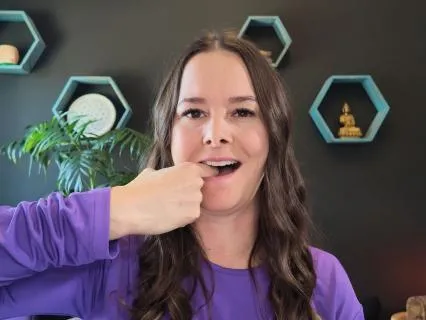
And a lovely way to do this is just with your thumb and your second and third finger,
Placing your second and third finger inside and squeezing with your thumb on the outside.
It is going to be thick like a fat juicy belly this muscle of the masseter and you'll know because as you roll off of it and you come forward it suddenly just becomes like skin and flesh is what it feels like and when you go further back it feels thick and juicy and plump and we're just going to squeeze and we can hold or we can strip.
Stripping the muscle means we're moving from the top of the muscle to the bottom of the muscle.
So let's get in there and see how that feels.
Just choosing either side first.
It can be a very tender point in the masseter.
So being mindful,
Haven't likely massaged yourself in this way before.
Just from having my pressure being applied for a second.
And bringing my fingers out,
It already feels more open.
So we don't have to do this for a long time.
Just a short time,
It's very potent and powerful.
Finding a spot that's a little bit tender and holding it there.
Keep going.
It can be nice to go higher,
Closer to the cheekbone.
You might notice more tension there,
But also try going lower,
Closer to the base of the mandible.
See where you find the most tension.
That is the spot you're being called to.
And we're going to do the other side now.
Using the fingers that feel best,
Maybe it's one finger,
Maybe you just want to stick one inside the mouth and not hold from the other side.
It's nice,
I find,
To hold from the other side because it gives us a surface to press against,
Making it a little bit easier on your fingers.
If ever your massaging in any of these points brings up the sensation of a headache.
Or tension somewhere else,
That's not necessarily a bad thing.
That's telling you that this spot is so tight that when you're having a headache or maybe when you're having neck pain It's actually referral paying from this specific point that you're on.
So that means you're on a really good spot and you're on a really good point.
So.
.
.
I'm excited to take you further on this journey now to some points that get missed.
They get missed a lot.
Maybe you've never been touched here in these points,
So being conscientious that emotions may also arise as you're doing this practice.
Our body holds and stores emotions.
So if any emotions arise,
Just allow,
Let them flow,
Let them come through.
And we're going to touch the pterygoid muscles.
So we have two pterygoids,
There's medial and lateral.
Medial means close to the center and lateral means further out from our center line or from the spine of the body.
And I would like to start with the lateral pterygoid muscle.
I will show an image of this to you.
I don't know if it will be very helpful,
But this is the lateral pterygoid muscle.
It's a very small muscle.
And it shows you the bones that it's connected to,
Just to give you an idea of where we're aiming for.
I like to use my pinky finger to get this one.
The reason for that is we do not need a lot of pressure.
It is quite sensitive.
And the best way to access it is we bring that pinky finger or pointer finger,
Whatever you'd like,
Along the upper teeth in our mouth.
And we follow them on the outside.
And I'll show you in a second internal what it looks like,
But we follow them all the way to the back.
With the pad of our finger pointed outwards,
Because we're actually pushing out this way.
We're not pushing in towards the jaw,
We're pushing out.
To the cheek.
And we're going to find a spot in here that feels Boom.
It almost feels like a bone because it's such a fine,
Thin muscle.
We will feel the bone on the other side of it.
But we'll know we're on the muscle because it will feel tender.
There will be a small tenderness there,
A muscle pain.
Are we ready to try this one out?
So when you're ready,
Bring your finger into your mouth.
Following your teeth.
Back to the back of the mouth,
Just past the last tooth.
And then apply that gentle pressure out.
And just hold there.
It's so small.
You could do little tiny,
Teeny tiny circles or just hold with some pressure there.
And push upwards just a little bit more.
It's an outward direction and up.
Beautiful.
Like I said,
We don't need to do it long.
Let's go for the other side.
Taking some deep breaths as you're doing this.
And there's one more muscle I'd like for us to touch on.
This is the medial pterygoid muscle.
And the medial pterygoid,
The best way to access this muscle is we follow our bottom teeth and I like to follow along the top of the bottom teeth using my pointer finger.
And then once you reach that last tooth,
You can go just a little bit further and then we slide down.
We slide down just past the gums.
And into like a pocket.
It gets a little squishy in there,
Like the bottom of our mouth can get squishy.
We're applying the pressure to the side,
To the inner wall,
Of that bottom jaw on the inside and we're pushing in.
So again,
Another small spot.
The difficulty here is our tongue is kind of in the way.
So try and just relax into it and melt into it.
Try not to have a tense jaw as you're doing this as that makes it more difficult.
So let's see if we can find that medial pterygoid muscle,
The back of the mouth,
Following the bottom teeth.
The inside out.
Just a little bit lower and melting in.
And let's do the other side.
Wow,
What a workout for the mouth.
Take this moment.
We're just going to assess the jaw.
Gently bring in some motion,
Some side to side.
And we'll do a little bit of forward back.
Just gentle and find a nice neutral spot.
Close your eyes.
And notice how it feels.
It feel different.
More open,
More spacious.
And we'll spend a moment here doing a little bit of Reiki for our mouth.
So it's connected to the throat chakra.
This energy center is the base of the throat,
But our mouth is that area.
Final expression of truth,
Right?
We're voicing our concerns,
Our ideologies,
Our desires to the world is how we connect.
And when we have a lot of jaw tension,
That means we are holding back.
At the last second.
It means we know our truth.
We know what it is.
We know what we need to say,
We know what we need to do,
But for some reason we are limiting ourself.
We're not going all in.
So let's take a moment to feel into that energy of the mouth of the jaw.
Noticing if there's any restriction in you expressing yourself.
Only.
And we can invite in a sense of flow,
Of energy moving up through the throat and out through the mouth.
And it's full expression.
You can visualize that as a white light or a blue light moving out of you,
Not being limited,
Being totally open,
Not restricted or closed,
Totally open for that flow to move through you.
Maybe it's a feeling or a sense of freedom.
Giving your mouth permission to relax.
There's nothing we need to fear.
Or hold on to.
It is all safe to be shared.
Is all safe when it aligns and comes from our heart chakra.
The issue is when it comes from our mind and our ego and our fears.
So feeling that connection from throat to heart.
Your truth,
Your portal of truth.
And knowing that that is always safe to share,
That is always coming from the vibration of love.
So letting that love flow through you and out of you,
Benefiting everyone around.
Wonderful.
So this was our jaw massage today.
How are we feeling?
I hope you enjoyed the practice.
Return to this as many times as you would like.
I find it's really potent just before bed if you're grinding your teeth at night.
If you have tension in the day or you're anxious,
It's a great opportunity.
To massage your jaw.