The Jewish idea of divine justice in the world is essentially the same as karma in the East,
That whatever we do comes back to us.
But if this is true,
Why is it that horrific things sometimes happen to good people?
According to the Talmud,
This is what Moses was asking God when he begged that God reveal his ways in Exodus 33.
But the 19th century rabbi known as the Chasim Sofer had a different way of understanding it.
It's not that whatever happens to people is what they deserve,
Lots of good and bad things happen to everyone.
Rather,
It's about how we receive the good and the bad that comes to us and it's our skill in receiving what happens with gratitude and grace that determines the quality of our lives.
That's what we'll be exploring in this episode of the Torah of Awakening Jewish Meditation podcast on Parshat Vayishlach with a guided meditation based on the Hebrew letter Mem.
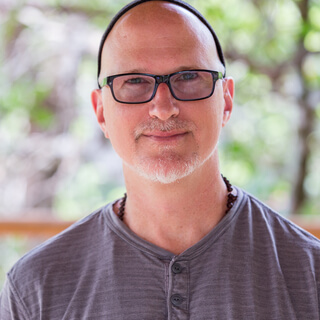
I'm your host Rabbi Brian Yosef Schachter-Brooks.
Enjoy.
So what is the nature of pleasure?
Is pleasure something to be enjoyed and celebrated or is pleasure a spiritual obstacle?
There is a teaching recorded in the Talmud that contains a puzzling dialogue between Moses and Hashem.
B'kesh lehudiyot derachav shel hakadosh baruchu.
Moses requested that the ways of the Holy Blessed One be revealed to him.
Ve'natan lo.
And they were given to him.
She'ne'emar hodiyeni na'et derachekha.
Please show me your ways and I will know you.
So the Gemara comments that he says,
Master of the universe,
Why is it that there are righteous people who prosper,
Righteous who suffer,
Wicked who prosper,
And also wicked who suffer?
And God replied to him,
Moses,
The righteous person who prospers is a child of a righteous person.
The righteous person who suffers is a child of a wicked person.
The wicked person who prospers is a child of a righteous person.
And the wicked person who suffers is a child of a wicked person.
And that's from Berechot 7a.
This teaching attributed to Rabbi Yochanan in the name of Rabbi Yosei attempts to answer that old perennial question.
If there is divine justice in the world,
Why do bad things happen to good people?
Why are there bad people who seem to have all the good things?
The answer that's given here is a little bit baffling.
It's just because of their parents?
Not the most satisfying answer.
However,
A novel interpretation of this passage comes from the renowned 19th century rabbi known as the Chasim Sofer.
He says that the good person who suffers,
Called the tzaddik viralo,
Literally righteous and bad for him,
Is not one to whom bad things happen.
Rather,
It is someone who doesn't know how to receive painful experiences.
After all,
Painful experiences will absolutely happen to all people,
Regardless of how good or bad they are ethically.
The issue is not whether pain will come.
It is how we deal with the pain when it does come.
That's why the passage says that the tzaddik viralo is a righteous person with wicked parents.
They have good intentions,
But because they have wicked parents,
They don't learn how to receive pain and not get caught by it.
They are still ruled by their impulses in the same way a wicked person would be.
Conversely,
The rasha v'tovlo,
The wicked person who prospers,
Doesn't mean a to whom good things happen.
Good experiences are constantly happening to all people,
Regardless of how good or bad they are ethically.
Like,
For example,
Our next breath.
Rather,
This is someone who may be ethically wicked,
But because they have good parents,
They have learned the skill of receiving pain without resistance,
As well as the skill of cultivating gratitude and appreciation for all the blessings.
The Chasim Sofer is interpreting the Gemara in light of this most fundamental spiritual quality,
The simple receiving of this moment as it is,
Also known as equanimity.
The main obstacle to equanimity is the impulse to resist and reject our present moment experience.
This resistance,
In turn,
Takes two main forms,
Rejecting or running away from what we don't want,
And longing for or running after what we do want.
One common approach to cultivating equanimity is to purposely restrict your enjoyment of pleasure and voluntarily take on a certain amount of pain.
This is the path of asceticism.
From the ascetic point of view,
Pleasure is seen as suspect,
Even immoral,
Because it leads to weakness of character and depends on external experience.
This is the context within which the pleasure negative point of view arises in Judaism and in many other traditions.
The counterpoint to ascetic point of view is the Hasidic approach,
Which came along to counteract the pleasure negative ideology that became so prevalent in 18th century Eastern European Jewry.
After all,
It is not pleasure itself that is dangerous,
But the clinging to and the dependence on pleasure that is dangerous.
Feeling good is a blessing of life,
Why should we go against our nature?
Put another way,
Why should we reject the gifts that Hashem gives us?
That's why Hasidism celebrated eating,
Drinking,
Dancing,
Sexuality,
And so on,
As a means to realize the sacred.
The key was the kavana,
The intention that one brings to pleasure.
There is a story that Rabbi Yisrael of Rizchan walked into a room where some of his Hasidim were drinking together and making merry,
And he seemed to look at them with disapproval.
Are you displeased that we are drinking?
One of them asked.
But it is said that when Hasidim sit together over their cups,
It is just as if they were studying Torah.
The Rabbi replied,
There are many words in the Torah that are holy in one passage and unholy in another.
For example,
It is written,
The divine spoke to Moses saying,
Carve for yourself two tablets of stone.
And in another place it says,
Do not make for yourself a carved image.
So why is the same word,
Fesel,
Carved or engraved,
Holy in the first passage and not holy in the second?
It is because in the first passage,
In the second it comes first,
And so it is in all that we do.
When the self comes after,
All is holy.
When it comes first,
All is not.
In other words,
The sacred function of pleasure is help us transcend ourselves.
It is to use the pleasure as a means toward praise and gratitude,
To connection with the source of blessing,
Rather than cling to the blessing for the sake of gratification alone.
And even deeper,
It is to awaken that presence which is the deepest level of our being,
Beyond that self that craves this and that.
After all,
There is something essential that we can learn from enjoying pleasure.
Just as we enjoy pleasure for its own sake,
Savoring the moment without any future goal,
So too can we learn to fully savor this moment as it is,
Even without any external gratification.
We can do this because there is a deeper goodness,
A deeper pleasure that arises from presence itself.
When we awaken this deeper pleasure,
We can see through the ups and downs of transient experience and pierce through to the oneness of being,
The divine ground that knows itself through our own awareness,
Through the living presence that we are,
Beneath and beyond the self of thoughts,
Feelings,
And changing experiences.
Vayomer,
He said,
Lo ya'akov ye'amer od shimcha,
No longer shall your name be called Jacob,
Ki im Yisrael,
But Israel,
Ki sarita im Elohim ve'im anashim va'tuchal,
Because you have wrestled with your divine nature and your human nature and you have prevailed.
In the Parsha,
Jacob is pushed into this realization of oneness through crisis.
He's terrified that his brother is coming to kill him and his family,
So he sends gifts to appease his brother,
He prays for salvation,
He divides his camp in the hope that some might survive if they are attacked,
But then he spends the whole night wrestling with a mysterious being who attacks and injures him.
By the time dawn breaks,
Jacob is victorious,
And the being gives him the name Yisrael,
Which means wrestles with God.
Then it says something interesting.
Va'ikra ya'akov shem ha'makom piniyel,
Jacob named the place piniyel,
Ki ra'iti Elohim panim el panim va'tinatzel nafshi,
Because I have seen the divine face to face,
Yet my life has been preserved.
So,
While it's true that all turns out well for Jacob in the end,
His brother forgives him and they hug and they weep on each other's necks,
This verse actually comes before he sees his brother,
So he doesn't know yet whether his prayers will be answered.
He doesn't know yet whether his brother will forgive him or kill him,
And yet he says va'tinatzel nafshi,
Which is usually translated as it is here,
My life has been preserved.
But the word for my life,
Nafshi,
Literally means my soul,
Not my life.
In other words,
His becoming Yisrael means that he is pierced beyond the good and bad of his personal experience to his underlying soul,
Also called consciousness,
His essential being beyond the self,
Beyond ego.
He becomes Yisrael because regardless of whether he lives or dies,
Regardless of whether his prayers are answered or not,
He knows now that everything is a face of the divine.
Ra'iti Elohim panim el panim,
I have seen the divine face to face.
And so this is our task.
Not to avoid pleasure and also not to pursue pleasure as the goal,
But rather to receive both pleasure and pain with full presence.
Because beneath our transient experience is a deeper pleasure.
A pleasure with no opposite,
A pleasure that is the nourishment we need now for our essential being.
This deeper pleasure is represented by the letter mem,
The symbol for water.
Just as water takes the shape of any vessel into which it is poured,
So too our consciousness can effortlessly take the shape of this moment in which we find ourselves.
And one shall be like a tree planted by streams of water.
And so let's take the pose of the letter mem.
It's making the shape of the mem with your body.
So you can open your hands,
Open your chest,
Put your head back a little bit,
Lift your chest in a gesture of surrender to the moment.
And the affirmation,
The covenant,
I am merging,
I am surrendered,
I am fluidity,
Chanting on long out breath.
And our chant that comes from the prayer for rain,
Grant abundant water,
Meaning grant abundant consciousness,
Abundant presence to take the shape of the moment in which we find ourselves.
Atim na mayim,
Don't hold back water.
In other words,
Don't resist the moment,
Don't run away or run towards,
But open and flow with what is appearing now.
And preparing for meditation,
Letting your body be in a comfortable but alert position,
And bringing forth an attitude of generous offering of your attention,
Pouring out your awareness like water into the fullness of the moment,
Bringing your right hand to your heart and expressing this attitude of offering attention from the heart with lecha,
Deep breath in,
And bringing your left hand to your belly,
Feeling awareness,
Pouring down,
Filling your belly with consciousness,
Consciousness permeating your organs,
Soaking your organs in awareness.
Awareness flowing down,
Down through your legs,
All the way down to your feet,
And draining down into the earth below.
And also rising up like a spring,
Consciousness rising up into your chest,
Upper back,
Shoulders and neck,
Flowing down arms and hands and fingers,
Coming more deeply into the sensation of the flow of your breathing,
Letting your breathing become a little more deep,
A little more slow.
Awareness rising up face,
Facial muscles,
Brain and nervous system,
Bringing a little smile to your lips,
Being the loving,
Benevolent,
Indwelling presence,
Life in the body,
Na'ase,
Deep breath in,
And bringing your right hand to lightly touch your forehead,
As awareness shines out from the body into the space around you,
Touching the objects,
The room,
The sounds vibrating in the air,
And noticing the feel of the room,
The light,
The dark,
Whatever appears beyond the body,
Noticing that all of it is arising and being perceived within awareness.
What is this awareness?
What shape is it?
What color is it?
Noticing that the shape of the awareness is just the shape of whatever is being perceived.
The awareness itself has no boundary,
No border,
Just a vast openness within which everything in your experience right now is appearing,
Is being felt.
The inner world of thoughts and feelings,
The outer world of the senses,
All of it appearing in this miracle of consciousness.
And beyond all of it,
You are this consciousness,
You are this vast field of openness,
Boundless,
Borderless,
And free.
B'nishma,
Deep breath in,
Kissing your fingers,
Relaxing your hands,
Or bono shalom.
Help us in our practice today,
Help us to meditate deeply,
To enter into that profound shift of identity from thoughts and feelings to the field of awareness itself.
Resting in the tefillah,
Atahu,
You who are not separate from anything or anyone we encounter.
Atahu,
You who are not separate from this awareness we are.
You are the divine.
Atahu,
Or atiyahu,
Or atiyahi,
The different variations.
Taking the chant to the inside,
Repeating the tefillah in the mind as we come into silent meditation.
And closing the meditation,
Taking a nice stretch,
Bringing some movement into your body.
Bono shalom,
As we prepare to come back into our activities,
May we be rooted in this quality of mayim,
Of water,
Of flowing with what is,
Of remembering that we have this capacity to relax resistance,
To take the shape of the moment,
And to know ourselves as that nourishing fluidity.
Shalom,
I hope you've enjoyed this Torah of Awakening.
I'm Rabbi Brian Yosef Schachter-Brooks.
Until next time,
All blessings.