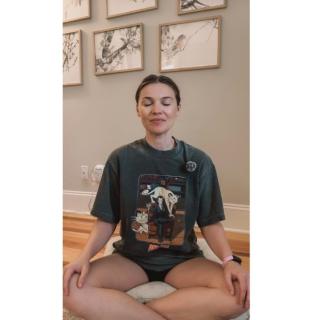
Hello and welcome.
Today's practice is inspired by acceptance and commitment therapy,
Or ACT.
ACT is an evidence-based approach that helps us build psychological flexibility.
The ability to stay connected to ourselves and our values even during difficult emotional experiences.
Rather than teaching us to eliminate painful thoughts or emotions,
ACT helps us relate to them differently.
We learn how to make space for discomfort,
Step back from unhelpful thoughts.
And continue moving towards a meaningful life.
Let's begin!
Find a comfortable position,
Whether that's sitting or lying down.
And you can start to soften your gaze looking down and forward or gently close your eyes all together.
Letting yourself fully arrive to this practice.
Noticing the points of contact between you and the support beneath you Noticing the temperature of the air on your skin.
And knowing that for the next few moments,
There's nothing else to do and nowhere else to be.
Let your body soften.
Bringing your awareness to your breath.
Taking a breath in.
And slowly let it go.
Again,
Breathing in,
Aware of your in-breath.
And breathing out,
Aware of your out-breath.
And as we begin,
Simply notice what is already here.
What emotions are present?
What sensations do you notice in your body?
Perhaps there is ease.
Or stress.
Fatigue,
Irritation.
Uncertainty.
There is no correct way to feel during this practice.
Whatever is present,
See if you can meet it with gentle curiosity rather than judgment.
You might imagine yourself observing your experience the way a scientist does.
Or compassionate therapist would.
Interested,
Open,
And without criticism.
Notice where your body feels tense or guarded.
Perhaps the jaw,
Shoulders.
Chest,
Belly,
Or hands.
Simply acknowledging what you notice.
Without requiring yourself to do anything about it.
This awareness itself is an important skill.
Often we move through our days disconnected from our internal experience until emotions become overwhelming.
And slowing down and noticing helps create choice and flexibility.
And now we'll explore one of the core processes of ACT,
Which is acceptance.
Acceptance does not mean liking pain,
Approving of it.
We're giving up.
It means allowing emotions to exist without fighting against them.
When we constantly struggle with emotions,
Trying to suppress anxiety,
Avoid sadness,
Or control fear,
We often become more exhausted and emotionally stuck.
So instead of asking,
How do I get rid of this feeling?
We begin asking,
Can I make a little space for this feeling right now?
Bring to mind an emotion you've been carrying recently.
Perhaps anxiety,
Grief.
Loneliness,
Shame,
Overwhelm.
Imagine you're holding your emotion in your hands.
Just like you would hold a delicate object.
Notice the shape of it,
The weight of it,
How it feels in your palms.
Whether it's a feeling of stress,
Sadness,
Or anxiety,
Just notice it.
You don't have to like it.
And you don't have to make it go away.
Just let it be right here.
Right now.
Knowing that you are not your emotion.
You are the one observing it.
You might say to yourself,
I notice you.
But you're not the only thing that exists.
Sometimes the feeling softens,
Sometimes it stays the same.
And sometimes it shifts in unexpected ways.
Goal is to practice willingness.
To stay present with your experience without becoming overwhelmed by it.
And we'll move into another ACT skill called Cognitive Diffusion.
Our minds naturally produce thoughts all day long.
Some are helpful,
Some are critical,
And some are repetitive.
Sometimes our thoughts can feel so overwhelming.
It feels like they define who we are.
But you are so much more than just your thoughts and emotions.
They are a part of you,
Not the whole of you.
Act teaches us that thoughts are mental events,
Not commands and not facts.
And bring to your attention a thought you've been struggling with recently.
Perhaps it's I'm failing.
I'm not enough?
Something bad will happen.
I can't handle this.
And instead of saying the thought as truth,
Place a little space between you and the thought by saying,
I'm having the thought that.
For example,
I'm having the thought that I'm not enough.
I'm having the thought that something bad will happen.
Notice how this changes your relationship to the thought.
The thought may still be present,
But now you are observing it rather than being consumed by it.
You are the awareness noticing the thought.
Not the thought itself.
You might even imagine placing the thought on a leaf,
Letting it blow down a stream.
Or watch it drift across the sky like a cloud.
Create some distance between you and this thought and let yourself see the separation.
Notice how when you let go of the belief that you are the thought,
It loses some of its power.
And take a slow breath in.
And release.
Notice the possibility that difficult thoughts can exist without controlling your actions.
Which brings us to our final piece,
Values and committed action.
Values are not goals to complete.
They are qualities of being that guide how we want to live.
Things like kindness,
Honesty,
Courage,
Compassion,
Creativity,
Or presence.
Sometimes when we feel emotionally stuck,
We want to stay where we are.
Either because the discomfort feels too much or because we're afraid of what might happen if we take action.
Even during painful seasons of life,
Values can help orient us toward meaning.
So you might ask yourself,
What matters most to me right now?
Or how do I want to show up for myself and others even in difficulty?
And now think of one small action you could take today that reflects your values.
Something realistic and supportive.
Maybe that's resting when your body needs care.
Sending a message to someone important to you.
Taking a walk.
Returning to a creative practice.
Drinking water.
Or beginning a task you've been avoiding.
Act reminds us that meaningful change often happens through small,
Consistent actions.
Not through waiting to feel perfectly motivated or fearless.
You do not need to eliminate discomfort before taking action.
You can carry your emotions with you while still moving toward the life you want to build.
So imagine yourself taking this small step forward.
Notice how it feels in your body.
Perhaps there is uncertainty.
Perhaps hope?
Or resistant.
Let it all be here.
And remind yourself.
I can take meaningful action even when difficult thoughts or feelings are present.
And take a few final breaths here.
Breathing in.
And breathing out.
And as we close this practice,
Take a moment to acknowledge the work you've done today.
You practiced awareness,
Acceptance.
And stepping back from thoughts rather than becoming trapped inside of them.
And you reflected on what truly matters to you.
These are skills that strengthen over time with patience and repetition.
Begin to bring awareness back to the room around you.
Notice the sounds nearby.
The feeling of the air on your skin.
Invite some gentle movement into your body.
And when you're ready,
Slowly open your eyes.
And carry this sense of psychological flexibility and self-compassion with you as you move through the rest of your day.