Hello and welcome to mindfulness online training.
My name is Darren Kayburn and this podcast is titled,
Five Reasons Why Mindfulness Is Great For Living Well With Pain.
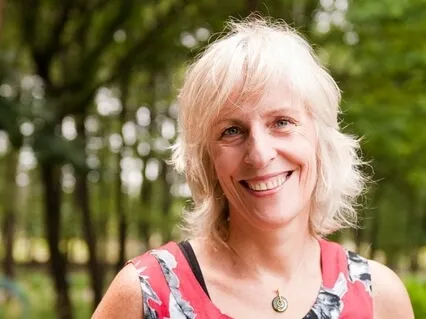
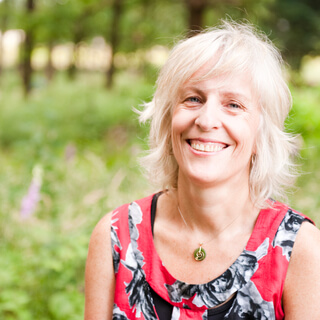
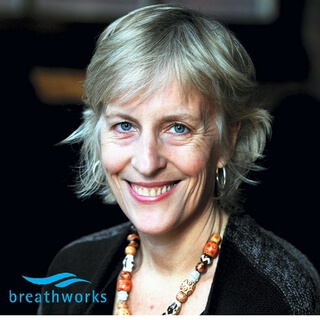
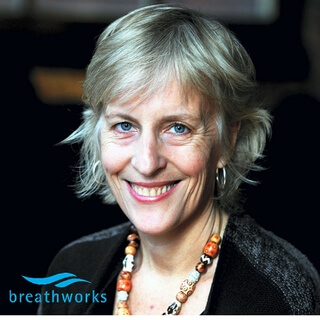
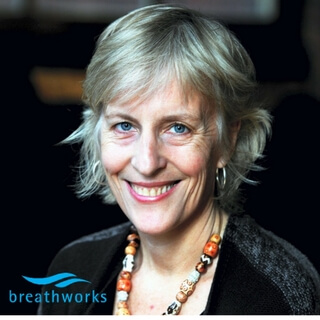
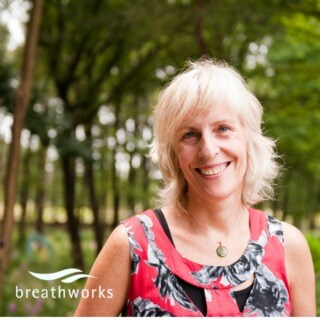
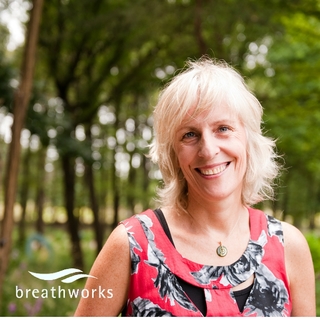
And it's my pleasure to have Vidya Mala Birch with me today.
Vidya Mala led a very active lifestyle,
Engaging in sporting and mountaineering adventures in the great beauty of New Zealand.
However,
Following two life-changing events in the 1970s,
She now lives with a chronic back condition due to spinal injuries and partial paraplegia.
She also navigates the trickiness of managing a paralysed bowel and bladder.
Thanks to mindfulness and kindness,
It's amazing that Vidya Mala now has a whole,
Happy and meaningful life.
But the journey to deeper acceptance has been long,
Slow and at times very tough.
Through a burning wish to help others in pain achieve the same freedom that Vidya Mala cultivated,
Back in 2001,
She founded the organization Breathworks,
To help people living with pain,
Illness and stress to repay their lives.
Breathworks is a recognized leader in this area and has now spread internationally with accredited trainers in over 25 countries.
Vidya Mala's written three acclaimed and award-winning books,
Which are Mindfulness for Health,
Mindfulness for Women and Living Well with Pain and Illness.
So Vidya Mala,
Thank you so much for coming onto the podcast.
It's a great honor to have you share your knowledge with the listeners through Mindfulness Online training.
How are you doing?
Well,
It's really great to be here,
Darren,
And thank you very much for giving me this opportunity.
Yeah,
Not quite sure what I'm supposed to look at you on the screen or the camera.
Anyway,
Hello everybody.
I'm looking at the camera,
But probably mostly I'll look at Darren because that's more natural.
Yeah,
On the screen.
Great.
So you've got so many books behind you.
Are they all your books or are they other people's books?
Oh,
No,
That is embarrassing.
They're all my books,
Yeah.
Right.
In various languages.
Yeah,
I just happened to be in my office where all my books are.
I didn't line them up,
Especially.
Yeah.
Well,
They look beautiful anyway.
They're very nicely presented.
So I'm going to ask you some questions now so you can share a little bit about your experience and knowledge and your teachings.
I mean,
It's absolutely remarkable what you've achieved for yourself personally and also what you've been able to share with others.
What do you think it was that triggered the crucial decision for you to share what you've learned and gave you the strength and the energy to teach all the people through the Breathworks organisations and the other work that you do,
Because I know you do a lot more than just directing Breathworks.
So what was it that enabled you to do that,
To do such a remarkable thing?
I think the way I'd like to answer that is to take myself and all of us back many,
Many years ago to when I was 25,
Which is 35 years ago.
And I was lying on a hospital bed in New Zealand and I was really in bad shape.
So my back was awful.
I had to give up my career.
My life had really fallen apart because of my spinal injury.
And I was lucky enough to be taught meditation by the hospital chaplain.
I think the medical team didn't really know what to do with me because there wasn't any medical solution.
So they sent the chaplain to see me.
He did a very,
Very brief meditation.
And I had,
I suppose,
Quite a deep realisation that I could learn to use my mind to help me manage my body,
To put it very simply.
And that's really what I've been doing for the last 35 years.
But that girl in that hospital bed in New Zealand all those years ago,
I was not really offered any help whatsoever in terms of how to do that.
So I was lucky enough to have this maybe 10 minutes with this lovely,
Lovely guy who did a very brief meditation practice with me.
But at that point,
I mean,
Nobody meditated in New Zealand.
Meditation is really quite common now,
But 35 years ago,
It was not easy even to find anywhere to learn it.
So I've had,
You know,
It's been quite a long,
Lonely journey trying to figure out how to work with my mind.
I've had a lot of fantastic help from people I've met along the way.
And I've become a Buddhist and that's been incredibly supportive.
But in terms of how to meditate when your body hurts,
That's a very specific learning,
If you like.
And a lot of the time that's been very lonely,
You know,
Figuring out how do I work with my mind in this body?
How do you work with your mind when your body hurts?
And I don't really want anyone else to have to figure it out over decades the way I've had to do that.
So every time I'm doing things like this or writing books or,
You know,
Doing things where,
Yeah,
It is quite hard and it requires effort and it requires determination and all those kind of things,
I just remember that girl lying in the hospital bed and how lost and how lonely and how devastated I was and how little there was really to help me.
So in a way,
It's my mission to enable other people who find themselves in that unfortunate situation that I was in.
That there will be resources to turn to and hopefully the things that I'm doing will just add to that pool of resources in the world to help other people who are lost and lonely and suffering.
Sure.
Yeah.
Yeah.
So although it was a real challenge for you and it took you a long time to develop the practice for yourself,
The benefit is that what you're doing with your work is you're now teaching people how to do it so they can do it much quicker.
And it's not a lonely experience for them because they can actually connect with organizations like Breathworks and groups and meet other people that are practicing.
So in a way,
All of that,
I guess,
The unpleasantness that you experienced through that,
There was a reason for it.
And now,
You know,
You're allowing thousands of people to benefit from what you've learned and to basically.
.
.
That's right.
Yes.
.
.
.
Where you are and easier and in a more pleasant way.
Yeah.
Exactly.
I mean,
I don't know if there's a reason for it as such,
But I guess what I've really tried to do is to turn the misfortune that I've had into something that's going to be good for the world.
That's been a choice that I've made.
Yeah.
And also,
I just.
.
.
It's just much more pleasant.
It is a much more pleasant way to live if you do things for other people.
Yeah.
That's what I've learned,
You know,
Lying in bed,
Being lonely and miserable and isolated.
That's really,
Really unpleasant.
Yeah.
But still having pain and then finding ways to do things for other people.
That's just a much more pleasant way to live,
I've discovered.
Yeah.
Yeah.
I've still got the pain,
But.
.
.
What is called the Bodhisattva ideal?
Is it doing the work that you do or your practice is for the benefit of all?
That's right.
I guess you realise from a Buddhist perspective,
You realise that ultimately we're not really completely separate.
That we're all fluid and changing all the time and we're affecting people all the time.
Even if I'm isolated,
You know,
The Buddhist will believe even by my thoughts,
I'm going to be affecting the world in some kind of way.
There's ripples going out all the time.
Sure.
So it's dropping into that much more interconnected space.
But that's all quite philosophical.
But on a very simple level,
I think there was a point some years ago when I'd been pretty much housebound.
And I just thought,
Gosh,
I just need to get out more.
I just need to think of others more,
Do things for others more.
And I think that's what I'm doing.
I'm trying to,
You know,
Take my pain with me out into the world and be a sort of more functioning human being.
And that has borne great fruits for me and I hope for other people.
Yeah.
Yeah.
Great.
OK.
So with pain,
Then,
What are the different types of pain that we can experience and how can mindfulness help us to distinguish between them?
So,
For example,
I might like right now,
My pain's quite bad today,
So I've got quite a lot of back pain.
And we can divide that up with awareness.
We can I can turn towards that pain and open to that pain.
And then I discover that it's got different components.
And one of the components is the basic unpleasant sensations.
Yeah,
The basic unpleasant sensations in my lower back right now is an aching,
A bit of burning,
Got pain in my feet,
Aching,
Burning.
And those are what we call the sort of bare sensations.
And I call that primary suffering.
Yeah.
So that's the primary suffering.
And with mindfulness,
We can learn to accept that with a kind of kindly accepting,
Gentle attitude.
If I wasn't aware right now and I wasn't turning towards the pain and investigating it in that kind of way,
Then I will be automatically resisting that pain and tensing against that pain.
So I would be having an experience that I called pain that was a combination of the unpleasant sensations plus resistance.
Probably I'd be holding my breath.
I'd be getting tenser and tenser.
I'd have all kinds of thoughts going on that I probably wouldn't be aware of,
Probably thoughts like,
Oh,
My God,
How am I going to get to the interview?
But I wouldn't be aware of those.
I'd have emotions of anxiety,
But I wouldn't be aware of those.
So the unaware person,
When they've got pain,
Has got this sort of unholy concoction of unpleasant sensations plus resistance,
Plus breath holding,
Plus thoughts,
Plus emotions.
And you end up with this whole sort of mass of suffering,
Which just feels awful.
So what we do at Breathworks,
What I've developed in my teachings,
And again,
This does come from the Buddha,
Is to learn awareness practice,
Mindfulness practice,
Where you turn towards what is actually happening right now.
What's my actual direct experience?
And you can learn to be with the unpleasant sensations.
To soften the resistance,
Soften the breath holding,
Breathe more fully,
Notice the thoughts coming and going without believing them.
Notice the emotional state without contracting against it.
And so what you're doing is you're you're softening and letting go of what we call the secondary suffering,
Which is all the emotional,
Mental tension and so on that so quickly accrues to the basic unpleasant sensations.
So we can let go of that,
Soften the resistance and then accept the primary suffering.
Because right now I can't do anything about those unpleasant sensations.
They've arrived.
Here they are.
So how do I come into a relationship with those in a simple,
Immediate,
Direct way that's kindly,
That's soft.
And I,
If you like,
Using awareness,
I prevent the arising of all the secondary suffering.
OK,
Yeah.
And the thing that I've learned through my own experience and the many people that I've taught.
It's the secondary suffering that's ruining your life.
It's not the primary suffering.
The primary suffering is unpleasant.
Sure,
I'm not in any way wanting to suggest,
You know,
It's a walk in the park.
It's unpleasant.
It's difficult.
But there's a kind of it's kind of clean suffering.
You know,
There it is.
It's unpleasant sensations in the body,
Whereas all the secondary suffering is sticky.
It's complicated.
It spirals out of control very quickly.
And you just end up getting more and more and more tense and tight and distressed.
Yeah.
So it's very,
Very liberating to be able to break,
Break free of that compulsion to add all the secondary layers of distress to what is essentially just an unpleasant basic experience.
Yeah.
Yeah.
So the key to all of this,
Then,
Is awareness.
What you're saying,
If you have some awareness on those on the pain and on the unpleasant sensations,
You're not going to go and get lost in thought and then cause yourself more suffering and add to the pain as a result of that.
Yeah,
Exactly.
Because the pain will increase.
If you've got,
You know,
Right now,
If I was if I was allowing tension to arise because I was unaware and I'm getting tenser and tenser and tenser,
Then my physical pain is going to get worse.
Yeah.
Whereas if I drop back down into the body and I breathe and I soften,
Then the physical,
The physical pain is not going to escalate.
Yeah.
Yeah.
That's interesting because I can imagine as well that the way that you're doing it is you're not putting all of your awareness onto the pain.
Otherwise,
You wouldn't be able to do the interview.
You're aware of me as well.
You're aware of me as well.
So you must be you must only need to put a small percentage of your awareness on the pain and then the rest you can direct onto other things to live well.
That's right.
Well,
I think but I think what we do automatically as humans,
If we've got something that we don't like,
We just push it away.
Yeah.
So if I was not being aware,
Then I wouldn't be aware of the pain at all.
And I would just be focusing solely on you.
I'll be splitting off my body.
I'll be contracting and guarding.
And yeah,
I would be able to do the interview,
But that I wouldn't be doing it from a place of wholeness.
So it's not it's not that one is not I'm not fixating on the pain.
That's a very important point you're making.
So I'm not obsessing about the pain,
But I'm not splitting off from it and then becoming sort of a bit heady,
But alienated maybe that speedy.
That's often what happens as we get speedy and a bit gabbling.
And I have to talk like this because I don't want to be in my body and my voice will get higher.
Yeah.
So I'd still be doing the interview,
But my voice would be high and I'd be holding my breath and I'd be getting more and more sort of agitated.
And perhaps speedy and not very grounded.
But if I allow if I allow the pain to be part of the conversation,
It's in the room.
Then it's a little bit like a crying child.
If you ignore a crying child is just going to cry louder and louder and louder.
But if you have a crying child and you sue that carry it on your hip,
You can get on with the rest of your life.
The child is there,
But you're moving around getting on with the rest of your life.
And that's very different from having a screaming child in another room.
And you're trying to you're getting on with things and you're thinking,
Oh,
I'm not going to listen to that.
I'm not going to listen to that.
But actually that crying child is going to be actually getting a lot of your attention through avoidance.
Things can dominate our attention through avoidance.
Yeah.
Yeah.
Yeah.
Yeah.
Great.
Okay.
So awareness,
Awareness is awareness.
That's the key.
Yeah.
So there we have the first reason why mindfulness is great for living well with pain.
So it helps us to distinguish between primary pain,
Which is given and secondary pain,
Which is optional.
So the organization that you founded is called Breathworks.
How does working with the breath?
I know you've told us a little bit about already,
But can you just expand on how working with the breath helps us to live well with pain and illness?
Okay,
So we'll do a very,
Very simple little exercise together here.
Okay.
What I'd like you to do and everyone at home can do this.
If you make a fist with one hand.
Okay.
And what's happened to your breathing?
What's happened to your breathing,
Darren?
Temporarily stopped.
Yeah.
Now imagine that you're guiding your tension,
Guiding your breath into the fist.
So you're breathing into the fist.
And what does the fist want to do?
It's loosening.
It wants to loosen.
Yeah.
And relaxing.
Yeah.
Yeah.
That's a very,
Very simple explanation of what we're doing.
So the fist here represents any kind of discomfort mentally,
Physically,
Emotionally.
So in this case,
We're talking about physical pain.
So when someone's got physical pain,
It's as if they've got this kind of fist in their body.
So there's something that's tight,
Contracted,
Bound in a certain kind of way.
And then automatically we hold the breath.
So then you've got the pain plus breath holding.
And then you get a more tension.
Probably the pain is going to get worse,
More breath holding and you get into this spiraling state of more and more sort of tension and contraction.
It's so interesting that you should say that,
You know,
Because I had a haircut this morning,
Like deliberately,
Because I knew that I was going to be speaking to you today out of respect.
No,
I actually needed a haircut.
It was getting too long.
But I had the haircut.
And the guy who cut my hair,
The barber,
He's been struggling with stress and anxiety.
And he doesn't know anything about mindfulness or meditation.
But one of the things that he said to me,
He said he actually catches himself,
Stop breathing.
This is without any training.
And he says,
I've got to just stop breathing.
And then he has to tell himself to breathe out,
Which is exactly what you're talking about.
That's right.
So he's got awareness,
You see.
I'm just going to turn my heater down because I'm getting really hot in here.
So he's got awareness,
Sufficient awareness to notice he's holding his breath.
Now,
Many of us,
We don't have that awareness.
I would say most people live with chronic breath holding.
You know,
You have a thought process,
Which is,
I've got to do the shopping.
I've got to do my emails.
Just notice,
Are you holding your breath?
Chances are,
There'll be this kind of catching of the breath.
So one of the little slogans that we use at Breathworks,
Which I really like,
Is when in doubt,
Breathe out.
When in doubt,
Breathe out.
So if you find yourself in a state of stress or a state of pain,
Just check in on your breathing.
And the thing to really focus on is allowing the out-breath to go all the way out.
And then the in-breath quite naturally will flow in again.
You don't have to worry about the in-breath.
But most of us,
We inhibit the full exhalation.
And then that's going to have all kinds of physiological consequences as well in terms of balance of gas,
Of oxygen and carbon dioxide in the cells and so on.
So when in doubt,
Breathe out.
And when you do that,
You're effectively softening that fist,
That fist of tension around the pain.
Great.
Great.
You can't have soft breathing and contracted states at exactly the same time.
As soon as you soften your breath,
You're softening the mind and you're softening emotionally,
You're softening yourself physically.
Wonderful.
I'm just going to breathe out.
Good.
Excellent.
Another Beth,
Feel.
Wonderful.
So there's a second reason why mindfulness is great for living well with pain.
Mindfulness helps us to use breath awareness to release tension.
And when in doubt,
Breathe out.
There we go.
So why don't we just give all the listeners a moment just to breathe out.
Good.
So how does mindfulness help us to manage our thoughts about pain?
Because I know when I'm in physical pain,
I will often I'll have thoughts.
It'll be doing all they'll be usually unhelpful.
It's like I get lost in thought and I start creating dreams and stories about what could be going on and why it's been caused.
And then my mind also does things not just related to the pain,
But I start like thinking very negatively about other things in my life as well.
As a result of that,
And it spirals and then I get more and more stress.
So how how can mindfulness help with that that process and that secondary suffering?
OK,
So the first thing is to to say that what you're describing is actually you are aware of your thoughts.
So that's a good first first base,
As it were,
Because many of us were not even aware of our thoughts.
Most people are completely identified with the content of the mind.
We don't we don't understand or realize that it's possible to step back,
As it were,
Sort of step out of being completely lost in thought to realize,
Oh,
I'm having thoughts.
So there's a kind of quality of awareness that can look back in on the mind and be aware of the thinking process.
So we call that looking at your thoughts,
Not from your thoughts.
Yeah.
And it kind of sounds obvious for like when you were describing what you do,
You notice you have these negative thoughts and you start having negative thoughts about other things.
But that is a quite remarkable capacity that we have as human beings to actually know what we're thinking.
So that's the first thing is to use awareness simply to know what is it that I'm thinking.
Yeah.
And then the second thing is not to believe all our thoughts to realize that thoughts,
Their mental events are flowing through the mind.
One of the ways we can an image for that is clouds passing across the blue sky.
Yeah.
So you could you could say that your awareness is like the blue sky and all your thoughts are like clouds passing across the sky.
Sometimes the sky feels completely solid with a whole massive storm clouds.
But somewhere back there,
There is a blue sky.
So we learn to rest in the blue sky rather than being completely identified with the clouds.
Yeah.
Yeah.
So so you begin to loosen up being so caught up with thinking.
And then the next thing you do is you use the body.
You use the body as an anchor.
So in the example you're giving where you're you've got your thoughts are spiraling.
You start noticing having negative thoughts about other things.
You simply come back to the body and back to the breath.
So you use breathing in the body as an anchor for the mind.
So you're not coming back to the breath as an idea,
But you're coming back to the actual sensations and movements of breathing in the body as you're allowing the out breath to go all the way out.
So you're you're softening the body.
You're coming into the body.
And there's a rather remarkable things about the way we're wired up that we can't be present to sensation in the body and lost and thinking at exactly the same moment.
We just can't do that.
Yeah.
We're not wired up like that.
That's a great teaching.
Yeah.
So as soon as you come into your direct sensation,
You're present.
Yeah.
Because you're feeling something directly.
It's not you can't feel a previous breath directly or a future breath directly.
The only one you can feel is now.
So as soon as you come inside breathing in the body,
You're present.
And that means you can't be lost in worrying about the future or worrying about the past.
You just can't do that.
So you keep on coming back to the simple anchor of breathing in the body.
And that's a very good way of interrupting all these disturbed thought processes.
You might bounce straight back again the next moment.
So then you come back to the breath.
You bounce back.
You come back to the breath.
You come back to the breath.
You bounce back.
You come back to the breath.
And what you're doing is you're gradually training yourself to,
If you like,
Having breathing in the body as a home base to the mind.
Yeah.
So if we can keep some awareness on our breath,
We're pretty much guaranteeing that at that point in time,
We're not going to get lost in thought because we're going to be present.
Exactly.
And this correlation as well I noticed when I get lost in thought that most of the time it's untrue.
So there seems to be this link between lost in thought and being delusional.
Do you find that?
Well,
It's interesting that there's been some research done that we have something like between 30,
000 and 70,
000 thoughts a day as human beings.
So our minds are just thinking all the time.
Something like 95% of them we've had before.
And then the unaware human being,
The person who hasn't done any training,
Something like 75% of the thoughts are negative.
So the way we've evolved as a species is we've got a lot of thinking going on,
A lot of it's repetitive and we're very what we call threat oriented.
So the most important thing for us is our survival.
So we've got all our sort of hyper vigilance out there,
Anything that's going to be threatening.
And in the modern world,
Obviously,
That's not going to be saber-toothed tigers like in primitive human beings.
But the modern equivalent,
According to psychologists,
Is other people.
So social threat is the biggest thing now.
What do people think of me?
Do they like me?
Don't they like me?
Am I doing any good in this conversation?
We have all these kind of thoughts going on all the time and they're nonsense.
Most of our thinking is nonsense.
It's just the same old chatter going round and round and round.
So you're saying that they're not really very true.
I think that is that is that's a true that's a true fact that most of our thoughts aren't true.
Yeah.
So we're just if you like,
We're some of the psychologists call it decentering.
So rather than being so completely identified by that thinking,
We step out of it and we rest back and we just see them as mental events and thoughts rather than truth.
Wonderful.
So there's another another lovely little saying which is thoughts are not facts,
Even those that say they are.
Is it good?
Yeah,
I keep these in mind.
So so there we've got the third reason why mindfulness is great for living well with pain.
It helps us get perspective on our thoughts with a kindly and also a positive attitude.
Yes.
I mean,
One of the things I haven't mentioned yet,
But it's very,
Very important to have a sense of humor when you're doing this work.
Okay,
Because when you really start to see what your mind gets up to,
You know,
You will.
It's not pretty some of the time.
So you need to be able to kind of laugh and think,
Oh,
There goes my mind again.
Yeah.
Rather than I'm a terrible person.
It's like,
Well,
This is what minds do.
You know,
Mine's not especially bad.
It's just we've got some some evolution that doesn't serve us very well.
I'm running a mindfulness training program out.
I run these eight week programs in Bournemouth.
And next week,
We're doing an exercise to basically dissect and observe our ego.
So to look at all the things that we're attached to and identified with to shine light on it.
And that's what I said to the guys.
I said,
Next time you come,
Bring your sense of humor with you.
Good.
Because you're going to need it.
Absolutely.
Absolutely.
Yeah.
Yeah.
Yeah.
Right.
Okay.
So let's talk a little bit about daily activities now then.
How can the everyday things that we do relate to our experience of pain and how do we manage that?
Okay.
So this is very,
Very important.
You know,
Often people think of mindfulness as being meditation,
Which they're not exactly the same thing.
So mindfulness is the quality of awareness that we can bring to everything and meditation is the training.
Ah,
So the way that you define it,
Mindfulness is a state.
Meditation is a practice.
Exactly.
Or you could say mindfulness is that you have the mind to use the physical fitness analogy.
Mindfulness is a state of being physically fit.
Yeah.
And meditation is going to the gym.
Okay.
Yeah.
Yeah.
So say you meditate,
Maybe,
You know,
Maybe one meditates 20 minutes a day,
An hour a day,
Whatever.
You've got a lot of hours in the day when you're not meditating.
So how are you going to bring mindfulness into all those other moments as it were?
And if you're living with a chronic health condition or chronic pain,
It's really,
Really important.
Yeah.
Because the chance is that.
What's the best way of doing that then?
Okay.
So the best way is at Breathworks I've developed this whole program of what I call mindfulness in daily life.
And it's about learning to pace one's activities because if one's got a chronic health condition,
In fact,
This is true of many people,
We tend to live in what's called boom and bust.
Yeah.
So you have a day where your pain's not quite so bad or if you've got low energy,
A day where you've got more energy.
And so you think,
Great,
I'm going to catch up on everything.
You know,
Do all the housework,
I'll go shopping,
I'll clear my emails.
And then almost inevitably the next day you feel completely wiped out.
I've done that before.
Yeah.
So many people just live in the spiral of booming and busting and booming and busting.
You can kind of get away with it if you're physically healthy,
Kind of.
But if you've got compromised health,
You can't really get away with it.
What will happen over time is you'll just be more and more knackered and able to function less and less well.
So the way we do it is we get people to keep a diary for seven days and to score their pain at the end of every single activity for seven days.
How long did that activity for seven days?
And then after that,
You analyze all and you identify activities that are triggers for you.
So for me,
Sitting is I realized through doing the diaries that if I sit for too long,
Then my pain gets worse.
And what I used to do is I would sit at my computer until I was completely in agony and couldn't do anything.
And then I'd be completely wiped out for the rest of the day.
But what I've learned to do with pacing is I use a timer and after 23 minutes at the computer,
The timer goes off,
I'll stand up,
Have a stretch,
Maybe potter about a bit,
And then I'll go back to my work.
What's significant about the 23?
Well,
I work that out through doing my diary.
So anyone who's listening,
There's a little booklet that's available on the Breathworks website that's called Mindfulness in Daily Life,
Little cheap five pound thing.
And that's got the whole pacing program in it,
All the different stages of keeping the diaries,
Analyzing the diaries and then setting what's called baselines.
So a baseline is how long you can do an activity safely without tipping into booming and busting.
And I,
For myself,
Learning to pace has transformed my life more than meditation.
Wow,
Right.
Yeah.
It's made that much of a difference.
Yeah.
Because it's established that balance.
It's profound behavior change.
Yeah.
And I've applied it to everything.
I've applied it to swimming,
Sitting,
Working,
Being in meetings,
All these kind of things.
Another nice little slogan is take a break before you need it.
Because usually what we do as human beings is we'll do something until we can't do it anymore.
That's like drinking water before you dehydrated.
Yeah,
Exactly.
Yeah.
Or it's like always keeping some money in your bank account.
Yeah.
So never let yourself run dry.
It's very simple,
But it's very important.
So I won't say more about it now because I've explained the principle,
But it's quite a detailed program that you do over about three weeks to establish your kind of the activities that you need to be careful about and how to set baselines.
And it's all of that little booklet.
Yeah.
Great.
Okay.
That sounds great.
So there we've got the fourth reason why mindfulness is great for living well with pain.
Well,
It helps us overcome doom and bust with pacing.
Yeah.
Yeah,
Exactly.
Right.
Okay.
Is this what the Buddhists call the middle way or is that something?
It is very similar.
I mean,
For the Buddhist,
The middle way is very philosophical between two philosophical positions.
But you could say the middle way between extremes is very Buddhist.
That the Buddhist approach to life and the Buddhist approach to action and the Buddhist approach to views is one of equanimity.
You don't fall into extremes in any domain,
If you like.
Yeah.
So equanimity can sound a bit cool.
Maybe you could call it even mindedness,
Equilibrium.
These are the kind of qualities we're aiming for.
I mean,
Imagine having a life which is one of equilibrium where you weren't getting sort of overexcited and then exhausted.
Your mind was in a state of equilibrium.
Your heart was in a state of equilibrium.
The way you used your body was in a state of equilibrium.
And how magnificent would that be?
It would be a life of peace and harmony.
It would.
Yeah.
Yeah.
Yeah.
So this is one doorway into something of that quality.
Great.
Great.
Thank you.
All right.
So next question I've got then is how can mindfulness help us to inform what action we can take to reduce or even remove our pain?
Because we talked about managing it and being with it and being aware of it.
But obviously we need to,
If we can,
Take responsibility for doing things to help reduce it.
Yeah.
So again,
This is more sort of theoretical,
But the thing I always say that the behavioral outcome of mindfulness or awareness is choice.
So we can learn to live a life of choice rather than a life of habit or rather than a life of reaction.
So sometimes this is called learning to respond rather than react.
I mean,
Again,
Imagine what that would be like.
Because we so habitually react to almost everything that comes towards us.
Something comes towards us that's unpleasant and we push it away.
Something comes towards us that's pleasant and we think,
I want more of that.
And we sort of fall into it.
So we're strung on these two poles of craving,
Wanting more of and,
Yuck,
I don't like that,
Pushing it away.
Yeah.
So mindfulness means that when we're no longer victim to those impulses,
So something pleasant comes towards us,
We enjoy it.
But we understand that nothing lasts forever.
So we let it go.
Something unpleasant comes towards us.
We acknowledge it with kindness,
With grace,
With a sort of gentle acceptance.
And then we choose,
OK,
How will I respond to this now that's going to help that discomfort ease,
If possible.
Oh,
So we can actually use the choice that gets enabled through mindfulness to help us choose to take the right action to,
If possible,
Minimize the pain or the illness through,
You know,
Some other medication.
Exactly.
Yeah.
It could be medication or it could be exercise or it could be some kind of therapy.
But mindfulness gives us that choice rather than us just reactively going around the same loops.
Yeah.
So that's the main thing.
Mindfulness gives choice.
So you're aware of your thoughts,
You're aware of your emotions,
You're aware of your body.
And the thing I'm particularly interested in at the moment,
Because I've been known as mindfulness for years and years and years,
But I'm really interested in how mindfulness becomes a kind of foundational quality to whole life health.
So,
Yeah,
Working with one's mind is very,
Very important.
But then the choice gets translated to diet,
You know,
Choosing to eat well,
Gets translated to exercise,
Choosing to do stretches,
Going to the gym,
Going swimming,
Whatever you can do within your capacity,
Gets translated to routine and habit,
Like going to bed at a reasonable time every night,
Having good sleep hygiene.
That's good advice.
Yeah.
Yeah.
And it gets it gets translated to getting out into nature if you can.
So all these other domains of your life that are all very,
Very important.
Chances are you're not really going to make much progress with any of those unless you've got awareness,
Unless you've got this ability to choose to respond rather than react.
So the awareness enables the choice and the choice enables us to be skillful and to basically do the right thing.
Any area of life,
Not just pain and illness.
Exactly.
And the whole area of life.
And I'm interested in diet,
Exercise,
Sleep and getting into nature.
Those are all very important domains.
Yeah.
Yeah.
And they're not rocket science,
You know.
None of this is rocket science,
But it's hard.
As we all know,
You know,
The mind is an unruly beast and it will undermine us at every opportunity.
So it's going to be friend the mind and then get the mind.
And another little saying I've been using is getting your mind working with you rather than against you.
Yeah.
I'm going to write all these sayings down and put them in an article,
By the way.
OK,
Fantastic.
Good.
Because there's so many really good sayings that I think you can kind of memorize and they just help you to practice.
Good.
Good.
Yeah.
That would be great.
Thank you.
I just remembered just then to breathe out.
Good.
Well done.
Because I was in doubt,
So I breathed out.
Yeah.
Yeah.
Yeah.
So it's not,
It's not,
OK,
That's,
I'm glad you said that.
So this when in doubt,
Breathe out.
You can use that in two ways.
One might be that you're having some doubt.
So the other might be that you don't quite know what to do.
You sort of come to and you're feeling a bit bewildered or stressed.
Just breathe out.
Yeah.
So you just stop.
It means if you don't know what to do,
Breathe out.
What to say?
Yeah.
Yeah.
Yeah.
Just breathe out.
Have a pause.
Breathe out.
Yeah.
Everyone will be grateful for that.
OK.
So,
So in relation to the choice,
Then,
This is a fifth reason why mindfulness is great for living well with pain.
And that it may enable us to take skillful action to help reduce or resolve our pain as the behavioral outcome of mindfulness's choice that it enables.
Wonderful.
OK.
So we've been through the five reasons there.
Would you be kind enough to restate them for us and summarize?
Good.
I'll do my best.
OK.
So the first one is that mindfulness helps us to distinguish between the primary pain,
The unpleasant sensations,
Which is a given,
And the secondary suffering,
Secondary pain,
Which you could say is optional,
Which is the reactive pain that we can learn to reduce,
Soften,
Dissolve away.
That's the first one.
OK.
The second one is breath awareness.
So put very simply,
Remember when in doubt,
Breathe out.
Just remember,
Let the out-breath go all the way out of the body and the in-breath will flow in and that breath awareness can help release tension.
That's the second one.
The third one is about our thoughts.
Learning to look at our thoughts rather than from our thoughts.
So to have perspective on our thoughts with an attitude that's kindly,
Good,
Humid and positive and patient.
That's the third one.
The fourth one is that mindfulness helps us in daily life by bringing equanimity or equilibrium,
By helping us get out of boom and bust with pacing.
And I suggest if anyone's interested in that to get hold of our little book,
The Art of Mindfulness,
Mindfulness in Daily Life,
Available on the Breathworks website.
Mindfulness in Daily Life,
£5 super book.
Yeah,
That's it.
Available and it goes through the whole programme in a lot of detail.
And then the last one is that mindfulness helps us make choices.
So the behavioural outcome of mindfulness is choice.
And then rather than being drawn by being sort of propelled through life through reactive tendencies,
We bring in this magnificent quality of choice and we can choose skillful action.
And the little saying I had there is working with your getting your mind working with you rather than against you.
Yeah,
And that can help us reduce or possibly resolve our pain in some instances.
Exactly.
And I talked about the importance of sleep,
Diet,
Exercise,
Getting into nature.
Yeah,
Yeah,
Great.
Wonderful.
So they're the five reasons.
Is there like an easy way to remember your approach because you've shared so much and it's all been really useful?
But what's one thing that you can leave people with to keep in mind?
OK,
So there's this there's two little saying so live with your breath,
Live with gravity.
So living with your breath means befriends your breath.
So your breath is something you take with you through life with awareness and you haven't got that tight fist.
Yeah,
You're not living life with a tight fist.
You're living life with an open hand.
Yeah.
In fact,
Maybe that's maybe that's the simplest way to say it.
Increasingly,
I'm thinking that the gesture of everything we're teaching is living with an open hand.
So rather than living with this tight fist struggling,
Just release,
Release,
Release,
Release,
Release the mind,
Release the heart,
Release the breath,
Release the body.
And so breathing will help you do that.
And the other thing is to live with gravity because very often we resist gravity and we're kind of straining away from gravity.
And it's so fascinating to give the body to gravity.
So when you're if you're sitting on a chair right now,
Listening to this,
See if you can settle,
Surrender the body to gravity rather than this kind of fighting attitude.
So many of us have.
But you're moving from from a closed fist to an open hand.
That's the gesture,
Metaphorical gesture of everything that we're teaching.
Wonderful.
Wonderful.
Thank you.
OK,
Thanks so much for sharing.
Can you tell us how or tell the listeners and the viewers how they can connect with you and how they can link in with your wonderful organization,
Breathworks as well?
OK,
So the Breathworks website is breathworks-mindfulness.
Org.
Uk.
You can go on the website,
You can sign up to a newsletter.
We have a weekly newsletter,
A really great newsletter that's produced by Oli at the office.
So that's one thing and on the social media feed as well.
Sorry to interrupt,
But I just got excited thinking about some of the stuff that I've seen on Instagram and Facebook.
And there's some really useful tips and quite funny stuff as well that gets shared on there.
That's right.
Yeah.
Light,
Isn't it?
Yeah.
Yeah,
We try to we try to keep things good humored.
I think that's important,
As I was saying.
So yeah,
Breathworks on Instagram,
Facebook,
Twitter,
All those kind of things.
I've also got feeds on all those things,
Vidya Mala.
And I've got my own website,
Which is Vidya Mala.
What is it?
Vidya Mala-Burch.
Com.
So you can go in there.
There's loads of stuff.
There are loads of talks,
Interviews and things there.
Yeah,
I got actually free stuff on there.
Yeah,
There's lots of free stuff there.
Yeah.
So that's probably the two things through the Breathworks website and through my own personal website.
On the Breathworks website,
There's information about teacher training courses.
We do online courses,
Face to face courses.
We've got a very highly respected teacher training pathway if you want to become a mindfulness teacher.
So it is a wealth of information there.
So that's probably the best way for people to follow up if they're interested in any of that.
Wonderful.
Okay,
Great.
Thank you.
Thank you very much.
Good,
Good.
Absolute pleasure.
Delightful to speak to you.
Yeah,
Yeah.
Nice to connect with you.
Vidya Mala is a featured teacher at Mindfulness Online Training.
This means that you'll be able to find many of her free resources at the site mindfulnessonlinetraining.
Org.
I'll also be including regular updates on Vidya Mala's content through social media and the email list.
Thank you so much for tuning into the podcast wherever you are.
I hope that the teachings,
Wonderful teachings that Vidya Mala shared with us will help you or those you know live well in times of pain and illness and just become a more skillful human being with an open hand.
A more light-hearted human being.
That's one of the other things I've found very interesting that another outcome of all this is becoming more light-hearted.
So good luck everybody and thanks for tuning in.