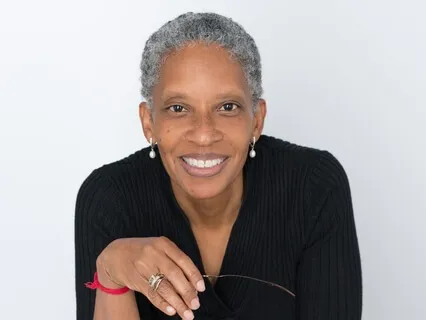
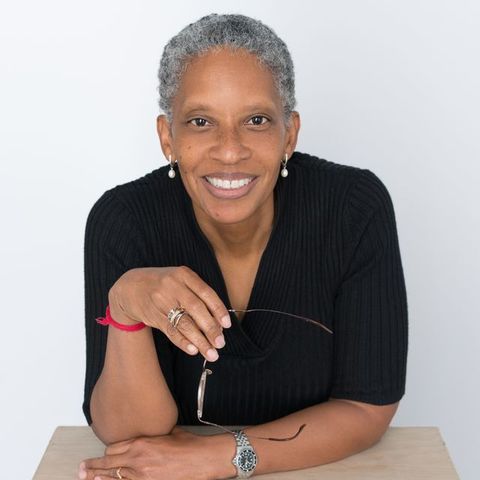
So I'll introduce Pamela Ayo-Yatunde,
Who's our keynote this morning on social borders.
She is a pastoral counselor and assistant professor at United Theological Seminary in the Twin Cities.
I had the great pleasure of meeting Ayo through a chaplaincy program,
A Buddhist chaplaincy program at Upaya Zen Center.
And so I just,
By way of introduction,
I want to share an inspiring quote from Ayo that really just struck me and has stayed with me since,
Before we welcome her to the stage.
Just take me a minute to get back to it.
Ayo shared with us,
Having or deciding to embody something beyond our own selfish desires is a way we can approach oppression with courage.
So I think the space that we're talking about these three days is really a space in which we're stepping out of our comfort zones,
We're challenging our assumptions,
And we're looking for ways in which we can engage with ourselves and with the other,
Such that it transforms our communities and the societies around us.
And I hope you all give Ayo a warm welcome and that we have a chance to enjoy another wonderful day together.
Thanks.
Okay.
Morning,
Everyone.
Can you hear me okay?
Everyone in the back?
Okay,
Great.
Great.
Some of you just came from yoga,
Right?
Yeah,
You're feeling unified.
Yeah,
That's what yoga is supposed to do for you,
Right?
You feel unified.
So I should begin by saying namaste.
I want to start with a little story,
Which was back in,
I think,
1981.
I was just with one of my college roommates,
Athene.
And she said,
So what are you talking on?
And I said,
Well,
On Theology of Prince.
And she began to laugh.
And she said,
Do you remember when we were living together and you were in the room and you were playing Prince and you were having just the best time,
Like your own little party?
And I came in and I turned down the volume.
And then I took the album off the record player.
Do y'all know what that is,
A record player?
Yeah,
Turntable.
And then I put on the go-go's.
And then I began dancing to the go-go's.
And I said,
Yeah,
I remember that moment.
She said,
Do you remember what you said?
And I said,
No.
She said,
Don't you ever,
Ever,
Ever do that again.
And so she was just reminding me of how much Prince meant to me when we were in college,
1980 to 1984.
And it just sort of surprises me now that I'm still talking about Prince 30 plus years later.
So just to get a sense of who's in the audience,
I'm trying to take in your faces.
How many people are aware of who Prince was?
OK,
Good.
All right.
OK.
I'm in friendly,
Friendly company.
All right.
I'm going to read my notes to you so that I don't forget anything that I want to share.
And we're going to have ample time for Q&A.
OK,
All right.
And also,
I'll say this.
What I have learned about talking about Prince when it comes to the Q&A,
Actually before it comes to the Q&A,
I have learned that people tend to be so eager to talk about their own experiences of listening to Prince's music or watching his movies that people tend not to really care what I'm saying.
And that's fine.
I appreciate that enthusiasm.
So just hold on.
And we will hopefully have a very robust Q&A.
So I titled this talk,
We Need a New Breed,
Leaders Stand Up,
Organize,
The Theology of Prince for Creative Resistance.
So as you already know,
I teach pastoral care and counseling in Minnesota.
And this project,
The Theology of Prince,
Came to me when I was having a conversation with one of my colleagues about what makes our seminary different than the other seminaries in the area.
And I don't know.
I was new to Minnesota,
Thinking about why would I leave Atlanta and go live in a place like Minnesota.
And I said to him,
I said,
Because our school can do the theology of Prince.
And he was stunned.
And the room fell silent.
And then he looked at me and he said,
What does that mean?
And then I looked at him and I said,
I have no idea.
And so I left and I thought,
OK,
That was just an idea.
And we're not going to talk about it anymore.
But then it kept coming back to me.
What does that mean?
What would that look like?
And so our school launched a project.
And we'll talk about that more in the Q&A.
So you already know that Prince was an extraordinarily gifted international funk rock sensation of music and film,
And that he lived in Minnesota and built his studio there,
The studio called Paisley Park.
Many people who know about Prince know that his music and other art forms were sexually provocative and explicit,
So much so that his song Darla Nikki in 1984 caught the ear of Tipper Gore,
The thin wife to representative Al Gore,
Who was from Tennessee.
And Tipper Gore helped organize the Parents Music Resource Center,
PMCR,
To place warning labels on recordings PMCR found morally inappropriate for children.
That's had something to do with that.
But that song,
That song about a lady masturbating in public with a magazine,
Also had at the end of the song a back-masked choir,
Gospel choir,
That sang,
Hello,
How are you?
I'm fine because I know that the Lord is coming soon.
Everything coming soon.
So today I want to share why I think understanding the theology of Prince can inspire non-dualistic and activist-oriented responsible uses of technology.
But first,
Some words about sex and spirituality.
If I say sex like that,
I know you would lean in,
Right?
Sex is sensational,
But spirituality not so much.
So the spiritual side of Prince,
Who I argue is the world's best-selling gospel music artist,
Was largely unknown until our seminary took on the subject matter in our Theology of Prince project.
In case you are wondering whether Prince wrote and performed gospel music,
Let me mention several of his songs.
Some songs with the most obvious religious references include Controversy,
Annie Christian,
1999,
I Would Die For You,
When Doves Cry,
Let's Go Crazy,
Temptation,
The Ladder,
Christopher Tracy's Parade,
Sign of the Times,
The Cross,
And God.
Other gospel songs that are less obviously Christian would include America,
Lady Cab Driver,
Free,
And Paisley Park.
This is 40 years of recording,
So there's absolutely no way I could list all the songs that are of gospel nature.
So when a scholar has to determine what they're going to study,
There's always going to be a limit.
So I had to make my limit to my experience of Prince between 80 and 84,
Not 1979 to 2016.
It's too much.
But what about Purple Rain?
Y'all know that song,
Purple Rain?
I can only call it mystical,
Where Prince,
As prophet,
Asked his followers if he can guide them into the Purple Rain,
And Prince,
As a witness,
Says he wants to see his followers in it.
If scholarship on the theology of Prince continues,
And I hope it does,
I've just kicked it off,
I anticipate there will be much agreement and disagreement about what Prince's music is about,
And I believe he would have liked it that way.
It's a myth about his art that is full of controversy,
Just as he was.
Prince,
Influenced by Seventh-day Adventism,
Seemed to believe in a government headed by Jesus where the devout would be awakened from the sleep of death and evil people would be destroyed.
This belief is known as pre-millennialism.
In many songs,
Prince wrote about government,
Those that were destructive and those that were more ideal.
For example,
In Controversy,
A song where the social critic,
Toure,
Argues Prince wanted to be viewed more than just a mere music maker,
But as a personal liberator,
Recites the Lord's Prayer.
Are you familiar with the Lord's Prayer?
Yeah?
Our Father,
Who art in heaven,
Hallowed be thy name.
Thy kingdom come,
Thy will be done,
On earth as it is in heaven.
Give us this day our daily bread,
And forgive us our trespasses,
And so on.
This prayer is prayed by probably hundreds of millions of people in church,
At least weekly.
But Prince includes this prayer,
And also in the same song,
A chant.
Here's the chant.
People call me rude.
I wish we all were nude.
I wish there was no black and white.
I wish there were no rules.
People call me rude.
I wish we all were nude.
I wish there was no black and white.
I wish there were no rules.
The Lord's Prayer intertwined with sexuality.
Are you kidding me?
In the 80s?
For the song Sexuality,
Prince sings,
Stand up everybody,
This is your life.
Let me take you to another world.
Let me take you tonight.
You don't need no money.
You don't need no clothes.
The second coming,
Anything goes.
Sexuality is all you'll ever need.
Sexuality,
Let your body be free.
The second coming of Jesus intertwined with sexual anarchy?
Are you kidding me?
What?
In the 80s.
And then later in that same song,
He sings,
New Age Revelation.
I think we got a case.
And what he's referring to is his favorite book of the Bible,
The book of Revelation.
Prince pleads in Ronnie Talk to Russia.
Ronnie talked to Russia before it's too late,
Before they blow up the world.
You go to the zoo,
But you can't feed gorillas.
He's not talking about gorillas,
Gorillas.
Can't feed gorillas,
Left wing gorillas.
You can go to the zoo,
But you can't feed gorillas who want to blow up the world.
Now according to the book of Revelation,
It is God's job to destroy this world,
Not ours.
And then Prince sings in Annie Christian,
Annie Christian wanted to be number one.
By the way,
That's like the worst sin to want to be God.
That's the worst.
So Annie Christian wanted to be number one,
But her kingdom never comes.
Thy will be done.
She couldn't stand the glory.
She would be second to none.
The way Annie tells the story,
She's his only son.
Annie Christian wanted to be a big star,
So she moved to Atlanta and she bought a blue car.
She killed black children.
And what's fair is fair.
If you try and say you're crazy,
Everybody say electric chair.
And then in the song,
Everyone says electric chair,
Annie Christian,
Annie Christ.
Until you're crucified,
I'll live my life in taxi cabs.
On that note,
A super fan,
A friend of mine,
Harbored grave doubts that I should put Lady Cab Driver in the gospel category because from her perspective,
Lady Cab Driver is too graphic in its sexuality to be gospel.
But what if the cab in Prince's songs is his vehicle to heaven and the driver is an angel getting him there?
Listen to these songs again from that perspective.
Between all the sex and spirituality,
Prince was a freedom fighter who wanted to encourage others,
The new breed,
To be leaders,
To stand up and organize.
Can understanding the theology of Prince inspire us to creatively resist oppression,
Especially commercial exploitation?
Before you answer that question,
Let's contemplate what it means to be a new breed.
Prince grew up Seventh-day Adventist,
But he was also exposed to United Methodist and Baptist teachings.
I believe Prince,
Even before he became a Jehovah's Witness,
Believed in the utter fallibility of human beings to govern themselves.
But from his view,
The best of us,
The ones who believe Jesus Christ to be the savior from eternal damnation,
As described in the book of Revelation,
Were the best of us.
The new breed would be pre-millennial Christians,
Christians that believe Jesus and God the Father will reign on earth over the righteous.
And this period would last a thousand years.
I believe knowing this gives fresh interpretation to Prince's song,
1999.
Do you have to subscribe to this belief system to be the new breed the world needs today to creatively resist oppression and economic exploitation?
Theologically speaking,
I don't think so,
But I do support the notion that leaders willing to stand up and organize need to have considered their path to being reborn,
And not exclusively in the religious sense,
But at least in the psychological sense,
To become new in this sense I argue means interrogating the old mentalities,
Old behaviors,
Old worldviews,
Old habits,
Old investments,
Old commitments that allow us to profit from the border and boundary making ways we separate one from the other,
Separate ourselves from the other,
And these are processes we engage in quite frequently,
Sometimes often in the subconscious mind.
One of the new commitments for the new breed in my view has to be leadership.
Through the Theology of Prince project,
I learned that many Prince super fans were not just fans of his art,
But were his spiritual followers.
Prince was their prophet,
Leading them to the psychotheological integration of good and bad,
Specifically God is good and sex as bad,
And by putting God and sex in dialectical tension for nearly 40 years of artistry,
Prince helped his fans as a prophet might know God as one that did not punish people because of their sexuality.
Sexuality was,
In his view,
God given.
Was Prince informed by the tantric sex practices of Hinduism and Buddhism?
I think so because clearly this did not come out of seventh day United Methodist Baptist theologies.
Those of us who grew up in different generations and those of us who grew up in religious traditions that were anti-recreational sex or anti-sex for pleasure can probably imagine the power of integrating the poles of God and sex.
Prince through art helped free some of his followers from shame.
So when you reflect on your own leadership,
What are you hoping to help people be free from?
Do you happen to have the skill and wisdom in working with dialectical tensions such that people will work with you to resolve the dialectical conflicts that lead to violence?
How does your technology advance peace without exploiting others?
In your New Breed process,
Have you undergone what you hope to help others undergo?
Are you willing to stand up as a New Breed leader?
Prince people often remarked,
Was a short man at about five feet three inches tall.
Yet he was a giant when it came to standing up against economic exploitation.
It is said that Prince sold more than 100 million records and made $270 million.
In essence,
He took home just a fraction of his income.
So does that seem fair?
Especially for someone who played most of the instruments on his early albums,
Wrote all of the music,
Produced,
So on and so forth.
He didn't think it seemed fair.
Prince was an evangelist from the very beginning of his recording career.
He was trying to bring fans to Jesus.
He warned of the destruction of the earth,
The need for salvation from evil.
He sang about the need for diplomacy in the face of nuclear annihilation.
He was a social critic and also fought against corporate exploitation.
He repeatedly returned to the fight against the corporate exploitation of himself,
His art,
Other artists,
And their art.
The advent of the internet and the ease with which art could be shared with the masses in seconds meant the loss of the artist's power of distribution and thus income.
Prince changed his name to a symbol,
Wrote the word slave on his face,
And in my opinion intentionally gave Warner Brothers some of his least brilliant music during their contractual disputes.
In doing so,
Prince was showing us that we needed to organize to resist enslavement.
How?
By rallying against technological advancements that weren't controlled,
For example the internet,
And partnering with others who had technologies and platforms that would better protect artists and their art.
Are you willing to have controls or accountability on your technologies so that others are not exploited?
We need a new breed,
Leaders.
Stand up and organize.
As Prince does in his song,
Sexuality,
He chants over and over,
We need a new breed,
Leaders.
Stand up,
Organize.
We need a new breed,
Leaders.
Stand up,
Organize.
Why don't you repeat it with me?
You ready?
We need a new breed,
Leaders.
Stand up,
Organize.
I know you agree.
I believe many of you are exactly the new breed leaders who are already standing up.
We are organizing around many issues,
So many issues.
How can we know which issue or issues to choose?
Can understanding the theology of Prince help?
I believe it can.
If Prince were alive today and still committed to an end of times worldview,
He'd read the signs of destruction all around us,
Many staunchly pro-life advocates remaining silent on the separation of children from their parents,
The caging of children,
Releasing some of those children to families not their own.
He'd see the manifestations of climate change and probably proclaim the fires,
Floods,
And storms as already written.
Read the book of Revelation,
The rise in audacious forms of racism and other forms of hatred,
The way Trump and Kim Jong-un,
The Supreme Leader of North Korea,
Threatening our existence with nuclear annihilation.
As you all know,
There is plenty of political unrest throughout the world to affirm from this point of view that the end day is near.
The younger Prince would say,
Party like it's 1999,
Or engage in dance,
Music,
Sex,
Romance.
In his song,
Ronnie Talk to Russia,
He promoted diplomacy,
But it's hard to know what he would have thought of Trump's ability to negotiate peace.
Freedom seems less vocal these days,
But weapons of mass destruction are still being tested,
And Iran is continuing their nuclear program.
Prince,
The manchild,
Believed Jesus would return and rule the earth,
But the maturing Prince,
The one who woke up to his own part in the exploitation of artists,
Including his first wife-to-be,
Maite Garcia,
And his collaborator,
Sheila E,
Saw that he was exploited too.
But he also obviously believed that before Jesus' return,
To live a life of dignity,
You had to resist oppression through the arts,
Through the law,
Through innovative technologies,
And collaborating with those willing to disempower oppressors,
And to do it financially where it hurts in the pocket.
As we think about disempowering people in their pocketbooks,
In their pockets,
Where should we begin?
So I'd like to take a few minutes in silence just for you to think about who you voluntarily,
Or what you voluntarily give your money to.
I'm really going to allow a few minutes for us to really think about that.
Think about who or what you give your money to voluntarily,
So that excludes taxes,
And why you do that.
Yeah.
Okay,
Thank you.
I used to be a financial planner.
Okay,
That's my confession.
I may confess something later about that.
So I'm used to talking to people about their money and their choices around how they make money and what they do with it.
But back to you,
As you thought about who and what you give your money to,
I want to ask you a question,
A few.
If you believe the prison industrial complex enslaves people for profit,
Don't invest in companies that profit from imprisonment.
If you believe certain forms of energy damage our environment,
Don't invest in those companies.
We know from the civil rights movement and from movements Gandhi led in India and South Africa,
That financial disempowerment or divestment happens when a mass of people organize and withdraw their investments,
Small and large,
And do so strategically.
Can your technology or technologies be used to help communities divest from predatory corporations?
Make no mistake about what I'm about to say.
Make no mistake about this.
Corporations that prey on their customers and potential customers can be put out of business.
It was only several years ago that we had a housing crisis in the United States because lending institutions were permitted to lend large sums of money to people who could not afford to pay their loans.
Quick profits for the banking industry,
Many of those companies are still in existence.
And long-term impoverishment for everyday people trying to achieve the American dream.
And I know that not everyone lives in this context,
So forgive me for just speaking from the context I'm most familiar with.
So from that situation that was just several years ago,
Even to a recent situation where the United States government shut down,
Started and ended by Trump,
Put people out on the streets,
Working people out in the streets,
In line for food.
Not that long ago.
It's amazing to me,
I try not to get too political,
But I do feel strongly about this,
It's amazing to me that we've forgotten about that.
But back to the housing crisis,
How did some Americans respond to that?
Occupy Wall Street.
You all remember some of you remember Occupy Wall Street?
Yeah,
Okay.
Occupy Wall Street appeared seemingly from out of nowhere in 2011 and virtually disappeared a year later.
Right?
But why?
Some said it didn't have clear demands that could be used to prompt formal policy changes.
Some said it demonized the rich by threatening to redistribute their wealth to the rest of us,
The 99%.
The movement was also criticized for not building a sustainable base of support.
Some said it lacked measurable goals.
Some said it was too closely tied to the activists physically occupying the park.
Some say the Federal Reserve should have been the target of Occupy's work.
And some said that the Occupy Wall Street protesters used anti-Semitic slogans.
There may be,
I haven't done the study,
But I'm pretty sure that there's legitimacy to all of these concerns if we just look at what happened in 2011 and 2012.
But is it possible that the Occupy Wall Street movement gave rise to Bernie Sanders and Elizabeth Warren's campaigns for U.
S.
President?
I think so.
We need a new breed.
I'm not saying this as an endorsement.
I'm not saying Bernie Sanders and Elizabeth Warren are the new breed.
On the other hand,
I will say this,
There's one thing,
Well no,
I'll tell you that later.
We do need a new breed though.
We need a new breed of leaders who are also willing to study the rise and fall of the Occupy Wall Street movement.
Why did it catch fire so quickly and why did it disintegrate so quickly?
Once we study that,
We need to stand up again and reorganize.
The problems are still,
The problems may even be worse.
How do we creatively resist corporate excess and exploitation?
Through the arts,
Through the law,
Through innovative technologies,
Through progressive public and practical theologies and collaborating across sectors,
Disciplines,
Communities,
Economic classes with those who have access to technology and those who do not and with all of those willing to disempower,
Financially disempower oppressors.
I know I keep asking you this question but I have to ask it again.
Are you part of the new breed of leaders taking a stand and organizing?
The December 2019 issue of Wired Magazine which is on the stands now and I want to let you know it's on the stands now.
It won't be on the stands forever.
Please buy a copy because there's an article in it that is so inspiring that I want you to read it.
I'll tell you a little bit about it.
It features on the cover Somali born Minnesotan Nemo Omar wearing her hijab.
Omar is the co-founder of Awood,
I believe it's pronounced Awood,
A-W-O-O-D,
Awood Center,
An organization comprised primarily of Somali refugees in Minnesota working for Amazon's fulfillment center in Shakopee,
Minnesota.
Now when you think about who gets your money,
I'll be the first one to admit I have given countless dollars to Amazon.
Countless.
I don't know.
I'm probably buying something from Amazon once a month.
You don't have to raise your hand but maybe you are too and it has implications for people.
Amazon is the second largest private employer in the United States.
Amazon's core principles include speed,
Innovation,
And customer obsession.
According to the article written by Jessica Bruder,
Amazon was not treating their employees at this facility particularly well.
To give you an idea,
Employees were expected to box orders at a rate of 230 boxes per hour.
Their productivity was monitored by Amazon's innovative inventory tracking system.
Let me tell you if they did not produce,
There were consequences.
Many coworkers endured back,
Leg,
And shoulder injuries and pain,
Were not paid well of course,
Worked in a building that had no air condition,
And was not set up for their Muslim employees to practice their prayer life.
On the other hand,
Amazon offered a shuttle to get employees from their homes to the facility which was a wonderful convenience but eventually they ended the service and I think that was sort of like a last straw for some people because it put the Muslim refugees in a place in Minnesota in danger especially at the height of homophobia at this time,
Muslim phobia,
Sorry,
Islamophobia at this time.
I highly recommend you read this article to see how a relatively powerless immigrant employee group especially powerless compared to Amazon brought Amazon to the bargaining table without the employee group becoming a union.
I also want you to read the article to learn how Amazon strategizes and I think this is typical of many large corporations,
How Amazon strategizes to undermine employee leadership and how their strategies were repeatedly resisted by this group of organized employees.
Using massive online stores can seem like a one-click magical experience with little to no inconvenience but between that one click and getting your product there may be many underpaid repeatedly injured overworked and overwhelmed employees working in high-tech sweatshops living with the moral injury that comes from trying to make a living while negotiating cultural and linguistic differences while honoring their culture and belief systems.
When we think about the theology of Prince and standing up against corporate exploitation,
We should consider whether Amazon's core principle of meeting customer obsession is something we are complicit in and if so whether our obsession with getting what we want when we want it as conveniently as possible means other people don't get what they need when they need it.
Here is what I mean by that.
Amazon was founded in 1994,
25 years ago.
The number of independent booksellers in the United States dropped 40% from 1995 to the year 2000.
In the 2000s,
Ebooks started to take market share away from printed books.
Amazon continued to gain significant market share and these competitive pressures resulted in a collapse of the chain stores and booksellers chain stores in 2010.
Given that Amazon is now in the grocery business,
Owning Whole Foods and delivering groceries to your door,
Again through the one touch convenience,
How long will it be before neighborhood grocery stores chain and independent clothes?
Independent booksellers were nearly cut in half in just five years.
We may not have known,
I'm guessing we didn't know,
The rate of destruction in 1994.
But in 2019,
We know grocery stores are at risk and that means the probability of more food deserts than ever before.
The good news regarding independent bookstores in the United States is that there has been a 35% increase in independent bookstores between 2009 and 2015.
The reason for the rise has to do with the buy local movement,
Success in curating interesting titles,
And hosting book-oriented community events.
Old-fashioned human technologies of community building are bringing back independent bookstores.
Can being an old-fashioned human connection communities stem the tide of food desert creation?
Can newer technologies help prevent the dynamic of customer obsession with convenient food shopping that will probably mean others become significantly inconvenienced?
Why do some people have access to drinkable water from within their homes,
But some people have to walk miles away from their home just to get water?
Are we willing to tolerate the creation of people having to walk miles and miles just to get real food?
If we are about building peace,
It seems to me we have to be about preventing food scarcity.
Are you leaders in technology willing to stand up for food justice,
Basic stuff?
And if not,
I would have to agree with Prince that we are in our end days.
But I would disagree with him about it being God's will.
I would argue that we are losing the will for our collective survival when we cannot stand up for food security and food justice.
We're going to have to learn.
If we are about peace,
I believe this,
We're going to have to get good with being inconvenienced.
We're going to have to embrace that.
It's okay,
Especially if it means other people can eat and drink with more convenience.
We're going to have to transcend customer obsession just so people can eat.
And you know the bottom line is this,
If we can't eat,
We can't live.
It's really that simple.
A few weeks ago,
A new book about Prince was released.
And there are several,
By the way.
But a new one was released.
I know,
Right?
So it's like just when you think you've got your scholarship down,
There's a new book.
It's like,
Oh,
Gosh,
My scholarship's old now.
But I love it.
This one is called The Beautiful Ones,
Edited by Dan Piping-Bring.
And it brings and it includes Prince's unfinished autobiography.
I would say it's sort of like a barely started autobiography.
It's a collector's item.
It's got the feel of a portable archive.
And also,
It's like honoring the fact that he was a musician.
So it's like a printed music album,
If you can imagine that.
And as I flipped through it and began reading it,
It made me think about what my own life album might look like.
And I began asking myself questions like,
Did I ever become new?
And if so,
In what sense?
When did that happen?
Why?
Have I stepped up to lead for real?
I'm not talking about just sharing an opinion,
Right?
In what areas did I help organize and help leaders do their thing?
Because I don't have to lead all the time.
Most of the time,
I don't.
How will I be summed up in a few words?
And so when your work is collected,
Should your work be collected into an album of your life?
What will the next generation know about how you lived life anew?
What did you give your life to?
Did you collaborate with others?
Did you have the courage to lead,
Support those who have the ability to lead?
What do you envision your legacy to be?
And this is actually a question I asked my clients in financial advising.
What do you want your legacy to be?
One thing that really,
Really concerns me about the human mind is how quickly we forget.
I mentioned this before.
The mind is such that through denial and defensiveness,
We can just remain ignorant of reality.
We want to,
Some of us want to forget how we've been complicit in systems of destruction.
Sometimes for our own survival,
We need to forget the pain and suffering we caused.
But then you know this,
History tends to repeat itself when we don't examine it.
In 2011,
When the Occupy Wall Street was at its height in that short period of time and I was still working in financial services,
I realized that I was complicit in the corruption of our industry and I had to get out.
Because actually,
I went from one company to the other company thinking I could escape and that's how ignorant I was.
It was an industry-wide corruption and so I had to get out.
Several years later,
When I wrote my last book on personal finance,
I reflected on the corporation of the industry,
My involvement in it,
And the Occupy Wall Street movement and my belief that that was a good movement overall,
Doing the right thing on the right issue.
And so I wrote a prayer for those who had been robbed of their life savings.
And I know this might be a mixed spiritual secular audience,
So I'm not going to ask you to pray,
But you can if you want to.
But if you would just open up to contemplating what I'm about to share with you.
So I've rewritten this prayer for a more secular audience.
I call it the Sermon on Mount Wall Street,
Dedicated to Ponzi scheme victims and the Occupy Wall Street movement.
Worthy are the disinherited,
For their worthiness is not based on wealth.
Worthy are those who grieve,
For their grief can be turned into wisdom and action.
Worthy are the betrayed,
For their betrayal is evidence of their faith in goodness.
Worthy are those who hunger for recompense,
For they are hungry for justice.
Worthy are those who forgive,
For they are free.
Worthy are the whistleblowers,
For they are soldiers for the truth.
Worthy are the honest regulators,
For they protect humanity.
Worthy are those whose calls for transparency were ignored for greed's sake,
For the day will come when your calls will ring like sirens.
Worthy are you when they minimize you,
Ostracize you,
Lie about you,
And abandon you in your pursuit of justice.
Take the light,
Dear ones,
And worthy ones,
For your rewards are beyond measure.
And lastly,
Thinking about Prince,
May we be inspired by Prince and other artists who creatively resist oppression through technology,
Including old-fashioned human community building,
So that we become a new breed willing to stand up and organize.
Thank you.
So we have about,
We're going to take about 15 minutes for Q&A reflections,
And then we'll move into the short talks.
So I wonder,
We have volunteers with microphones,
And we'll just kind of do one at a time,
So we'll see.
Hey,
Ayo.
I really appreciated this lens between,
This link between sort of our daily activities and choices,
And how they oftentimes reinforce systems that I think that don't match with us or sort of align with us spiritually.
I feel this very deeply with Amazon,
For instance,
Because I think it is such an extractive system.
And I was curious if you could talk a little bit about,
You know,
We spent yesterday on sort of the physical border of the US,
And I think here we're sort of speaking about economic borders or sort of social or spiritual borders at the same time.
And I was curious,
You're sort of pointing to this piece of living within the dichotomies of our current and sort of present existence.
And I was wondering how you sort of think about balancing this need for sort of activism and also this need for the duality that you spoke about early on in your conversation,
And just how you think about balancing both of those efforts at the same time.
Don't give the mic away yet.
I thought I was just going to be able to be done right there.
No,
Because I think I have a clarifying question.
So can you restate your question in one sentence?
Yes.
Okay.
Because I heard you ask about balancing activism and dualism.
Yeah.
Okay.
So I took dualism not to mean sort of religious dualism,
But sort of this dualism in terms of balancing kind of multiple pushes at the same time.
And I think one conversation that's come up a lot and comes up a lot within the Build Up team is this space between we know personally and collectively that we want to move society forward in terms of a more just society,
And at the same time,
Peace building sometimes can feel at odds with that or sort of at tension to that.
And so I was thinking about the way in which you use duality as that balancing and sort of tension.
I see.
Okay.
Thank you.
Thank you so much.
That makes sense.
In my experience,
Sometimes in activism,
We sometimes start with hurt,
And that hurt,
We then begin to blame someone for that hurt.
And so in blaming that other for the hurt,
We sometimes minimize them,
Reduce them to what they did to us rather than see them as whole beings.
And so then our activism becomes more like war and then less like the potential for arriving at common ground so that we can live peaceably with each other with our differences.
So it seems to me that when we think about duality,
Our minds are sort of geared for that,
Like unexamined.
That's how we operate.
So to begin through an examination of why was I hurt by this?
What was it about me that was vulnerable or what have you?
And I think it's important to seek justice,
But in that justice seeking to not reduce other people such that it's like a continuing war,
Right?
That we all have the capacity to hurt others,
And we do this sometimes unintentionally.
How would we like to be treated if we were on the receiving end of someone else's hurt and imagine that and then maybe operate from that space?
Thank you.
Yeah.
If there would be world peace if I knew the secret,
I would espouse it,
Right?
It's complicated.
It's complicated,
Yeah.
And what I'm suggesting is that we make it more complicated.
Because dualism is very simplistic,
Right?
It's this or that,
Black and white,
And I'm suggesting we complicate that.
Can I ask a follow up?
Can you talk about structural violence in the same question but about structures as opposed to individual transformation or individual behavior?
If you will tell me more about where you're coming from,
I might be able to.
Right.
So I think we can self-examine for sure,
And we can make sure that we don't dehumanize and be agents of change and not replicate the violence we're trying to stop in the world.
But sometimes structures need to be destroyed to be rebuilt.
And that could look like violence for people that have a lot of privilege and a lot of power.
And so as peace builders,
Sometimes we are all about building common ground and not about destroying those structures.
Well,
You answered it.
What's your name,
By the way?
Monica.
Monica.
You just answered it.
Some things have to be destroyed.
Everybody heard that?
Right?
Yeah.
And things have been destroyed.
Like I said,
Make no mistake about it.
We can bring certain things down.
It has happened.
Can you imagine,
Just think about India and Gandhi and having the British Empire leave India because the Indians would not cooperate with the system.
Think about black folks in Montgomery,
Alabama.
Right?
Well,
We'll just walk to work.
Right?
Transform that.
When we can suck the power of the money out of this oppressive structure system,
It's amazing.
But we have to be strategic.
And what I would say is we have to be inconvenienced.
And we have to find redemption in that inconvenience.
Yeah,
It may be hard for me to walk to work,
But I'm going to sing from the time I leave my house to the time I get to work because I know I am not contributing to a system that oppresses me.
I may get to work on the bus in 15 minutes,
But when I get to work,
What will I be?
And what will I be making and contributing to?
No,
That's not going to work anymore.
Thank you for your presentation.
One thing that I got out of it,
Or I think I got out of it,
Was that the new breed emerges out of the fountain of spiritual traditions.
And in my work over the years,
I've seen one part of the spiritual tradition go to the streets,
Get arrested,
Engage around a whole variety of different issues.
Environmentalism and immigration aren't just two examples of that.
But I've seen a whole other part of the spiritual tradition go in a deeply reactionary direction.
And I don't know how to reconcile that.
Like how is that the case?
And I was just wondering if you had a view on that.
Thank you.
Right.
So I hope that also what I was trying to convey is that to be a new breed leader doesn't have to be religious or spiritual.
So that's where Prince was coming from.
I come from that sometimes,
But really,
On this issue,
I'm a humanist.
So it begins,
It can begin with self-examination,
But sometimes that self-examination is preceded by confrontation.
I need to get you to see something about what you're doing.
So ethics has to be part of the spiritual tradition,
No matter what the spiritual tradition is.
And within a system of ethics,
We need to ask ourselves,
Be it,
Let's say,
On one hand,
Roman Catholicism,
And on the other hand,
American Baptist.
Very different.
How do you resolve moral dilemmas so that the ethos that you are living in and espousing either reduces harm or avoids harm?
And as we can see,
None of these systems are perfect.
Some are unwilling on their own to examine what they do.
We know that some of them invest a lot of time,
Energy,
Money in avoiding the gaze of people outside.
So sometimes,
And it may feel destructive,
I'm going to be in front of you until you change.
And you can't use this holier-than-thou stuff with me.
I don't buy it.
As a matter of fact,
I think there's an article in the paper today about the decline of Christianity in the United States.
There's a desire for people to have meaning,
For there to be good,
For people and leaders to act ethically.
But you also have the hypocrisy,
Right?
That's part of it.
And people aren't getting up on Sundays going to church for hypocrisy anymore.
So there's nothing.
One second.
One thing that I've learned,
I'm also a psychotherapist,
Right?
Yeah,
I wear a lot of hats.
I'm a pastoral psychotherapist.
One thing that I know about a lot of people,
Not all,
Who are religious is that there tends to be,
There's a lot of prefacing,
Seeds of superstition.
Well,
If I confront the priest,
If I confront the nuns,
If I confront the pastors,
God will punish me.
So I work towards disabusing that belief.
No,
You will be rewarded.
Just your own sense of self.
You will be rewarded when you stand up to evil,
Right?
Because how you see yourself will change.
We have a few more questions in just a few more minutes.
Tenday,
Can we pass the mic just there?
Okay,
Thanks.
Hi.
I was just going to make a comment about how if we are to be a new breed of leaders,
Then we should be willing to interrogate,
Constantly interrogate the values of the people we espouse as our spiritual and political leaders.
Because I hear you talking about Gandhi and his resistance,
But at the same time,
Gandhi was also a very flawed man,
Because he's someone who also supported,
Well,
Okay,
Expressed views that were very controversial in terms of race,
In terms of the apartheid state,
And also he was a patriarch.
And as someone who is a descendant of the evils of the British Empire in Africa,
I find it problematic.
And I think it's necessary for us if we are to speak of the future and where we see our construction of narratives of peace going,
Then we have to be in this constant interrogation of those that went before us that we also hail as people that were peace creators of their time.
Yes,
I couldn't agree with you more.
I want to tell you,
So when I fell in love with Gandhi,
I fell in love with Gandhi,
I was reading his books,
And then there was one thing that really stuck out to me.
I'm like,
What is wrong with you?
His desire to test his ability to renounce sexuality by sleeping with young girls?
I'm like,
Come on now.
No.
And also that doesn't take away from the fact of the matter in terms of the success of the movement.
Same with Martin Luther King Jr.
,
Right?
Sleeping around.
Come on.
So we're not perfect.
These movements,
Sometimes leadership in these movements don't bring out the best in us.
And I think we should know that our work,
The sustainability of our work is predicated upon sharing leadership and constantly interrogating and being held by our comrades so that we don't burn out and do stupid stuff,
Hurting people while we espouse non-harm.
Thank you.
Yeah.
Pamela,
You mentioned fighting evil and how we should push for that.
I wholeheartedly agree with you,
But sometimes fighting evil doesn't work as much if I don't have the privilege or the deserved entitlement to do so.
And without privilege,
My voice is not heard as much.
So how do unprivileged or the less privileged reconcile that idea with self-preservation?
Because let's just say under autocratic regimes,
Sometimes it's not worth it when you kind of try to balance out your self-preservation or being safe with standing up for evil.
Yeah.
You're right.
You're right.
So when,
So you mentioned self-preservation.
So I'll just say about that real quickly that when I was writing my dissertation,
I used Audre Lorde,
Are you familiar with Audre Lorde,
Black feminist poet and essayist?
I used her as a conversation partner to answer the question whether acts of self-preservation are considered spiritual.
And I believe in the face of oppression,
It's one of the things that we are called to do is to preserve ourselves,
Not to give people the message that what they're doing is okay.
It's not okay.
Civilization is okay.
You're trying to kill me,
Minimize me,
Whatever it is,
That's not okay.
And it doesn't further our ability to live peaceably and cohabitate this planet together.
So that's one thing.
And also I want to bring us back to this article in Wired Magazine,
Right?
Who would have thought a group of Somali immigrants in Shakopee,
Minnesota could bring Amazon to the table for change?
So not one individual did it,
Right?
But a collective said we're willing to risk losing our jobs because we know who are they going to hire if we don't do this?
It is a balance.
And I do think everyone needs to make a choice,
Right?
If you're parents,
You need to make a choice.
Who's going to raise your children if you sacrifice yourself to XYZ?
You need to make choices.
Yeah,
I agree.
I feel like this is just the start of what could be a much,
Much longer conversation.
So the good news is that Ayo is here with us today.
So please find her on the lunch break or she'll be around with us.
And it is 10.
15,
So we're just running a few minutes behind schedule,
Which we'll make up now during the short talks.
But just want to appreciate Ayo's presence with us and all of your great reflections.
Thank you.
Thank you very much.
Thank you.