Hello and welcome to Amanda's wellbeing podcast,
Five Minute Food Facts series.
I'm Amanda Hayes,
Your host and nutritionist with a passion for wellbeing.
I decided to do this series because there is so much conflicting information available about food and various diets.
Some of it is credible and some of it is not.
It can be time consuming,
Not to mention confusing to try and sift through the noise and get to the heart of the matter.
In this series,
I will do all of that for you and present factual,
Reliable information to you in a concise and easy to understand way.
The content of my Five Minute Food Facts series is for information purposes only and it is not a substitute for advice from your own health professional.
Today I am going to talk about protein and this will be the first of a four part series all about protein.
The four episode topics will be a protein overview,
What it is and why we need to eat it.
Then I'll look at protein intake and athletes and then protein and plant based diets and finally I'll talk about protein and people over 40 and the role of protein in healing from injury and trauma.
First of all let me explain in simple terms what protein is.
Proteins are made up of chains of amino acids.
They are organic compounds linked by peptide bonds.
So each protein comprises a sequence of amino acids arranged in a particular way,
Giving rise to a distinct structure,
Size and shape and that determines its function.
There are 20 amino acids,
Nine of which are considered essential.
This means that we need to consume them in our diets because the body cannot synthesize them.
However,
The body can synthesize the other 11 amino acids and I'll put a link of the essential amino acids in the show notes in case you are interested.
Generally speaking,
Proteins are made up of carbon,
Hydrogen,
Oxygen and nitrogen.
Nitrogen is the special player here because carbohydrates and lipids or fats both contain carbon,
Hydrogen and oxygen too but not nitrogen.
So what do proteins do in our body?
All the cells in our body contain protein.
Half the total protein in our body comprises of the following four proteins.
Collagen which is the most abundant protein in the body and that is the structural part of skin,
Bones,
Ligaments and tendons.
Hemoglobin and that's the protein that carries oxygen from the lungs to the body tissues and myosin and actin.
They are found in muscles and are responsible for muscle contractions,
In other words movement.
Protein has numerous functions in the body and some of them are structural as I mentioned with collagen,
Protective,
They are the building blocks of our immune system,
They help form antibodies that protect us against and fight infection,
Communication,
Hormones are proteins and they are essentially messengers between cells,
For example insulin.
And also proteins are enzymes that aid the thousands of biochemical reactions that take place in your body like the metabolism process.
When we eat protein the body breaks it down into its constituent amino acids and small peptides and from them the body then makes its own or synthesizes proteins,
The ones it needs.
Therefore proteins in the body are in a dynamic state,
They are constantly turning over in a cycle of synthesis and degradation.
Proteins have various half-lives which means that the proteins in our bodies themselves are turned over at different rates.
Collagen for example has a half-life of 300 days whereas some proteins have a half-life of only one hour.
The body synthesizes about 200 to 300 grams of protein every day.
In adults the rate of synthesis and degradation are similar so the amount of protein remains more or less consistent over time and this state is known as nitrogen balance.
In children and pregnant women protein synthesis exceeds protein degradation and that's how growth occurs.
Protein turnover accounts for about 15 to 20 percent of our basal metabolic rate and that refers to the amount of energy required to keep your body functioning at rest so things like breathing,
Digesting food and circulation.
The instructions or recipe for making proteins is contained in our DNA in the nucleus of every cell in our body.
When a cell makes a protein we say that the gene for that protein has been expressed.
Diet can influence gene expression and disease development.
This is a really fascinating and growing area of science known as epigenetics.
In a nutshell epigenetics looks at how environmental factors like diet can switch genes on and off.
I'll put a link in the show notes to a short YouTube clip that illustrates how epigenetics at least in mice works.
It's really fascinating.
You may have heard people talk about protein quality or its biological value.
This refers to its amino acid composition and digestibility which means the amount that can be absorbed from a given intake.
So 90 to 99 percent of animal protein like meat is absorbed whereas between 70 to 90 percent of the protein in plant food is absorbed.
A high quality protein refers to a dietary protein containing all the essential amino acids in relatively the same amount as humans require them like animal foods.
It is not a moral descriptor.
Scientists have tried to come up with ways to classify or measure protein value and one way is called the protein digestibility corrected amino acid score,
The PDC-AAS.
This is not perfect but it has been widely adopted for example by the World Health Organization.
The PDC-AAS is based on the amount of essential amino acids in a food and what our bodies can use.
The highest score of food can be ranked on that scale is one and foods with a value of one include eggs,
Cow's milk and whey.
Beef for example has a value of 0.
91,
Wheat 0.
42 and wheat gluten 0.
25.
And as you may know plant proteins tend to lack one or more of the essential amino acids but that does not mean that you can't get all the essential amino acids you need from a well-planned plant-based diet because if you combine various sources for example like legumes and grains between them you'll have all the amino acids covered.
I'll talk to this in more detail in the third episode in this protein series.
And next I'll cover how much protein we need.
As with most things in nutrition it's not black and white.
According to the National Health and Medical Research Council the recommended dietary intake for men ages 19 to 70 is 0.
84 grams per kilogram of body weight and for women it's 0.
75 grams per kilogram.
So for example a 60 kilogram woman should eat around about 45 grams of protein per day.
The amount is greater for children,
Adolescents,
Pregnant and lactating women due to the growth requirements.
It also goes up for elderly people and I'll speak to that in the fourth episode of this series and for athletes which I'll speak about in episode 2.
When you eat food how much protein you consume obviously depends on the quantity of the food you eat and the quality of that protein.
A 200 gram steak for example does not contain 200 grams of protein.
A 100 gram skirt steak contains 28.
7 grams of protein and therefore 200 grams would contain 57.
4 grams.
Other examples are 100 grams of lean chicken breast contains 32.
1 grams of protein,
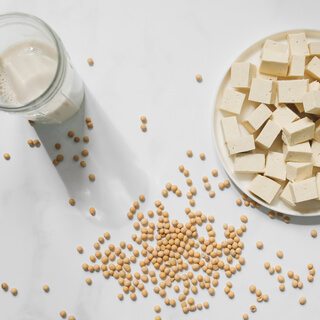
100 grams of firm tofu contains 17.
3 grams and one large egg contains about 6.
3 grams.
Most Australians consume more protein than they actually need so deficiency is rarely a problem in this country.
The main protein intakes are 79 grams per day for women and 107 grams per day for men.
Having said that protein deficiency can have a profound impact on health.
When one essential amino acid is inadequate protein synthesis is impaired across the board and that's the reason why it's really important for vegans to eat a large variety of plant-based proteins to make sure they consume all the essential amino acids.
Protein energy malnutrition PEM is predominantly a problem in undernourished children.
According to the FAO that's the Food and Agriculture Organization of the United Nations PEM causes the death of 6 million children every year.
There are two main types of PEM,
Marasmus the chronic form and quasio called the acute form resulting from an abrupt alteration in food supply so for example a famine.
In both cases the immune system which relies on protein is compromised.
On the flip side excess protein can also impact your health.
It can have consequences like disordered bone and calcium homeostasis.
It is hard to say exactly how much would constitute excess protein.
It may be in excess of 2 grams per kilogram per day however this wouldn't apply for athletes or pregnant women so there's no hard and fast rule here.
To wrap up protein is a really important macronutrient.
The best and healthiest way to eat protein is to spread it out over the day and this has been shown to help with metabolism and to help with appetite control.
It's also important to include a variety of protein sources within a well-balanced and varied diet that way you can ensure you're consuming all the essential amino acids that your body needs.
So that's my general overview of protein.
Thank you for tuning in,
Eat well,
Move well,
Think well.