Hello and welcome to Amanda's Wellbeing Podcast.
This is my 5-minute food facts series.
I'm Amanda Hayes,
Your host,
A nutritionist with a passion for wellbeing.
I decided to do this series because there is so much conflicting information available about food and various diets.
Some of it is credible and some of it is not.
It can be time-consuming,
Not to mention confusing,
To try and sift through the noise and get to the heart of the matter.
In this series,
I will do all of that for you and present factual,
Reliable information in a concise and easy to understand way.
The content of my 5-minute food facts series is for information purposes only and it is not intended to replace the advice of your health professionals.
Today I am going to discuss dietary fibre.
Most of us know that dietary fibre is good for us,
Especially for our digestion.
What we may not have a grasp on is how much do we really need,
What does that amount look like as food,
What are the different types of dietary fibre and what does dietary fibre do in the body that makes it so good for us.
Simply put,
Dietary fibre is the edible,
Structural part of plants.
Dietary fibre is resistant to digestion and absorption in the human's small intestine and is usually completely or partially fermented in the large intestine.
Like complex carbohydrates,
Dietary fibre is made of chains of glucose molecules.
But the way the molecules are linked together,
In other words their chemical structure,
Prevents human digestion enzymes from breaking them down and therefore dietary fibre contributes little energy to the diet.
Dietary fibre is generally categorised according to its solubility.
Soluble fibre dissolves in water and forms viscous gels that are fermented by bacteria in the colon.
An example is pectin,
A component of the cell wall of plants and as many of you know,
Pectin is what causes jam to set,
So soluble dietary fibre is found in oats,
Barley,
Legumes,
Fruits and vegetables.
Soluble fibre does not dissolve in water and therefore does not form gels.
It is less readily fermented in the bowel.
An example is cellulose,
Which is the main structural component of plant cell walls.
It's found in whole grains,
Nuts,
Seeds and the skins of fruits and vegetables.
Another category of dietary fibre is known as resistant starch.
It's a type of insoluble dietary fibre.
It's not digested in the small intestine.
It makes its way to the large intestine where it is fermented and acts as a prebiotic,
That is a substrate or food for the good bacteria in your gut.
It's found in cooked and cooled potatoes and rice,
White beans,
Lentils and under ripe bananas,
Although I'm not sure how many of us eat those.
A diet rich in dietary fibre generally has lower energy density than one low in dietary fibre,
A lower fat content and is rich in micronutrients.
I'll just note that it's important to drink adequate water with a high fibre diet to avoid getting blocked up.
Health Benefits of Dietary Fibre Soluble dietary fibre slows the emptying process in our stomach,
Which makes us feel fuller for longer and can help regulate the amount we eat.
It lowers blood cholesterol by binding with bile acids and increasing their excretion.
This means the liver uses its own cholesterol to make new bile acids,
Lowering the overall amount of cholesterol in the body.
Fermentation of dietary fibre in the colon produces short chain fatty acids,
Acetate,
Propionate and butyrate.
These inhibit inflammation and are believed to activate cancer killing enzymes.
Insoluble dietary fibre absorbs water and keeps the content of our bowels soft to support regular bowel movements.
It also stimulates muscles in the gastrointestinal tract so they retain their tone and this reduces the risk of diverticulosis.
Increased dietary fibre intake has been linked to lower rates of obesity,
Probably due to the satiating effect of high fibre foods and that food naturally high in dietary fibre is generally lower in fat.
It's worth noting that it is dietary fibre in foods,
Not in supplement form,
That makes the magic happen,
Likely due to the synergy with other healthy nutrients in fibre rich foods.
It's also linked to lower rates of cardiovascular disease,
Likely through the effects of some dietary fibres.
It's also linked to lower rates of cardiovascular disease,
Likely through the effects some dietary fibres have on reducing plasma cholesterol.
Many but not all studies have found diets high in dietary fibre have been associated with lower risk of breast and colon cancer but the World Health Organisation says the data in relation to cancer is insufficient,
Which means more studies need to be done.
High dietary fibre diets play a role in decreasing the risk of type 2 diabetes.
Soluble dietary fibre delays the transit time through the GI tract,
Slowing glucose absorption which helps to stabilise blood sugar.
And there is more!
Diets rich in fermentable dietary fibre and low in animal fat and protein are associated with increased bacterial diversity in the gut which is understood to be beneficial to health.
The gut microbiome is a fascinating area of ongoing research,
Uncovering mounting evidence on how healthy gut flora can positively influence human health in a variety of ways.
I'll do a 5 minute food fact podcast on the gut microbiome to explain this.
I've already mentioned some,
But which foods are sources of dietary fibre?
It's found in plant based foods like fruits,
Vegetables,
Legumes,
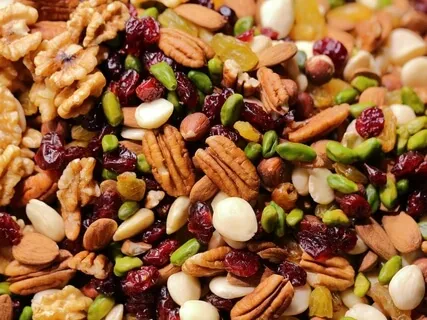
Whole grains and nuts.
And just for the sake of clarity,
There is no dietary fibre in meat or dairy products unless it's been added during processing.
The National Health and Medical Research Council in Australia recommends 30 grams per day for men and 25 grams per day for women.
The amount does vary with age so I'll put a link to that information in the show notes.
So what does that look like?
How much plant food do we need to eat to obtain 25 grams of dietary fibre?
For example,
Half a cup of rolled oats has 4.
5 grams.
You could have this for breakfast with fruit,
Like an apple which has 2.
2 grams.
For lunch you could have a salad including a cup of vegetables that's 3.
8 grams and a small handful of nuts,
Of almonds perhaps 2.
6 grams.
For dinner you could have a cup of wholemeal pasta or of lentils which each have about 8 grams and a cup of broccoli or similar vegetable,
Again 3.
8 grams.
So that makes up about 25 grams.
Obviously other foods would be included like some sources of protein but I'm just illustrating the dietary fibre amounts.
I will note that given the popularity of low carbohydrate diets,
It is possible to achieve the recommended dietary fibre intake on a lower carbohydrate diet too.
You simply need to choose foods that are high in dietary fibre but low in carbohydrate.
An example of these are ground flax or chia seeds,
Berries,
Avocados,
Cauliflower or broccoli.
So how much dietary fibre do Australians actually eat?
According to the most recent National Nutrition and Physical Activity Survey in Australia,
The median dietary fibre intake for adults was 20.
7 grams per day,
About 5 to 10 grams below the recommended amounts.
Dietary fibre has been flagged as a nutrient of concern in Australian diets.
Not eating enough dietary fibre is a much more common problem than eating too much.
However you can eat too much,
For example if you were to eat 70 grams or more per day,
That could cause some uncomfortable side effects like bloating,
Gas,
Constipation and the possible poor absorption of some key nutrients because fibre can bind to some minerals like calcium,
Magnesium,
Zinc and iron and can therefore interfere with the body's ability to absorb them.
And just to wrap up,
For some people there are medical reasons why they need to consume a low fibre diet,
For example the risk of bowel blockage.
And people on low FODMAPs diets need to be selective about the dietary fibre containing foods they eat,
Particularly in relation to fermentable dietary fibre.
In this time while we have no cure or vaccine for COVID-19,
You can make sure your diet is one that promotes a healthy immune system.
As I've discussed dietary fibre is good for your digestive system and your gut microbiome.
This is important because a healthy immune system depends on a healthy digestive system.
Plant foods are full of dietary fibre so make sure to include them in your diet.
They're also bursting with vitamins and minerals and antioxidants.
I'll put links in the show notes to my 5 minute food fact episodes on those topics.
If you have any questions please email me at contact at wellbeingpodcast.
Com.
I'd also like to say from Amanda's Wellbeing Podcast that I hope you're all keeping safe and well during the coronavirus times.
And thank you so much to all our wonderful health workers,
Supermarket workers,
Truck drivers,
Volunteers and so many more for keeping us safe and well fed.
You can subscribe to my podcast Amanda's Wellbeing Podcast on YouTube,
Hit the subscribe button and while you're there click on the bell to be alerted when new episodes are available.
You can also subscribe on your favourite podcast app iTunes,
Stitcher,
Spreaker,
Spotify or Google Podcasts and you can follow the podcast on Twitter,
Instagram and Facebook.
Direct links to all social media can be found on the subscribe page of my website at www.
Amandaswellbeingpodcast.
Com.
Producing the podcast is a labour of love.
We put in a lot of time,
Money and effort behind the scenes.
So if you enjoy Amanda's Wellbeing Podcast and would like to make a contribution you can do so via Patreon,
Paypal or by Amazon.
You can simply visit the contribute page on my website.
Please take a minute to leave a rating on iTunes.
It improves visibility and will inspire me to keep researching for this five minute food facts series.
Finally in Amanda's Wellbeing Podcast news I've decided to reclaim my Sunday evenings so I'm trying out changing the publication day of my podcast from Monday to Tuesday.
So let's see how that goes.
Thank you very much for tuning in.
Eat well,
Move well,
Think well.