If it is driven by selfishness and intense competition for personal success or for their own country,
It ends up creating mutual suspicion.
Each side feels the need to protect themselves,
Leading to the acquisition of powerful and destructive weapons.
They believe that having superior weaponry will help them safeguard themselves or their country,
And that others will not dare to invade.
Been the case since before the time of the Buddha and it was the same during the time of the Buddha.
Those who possessed weapons and strong military forces could easily dominate others.
If it were only for defense then that would be one thing,
But those with great power often end up oppressing others because others can't resist them.
When morality and virtue are lacking,
Things become endlessly chaotic.
This is because people are not living according to the teachings of the Dhamma,
Which promotes peace and unity.
Instead,
They follow a path that leads to ruin and destruction.
Therefore,
When humans are deluded,
They inevitably cause harm,
Whether by thought,
Speech or action.
It begins in the mind,
Then manifests in physical actions and speech.
As this increases,
People develop anger and resentment towards one another.
It becomes a cycle of,
You hurt me,
So I have to fight back.
There's revenge and retaliation.
When there is anger,
There is hostility and the desire for vengeance.
But this is not the path to peace.
Now that we live in this world,
There may not be much that we can do.
So we cultivate loving-kindness meditation.
And if we are in a position of power,
If we have the ability,
Then we should try to seek compromise first.
Because engaging in conflict or war brings no real benefit to either side.
So the policy must change,
Mustn't it?
You see,
There are some countries that have been bitter enemies for a long time.
Even though they speak the same language and can understand one another.
Another.
But due to karmic consequences,
They've been divided into North and South,
Each supported by a major power.
This leads to mutual suspicion and a lack of metta,
Goodwill for each other.
That's why metta,
Goodwill,
Loving-kindness,
Is the virtue that sustains the world.
It's a form of positive energy.
And the people in one country generate positive energy towards a neighboring country,
It draws them closer through goodness.
This can lead to mutual economic benefits and cooperation.
Even the borders that divide nations or countries that share a language can become areas of economic collaboration for mutual benefit.
You see,
We must turn tense situations into opportunities for trade and cooperation,
Into unity.
This is the way of Dhamma.
If we listen to those who provoke us to continually be angry and to hate,
Then we fall into their trap.
Those who stir up such conflict don't have good intentions.
They mean harm.
Time and it continued in the Buddha's era.
King Ajatashatru wanted to conquer the Licchavi kingdom so he sent the Brahmin Vasakara to infiltrate them by becoming a teacher.
But he couldn't just send him plainly.
He had Vasakara beaten and tortured first so that the other side would let their guard down.
Vasakara then fled in apparent desperation and became a teacher to the Lichabees.
They believed him,
And little by little he sowed discord and stirred them up.
In the end,
The Licchavi kings became divided.
They lost their unity and virtue,
And King Ajatasattu was able to march in and conquer them with ease.
When neighboring countries lose their unity,
Anyone can come in and divide them up just like that.
So unity must be preserved by having the Dhamma,
Having the qualities of loving-kindness,
Compassion,
Sympathetic joy and equanimity.
This is why the cultivation of metta,
Goodwill,
Through meditation is so important.
When our mind is calm,
Through concentration,
We are said to have metta within us.
Why?
Because when we speak or think wrongly,
With malice or ill will,
It pulls us away from peace and we go towards the lower realms and to complete ruin.
That's why the four Ramaviharas,
The sublime abidings,
Are so important.
Love and goodwill towards all living beings,
Even those who aren't our friends.
Karuna,
Compassion,
The wish to help others be free from suffering.
And metta,
Goodwill,
Is expressed through actions,
Speech and thoughts.
You see,
It expects nothing in return.
It's done from a pure heart.
We share what we have,
We trade fairly without exploiting each other,
And we remain united.
Sometimes when problems arise,
It's better not to say anything,
Better not to argue or quarrel,
And stir things up.
Hold back the issue for now,
Because it could turn harmful.
When people share the same Sila,
Morality,
It allows us to live together in peace and harmony.
The same applies to nations.
Each country can live peacefully without fear or suspicion of being invaded,
Or of invading others.
But once fear sets in,
Conflict and chaos follow,
Just like what we see in the world today.
You see,
It's all so chaotic.
The truth is,
The Dhamma,
What the Buddha taught,
Is already complete.
The principles of unity and how to practice it are all there.
But humans simply don't apply it.
The teachings are in the scriptures,
In the Tripitaka.
If people put them into practice,
They would bring immense benefit.
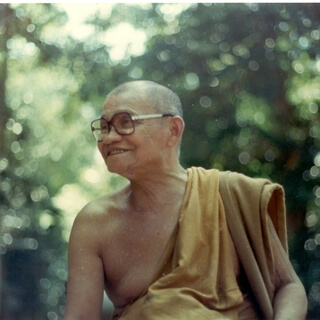
Venerable Ajahn Chah also spoke about this.
I used to stay and attend on Ajahn Chah,
And he said that when great teachers pass away,
Their disciples often become divided due to differing opinions and a lack of unity.
He said,
I've already thought about what to do about it.
What he thought and instilled in us was the importance of respect and reverence.
He emphasized how essential it is for juniors to show respect to their seniors.
Even if we feel that the elders may not always act correctly,
Respect leads us to be patient and not argue.
Because once opinions begin to diverge,
It's easy for people to become unwilling to yield,
Especially when they're younger or ordained after them.
We give that elder respect because he had studied under Venerable Ajahn Chah before us.
We respect him because he was ordained before us.
Even in ancient times,
The Buddha taught about unity and respect.
This teaching appears in the Thitta Thira Jataka.
At that time,
The Buddha was staying in Savatthi.
The story is that Anattapindika,
The wealthy benefactor,
Had just completed the construction of a monastery and sent messengers to invite the Buddha.
The Buddha travelled there with his Sangha.
When they reached Rajagaha and accepted the monastery offering,
Six monks,
Who were disciples of the group known as the group of six,
They went ahead and arrived in Savatthi before anyone else.
What did they do?
They claimed all the lodging spaces for their own teachers and mentors.
When Venerable Sariputta,
The Buddha's chief right-hand disciple,
Arrived later,
Place left for him to stay.
So what happened?
The Buddha had to call a meeting.
He asked,
How should monks in this dispensation practice?
The Buddha taught that monks must show respect,
Offering seats,
Through anjali,
Greeting with joined palms,
And performing duties for the senior monks.
The best seats,
The best drinks,
The best food.
Should be offered to those by seniority.
Then the Buddha told a story.
Once,
Long ago,
There were three animal friends.
A quail,
A monkey and an elephant.
Living together under a large banyan tree in the Himapan forest.
It must have been an enormous tree.
Perhaps like the giant trees we see in the Amazon forest today.
No one would have disturbed a tree in the Himapan forest.
Holding hands to encircle it.
A tree of such size would surely have stood for thousands of years.
The three animals respected one another,
But over time they began to lose that respect,
Reverence and a sense of equality.
So what did they do?
They began to think,
Who was born first?
One day,
While they were under the banyan tree,
They asked each other,
When did you first know this tree?
The elephant said,
Back when I was a baby elephant,
This banyan tree was just a small bush that was up to my thighs.
I've known it since it was tiny.
The monkey then said,
When I was a baby monkey,
I sat on the ground and chewed on the shoots of this young banyan tree.
I saw it when it was even smaller than what the elephant described,
So I must have seen it first.
Then the quail spoke up.
Towards the quail.
Even animals you see can possess wisdom.
This story shows they were no ordinary creatures.
This Sutta teaches us that respect,
Humility and reverence towards our elders are virtues to be praised.
With these qualities,
It leads to a pleasant rebirth after death.
That's why the Buddha taught the importance of metta,
Loving-kindness in action,
Speech and thought,
And the sharing of the four requisites.
In the past,
Venerable Ajahn Chah set monastic rules in order to maintain harmony.
One principle was about shared gains.
People often become divided over material gain.
So when the monks were invited to house invitations and received donations and offerings,
Everything was collected and pooled together in a shared space.
No one claimed anything as their personal right.
That way,
Everyone shared equally in what was received.
When someone became sick or needed support,
They could ask to take from the communal resources without dispute.
So then the house invitations that were in the city or the house invitations in the local villages,
They didn't cause any aversion in the monks.
The monks simply performed their duties,
Chanting,
Meditation and dhamma practice.
And this led to harmony to arise.
This is what Ajahn Chah meant when he said he had already thought of and had laid the foundation to prevent division.
And there was even a time when communism was gaining strong momentum and they were about to invade the Ubon province.
The movement had reached the border.
Some of them even came to Wat Nong Pa Pong to see what the monastery was like.
They learned that the rules there required any personal gain or offerings received to be pulled together and weren't divided up.
The communists said,
This monastery is good.
There's no need to destroy it.
It was something like a commune.
Everything was shared,
Regardless of how many people there were.
Whatever the abbot received was distributed among everyone.
As a result,
The community lived in peace,
Without quarrels over money or the four basic requisites.
In other words,
They didn't take possession over them.
Venerable Ajahn Chah used to say They say,
If you die with money in your monk's bag,
Then you should be ashamed to the laity,
Because that money came from laypeople who offered it.
And so harmony naturally arose.
May all of you practice sincerely to cultivate Dhamma in your hearts.
Then you will find peace and happiness within,
And you grow in blessings.