So now,
May you bring about samadhi in your mind,
Which means bringing the mind to a firm state,
Bringing it into peace.
Because the nature of our hearts is that they're always concocting,
They're always proliferating,
And so they're never peaceful.
And when that's the case,
We don't have sufficient samadhi to be able to understand or see or to know the Dhamma.
And the nature of things,
Of all physical things or mental things,
Is that they arise,
They stay for a bit,
And then they cease.
But our minds just don't have wisdom to see that,
Because they don't have peace.
And so therefore we need to train our minds to become still,
To become peaceful,
Through bringing them to a meditation object and allowing the mind to settle with that.
So knowing the in-breath or the out-breath,
For example,
And we can bring up a meditation word like buddho along with that as well,
But we also shouldn't be too intent to the point where we get stressed,
That that's also not correct,
That we need to make things balanced to get it just right.
And so the great teachers,
They tell us to practice with letting go,
That we're not excessively intent,
Not striving too much,
Because if we are,
Then that's happening through tanha,
Through craving.
And when we do this through craving,
Then it creates chaos.
You can see in the world that when we do things through this desire,
Through craving,
Then chaos ensues.
But when we practice the Dhamma,
We need to practice with wisdom.
We don't practice in a way that brings up suffering,
Because whatever it is that we do with craving,
Then we will suffer as a result of that,
That we don't experience peace.
And then the agitation,
The chaos that we experience grows and grows.
And then when that happens,
Occasionally we'll just lose faith in what it is that we're doing.
So we need to do an act with the sense of letting go,
To have a lot of mindfulness,
And then the mind can settle into samadhi,
And then we'll be able to see the Dhamma.
In truth,
The practice,
It's not something convoluted,
There isn't all different kinds of things to it,
That really what we have to see is what happens when the mind meets with a sense object.
If it meets with something that it likes,
Then the mind goes into disliking towards it.
If it meets with something that it dislikes,
Then it becomes displeased with that.
So it can go in these two different ways.
Just like in the world,
How we meet with the worldly Dhammas,
These worldly Dhammas of gain and loss,
Of praise and blame,
Of status and disrepute,
Of pleasure and pain.
And it's natural for our minds to just go and chase after these worldly Dhammas.
But when we practice,
What we're trying to do is to know these worldly Dhammas for what they are,
That they're just natural things,
It's natural for the world to be like this.
But normally what happens is when we meet with something we like,
Then we just fall into liking towards it.
If we meet with something we dislike,
Then we just fall into disliking.
And so we need to have a lot of mindfulness right there at that point.
So we should contemplate that whatever the case,
Whatever happens,
Our lives and our bodies are not sure things,
And they're deteriorating with each in-breath and out-breath.
So once the Buddha asked Venerable Ananda how he contemplates death,
And at that time Ananda was a high-level Sotapanna,
And he had the barami of the highest level of Arahant.
And he answered the Buddha that,
I contemplate death seven times a day.
And so we may think that seven times,
It's a lot of times.
But the Buddha replied that it's too little.
The Tathagata contemplates death with each in-breath and each out-breath,
Which means that he's not heedless.
And so we recollect death in order to become careful,
Heedful,
So that we create a lot of goodness.
It's like the generosity that we do,
The things that we give.
Then what we gain from that is truly ours.
And when we are generous,
Then we give something on an external level.
But really what we're gaining is within our own hearts.
And we collect that.
We create that goodness in our hearts,
And we collect it in our hearts,
All of that merit.
Like ordaining,
This too is collecting merit,
The merit of sila dhamma,
Of virtue.
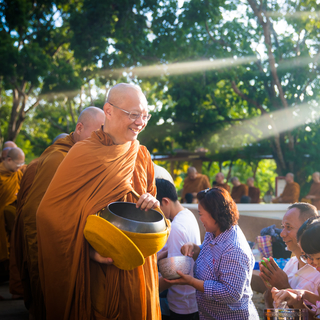
It also gives us the time to be able to practice with the faithful laity supporting us with the four requisites.
So the duty of a monk is to do the morning chanting,
The evening chanting,
To be keeping the standards of practice and the schedule that has been set out.
And so to go in arms around and to keep that as a practice.
And to do these ascetic practices,
So like eating just from the one vessel,
Just from the bowl,
Eating in just one sitting.
And these are things which we need to train ourselves in.
And perhaps as we've carried on,
Then we start getting slacker and slacker about these things,
So we need to bring them up again and train ourselves.
And so like eating,
It's just one time.
We don't eat many times.
But it's possible that we let this practice go,
We let this aspect of the standards go,
And we start becoming slacker and slacker in it.
So we need to train,
We need to keep this well.
And if many monks are doing it,
Then it's easy for the rest to be able to do it.
And so the aspects of the core ones,
The standards of practice,
The schedule are like this.
We don't just follow our own moods.
But we keep up these ascetic practices,
And that's a bhārami that we're creating.
So like if we just eat the alms food,
Then we're creating bhārami.
If we just eat one time a day,
Then we're creating a bhārami.
And this is something which can be quite difficult to do.
If we have become slacker in this,
Then we should come back and contemplate again,
And try to keep up this practice again.
And so we do this,
To eat little and not a lot.
And that's in a good suitable state for us to go on and meditate.
Like when we ordain,
Our preceptor gives us the objects,
The meditation objects,
Of kesa,
Loma,
Naka,
Tantra,
Tattva.
So hair of the head,
Hair of the body,
Nails,
Teeth and skin.
And when we hear that,
We may think,
Well this isn't something that's difficult to do at all.
But that's because we haven't actually seen what they are,
For what they are.
And so we need to then try to contemplate them.
And Ajahn Chah spoke about this in a very deep way.
He said that if we just clearly know one strand of hair,
Then we will know all hair.
If we just know one glass,
Then we will know about a hundred glasses,
Ten thousand glasses,
Every single glass in the world,
That we will know it for what it is.
And so this body is the same.
If we just know about the hair of the head,
Hair of the body,
The nails,
The teeth,
The skin,
How these are not beautiful things,
Then we will see that all bodies in the world are exactly the same.
So we come to contemplate,
What is it like?
So this hair of the head,
What's that like?
Is it something that's beautiful?
Where does it come from?
That it's fed by blood.
And we can see how it's changing.
Its color changes over time,
Changes into something which isn't attractive.
How it's something that we always need to be washing.
If we don't,
Then the bad smell will come up.
Or if there's a glass of clean water and we put a handful of hair in it,
Then it becomes dirty.
The water becomes oily and we don't want to drink it.
We put that hair into expensive food and it loses all its value.
So we should contemplate.
And contemplating like this is Gaya Gita Sati.
So this mindfulness over the body,
Contemplating the body.
So like the hair of the head,
The hair of the body,
The nails,
The teeth,
The skin,
All 32 parts.
And these outside parts are things that we are able to see with our eyes.
It's like the teeth,
For example.
What are they like?
Where are they?
And they're constantly drenched in saliva.
And really they're just bones.
But it's the defilements that teach us that these are beautiful things.
That my teeth are attractive,
Other people's teeth are attractive.
But if we contemplate them frequently,
Then we'll see that really they're not attractive.
That if we don't clean them,
Then quickly they become covered with bacteria.
They start to decay.
So we should contemplate like this.
If we don't brush our teeth,
If we don't bathe,
Then this body becomes dirty.
And dirty things exude from our bodies.
Exude from the skin throughout through the pores.
And therefore if we have a clean robe or clean clothes,
And say a sabong,
A lower robe,
We wash that.
And after just one day of being in contact with this body,
Due to the fat that's exuded through the pores,
Then it becomes dirty.
And so we contemplate like this,
How the body's always pushing dirty things out of it.
The body's always being pushed towards uncleanliness.
And that's why we need to wash it very frequently.
And so the skin,
It's not beautiful.
It's not beautiful in the way that we think that it is.
And the same thing for the hairs throughout the body,
For the nails as well.
So we contemplate this back and forth,
Back and forth,
Do it frequently until our minds settle into peace.
Because it's normal for our minds that if we just try to bring it to just one thing,
Perhaps they won't become peaceful.
It can be difficult for us to see that object.
And so we can contemplate through the different parts of the body and try to see them for what they are.
And also see how the other sensory experiences that we come into contact with,
And so there's the forms that we see,
But there's also the sounds that we hear,
And the tastes and the odors,
The tactile sensations.
And where do all of these come from?
So sounds that we may like,
They come from forms.
And these forms,
Are they something beautiful?
Are they something which last a constant?
Well,
They're not.
So we contemplate in this way in order to bring the mind into peace.
We can contemplate about odors like this as well,
About tastes,
Tactile sensations like this as well.
And this is all contemplating within this body.
And this is the path to peace.
This is the ambrosia of the deathless that we drink.
And people who contemplate the body,
They're drinking this deathless ambrosia,
Which is talking about the heart,
That the heart doesn't die.
That it can,
Through this practice,
Rise above the world.
And so these are the methods of bringing our minds to peace.
And so how do we do them then?
Well,
If we don't yet see clearly,
Then we can bring up sannyā,
A perception or a memory into our minds and use that to contemplate.
So bring up this memory,
Say an image of the hair,
Hair of the head,
Hair of the body,
The nails,
Teeth,
The skin,
All the 32 parts of the body.
And then we can ask ourselves,
What are they like?
So we can use our memory here then in order to contemplate,
In order to see clearly.
And if we can see clearly just one part,
Then we should go over that part again and again,
Contemplate that again and again.
And if this doesn't work,
If we're not able to see any of the parts in line with their truth,
Then we can come to contemplate death.
And then bring the body to death.
What's it like then?
Because sometimes if we just go through the hair of the head,
The hair of the body,
The nails,
The teeth,
The skin,
The defilements,
They don't reduce.
They don't flinch from that.
So then we bring it to death.
What happens?
The body turns a green tinge.
It starts becoming bloated.
And we see that this body,
When it doesn't have the fire element present,
It becomes stiff.
It becomes cool as well.
It starts to go hard.
And then it bloats,
Expands.
The bacteria start to work away at it.
And maggots start becoming born inside it and eating away until it's full of maggots.
And the body becomes full of these worms and maggots and various animals,
Both big and small,
Come to eat it as their food.
And in the end,
The bones just scatter about.
And even those scattered bones deteriorate and decay.
They change and change until they just turn back into the earth element.
So we see that when the fire element is gone,
The water element goes,
The air element goes,
And then the earth element decays and decays.
And so this all happens by itself.
And so we should contemplate and do this again and again,
Again and again,
Back and forth,
Back and forth.
And do it until the mind becomes calm and comfortable,
At ease.
Until there's this feeling of lightness within the body and the mind.
Until the mind isn't proliferating about any other kind of thing.
So maybe we have to go through it a few times for that to happen,
Maybe two times,
Three times,
For the mind to become still.
And then it doesn't want to think about anything.
In the beginning we have to do it like this,
Perhaps just using the breath,
The mind doesn't become very peaceful.
And so we bring up our memories and perceptions then,
Until it becomes better.
And contemplate death like this can help to reduce the greed,
Hatred,
And delusion that we feel.
And when the mind becomes peaceful,
Then we begin to see,
We begin to understand.
And so,
Like seeing,
Or when we have this peaceful mind,
Maybe we see just one glass,
And we understand how this is just a convention that doesn't have any true reality to it.
And the same goes for any size that we may suppose upon it,
Or any color,
Or any name that we may give it.
And the heart becomes bright,
And it sees truth,
It sees reality.
And there's this rapture which appears within the heart through the practice that we do.
And so we should try to carry on doing this.
And as we carry on proceeding,
Then we gain this belief that Nibbāna really does exist.
So in the practice we bring our minds to peace.
We do our walking meditation,
Our sitting meditation,
Reciting Buddha,
Going through the 32 parts of the body,
Doing all of these practices,
And also cultivating and spreading outwards the hearts of metta,
Loving-kindness,
And all of the brahma,
Viharas,
The divine abidings.
And also controlling our body and speech so that they are within the bounds of virtue.
And this is able to control the coarse defilements that we have.
As we carry on doing this,
Frequently then we become more and more skilled.
And when the peaceful heart arises already,
And settles into stillness,
Then the mind comes into a state of upajara samādhi,
Of neighborhood collectedness.
And it's really incredible when this happens.
This may even happen when we're doing walking meditation as well.
And at this point we don't need to force ourselves that we can do our sitting meditation,
Our walking meditation.
We don't feel fed up with it.
So the awakened teachers,
What they have instructed is that when the mind settles into peace,
Then come to contemplate the body.
And this is something that they emphasize.
It's something that's really important.
And as we do this,
If we don't stop,
Then we will see the Dhamma.
And we see the Dhamma within our heart.
And it's like the heart crosses over to another shore.
It's like it goes to another world,
Becomes empty.
And we don't have any doubts anymore.
Perhaps we read in the scriptures that if we contemplate death,
All we're able to get from that is upajara samādhi,
Is neighborhood samādhi,
And recollecting the Buddha,
All the different methods or meditation objects of recollection,
That all they're able to do is bring us to upajara samādhi.
But the thing is,
When we reach that level of upajara samādhi,
Then the mind will carry on to the next stages by itself.
It will be able to carry on correctly,
To proceed.
So this isn't something that we should doubt about.
It's just that when we read the scriptures,
Then this is what it can be like.
But all we need to do,
Really,
Is to practice.
To practice not allowing our minds to go into liking and disliking.
And to just carry on doing that.
That we have this wealth of sila,
Of virtue,
That we're keeping our precepts well.
And then we set our hearts on meditating.
And when we do that,
Then eventually we'll come to know with clarity what the mind that isn't given to liking and disliking is like.
Initially it can be a bit difficult to do this,
But as we carry on,
Then it gets better,
It gets easier.
And we'll meet with this heart which is peaceful,
Which is at ease.
And we'll be able to do this more easily.
So just carry on with it,
Keep on developing it.
Put in your efforts consistently.
When there's wisdom present in the mind,
Then it won't be caught by either liking or disliking.
And just this is what you need to know to be able to practice.
Just this is the path of training,
Of practice.
But if we read the scriptures,
Then there's all different kinds of things.
There's this thing and there's that thing.
And this can bring our minds to confusion and doubt and chaos.
But the great teachers,
What they have said is that we cultivate samadhi within our minds.
That we have virtue,
We have samadhi,
And we cultivate wisdom.
And so this is our duty to do this.
And also to fulfill the various activities within the monastery.
And so there's another sangha duty that's coming up.
There's a ceremony in Australia,
Bodhisattva Monastery.
And those monks who go there are giving,
That they're being selfless in their giving with the work that they do there.
And there are also the other monks who will be staying here at this monastery and fulfilling the duties of the sangha here at this monastery.
And so they depend upon each other,
That the monks who go off,
They depend upon the monks who stay here to fulfill the duties here.
And so both the monks who go,
They're fulfilling the duties and they're ones who have a good level of keeping the standards.
But no matter the case,
Whether we stay or we go,
We should have mindfulness with what we are doing.
And also to be fulfilling duties of meditating,
Of cultivating our minds,
Of bringing about samadhi.
And this samadhi is something that's really important for us to be doing,
Something that we need to train our minds to do.
That we shouldn't be careless,
Thinking that I'm not yet old.
We shouldn't think like this,
Because it's not sure.
When is illness going to arise?
We just don't know.
But for now,
We are strong.
So we should use that strength of body to do our walking meditation and sitting meditation.
To be fulfilling all the various aspects of the schedule and the standards.
And to not just let that go.
And there are disciples,
Lay men,
Lay women,
Who are 60 years old,
70 years old.
They have someone who is good leading them.
And they can go for the whole night without sleeping.
And be practicing for the whole night.
So as monks,
We shouldn't be heedless in this either.
That we eat little,
We sleep little,
We awaken ourselves through our efforts.
And so the mind that isn't drawn into liking or disliking,
Is a mind which will reach nirvana.
So may all of you train yourselves in this.