When the practice declines For those who have taken up the monastic life,
The Kṛbha-Ajāns in the tradition of lungpūman have always stressed developing samādhi.
When we have no involvement in work projects,
Then there is opportunity in the forest and mountains to develop the heart to deeper levels.
But if we do have a lot of responsibilities and duties,
Then we really have to watch over the heart with wisdom.
Sometimes we have to rely on contemplation first to bring the heart to calm.
But sometimes just by relying on our parikāma,
Or on the breath,
It becomes calm and quiet.
Whatever the case is,
These two methods can be used accordingly or alternated at different times.
When the heart has experienced calm and withdrawn from it,
We need to get in and investigate this mass of physical form that is the body.
We keep at this until there is no calm in our understanding.
This is called vipassana.
We use the calm to focus our attention firmly within the body for the arising of pañña.
One kind of pañña comes from listening and hearing,
Another from reflecting and pondering.
But the pañña that arises from calm is the pañña of bhāvanā.
This is vipassana that will give rise to clarity on our heart.
We may sometimes experience enormous amounts of clarity for a month,
Maybe even for many months.
If we think that this is vipassana,
We lose ourselves to vipassana-nupākilesa.
We aren't interested in taking up the investigation into the body and our own moods and emotions.
We may think we don't need to investigate the elements of earth,
Air,
Water,
And fire anymore.
We feel there is no need,
That just watching the mind is sufficient.
Because when we start to investigate the body,
It just switches and wants to drop into calm.
This makes us think we only need to investigate the mind,
And that it's not necessary at all to investigate the body.
Yet,
Lungpūcā would always teach to get in and investigate the body.
But to just keep investigating the mind won't last very long and our energy will be depleted.
All the calm and peace we experience will disappear,
The same as someone who has never done any meditation at all.
All the proliferation will take over again in a flooding wave,
Liking and disliking take over again.
This is common.
We might think that our meditation has fallen apart,
But if we rise up with a resolution to put forth effort in every posture,
Standing,
Walking,
Sitting and lying down,
To focus our sati continuously and firmly as we had done before,
Putting down our various burdens and duties,
This should make the calm of our mind come again anew.
And this calm will be deeper than before,
And our paññā before.
This is the natural way of progress.
This is the natural progress of developing samādhi.
Initially it isn't that firm,
It's not so full,
So we must go back and reapply ourselves to the practice until the mind is totally solid,
Without room to fall back and without flaw.
Our formal practice will evolve to a new stage of maturity.
Therefore,
Let us all have patient endurance and persistence in our practice.
Let us always work towards developing the five spiritual powers to perfection,
These five powers of sada,
Faith,
Wirya,
Energy,
Sati,
Samādhi and paññā,
Until they are sources of power for the mind.
The parami from this is of the highest kind and will lead us to understand the dhamma.
Putting forth effort in samādhi is something of the utmost importance.
We have to try to steadily apply our mind so as to experience deep calm and peace,
To surpass all the moods and emotions,
All the vedana.
If we can cross over and rise above the barrier of vedana,
Sometimes we will be able to see it as a totally separate phenomena from the mind.
Whenever vedana arises within our body,
We focus in and investigate it,
So that the mind pulls away and disassociates from it.
This struggle with vedana is really an exercise of development in line with the satipatthana-sutta.
Therefore,
Every single one of us that has come here,
With the firm resolve to practice,
Needs to put forth effort and have patient endurance.
If we can keep this practice constant,
This will make our minds advance and progress,
Giving us encouragement to keep practicing further.
The Buddha always taught that every aspect of rūpa,
Vedana,
Sannyā,
Sankhāra,
And vinyāna has the characteristic of arising,
Remaining,
And then passing away.
Its nature is to stay for a while and then cease.
All rūpa and nāma,
Our only conditions that arise,
Remain,
And then pass away.
Yet because our sati can't keep up and recognize this,
We go grasping at the rūpa,
Believing it to be ours.
We grasp at the vedana as ours,
All the feelings that arise.
We grasp at sannyā,
All our memories and perceptions that seem to be our own.
We grasp and take as self the sankharas,
The various thought formations.
We grasp as ours the vinyāna,
The various sense impressions.
These all occur so quickly that our sati can't keep up and understand that none of these are actually ours.
In reality,
They all have the characteristic to simply arise and pass away.
All the pleasant feelings that we have previously experienced,
Where are they now?
If they were ours,
Where are they now?
Those pleasant feelings arose,
Persisted,
And then passed away.
All the painful feelings that we have ever experienced likewise only arose,
Persisted,
And then passed away.
All the feelings have passed.
All the sukha and dukkha eidana that we experience in the present only ever arises and passes away in the present.
But at this point,
Maybe sannyā will arise and we remember and identify with it.
This person said this and it pleased us.
This person just complained.
This other person speaks and acts like this.
It's all just sannyā.
Whenever someone speaks,
Sannyā will latch on and remember it.
But this sannyā of speech isn't anyone's self.
In truth,
It's anicca,
Dukkha,
Anatta.
But if our sati doesn't know this,
We will just go grasping and taking on all this sannyā as ours.
Then we will go on proliferating about it.
It's simply the nature of sankharas,
Whether good or bad,
To proliferate.
Along with all this is vinayana,
Constantly arising and ceasing.
If we pull apart the whole process,
There are just piles of rūpa or piles of nama.
For example,
With vinayana,
We sense that we see,
But the sensation of seeing,
If there is no light,
Will it occur?
What if we're blind?
Or if we're deaf,
Will we hear the sounds around us?
Will we experience them?
If we are deaf but there is a sound there,
We aren't going to hear it.
The nerves in the ear don't even work.
So this thinking that we are hearing,
It comes from a functioning nerve system in the ear.
When the sound comes into contact with the nerve system,
This gives rise to hearing.
So the sensation of hearing,
The mind knows that it's hearing a sound,
But our wisdom can't keep up with it.
The mind grafts on to the notion that we are hearing,
That we are the ones that hear.
When the sensation of hearing occurs and we still identify with it as ourselves,
It will have liking and disliking arising along with it.
This further perpetuates delusion.
This is aujā,
Blinding darkness.
The resulting delusion conditions kāma formations and feeds the process that gives rise to tanha,
Or craving,
And kīlēsas.
This is the cause of all suffering,
Paticha-samuppāda,
Happening right in the present moment.
Arising in a single mind moment,
This is the process that leads on to suffering.
This is becoming and birth occurring in every single mind moment.
The noble ones rise out of delusion.
The Buddha laid down the path for the way out of the wata,
Round of rebirths,
Which in essence is kīlēsas,
Kāma,
And vipaka,
Or kāmic result.
The cycle of kīlēsas,
The cycle of kāma,
The cycle of vipaka,
The way out of these cycles is through the practice of sila,
Samadhi,
And pannya.
Sila,
As we probably understand already,
Is restraining our bodily and verbal actions so that they are blameless.
Samadhi is making our minds firm and steady.
This firmness and stability of the mind comes from focusing our sati steadfastly.
Knowing the in and out breath is one method,
Called anapanasati.
This is the foundation,
The crown pinnacle of all kamatthana.
When we have sati knowing the in and out breaths,
Or we fix our attention solely on one specific point in the body,
The heart will converge and our sati gathers together.
Vṛtaka picks up the object of the breath,
Meaning it focuses on its one specific object.
Vīcāra keeps and holds the object so that it doesn't wander anywhere.
Vīcāra is holy with the kamatthana that we are using until pīti and sukha arise,
Bringing about a state of inner fullness.
The mind that is still,
Not moving around here or there anymore,
This is the ekā gatā citta.
It is the mind in one unified state.
Calm and stillness arise and the mind reaches a level of samadhi.
The mind will be calm and firm.
When pīti arises,
Vītaka and vīcāra seem too coarse.
Then when sukha arises,
Pīti also seems coarse.
Finally,
When sukha seems too coarse,
The mind gathers into unified stillness and all the factors,
Pīti,
Sukha,
Ekā gatā,
Merge together and are contained in that stillness.
The mind converges into a state of samadhi that is firm.
The mind experiences ascending levels of depth and refinement.
Pīti manifests clearly,
Then follows sukha,
Until finally the mind rests and abides in a state of equanimity.
This is the practice of samadhi,
With its various levels from coarse to refined.
When the mind is in this unified state of samadhi for a long time,
We may fall into delusion and think that this is nibbāna,
That we have seen the dhamma.
The dhamma is like this,
Nibbāna is like this.
Though the state arises out of samadhi,
Out of firm and solid calm,
This still isn't nibbāna.
If this is nibbāna,
It is a nibbāna that only comes about due to a temporary suppression.
The kalāsas of lobhā,
Greed,
Dosa,
Anger,
And moha,
Delusion,
Are still there.
If we get to this state,
Maybe we will fall into delusion and we will get caught into misunderstanding.
You might think that we've seen the dhamma,
That we know the dhamma.
But this view is conditioned by the presence of our samadhi.
This kind of thing occurs very often in meditators when their samadhi is firm and strong.
But of course this samadhi is still important.
If the mind didn't attach to samadhi,
It would just go and attach to forms,
Sounds,
Smells,
Tastes,
Bodily sensations,
And mental objects instead.
We need to have sati fastening and focusing the mind into stillness first.
We need to learn to become skilled in the area of samadhi until we can experience it clearly.
Sometimes we might think that developing samadhi isn't important.
It's like someone thinking,
I've experienced the stage of pīti and now I'm set to move into sukha.
However,
Maybe it's only pīti at the level of kānaka samadhi,
But we think that it's pīti at the level of upajaras samadhi,
Or the pīti of apana samadhi,
Or second jhana.
We can easily make this mistake.
We can even think that next is the third jhana.
This happens a lot if we don't know what is real and true and have no experience in this area.
It's easy to get caught into delusion about the levels of samadhi because there is wanting and expectation there,
Or tanha.
This makes us overestimate ourselves and feel assured that we have attained jhana,
Or the paths and fruits of the practice,
And so we have to use sati to reassess and review ourselves.
The Kṛbha Ajāna's taught the way to overcome this delusion over attainments in our practice.
If we think we have attained jhana,
They would tell us that this isn't certain,
That it's not sure.
If in the course of our practice we start to think,
Oh,
I'm a sotāpana already,
Then they would emphasize that it's not a sure thing,
Reconsider it in the light of anicca.
This is the way to gain pāṇya.
We investigate to see the sābhava dhamma,
That every state that arises is just anicca dukkha anatta.
These characteristics all apply together.
Don't go grasping at anything at all.
It's just upadana.
We practice to abandon having things or being anything at all.
We don't practice to get or to be a sotāpana,
Sakadagami,
Anagami,
Or arahant.
These are just conventions that refer to the mind of a practitioner who has reached a certain level.
But that individual wouldn't attach to a perception of self based on that attainment.
They would not attach to the view that they are a this or a that.
They would understand these terms as just conventions.
In truth,
These terms just indicate the progress toward wamutti,
Or liberation,
Where we are beyond these conventions,
Unable to escape and pass through all these things that bind us.
Abandoning sakayaditi,
Personality view,
Vuccikiccha,
Skeptical doubt,
Silabhata paramasa,
Attachment to precepts and practices,
This is the start,
The preliminary stage.
The samādhi of apana samādhi is strong,
Powerful and unified.
If we really haven't experienced the heart at one,
It's so hard to intellectually understand.
We will just take someone else's description at face value.
At the stage of my own practice where I started to experience some pithi,
I had the expectation that after I attained that pithi,
Sukha was coming up next.
But on trying to enter into sukha,
The power of mind was not sufficient to pass beyond pithi and couldn't make progress.
Without even realizing it,
Sati wasn't gathering anymore and was gradually getting weaker.
It had become so weak now that even pithi could not be accessed.
Why is this?
Because we have abandoned the meditation word or abandoned watching the in-and-out breath.
We have to earnestly resume our repetition of our meditation word,
Get back in and redo it from the start,
Putto anu,
Dhammo anu,
Sango anu,
Investigate anu.
In the course of our practice,
We have to come back and rebuild again,
On the same spot we started on.
We have to establish our sati anu,
Rebuild,
Do our practice anu,
Pursue it constantly and continually until the heart can re-experience peace and calm and get past the moods and emotions again.
Then we can be at peace.
In the course of my own practice,
I experienced and passed through a lot of pithi,
A lot of sukha,
Oh,
Tremendous amounts of it,
Even up to the point where it lasted for a whole month.
But even if it's like this,
Still we have to come back and go over the fundamentals of the practice back and forth.
We have to keep bringing up the level of the mind over and over again.
With vitaka and vichara,
We may think that they are gone and we don't need to bother with them anymore.
We think that we have passed beyond them,
But sometimes we have to come back to vitaka and vichara,
Back to the breath again.
These are the coarser and also more refined levels of the mind that we have to go through in the practice.
With every step and with every stage,
We can't throw it away,
But must constantly turn back to our basis,
Our foundation,
The guiding path of our practice.
Having sati and doing bhāvanā,
We have to fix our minds on our chosen kamatāna that we are skilled in.
Here,
When we are practicing and investigating,
Breaking apart the elements,
Breaking apart the khandhas,
Breaking apart this form we now have,
We need to pursue this until we see clearly.
When there is clarity,
We will know and understand for ourselves.
At this point,
The one that knows doesn't claim that it is a sotapana,
Sakadagami,
Anagami,
Or an arahant.
There is only knowing.
If the practice is really at this stage,
We know it has been abandoned and also what more needs to be done.
We know and see clearly,
But we don't need to talk about it.
The more we talk about it,
The more we are just bragging.
We come to abandon everything,
Not to blemish the heart further.
We are purifying the heart,
Because in reality,
When we have broken through these thick layers and have done the real practice,
There isn't anyone here at all.
Whatever rūpa or nāma there is,
We will see it all as anicca,
Dukkha,
Anatta.
So,
Where is the sotapana?
Where is it to be found?
Is it in rūpa or nāma?
Actually,
It's only conventions of speech that label levels of attainment.
It's the heart that knows rūpa or nāma,
Knows that they are impermanent.
They are only anicca,
Dukkha,
Anatta.
The knowing that arises from this is the knowing that arises from sila,
Samadhi,
And pannya,
And then it is all let go of.
The heart is poised and maintained in the present moment.
So,
We keep practicing,
Abandoning the kalasas,
Then move on to abandon greed and anger little by little until the burden is lighter.
The insight and knowing will come clearly into our own heart.
We will not need to label this as the stage of sakadagami.
When we abandon greed and anger,
Then we will know we have reached the stage of anagami.
Once all greed,
Hatred,
And delusion have been abandoned,
Then we will know we have reached the stage of arahant.
This is the progression of someone who has traveled the Noble Eightfold Path,
Walking the way of sila,
Samadhi,
And pannya.
Sometimes in the course of practice,
We will have the wrong view that we are at this or that level.
This is just mistaken sannyā,
Simply foolish.
It doesn't accord with the truth.
We really have to be careful.
We may experience a calm so deep and profound that it seems to open up to the truth,
But the Buddha explained that this is just the vipassanupākylaiṣa arising.
This is an obstacle to the practice and will create difficulties in the development of vipassana.
When we sit meditation,
It can happen that a lot of pithi arises,
A lot of sukha arises,
And we experience great peace and calm.
Radiance and brightness seem to be all that is left.
Maybe we think that this is magapala,
Path and fruition.
We have to be careful and have sati and pannya watching over our experience.
Lu Pucha would always point out that it is anicca.
It is only anicca.
He taught not to be fooled by this.
We may think that our samadhi is so great to the point where we believe we have jhana or are a sotapanna or even that we are a sakadagami.
If this comes about,
There is obviously still a sense of self there.
Lu Pucha would say that it's uncertain,
It's not permanent.
And if we think that we are an arahant,
This is uncertainty at the highest level.
We have to have sati and pannya always so we don't fall into this delusion.
This will stop others from being deluded about us as well,
Thinking that we are this or that.
Some people would come and ask Lu Pucha,
Are you an arahant?
But he would just answer that he wasn't anything.
If the heart doesn't have anything,
How can we be an arahant?
If we are still anything,
We will still have suffering there.
If we think we are this or that,
Or that we are already a sotapanna,
Some people may disagree or not believe us at all,
And this will make our kelesas arise,
Followed by dukkha.
If we think we are an arahant,
We have an even bigger problem,
Because if people don't believe us,
It's really going to make us suffer.
An arahant with suffering.
How come an arahant is suffering?
How is this going to happen?
How are they going to have anger or greed arising?
This just shows that it is difficult to really know.
This is something that is patatam viditabho in yuhi-ti,
To be experienced individually by the wise.
The krubha ajants whose hearts have attained to the final goal,
The words and emotions they express are simply external modes of behavior.
Kama is not being made.
They may speak harshly,
Softly,
Timidly,
Or whatnot,
But it's just mere bodily and verbal expression.
Free of kelesas,
They explain,
That's not kama,
It's kirya,
Mere action,
Without upadana.
This absence of upadana is something hard to fathom.
The mind is one thing,
The mind objects another.
They aren't the same.
Lumpucha would give the comparison of a crazy person and the arahant.
Sometimes we might look at them and think there is no difference.
Lumpucha said that this lunatic and the arahant might on the outside appear the same,
But one is traveling on the lower road,
And the other has traveled on the highest of paths.
Therefore,
In the course of our practice,
We need to always have sati and panya.
Whatever we come into contact with,
We should know it as anicca.
This will make our hearts wise,
Not wallowing in low-lying ignorance.
When we practice like this,
We will understand clearly and be able to let go.
When we see people who are acting out of delusion,
We will understand the situation,
That it's anicca,
Dukkha,
Anatta.
In the start,
Our conviction comes from faith.
We have belief and we have reverence.
Though sometimes we have no panya,
No wisdom at all.
Lumpucha gave the example of when he was younger and he met a monk who he believed at first to be an arahant.
That monk could just act like an arahant.
He could let go of whatever it was,
Just like an arahant.
After a while,
Lumpucha noticed that this monk's way of practice and behavior had changed.
He then saw the truth of the matter.
Oh,
I was mistaken.
This gave rise to wisdom.
In retrospect,
These mistakes are normal in the course of practice.
This is important to remember.
Whether a practitioner is living near or far from a kruba-ajan,
Above all else,
We have to keep close to the Buddha.
Close,
Meaning that we have to keep close to the reality of anicca.
Anicca has to be embedded within our hearts always.
With anicca there,
Right in our hearts,
This supports and helps sustain us whenever any kinds of thoughts or feelings come up,
Good or bad.
Sometimes we don't like a certain person,
But another person we like a lot.
Well,
It's anicca.
A certain kind of food that we find delicious.
This again is anicca.
If we eat it all the time,
Pretty soon we're going to get bored of it.
This is just the nature of these things.
It's not certain.
All the thoughts and feelings we experience,
It's all anicca.
If we are investigating like this,
It shows that we have panya.
If we can't keep up with these thoughts and feelings,
We will go grasping at the five khandhas.
This is upadana and gives rise to all the suffering in our hearts.
The Panya that arises from Bhavana For a practitioner,
Samadhi is important.
Sometimes we might think,
I've been practicing well now,
Samadhi isn't important,
I don't really need it,
I'll just develop panya.
I only need panya to finally reach the highest goal.
But if we only try to develop panya,
In the end we will be without it.
The Buddha taught samadhi,
Paribhauita,
Panya,
Mahapala hoti,
Mahani,
Samsa.
The benefit of samadhi is that it is the direct cause for the arising of panya.
If samadhi isn't firm and stable,
The panya of a deep and profound nature won't arise in full clarity.
Though panya may arise from listening and hearing,
Sutamaya panya,
Or from intellectualizing and thinking,
Jintamaya panya,
Bhavana mayapanya still hasn't arisen.
Bhavana mayapanya is the panya that comes about through our practice,
From our bhavana of making the mind quiet.
True panya can only arise from a heart which is still and serene.
When we support and aid our mind,
By making it peaceful,
The dhamma may naturally arise for us to see and investigate.
This gives rise to panya.
If we have tendencies to be angry or to be moody at certain people,
Or have things that we are afraid of,
They will fall away.
If we look at these tendencies and investigate them,
We will be able to let go of them.
In the periods we are investigating like this,
We have to rely on samadhi as our foothold and foundation.
If there is no samadhi,
The panya that arises from bhavana can't come about.
This is something that is assured.
Looking after our sila well will be a cause for the arising of samadhi.
Samadhi that is developed well will be a cause for the arising of panya.
And the panya that is developed well will give rise to vimutti.
This is the freedom from upadana,
Grasping at all the various mental states,
Which is the cause of all suffering.
Umpu ca taught us to see things in the light of panya.
This means to investigate in the present,
To abandon upadana in the present,
To abandon all wrong views in the present.
This gives us right view in the present.
The heart won't have any dukkha,
Only freedom and emptiness.
The abandoning of greed,
Hatred and delusion gives rise to this emptiness.
Only the pure,
Radiant heart remains.
Practitioners,
Having gained experience,
May grasp at some aspects of their practice and take them to be maga or pala.
But what is important here is to maintain the investigation of anicca,
Dukkha,
Anatta within the heart.
Whatever we feel about anything,
It's never certain or lasting.
Leave it aside.
When we hear or listen to anything,
We must have sati and panya.
Consider it deeply,
But don't yet believe it.
Keep practicing until the results are seen.
This is the way of the wise,
Like the venerable Sariputta,
Chief disciple of the Buddha,
Endowed with great sati and panya.
Calm is impermanent.
Within the practice of bhāvanā,
We have to look at the heart and see how we are feeling and reacting.
Is there liking?
Is there disliking?
If we don't get what we wish or want,
How do we feel?
This is where we need to investigate.
When we contemplate these mental movements,
Mūpūcā said that this is the path.
But if we are going to abandon all these mental states and be able to investigate this liking and disliking,
The heart has to be at calm first.
I can't stress this enough.
It has to be at peace.
Whatever object of meditation we are using,
Whether it be bhūto,
Nāmmo,
Saṅgo,
Keśa,
Loma,
Nāka,
Danta,
Tacho,
We have to keep that object with us at all times.
If we don't,
Useless thinking will overrun us.
The mind will just proliferate as it pleases.
A oeja is the condition for the arising of saṅkāras.
When we have these saṅkāras and we don't do any bhāvanā,
Everything is difficult.
These saṅkāras will be reckoned as self or belonging to self.
They become mine.
If we practice using the parikāma bhūto,
Then we have to keep recollecting bhūto continuously.
We must keep our bhūto going always.
Some of the great terrors taught to repeat bhūto without a space in between.
If they were sitting,
Then bhūto,
Bhūto,
Bhūto,
Bhūto,
Bhūto,
Bhūto,
Bhūto,
Keeping only this in mind every day for great lengths of time.
We need to do this to gain calm and stability within the heart.
When the heart experiences quiet and stillness,
It's so dazzling.
This is the amazement that comes from the Dhamma.
The body is light and the heart is tranquil,
Open and at ease,
Free and empty of everything.
The impressions that have heaped up on the heart,
About this and that,
This person,
That person,
They are only just affairs of a self,
Being,
Person,
Me,
Us,
You.
But if the heart is calm,
If it's empty already,
Investigate right at that point.
We'll see that there is no self,
No being,
No person,
No me,
No us,
No you.
Go right into it there.
This is the heart that is emptiness.
It can let go of everything.
If we're going to let go to this level,
How are we going to do it?
We have to practice bhāvanā.
Sometimes practitioners might not even see any progress for a whole year.
It just stays the same.
But we have to be patient.
Even if it seems to be declining,
Don't go thinking that keeping our meditation object isn't important.
Though it's true that sometimes when our practice is good,
We barely need the meditation object.
As we sit down and are preparing to cross our legs,
We're already in a state of calm.
The mind straightaway plummets into stillness.
We only watch the breath for a short moment and,
In a flash,
The mind falls into calm.
We may even think that it will always be like this,
That it will always be still.
If we have enough parami,
It can be like this.
But if our parami still isn't full,
The calm that we have experienced will start to fall and pull away.
It falls away until it seems like we have never done any practice at all.
It has just disappeared.
The mind is confused and scattered like it was before.
We don't see the danger,
The danger of all the sights,
Tastes,
Sounds,
Smells,
And bodily sensations.
All the pleasure associated with them comes back again.
We've got to start anew,
To get into our meditation object again.
Continuously,
We work to raise the mind with our meditation object,
Raise the mind until it's calm again,
Until there is pithi,
Until there is sukha,
Until the mind is calm and quiet.
We have to rely on the meditation object as our refuge to help us.
I can't stress how important using a meditation object is.
It makes the heart still and quiet.
And when this calm comes about,
What are we going to do?
Investigate.
Investigate continuously,
Seeing anicca,
Dukkha,
Anatta,
All throughout the body.
Nibbāna is the highest happiness.
Mūṇpūcā emphasized that we have to get out and walk jangama.
Sit meditation,
Recollect and investigate,
Kesa,
Loma,
Nakkā,
Danta,
Tacho.
This is what will make us happy and content.
If we don't get in and investigate,
What will our lives be like?
Distressed.
Why is that?
When liking arises,
All different sorts of substances flood the body,
Like hormones rushing up and overflowing the brain.
It influences our behavior.
This is the natural way of the world and of our physical bodies.
We have to fight these natural tendencies,
Rise above them.
Keep watching over them by investigating always.
The heart then will be at peace.
I ask that everyone be intent,
Intent on the practice of asubha-kamatthana.
If someone has the tendency of leaning towards panya,
Probe,
Question,
Inquire,
And find the cause and effect.
This can make the mind quiet and drop into calm.
Use your sati.
Use your panya.
Look inside the body and see it as merely elements.
See it as anicca,
Dukkha,
Anatta.
Make it peaceful.
Look at all the moods,
Some oceans and feelings of the body and of the mind.
Whether sukha or dukkha,
They're all anicca,
Dukkha,
Anatta.
Any sleepiness that arises,
See it as dhamma.
When it is there,
It has to pass away.
It doesn't belong to anyone or have any abiding self.
This is dhamma.
Whatever arises,
Thoroughly investigate it and frequently examine it.
Diligently train and practice a lot.
The sila that is kept well will be the cause for the arising of samadhi.
The good fruits from our development of samadhi will be the cause for the arising of panya.
And the panya we have developed well will give rise to the knowledge of release.
This is the practice developed step by step.
So the practice of dana,
Sila and bhavana is the way that will lead us out of all dukkha.
Panya will arise out of bhavana and will lead to peace in the heart.
If our dana still isn't well established,
Our sila isn't perfect,
And our samadhi isn't firm,
Our panya won't come about.
If we think,
Hey,
I've done so much samadhi practice,
Why haven't I seen any results?
We've got to take a look at ourselves.
How is our sila?
Are we restrained in bodily and verbal actions?
When we have this base well established,
We then have to train the mind.
The kubhajans taught to stick with our kamatthana.
Look at that.
They didn't teach anything extravagant.
They taught,
Stick with butto.
But when we use butto,
We don't stay with it.
We're only with it for a moment,
And then the mind takes off.
So we think,
Oh,
Butto doesn't suit my character.
This is because we aren't really staying with it.
Naturally,
It creates all sorts of doubts.
This kamatthana doesn't suit me.
Maybe this isn't the path at all.
I haven't even experienced any kam yet.
I think I'll try something else.
We can switch to another kamatthana,
But we have to use something that will make the mind quiet,
Like frequently recollecting death.
Contemplate it a lot.
When we come into the world,
We also bring along old age,
Sickness,
And death.
We all have to die.
No one can escape it.
Constantly contemplate marana and usati,
Thinking about all those big tall skyscrapers full of busy people these days.
Are any of them aware that they will die?
Nobody is thinking about it.
Our lives have to end with death.
Nothing is certain.
We all have to die.
This isn't just something that happens to other people.
When a close relative or friend passes away,
Then we should see it with a wise sadness.
This is pannya.
But it's not the same as one who is cold-hearted and feels nothing.
It's not that once we abandon upadana,
There is nothing left at all,
And the mind becomes dried up and cold to experiences.
Nibbāna isn't like that.
Nibbāna by definition must be the highest,
Most exalted state.
How is it that nibbāna is the highest happiness?
Nibbanam paramaṁ vādantibhūtah.
Nibbanam is the supreme dhāma,
Say all the buddhas,
A happiness above all others.
It's a happiness that has not a drop of suffering mixed in with it at all,
And it won't decline and fade back into a state of suffering.
It's the only permanent happiness.
Would you like that?
It's something that is truly permanent and lasting,
A happiness that never changes.
But this happiness has no owner.
We could say that we experience this happiness,
Yet we don't attach or identify with it as our own.
It isn't happiness like on the lokīya,
Worldly level.
It's lokuttara,
World transcendent.
It's niramīsa-sukha.
It's a happiness independent of material things or sensual desires.
It's a happiness that doesn't change.
It's amatā,
Undying,
Deathless.
And this is the taste of the dhāma,
Supreme over all other tastes.
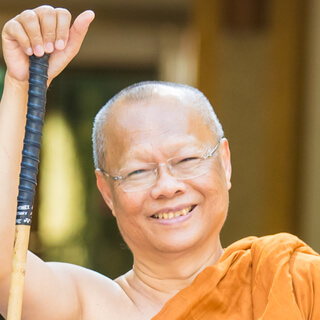
Venerable Ajahn Anand at Kinchenau,
Trained for many years under the guidance of the renowned meditation master,
Venerable Ajahn Chah,
After vigorous meditation practice,
Ajahn Anand set off into the forest and jungles to deepen his meditation.
In 1978,
He was offered land to establish a forest monastery,
Wat Map Chun,
Where he now resides as the abbot.
Ajahn Anand is today considered one of the most prominent teachers in the Thai forest tradition.
Ajahn Anand has a gift of teaching on many different levels,
From everyday life issues to the highest of dhammas.