In the time of the Buddha,
On the full moon day of the sixth lunar month,
Was Visakha Puja day,
That we know as when the Buddha was born,
Became enlightened and passed away into final nibbana.
After the Buddha had become enlightened,
He enjoyed vimutti-sukha.
Vimutti-sukha is the happiness,
The bliss,
That arises from liberation.
The liberation from birth,
Aging,
Sickness,
Death,
From all the mental defilements and taints and from all suffering.
There was none of that in the Buddha's heart.
The Buddha dwelled in this vimutti-sukha for seven weeks.
In the first week,
The Buddha stayed underneath the Mahabodhi tree.
He contemplated paticca-samuppada,
Dependent origination,
Back and forth,
Contemplating it and understanding it clearly,
Initially understanding its causes and later understanding how all the causes ceased.
How did it end?
By abandoning upadana,
Attachment,
The cause of all suffering arising.
So the Buddha understood it clearly.
In the later part,
He contemplated paticca-samuppada in stages and in reverse as well.
And the Buddha exclaimed,
When indeed the truths become manifest unto the strenuous and meditative Brahman,
Then he stands,
Routing Mara,
The evil one,
And his hosts,
Just as the sun illuminates the sky.
It was a Buddha-udana,
An utterance of the Sama-sambuddha,
The perfectly self-awakened one,
Coming from contemplating the Dhamma.
And the Buddha had great gratitude for the Mahabodhi tree.
In the second week,
The Buddha stood and stared at the Bodhi tree without blinking his eyes for seven days and seven nights.
This place is called the Animisa Cetiya.
In the third week,
The Buddha walked jhankama,
Meditation from the Bodhi tree,
Walking back and forth,
To the east and back to the west.
He walked meditation like this for seven days.
This is called the Ratana-jhankama Cetiya.
In the fourth week,
The Buddha contemplated the Abhidhamma.
This place is called the Ratana-gara Cetiya.
In the fifth week,
The Buddha stayed under the Ajapala-banyan tree,
Where there was a boy herding goats.
He answered a question of the Brahman,
Bhu-hun-ha-jatika,
Showing what makes one a true Brahman,
And the Dhammas that make one a Samana-pronunciant.
The Buddha gave the Dhamma to this Brahman in form of answering his questions.
In the sixth week,
The Buddha sat under the Mucchalinda tree.
Here it rained,
And the King Naga coiled around the Buddha so as to not let any drop of rain fall onto the Buddha.
The Buddha then gave Natarans in joy.
Blissful is detachment for one who is content,
For one who has learned Dhamma,
And who sees all compounded phenomena according to the truth.
Blissful is non-affliction in the world,
Restraint towards living creatures.
Blissful is passionlessness in the world,
The overcoming of sensual desires,
But the abolishing of the conceit,
I am,
That is truly the supreme bliss.
In the seventh week,
He stayed at the Rajayatana tree.
Here the Buddha received alms bowls from the four great kings.
The Buddha made the mental aspiration that they would become one bowl.
Here the Buddha met the first pair of lay disciples coming from Burma.
The Buddha gave them strands of his hair to the merchants Tapusa and Balika,
Who took it to build the Shwedagon Pagoda.
When the Buddha was here,
He thought of how refined the Dhamma was that he had attained to,
That is the Dhamma of Paticca Samuppada and of Nibbana.
The Buddha thought of not teaching,
And this was the cause that the Brahma Sahampatti came to request the Buddha to teach the Dhamma,
Because they were those that had the spiritual capabilities to attain the deathless.
This was in the seventh week.
So we see that this is the highest happiness,
Bliss.
Happiness can be separated out differently.
There is the happiness of having things and experiences in the world.
But when it is not in line with right practice and Dhamma,
Then there are many who go the wrong way.
They want happiness as well,
But don't know the right way and end up losing the way,
Getting intoxicated in happiness that is not correct.
There is mental agitation and trouble.
One looks for happiness only from material things,
And then the mind is only hot by not having enough.
One just consumes material things,
Which is feeding oneself through food from the eyes,
Ears,
Nose,
Tongue and body.
It's an ordinary happiness that the world desires.
Then afterwards,
One must keep chasing happiness.
One gets happiness and it's not enough.
Then going in search for it again.
There's desire and longing continually.
It's a happiness outside of us.
It's happiness related to all the material things and things outside of us.
We need to get it and search for it,
Without end.
The state of heart is in a state of struggle.
It wants to get it.
It has desire continuously.
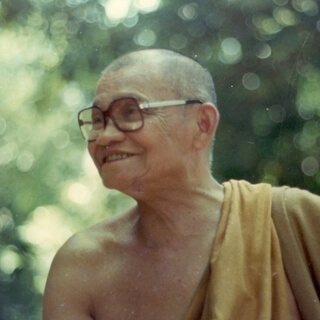
Venerable Ajahn Chah said this quality of tanha,
Craving,
Is something that is open-wide.
Ah,
We want to get it continually.
We struggle continually.
We long and desire for it continually.
There is no contentment in all the material things.
One gets it and one has happiness.
The happiness disappears,
Then one needs to struggle to find it again.
One enjoys and indulges in that happiness,
Then wanting to get more and more continually.
The more we get,
The more great we think we are.
We feel greater and greater.
We feel proud and delighted and we show it to others.
Or in competing with others.
It's happiness.
If we win,
We gain victory.
Then the sportsman is delighted.
We pass our exam,
Then we are delighted.
We get a promotion at work,
We're happy.
This is happiness as well.
This is happiness related to amissa,
From material things,
From external things.
But the more we are attached to it,
The more our mind loses its freedom.
If we go attached to material things too much,
Then the more we attach,
Then one day if we don't have it,
We can't live.
Whether it's having something we love,
It has consciousness,
It's a living being,
Or it's a thing that has no consciousness,
Then we have happiness from it.
But if it's separated from us,
We have lots of torture.
We have loss of material things we love,
Of our beloved pets dying,
Or people we love and like passing.
So we have to be careful.
Venerable Ajahn Chah gave the simile that it's like we're leaning on a post that is rotten.
It's rotten,
So it can give way at any time.
And then,
Bang,
We will fall down and can even die.
So we can't find happiness solely in this way.
As Buddhists,
We have to look for a higher happiness than we have.
We need to progress the happiness of two aspects in conjunction.
The external things we still need to have.
We need to find wealth to look after ourselves,
Our family.
For times of sickness,
We need to have these.
But we also know that it's not a sure thing at all.
We need to look for inner happiness as well.
This inner happiness comes from training the mind,
From building goodness.
If we have happiness only,
It's a cause for suffering to arise.
So,
Build goodness.
Have the five moral precepts.
We train in this.
We aren't heedless.
We need to develop it.
When it comes to the one Prat Weekly Observance Day,
We keep the eight precepts for one day.
We train in this.
We aren't letting the mind get too lost in the world.
So training the mind in building goodness is important.
May we have metta,
Goodwill and faith.
Try to train the mind to be peaceful.
Have samadhi,
Concentration.
Have rapture and bliss.
Then we will have effort and diligence to practice Dhamma.
We have happiness from giving dana,
From keeping sila,
Moral conduct.
And we do it on and on,
And our greed reduces.
But if we don't know how to give dana,
Then we have more and more desire continually.
We have a hundred thousand.
We want one million.
We have one million.
We want two million.
Three million.
Five million.
Ten million.
On and on.
We have one hundred million,
And we will want more and more.
It's the nature of tanha,
Craving.
It revolves around like that.
It doesn't end.
But if we have charity and generosity,
Doing goodness,
We feel that when we do this goodness,
We have a feeling of fullness of heart and inner happiness.
This is happiness arising from giving.
Happiness from helping others.
Happiness from a mind that is peaceful and joyous.
Happiness from keeping sila,
Moral conduct.
Making the mind empty,
We feel that it's light.
The happiness that comes from attachment is heavy.
It's heavy.
So we need to have wisdom.
We need to search for wisdom.
For wisdom to arise,
One needs to have samadhi.
For samadhi that is well established,
It needs sila.
So the Buddha taught the son of a wealthy family,
Yasa,
About giving,
Dana,
Generosity.
And the benefit of dana is having happiness.
The Buddha taught of sila,
So that having sila and not harming others,
Then the mind is at ease.
We have lots of happiness.
Having dana and sila,
Then it's like heaven.
The mind is joyous and uplifted.
We look at the things we have,
That we are satisfied and delighted with.
It's a cause for suffering to arise.
We see the faults of this,
So we try to practice dhamma,
To train the mind to have peacefulness to arise.
Then we can have another type of happiness,
Entering jhana,
Mental absorptions,
Which is happiness.
But even if we can't enter jhana,
We can have rapture,
Feelings of inner fullness and bliss.
It's way more happiness than external happiness,
Without comparison.
It's rapture and a feeling of inner fullness.
We eat some delicious food,
And in just a brief time it's gone.
We get something we like,
We get a feeling from that,
And it ceases.
We get lots of money,
The feeling arises,
We feel delighted.
Then that feeling is gone.
But if rapture and inner joy arises,
It lasts a long time.
It's fullness and bliss.
And the more we see the truth of nature that we've been deluded about,
Then oh,
The dhamma arises and our mind goes brighter.
We see what we usually see,
But we see it in another way,
According to the truth.
There is dhana,
Sila,
Bhavana meditation,
And the benefit of dhana,
Sila,
Bhavana.
We see the drawbacks of it.
We put forth effort into dhamma practice.
The mind is peaceful.
Wisdom arises.
It's bright and radiant.
Rapture and bliss arises.
And we see the dhamma.
It's amazing,
Very amazing.
We can't see it right now,
Because avijja,
Ignorance,
Hides it.
Nature is already revealing itself.
It's showing itself already.
The Buddha taught of things that are already revealed.
He taught it to people that are still ignorant,
To open their hearts,
So that the heart would open up,
To have samadhi arise,
To have wisdom,
And then one will see the truth,
The truth that rupa and nama,
Material and mental phenomena,
Are aniccaṁ dukkhaṁ anatta,
Impermanent,
Unsatisfactory,
And not-self like this.
It's not a self like this.
Then one can let go.
We've understood this.
We've heard it.
We've thought about it.
And we can let go,
But it's coming from memory.
But in a little while,
Ignorance comes back.
It's taken as a self again.
So we need to try to use wisdom from thoughts first,
Till the mind is peaceful,
Then we will start to understand.
Whenever we see it,
Then we will have rapture and bliss arise.
This is in the beginning.
When samadhi goes deeper,
On the level of being able to enter jhāna,
It can even be to the level of entering samāpatti,
Nirodha samāpatti,
Attainment of cessation,
Then that's a great happiness.
And this does exist.
So we need to train ourselves and search for the true type of happiness,
Not the type of happiness that burns and grills us,
That is waiting to burn up our minds,
That's too much to handle.
So we need to find something better than that.
In conclusion,
The Buddha enjoyed the bliss of liberation,
And then the Buddha taught the Dhamma,
So that we would get to true happiness.
The Sangha,
Noble disciples,
Practiced it and saw it.
Venerable Ajahn Chah saw it,
And he taught us,
Don't attach and cling,
It will be suffering.
We get it somewhat,
So we need to train and develop ourselves,
Put effort into it.
Then one day we will understand and see the Dhamma.
May you grow in blessings.