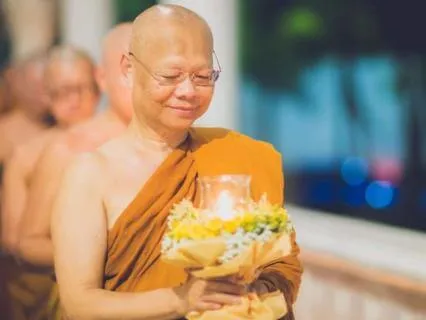
The 12th of February is the commemoration of Magha Puja,
Which is the full moon,
On the 15th day of the 3rd lunar month.
And this is an important day in the Buddha sasana,
The dispensation.
The day when the Sammasambuddha,
The perfectly self-awakened one,
Taught the Dhamma,
That we call the Avata Padimokkha.
The Buddha gave this Dhamma on the Padimokkha day to 1250 bhikkhus,
Monks,
Who were all fully enlightened arahants.
And they were monks that the Buddha had ordained by himself,
Through the method that we call Ehi bhikkhu upasampadā.
The Buddha had said,
Come monk,
Well expounded is the Dhamma,
Take up the Brahmacharya,
The holy life.
And the monks had gathered together without any prior notice.
They had a mind that recollected and thought of the Buddha.
And there were a great number of monks who gathered together,
Including 1003 monks from the group of the three fire worshipper Kassapa brothers.
And the Buddha taught of the heart of his teachings on the day of Magha,
To give up all wrongdoing,
To accomplish goodness,
Skillfulness,
And to cleanse and purify the mind.
These are the teachings of the Buddha.
In giving up all the wrongdoing,
The bad karma,
There is bhāpa,
Which means heat.
It's hot.
Anything we do by way of the body is kāyakamma.
Karma by way of speech is vajjikamma.
Karma by way of the mind is manogamma.
What we think,
We speak,
We do,
And it brings up heat.
This is called bhāpa.
So here the Buddha taught us to have coolness in the beginning,
From sila-dhamma.
The dhamma of sila,
Morality or virtue.
For one to see the benefit of having sila,
And seeing the danger of not having sila.
If one does not have sila,
Then it's a lot of danger.
There is chaos arising.
There is trouble and distress.
Here,
Sila is about actions and speech.
And there are thoughts that go on the side of bhāpa,
Heat.
Whether it's coarse,
Middling,
Or refined.
This is bhāpa of the mind.
But about sila,
About actions and speech,
We can control it.
Even if we have greed,
Anger,
Or delusion.
But we don't act on it.
We are someone who has sila-dhamma.
This is called the kāliyāna-jhāna.
A person who has a beautiful mind.
They don't follow their moods,
Don't follow their impulses.
They can think first and have restraint.
They have sati,
Mindfulness on this level.
We call this having sila.
So in the beginning,
We train.
Like we are practicing samādhi,
Meditation,
Concentration.
When we have good samādhi,
This will help our minds to have strength to keep sila well.
The sila where we can control our actions and speech well.
This will benefit us and make us have samādhi arise easily.
And this gives the result of having bhajna,
Wisdom to arise.
There is the wisdom to keep sila.
Wisdom to practice samādhi.
And the wisdom to know clearly into the Four Noble Truths.
So sila,
Samādhi,
Bhajna help each other.
It progresses our minds to go higher.
The Buddha taught us to firstly abandon all wrongdoing.
So initially we see that wrongdoing arises in actions and speech.
We have learnt about this.
And so we have the five moral precepts.
When we have the five precepts,
We have controlled over the wrongdoing a lot already.
And we also have to have dhamma.
The dhammas of metta,
Goodwill.
Of karuna,
Compassion.
Of mudita,
Sympathetic joy.
Of upeka,
Equanimity.
We have these four sublime abidings looking after our minds.
And then sila is easier to keep.
Because we have a sense of self,
We have me and mine.
We have self.
When we have self,
Then we have wanting and not wanting.
It is kilesas,
Mental defilements in the mind.
It controls over our minds.
Our mind that has no strength follows it.
Because we have no wisdom.
And since we were born,
It's been like this.
But when we understand,
We listen to dhamma.
Then we know that this is bhabha.
And we want to have coolness.
And bhabha is hot.
So we start to train.
To have mindfulness.
To have firm samadhi.
And our mind improves.
We have sila.
Have dhana.
And we have the building of goodness.
Building goodness.
Accomplishing kusala,
Skillfulness.
It has self within it.
But it is a self that is on the side of merit and goodness.
In the beginning,
Giving dhana,
Generosity,
Having self-sacrifice,
Are actions by way of the body.
And by way of speech,
There is giving knowledge,
Giving advice on different subjects.
So this is all goodness.
Or by building hospitals,
Helping those in difficulties,
Building schools,
Helping all the poor.
It's all goodness.
And all that is goodness,
We do it according to our strength we have.
This is skillfulness,
Which we do from actions and speech.
As for the mind,
Can we see that even if we have sila,
That is beautiful,
And we are intent to build goodness of all types,
But the mind still has thinking.
Like when we have anger,
And we don't speak and act on it,
But the mind is angry.
There is the mood present.
We have liking and being pleased.
These are things that make the mind to be lowered.
We call it bhabha in the mind.
So we need to train the mind to have firm samadhi,
Like the three fire worshipper brothers trained the mind,
Until their minds were at peace and still.
They focused on the fire kasina,
A visual meditation object,
Until they could enter jhana,
Mental absorption,
From this kasina.
It is a high level of samadhi.
But sometimes they would have thinking,
So then they would carry sand and pile it up,
Like chedi,
Stupas.
It was a reminder that the mind that thinks out is not good.
They trained until they were skilled,
Until their bharami,
Spiritual accumulations,
Were full.
Then they listened to a talk by the Buddha,
Teaching about heat.
The forms,
Sounds,
Tastes,
Odors,
Touches,
Mind objects,
Are something hot.
The eye sees forms,
Ear hears sounds,
Nose smells odors,
Tongue tastes flavors,
Body feels touches.
The mind knows mind objects.
And if there is no wisdom,
Then it's all hot.
All the fire worshippers understood this dhamma.
They all attained arahantship.
They saw dukkha,
Suffering.
They had wanted freedom from suffering.
And they saw upadana,
Attachment,
Was suffering.
They had wisdom arise.
Sila,
Samadhi,
Anya arose.
So they could abandon attachment.
It was nirodha,
The cessation of suffering.
Their minds became purified.
And they became arahants.
From the beginning,
Venerable Anyakodanya of the Panchavagya,
The five ascetics,
Had seen the dhamma first.
He had the wisdom to see the four noble truths first.
That to see rupa,
The body,
As being self and belonging to self,
It is suffering.
He saw it.
He saw it was not him.
It has arising,
Persisting,
Ceasing as being something normal.
The Buddha taught this,
That it's not a self.
And he saw the dhamma.
And when he saw anatta,
Not self,
Then he attained to enlightenment.
All of the five ascetics attained enlightenment.
They all completely understood the four noble truths.
Here,
When we have a sense of self,
Then we take that self to build goodness.
We build goodness and be accomplished in skillfulness.
This is the arising of samadhi.
So practicing samadhi has more benefits than giving dhana or keeping sila.
Because bhava arises in the mind.
And we can control the mind through samadhi.
We have rapture,
Inner happiness and coolness.
When we can make the mind have peace and coolness,
Then we get to compare.
We can see the hot state of mind.
When our samadhi reduces,
We come out from samadhi,
We receive sense impressions,
And greed,
Anger and delusion arise.
And it's hot.
If it arises a little,
It's a little hot.
If it arises a lot,
It's very hot.
It's a fire.
So comparing like this,
We can see the benefit and value of samadhi.
Then we will train in it.
But having trained in samadhi,
We need to have mindfulness as well.
We don't get deluded in that samadhi.
If we have greed,
Anger,
Delusion,
We need to have mindfulness as well.
It's not that we have no mindfulness.
So we have samadhi and mindfulness overseeing our actions and mind.
Then we are not deluded.
So when we train like this more and more,
Then the skillful mind states become more complete.
We have a sense of self,
A self that is peaceful and cooled.
But the upadana attachment is still there.
The cause for suffering to arise is still there.
But never mind.
Train in this first.
And this is taken as being a person who is beautiful and high as well.
So we learn about making the mind purified.
This is vipassana jnana.
It's insight.
Seeing rupa and nama,
Material and mental phenomena,
As having only arising,
Persisting and ceasing.
If we see this clearly,
It's called seeing the Dhamma.
Like the Buddha taught on the Salaha Puja,
That whatever has the nature to arise,
Has the nature to cease.
And Venerable Anya Kudanya saw the Dhamma.
So we use the samadhi we have to develop wisdom.
Throughout the day,
When we have any feelings arise in the mind,
We have liking or disliking,
We teach the mind that it's not sure and it's impermanent.
Don't let the sense experiences make the mind proliferate.
Don't let the mind have the sense object come in and proliferate over it.
Keep trying to teach the mind,
Continually.
Not liking and not disliking,
Right here is the path to see the Dhamma.
In the beginning,
We see the Dhamma a little first.
And later when samadhi is more stable,
We see clearly.
It's very clear.
There is no need to doubt about the path of practice.
So when you practice this,
May you have forbearance.
Be within sila dhamma.
Not harming yourself and not harming others.
Not harming others through speech.
Speaking to others,
We speak correctly and rightly.
And this is beneficial.
So make your actions and speech be within sila.
Practice samadhi and develop wisdom.
Then we enter the principles of the teachings of the Buddha.
To give up all wrongdoing.
To accomplish goodness and skillfulness.
And to make one's mind to be clean and pure.
And we all want clean things.
A clean house,
Clean clothes,
Clean and good food.
So we need to do the same for the mind.
The mind is important.
We make the mind to be clean.
To sweep and wipe the mind,
To be well cleaned.
Have the quality of dana,
Quality of sila.
Quality of samadhi and the quality of wisdom.
Have effort and determination.
Even if we have desire,
Then we rely on this desire.
We rely on this self to build more goodness.
Until we can let go of self.
This is called seeing the self.
Venerable Ajahn Chah taught deeply that.
May we see the true self.
Seeing the true self means seeing that there is no self.
No I.
Then we can see it.
If we see the self and we attach and cling to it as being a self.
An I.
Then we don't see it yet.
It shows we are deluded.
We got deluded.
And all lives that are born are deluded like this.
So we rely on practice and training.
And those who are practicing and training like this.
It shows they are people who have built an appropriate level of barami.
So that they are interested in listening to Dhamma.
But for those whose time has not yet come.
And are not yet interested to listen to Dhamma.
Never mind.
But when the time comes and they see suffering.
The suffering arises.
Then they see it.
Then they try to find the way out of suffering.
And they build goodness.
And ultimately they will understand deeply into the Dhamma.
So this is what the Buddha taught on the day of Magha Puja.
May you learn and listen to Dhamma.
And practice Dhamma.
Then you will see and attain to the Dhamma.
May you grow in blessings.