In this world,
People in various countries may have different days they celebrate the new year.
For the Thai people,
Since the old days,
It has been the Songkran festival.
This is the new year of the old Thai calendar.
If it is the international new year,
It is the first of January.
For the Chinese people,
It is Chinese New Year.
So these are the traditions of each country.
And when we get to this new year,
We give each other blessings.
We develop metta,
Goodwill and compassion.
We wish that we have happiness,
And for family and relatives to have happiness as well.
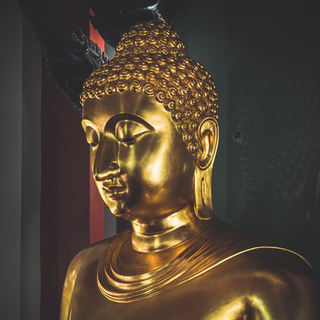
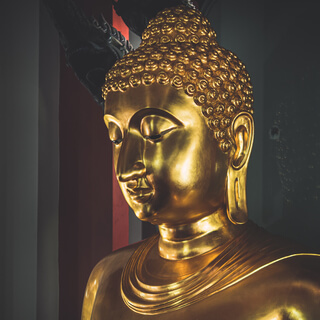
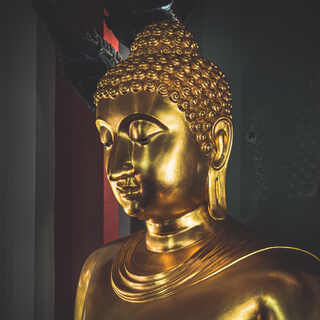
And there is the tradition of pouring water on the Buddha statue.
We recollect the virtues of the Buddha,
That he had metta,
Goodwill and compassion.
We may ask,
Why do we pour water on the Buddha statue?
The Buddha was the knowing one,
The awakened one,
The joyous one.
He was one who was cooled.
One whose heart was cooled,
Having no anger.
He had no greed,
Anger,
Delusion in the heart.
So that we pour water on him,
Is us recollecting his goodness.
And we bring it back to ourselves,
That we will make our hearts to have goodness,
And to give homage to the Buddha through our practice.
And the resulting benefits of having offered our practice in homage,
Having offered food and water,
And offered this respect,
Is that we have more coolness of heart.
And we take the tradition as a part of our practice as well.
At the time we are pouring water,
We make a determination.
And at that time,
The heart is cooled already,
It's peaceful.
But after that,
When we receive sense experiences again,
If we don't practice,
The heart goes back to its old state again.
So we need to make the heart cool,
And refreshed,
Like water.
The mind is joyful following what the Buddha taught.
But it's normal,
When that which makes our heart not be cooled has power over our hearts.
This we call ignorance,
Darkness,
Or avijja in the Pali language.
It is delusion and darkness that is in our heart,
And in other people's hearts.
Sometimes we have problems with the way we feel,
Thinking,
Why is it like this,
Why is it like that.
Problems with people in the world,
Even with good friends.
Sometimes things are good and we are pleased with them,
But sometimes we get displeased with them.
Being together with them,
We have some feelings of love,
Sometimes hate,
Some jealousy.
Or sometimes they do things to make our bad situation worse.
This all can be so,
If we see it as a self,
As me.
Then there is this person and that person.
But if we see it in terms of Dhamma,
Then it's seeing that there is ignorance covering the heart temporarily.
Then karma,
Intentional actions are done by way of body,
Speech and mind.
We experience the sense impression,
And we have disliking arise,
Anger and ill will arises.
This is also from the power of ignorance that covers over our heart temporarily.
But if we have satip,
Mindfulness,
Then we can overcome it.
We see that there is no one who does it to us.
That we suffer like this,
It is because of ignorance in our heart.
It makes us suffer.
If our heart has knowing,
Then no one can make us suffer.
The sammasambuddha,
The perfectly self-awakened buddha,
And all the arahants,
The enlightened beings,
No one could make them suffer at all.
But it is normal for the people in the world that whenever we have any suffering,
We think that it is caused by this or caused by that,
Because of this or that person.
That they make us to be like this.
This is if we see it on the outside.
If we see it on the inside,
Then we must look at it in our heart.
Then no one can make us suffer.
Because that person who does it isn't there.
It's just ignorance.
There's no true self.
It comes from causes and conditions.
If we contemplate a bit like this,
Our heart can let go of anger and ill will.
Our heart will be light.
Our heart is bright.
We can forgive.
Then there's dhamma arising in the heart,
Which is sila,
Samadhi,
Bhajna,
Morality,
Concentration and wisdom.
When it comes to the time of the new year,
We pour water on the Buddha statue,
Pour water to the elderly and ask for their blessings.
We give dana and make merit,
Which makes our heart be refreshed with goodness.
It is the first day of the new year,
Starting with blessings to our lives.
So our actions are within the principles of auspiciousness.
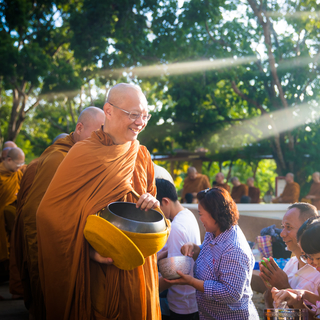
We offer alms,
Make merit,
Develop a heart of metta,
Have respect and reverence,
And listen to dhamma.
We sit meditation and we reflect on the virtues of the Buddha,
Dhamma,
Sangha.
We give dana,
Give cast of cloth to the monks in dedication to those who have passed away.
Sometimes our departed relatives have not yet received that merit and are waiting for merit we dedicate to them.
This merit is lightness.
It is a mental phenomena which is light.
And when we give it to our relatives,
Then when they receive it,
They have happiness of heart.
If they can finish off the results of their karma,
Then they will be reborn in a better destination.
So this is about merit.
Each person does merit,
And anumodhana rejoices with the merit others make.
And then our merit grows.
So this merit is the refuge of living beings in this world and the next world.
And if we look at it in terms of the dhamma,
Then our elders,
Grandparents,
Parents,
Siblings who have already passed away,
Before they were like us,
They could speak,
Walk,
Eat,
They could make merit,
But one day it was their time to pass from this world.
So it shows that we are in this world temporarily.
We have to share it to let others come to live here.
If we are only born and don't die,
That there's only birth,
Then the world resources would be insufficient,
And it would be difficult and hard for us.
So it's normal that birth and living here is temporary.
But before we have to pass away,
Which is something normal,
We need to search and build something,
Build our merit and goodness a lot,
Make it full in our hearts,
So that it can bring up a heart of joy,
Happiness and inner fulfillment.
This is merit and goodness arising.
So this is important.
We need to build and do it a lot.
When the results of our merit come up,
That there is inner joy and happiness arising,
Then we can see into arising,
Staying and ceasing.
This is seeing into the four noble truths.
And then our heart will be cooled,
Which is Nibbana.
It's our highest goal.
Because if we are still cycling around birth and death,
Then we will experience suffering continually.
We have passed so much,
Birth and death,
Birth and death,
Birth and death,
And in the future as well we need to die,
And we don't know when that will be as well.
When we know this,
Then we put effort into building goodness,
So that the births and deaths we will have are diminished and reduced.
We give dana,
Keep precepts and meditate.
It's a new start to our lives.
All the new things,
Like new clothes,
Are clean,
They're good to use.
The house we have,
We like to stay in it and use.
If it's a bit dirty,
We clean it and it looks fresh and we want to use it.
Our hearts are the same.
If it's just the old moods and mind states,
There is just attachment and clinging.
Just greed,
Anger,
Delusion,
Ill will,
Harmful thoughts,
Thoughts of not having enough.
And this is the old heart like this.
It is the heart that has ignorance covering it.
But we will have a new heart,
Which is the heart that has the Buddha.
The heart that has knowing is awakened and joyful.
Meditating with the word Buddho,
This is the one who knows,
The awakened one,
The radiant one.
And so we will know Buddho of how the heart is awakened.
It is awakened from ignorance.
Like if we are asleep and the mind drifts off into this and that subject to various stories.
We take it as if it's truly a real experience.
But we wake up and we know it was a dream.
Now that we are born,
But if we aren't awake,
We don't have awakened knowing,
Then life is like in a dream.
Every day there are a lot of stories and experiences,
Lots of our stories,
Other people's stories.
And we know so many things that are happening around us.
And all these stories pass and pass by,
But we can't find any substance or core to it that can enable us to be free from the suffering in our hearts.
So this is still being asleep.
If we have no mindfulness,
Then we are still heedless,
Then we are still asleep.
But if we are awake,
Then we will know that before this we were asleep.
If we are awake,
Then we'll know that in our daily life we attach to so many things.
We think it's really us.
But now we have knowing that it's only ours by convention.
We still have mine,
But it's only conventionally so.
Our house is ours,
Everything is ours.
But our heart has to know of its normal state,
That it must change.
Sometimes we really like this person,
We say it's not a sure thing.
One day it may change,
And then we don't like them and suffer.
Sometimes we don't like someone,
And it may change,
And then we like them.
It's not a sure thing.
It's up to our hearts whether it has ignorance or greed.
Especially in society and family,
We have even more problems.
If we have no mindfulness and wisdom,
Then household life will be even more suffering.
So we need to train and instruct our hearts to be good,
And not to be heedless anymore.
The Buddha has taught that the foundations are to abandon evil,
Cultivate goodness,
And to purify the mind.
We all know it and have learnt it every year on the important Buddhist holy day.
But the Buddha taught before his parinibbana,
Don't be heedless.
The Buddha was one who was not heedless already,
And he taught the Savaka disciples and the public as well to not be heedless.
Like today,
It's very good to see on Songkran day that there are many people from the city who go back home.
From Rayong they'll go back to their provinces,
But we don't think that from other provinces like Ubon they'll go back to Rayong.
And you have been determined that today you will make merit on the new year,
Which is impressive to see the hearts of the people that have done this until it's become a beautiful tradition of Songkran day.
And having made merit,
Then there is enjoyment and fun,
Having kindness and compassion to each other,
Which we call Songkran Water Festival,
Which is giving coolness,
Giving refreshment to each other.
It's developing kindness to each other and is happiness.
It's a good energy,
Which is an energy that arises all over Thailand,
And it has pulled in Western people's interest who want to come and have happiness along with the Thai people.
And so it's become an international Songkran festival,
Which is amazing.
Thinking back to the beginnings of Songkran of the Sukhothai,
Ayutthaya,
Ratanakosin period,
It has been practiced for a long time,
No less than 400 years.
But we have done it continuously until it has become widely recognized.
This is the development of the kindness of Buddhist people that live in Thailand,
Together with all nationalities,
All religions,
Who have minds of goodwill and self-sacrifice,
And being of one heart in concord and harmony.
It's peaceful and happy,
A country of peace,
Free from war and all dangers.
And so people want to come to Thailand,
Which has happiness and peace,
And the goodness and inner beauty of the Thai people.
So we try to build goodness today.
It's the first day that we give forgiveness.
Whoever does something that makes us feel bad,
Today we will forgive.
We will not get angry,
Have ill will,
Or harmful thoughts.
If it arises,
Then we will know that this is ignorance in our heart.
It is ignorance in their hearts.
Because in reality,
What makes us upset doesn't exist.
There is just dharma that arises,
Stays and ceases.
Then our heart will be emptiness.
Our heart will be pure.
Our heart will be clean.
Our heart will be Buddha-knowing.
The heart is cool,
Just like when we pour water on the Buddha.
May we recollect this as an object of our mind all day.
As a recollection of the virtue of the Buddha.
And then we'll meet with happiness and growth in the Dhamma.
May all the bad things that have happened in the past year to you,
May it cease and be gone.
May your sickness subside,
May you be free from dangers.
May you be free from suffering,
Grief and pain.
May the bad things go away from you and get out of your hearts.
May all good things come find you,
Enter into your hearts and to your family.
May you succeed in doing your work,
Responsibilities and duties.
May you have dhamma arise in your heart.