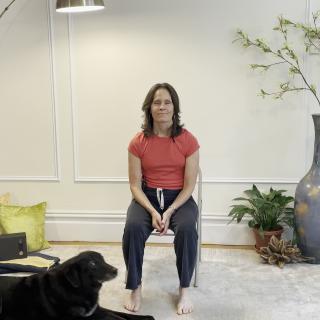
Hi,
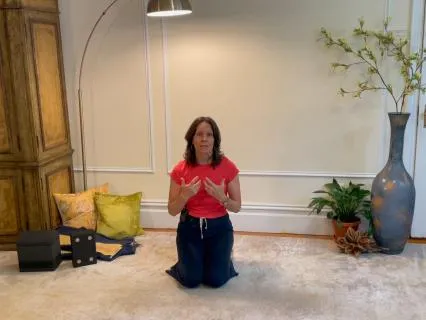
I'm Lisa,
And I'm so happy you're here for this HANA somatic yoga practice.
In this work,
We are very interested in regaining a sense of our body when we are experiencing it from within.
It's what Thomas Hanna referred to as your soma.
And so,
As you're doing your practice,
You're tuning in to the internal sensations of the movement being done.
And we also take time after a movement has concluded to tune in and notice that sense feedback.
In this practice,
We do not force.
We're trying to do what we do with the greatest degree of ease possible.
So if that means today you need to move a little slower,
If it means your movement needs to be a micro movement or a movement done only in your imagination,
That's what you do.
Trust that specific subtle movements.
Are effective because they are.
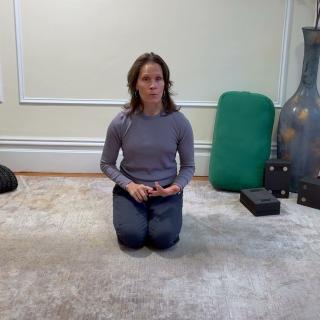
So I have a lot of blankets and pillows and my block and roller nearby so that I know I'll have support as I may need it.
We're going to start.
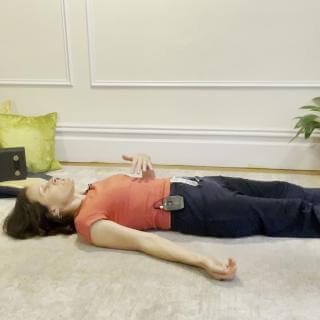
Lying on your back.
In a position that's comfortable for you.
So if that's legs long,
It can be legs long.
If it's knees bent,
You can have your knees bent.
And you're just going to start to breathe a little bit slower and a little bit deeper than you were breathing a moment ago.
You can put your attention in the area of your heart.
And if you'd like,
You can bring to mind the image of someone or something that you appreciate.
Take a moment and scan your body,
Tune in to the internal sensations.
And we'll begin with some somatic exercises that prepare us to do the postures we're going to do.
Bend your knees if your legs are straight,
Stand your feet on the floor.
We're going to do our arch and flatten,
And we're going to combine it with some head movements and then some arm movements.
Arch your low back,
Which is a lifting of your low back.
Your tailbone goes into the floor.
And then slowly release.
Returning to your neutral.
Flatten your low back,
Gently moving it towards the floor.
As your pelvis rocks back,
Your tailbone lifts a little,
And you slowly release what you contracted and return to neutral.
When you arch,
You're contracting muscles in your back,
Your pelvis is tipping forward.
You slowly and with control return to neutral.
When you flatten,
Your pelvis is rocking back and you're contracting abdominal muscles.
As your brain decreases the level of contraction in those muscles,
You return to neutral.
The next time you arch,
Tipping your pelvis forward,
Just gently tip your head forward without lifting.
Slowly release.
When you flatten,
Rolling your pelvis back,
Gently roll your head back.
And slowly release.
Nodding head and pelvis forward.
Slowly coming back to your neutral.
And then rolling head and pelvis back.
And slowly coming back to neutral.
Pause a moment.
Turn your head a little to one side.
And with your head to the side,
Resume those head and pelvic nods.
Move slowly so that you can tune into the sensory feedback of the movement being done.
Move slowly so that you know you're using your motor cortex to do your movements.
And then pause.
Gently turn your head to the other side.
And continue with your head and pelvic nods.
I first did these movements with my teacher,
Phil Shank,
And they're one of my most favorite things to do.
When you've completed about three cycles,
Pause.
Bring your head back towards neutral.
And we're going to do head,
Arm movements,
Arm and shoulder movements with your arch and flatten of your lumbar spine.
As you arch your low back,
Roll your arms out and gently press your shoulders back.
You may notice that has an effect on your thoracic spine.
Slowly release.
As you flatten your lumbar spine,
Roll your arms in and bring your shoulders forward.
And slowly release.
You can let,
If you notice your head wanting to follow the movement,
Let it follow.
But here you're not directing your head.
As you flatten your low back,
You're rolling your arms in and bringing your shoulders forward.
There's a controlled return to neutral.
And when you arch,
You're rolling your arms out and pressing your shoulders back.
Complete the cycle you're in the midst of.
Bring your attention to your lower body and we're going to work with some muscles there.
Your attention,
If it's helpful,
You can use your hands,
Is in your gluteal area,
The upper part of your hamstrings.
Press your feet into the floor and just slightly lift your buttocks.
You're moving in the direction of hip extension and gluteal muscles and hamstrings do hip extension.
Slowly release.
Let your pelvis sink.
Inhale as you push your feet down and slightly pick up your pelvis.
And exhale slowly,
Really.
We're going to do a lot of different exercises here.
So for the sake of time,
We're going to do two repetitions of each rather than three.
You can always pause the video and do more repetitions of something if you'd like.
Straighten your one leg down and so you're working with your bent knee side,
Still working with those hip extensors.
Press your bent knee foot down into the floor,
Slightly picking up that side of your pelvis.
Let your long leg,
Your long side pelvis just be heavy and slowly return to neutral.
One more time,
Press your bent knee foot down,
Slightly lifting that side of your pelvis,
And slowly release.
Now straighten the leg that's bent.
And bend the knee that was straight.
You're working with the same leg,
Though.
You're now working with that same leg.
It's straight,
And you're working with hip flexors.
We're going to start with psoas.
Have your straight leg turned out no more than 30 degrees.
And lift it no higher than two inches.
Slowly release what you contracted.
Let that leg come back and sink into the ground.
With your straight leg turned out about 30 degrees,
Lift it no higher than two inches.
And slowly release.
So we're now going to do a movement with your leg that will get so as at the beginning,
And then as you continue to lift,
Now you're involving other hip flexors.
Bring your straight leg to neutral,
Keep it straight,
And slowly lift it.
Going only as high as you go easily.
And only as far as you can go without feeling like you're pulling on tight hamstrings.
Then very slowly,
Let your leg come back down.
And when your leg has found the floor and you've completely released,
Just pause.
Tune in to the sensations.
Changing sides,
We'll start with the muscles that help you to do hip extension.
You're now working with your bent knee leg.
Push your foot into the floor,
Slightly lift that side of your pelvis.
And slowly release.
Inhale as you press your foot down,
Lift your pelvis up a little.
Exhale,
Slowly release and come down.
Changing the position of your leg to work with flexors,
Straighten your bent knee,
Bend your straight leg.
Working with your straight leg side,
Turn your leg out slightly,
Lift it up no higher than two inches you're targeting psoas,
And slowly release.
Inhale as you lift your leg up a little.
Exhale as you release and let it come down.
And now working with other flexor muscles in that hip.
With your straight leg in neutral,
Keep it straight and slowly begin to lift it up.
Going only as far as you go easily.
And then even more slowly release down.
And when you've completed,
Just rest a brief moment,
Tune into the sensations.
And we're going to use this position to work with the muscles that hike your hip.
They bring your hemipelvis up towards your head.
Let your pelvis stay as flat on the floor as you can.
You're working with your straight leg side.
You're going to draw that straight leg hemipelvis up towards your head.
So you shorten that side waist.
And you can also press your bent knee.
Forward.
And then slowly release.
Remember you're listening to the instructions,
Organizing them within your own soma to do your movement.
If you find you need to watch,
Watch without doing.
And then once you have a clear sense of the movement,
Do your movement.
So another time,
Gently bring that side pelvis up.
You can press your bent knee forward and slowly release.
Changing sides,
Bend the leg that's straight,
Straighten the leg that was bent.
Straight leg side,
Hemi-pelvis buttock,
Slide up the floor towards your head.
You're contracting oblique muscles in that side,
Quadratus lumborum muscle in your low back,
And as you release those muscles,
You come out of that pattern.
One last time,
Draw that side of your pelvis up a little.
You can push your bent knee gently forward and slowly release.
Bend both knees to stand your feet,
Place your hands under your head for arch and curl,
And do about three cycles.
Inhaling as you arch head,
Tailbone,
Elbows go back.
Exhale,
There's a return to neutral.
Curling forward,
Elbows come forward,
Head and pubic bone nod towards one another in front of you,
And you slowly return to neutral.
Inhaling to arch,
Put your attention on the muscles you're contracting in your back.
You get to feel those muscles return to length as you return to neutral.
And when you curl forward,
You do the same thing,
But now you're focusing on the muscles you're contracting in the front of your body.
Inhaling to arch.
.
.
Exhaling coming out of your arch,
Keep exhaling and curl forward.
And as you inhale,
Slowly,
Really.
Let your arms come down.
Let your legs come down if it's now comfortable.
And we'll take just a brief moment,
Invite your body to relax.
Tune in and notice the effects of doing those somatic movements.
Know that you have prepared your body and your mind to do your postures with a greater degree of integration,
Communication,
Cooperation,
Coordination.
Visualize coming into your legs up position.
You bend your knees,
Bring them into your body,
And then extend your legs up towards the ceiling.
Once you visualized it,
Slowly come into the posture as you visualized.
Your attention is on the muscles that you're contracting in the front of your body.
If you're getting strong sensations from the back of your body,
It's not because they're contracting.
What you're sensing is stretch.
You want to back off a little.
In this practice,
We try not to stretch.
Okay,
Slowly release.
Bend your knees.
Placing your feet on the floor,
Sliding your legs out slowly,
Coming out in a reverse fashion.
Taking just a brief moment to tune in and notice what new sensations are present.
Visualize now a half shoulder stand.
You start as though you're going to come into the legs up.
You contract abdominal muscles and roll up towards your shoulders,
Resting your buttocks in your hands.
If there is a sense of forcing that has to happen to get into it,
Or you know that that is not a good posture for you to practice,
Please do your legs up posture again.
Visualize the posture you're going to do.
And then come into your posture going only as far as you can go easily.
You're breathing as regularly as you can breathe.
And if you notice there's tension in your body,
You're working to let that tension go.
Reversing out,
Bend your knees.
Round your back and slowly roll down.
Lengthen your arms and legs out.
Invite your body to relax.
And we'll take the full minute.
You're breathing a little slower.
You can use the ohm count.
Silently count four ohms as you breathe in,
Four ohms as you breathe out.
And tune in to learn the effects of the postures you just did.
Okay,
Please visualize camel posture.
You'll be standing on your knees.
If it's better,
You could always do a version of this standing on your feet.
Your hands are on your low back or buttocks.
And you're contracting muscles in your back to arch your spine,
Bringing your chest forward as your head,
Shoulders,
And tailbone go back.
Once you've visualized it,
Slowly transition up onto your knees and feel free to add additional padding under your knees.
So that you make sure that your knees are very comfortable.
Then you're going to bring your hands behind you.
And as you inhale,
Move your chest forward.
Notice your pelvis is coming forward.
Head can go back.
Go maybe a third as far as you can go,
And then exhale,
Draw your belly back,
And return to neutral.
Find an inhale again,
Bring your chest forward,
Moving towards Ustrasana a little further,
But not as far as you could go.
Exhale,
Coming out.
And this time,
Come into your Ustrasana and stay for a few breaths.
Focus on the muscles you're contracting in your back.
Coming out of it.
Turning onto your back,
Find your position for relaxing and take a moment to relax.
Please visualize the side-lying Buddha posture.
You lie on one side,
Your bottom arm supports your head,
Your legs are stacked,
Your top arm is at your side.
This is a balancing posture.
You can start on the side you'd like.
After about 30 seconds.
.
.
Slowly release out of the breath.
Sideline Buddha and change sides.
Sometimes there's a real difference in sides.
And so one thing you may discover in practicing this is that It's much easier.
On one side than it is on the other.
Scan your body.
If you notice you're holding tension,
See if you could release it.
Slowly turn on to your back.
And take a brief moment there to tune in,
Feel the effects of having done the side-lying Buddha.
And let's do the starfish.
Visualize the shape of a starfish.
And then come into that shape.
Your legs and feet are wider apart,
Your arms are away from your sides.
As you're in the shape named for the starfish,
You may imagine yourself a starfish floating in the water.
Release out of your starfish.
Feel free to pause the video and stay longer.
It's a wonderful posture.
Take a moment to come into your relaxation.
Tune into your body and see what it wants to communicate to you about having done those postures.
Please visualize now a standing posture.
You're going to come up to stand,
And you want to pay attention to the movements that bring you to stand.
Those transitional movements have the power to teach us as well.
Going to come into your side angle posture.
Your legs and feet are wide apart.
Your right leg and foot are turned out.
Right knee is bent.
Arms are lifted away from your side and you're bending sideways towards your right leg.
Once you've visualized it,
Slowly come up to stand as you visualize coming up to stand.
And then come into your side angle posture.
As you visualized,
Your attention is on the right side of your body.
You continue to breathe regularly.
If you notice tension,
See what you can do to ease the tension.
Use an inhale to come up.
We're going to do several different variations here so we won't stay that long.
Change sides,
Turn your right foot in,
Your left foot out,
Bend your knee,
And gently bend towards your left,
Focusing on the muscles you're contracting in the left side of your body.
You're breathing easily,
That gives you a sense of how you're doing the posture you're doing.
And it's also a way of helping you to maintain an internal sense,
A first-person sense of what you're doing.
After about 30 seconds,
Come up.
And let's do triangle.
So visualize the same thing,
Only now your legs are straight.
When you're ready,
Turn your right leg and foot out,
Lift your arms,
And gently bend to your right.
With an inhale,
Come up.
And change sides.
As you're shortening your left side,
You get to feel the sensation of your right side.
Long.
And coming up.
And take a moment,
You can bring your legs and feet closer together,
Just take a moment to feel the effect.
We're going to do a one-legged balance half moon.
Feel free to hold on.
Visualize your legs and feet closer together as though you were going to do a triangle.
And as you bend towards your front leg,
As you shift your weight over that front leg,
You may come up onto your tippy toes of your back foot or it may lift.
Turn your right leg out.
If you need,
Watch me.
Then pause the video,
Visualize yourself doing it,
And then do it.
Lift your arms,
Look towards your right hand,
Push off with your back foot,
Bringing your weight more over that front leg,
And play with balancing on your right leg.
You can keep your left toes on the floor or maybe your foot hovers.
Do your version.
Slowly reversing out as best you can.
And changing sides.
Doesn't matter how far you go.
And then slowly reverse out.
And come all the way down to the floor.
Find your position for relaxation.
Relax,
Tune in and enjoy all of the new sensations.
So we're going to do a hanosomatic movement.
And then we'll do some abdominal breathing before we.
And with meditation and chanting.
Bend your two knees,
Stand your feet.
Bring your arms out.
We're going to do our supine twist.
And focusing on leading the movement of your legs with a movement at your ankle.
Press the outer edge of your right foot down,
Inner edge of your left foot down.
That takes your knees to the right.
Roll your arms to the left and roll your head to your left.
Now press outer edge of left foot down,
Inner edge of right foot down,
And as your knees go to your left,
Roll your arms right,
Roll your head right.
And continue to alternate.
Complete the movement you're in the midst of.
Release your arms and legs down.
And begin to breathe with your abdomen.
As you exhale,
You're gently squeezing abdominal muscles in.
Your inhale is the release of those contracted abdominal muscles,
Which allows your diaphragm to make its full descent,
Causing your belly to go forward.
Exhaling,
Belly moves back,
And then you contract and squeeze it in a little bit.
Inhale releasing the contraction letting your abdominal muscles.
Be long and free and have the ability to let your abdomen expand out.
As you exhale,
Belly is going towards the floor.
As you inhale,
Belly is going towards the ceiling.
Practice a few more cycles.
Apply the same principles of practice that you do to movement.
Do this breathing with as much ease and smoothness as you can and stay with what's comfortable.
Return to natural breathing.
Take a moment to notice the effect.
And prepare for your guided relaxation.
You're going to make yourself comfortable.
You're going to invite your body to relax.
Let me be your voice for a little while.
When I name a part of your body,
You can tune in to that part of your body.
If you'd like,
Use this as the opportunity to send appreciation to each part of your body.
I am relaxing my feet.
I am relaxing my leg.
I am relaxing my pelvis.
I am relaxing my abdomen.
I am relaxing my chest.
I am relaxing my back.
I am relaxing my hands.
I am relaxing my arms.
I am relaxing my shoulders.
I am relaxing my neck.
I am relaxing my head.
I am relaxing my face and jaw.
I am relaxing my brain and nervous system.
I am relaxing my internal organ.
I am relaxing my entire body.
Slowly bend your knees.
Turn gently onto one side.
Bring yourself up to sit.
Sit on something if you need so you're comfortable and your spine is erect.
If you'd like,
You can take a hand gesture.
Hakini mudra is sometimes a nice gesture.
Your eyes can be opened or closed.
When you breathe in,
Think Aum.
When you breathe out,
Silently count one.
As you breathe in again,
Think Aum.
As you breathe out again,
Silently count two.
Continue in that fashion.
Holding your focus on your breath.
If you lose count,
Start again at 1.
If you reach 10,
Start again at 1.
Bring your focus back.
Sense the ground under you.
Take a full breath in and om to the end of your exhale.
Breathe in again.
And one last time.
Namaste to you.
I look forward to seeing you in a session soon.