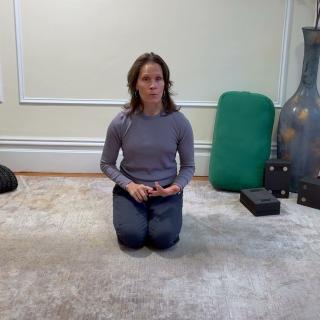
Hi,
I'm Lisa,
And I'm so happy you're here.
I'd like to share a few hanosomatic exercises that help to work with muscles in your neck and shoulder area that may be holding contraction.
When a muscle habituates to holding excess contraction,
You may experience that.
Is the area feeling sore?
It could feel stiff.
It could be hard to move that part of your body.
We're going to be using a technique called a voluntary pandiculation.
So you're moving a part of your body which contracts the muscle targeted,
And then you're slowly releasing.
It's a controlled release.
Where your brain,
Motor cortex,
Is now decreasing the level of contraction in the muscle.
You'll put your attention in the area that you're contracting,
And you're not going to worry if you don't yet feel the sensation of contracting.
As you do this work,
You're developing your sensory nervous system,
And you will begin to feel the internal sensation of muscles contracting and then releasing.
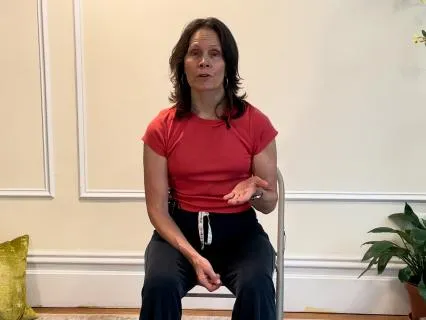
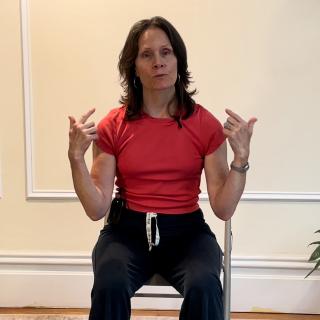
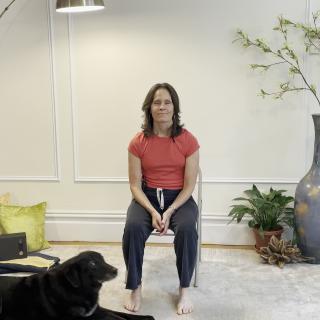
So I'm doing this sitting in a chair.
This is an area a lot of us tend to hold contraction.
We're tense.
And you can do this any time you're sitting at work,
On a bus,
As a passenger in a car.
Make sure that you're comfortable,
That your feet are grounded.
And we're going to start with a movement for the upper part of your trapezius.
So you're going to bring your two shoulders up.
And tilt your head back just a little.
That's the contraction.
Now slowly,
Smoothly let your shoulders come down and let your head come out of that backward tilt.
You're controlling it.
Letting go all the way.
And when you're ready,
Doing that again.
Draw your shoulders up,
Tilt your head back,
Go just as far as you go comfortably.
And slowly release.
If your brain were not decreasing the level of contraction in the muscle,
Your shoulders wouldn't be coming down.
Your head wouldn't be coming forward.
And one last time when you're ready.
Pick your two shoulders up gently,
Tilt your head back.
And slowly release to let your shoulders sink down and let your head come forward to neutral.
Then pause a brief moment and see if you notice you have new sensations.
Some parts of your body may feel heavier or lighter.
You could feel a change in temperature,
Warmer in some areas.
So let's do a different movement targeting levator scapula.
You're going to be tilting your head a little to the side and lifting that shoulder up.
Slowly releasing to let your shoulder come down and let your head come in towards neutral.
Your attention is on the side you're tilting your head towards.
We usually do our movements about three times.
That's about the number necessary to reset the muscle.
And Eleanor used to say,
You only do as many repetitions as you can with full attention.
When you've completed about three pauses,
And you can tune in to notice the sensations in the side you were working with.
And then we'll change sides.
Gently bringing your ear towards your shoulder,
Your shoulder up towards your ear.
And then slowly releasing.
Remember,
You're using your motor cortex to do your movements.
It's the only part of your brain that can decrease the level of contraction in a muscle.
Your motor cortex works with sensory feedback.
So as you're moving.
You're tuning in to the internal sensations.
Tilting your head a little to the side,
Gently draw your shoulder up.
And slowly release.
And you can take a moment to tune in.
You may feel calmer.
You could feel more present.
Let's do one more movement here,
Very valuable movement to do.
So a lot of us,
Because we sit in front of devices,
Have habituated to this head forward position,
Which puts a lot of strain on our neck.
We've held it so long that it's become habituated.
We're no longer aware that we do it and we can't Choose not to do it.
We can contract different muscles when we think of it to pull our head back But as soon as we need to think about something else the pattern reemerges and pulls our head forward So the way you work with it is in the hanosomatic way is to voluntarily do what's being done involuntarily.
And as you slowly release out,
You're resetting the muscles that are contracting to pull your head forward and your head will just naturally align more over your spine.
You're going to sit tall.
You can slightly pick your chin up,
Which is a little bit of an arch in your neck.
And then glide your head forward.
Release,
Slowly let your head come back and let your chin sink that little bit you lifted it.
Tune into the sense of your neck being long in the back.
Lift your chin a little.
Glide your head forward.
And slowly release.
Inhale as you lift your chin,
Glide your head forward.
Exhale,
Release what you contracted,
Let your head come back,
Let your chin sink.
And take a moment,
Tune in and feel the effects of what you just did.
And then if you'd like,
You can close your eyes,
Invite your body to relax for a moment.
Even though we were targeting muscles in your neck and shoulders,
Your nervous system organizes you as a whole.
So you are affecting and upgrading all of your muscles.
As you take this moment to tune in,
You may experience the changes that have occurred.
When you're ready,
Slowly open your eyes.
Thank yourself for practicing,
And I hope to see you in a video soon.