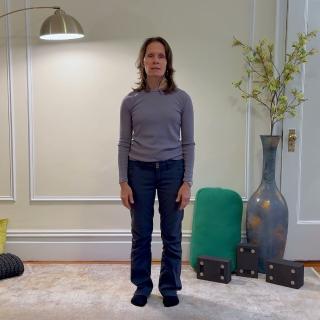
Hi,
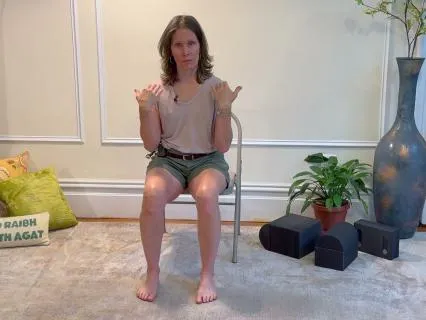
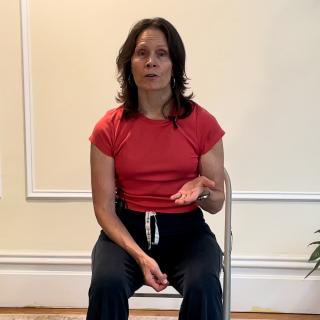
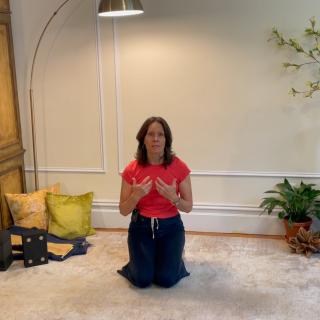
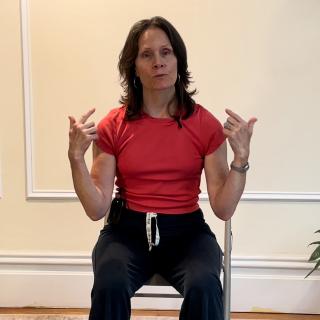
I'm Lisa.
I'm so happy you're here.
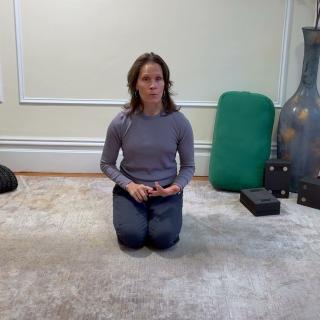
I'd like to share a few hanosomatic movements that you can do.
When you're sitting,
And you can tune in to.
What you're doing in your body.
Remember that in this work,
You're specifically working with your brain and nervous system.
So it may not feel effortful physically,
But it's not meant to.
And in fact,
We're trying to do our movements with the greatest degree of ease we can.
Because the sensory feedback that your motor cortex uses to help you do your movement is more subtle than the sensations of efforting.
You only go as far as you can go in comfort.
And so if today that is imagining a movement or doing a micro movement,
That's what you do.
Because I want you to have your experience.
I want you to be able to put 100% of your attention on the internal sensations of your movement.
Please try to listen to my instructions,
Organize what you heard within yourself,
And then do the movement that you can do comfortably.
Take a moment,
You can close your eyes if you'd like,
And just tune in.
See what your body wants to communicate to your brain.
The language it uses is sensation.
So you're noticing sensations in your skin,
Your muscles,
Your joints.
Turn your head now gently to your left.
Bring your left hand over and just lightly touch along the top of your right shoulder.
This is part of the muscle we're targeting,
Upper trapezius.
You can sense when you press into that muscle how hard or soft it's feeling.
The movement you're going to do now is to lift your right shoulder up.
And tilt your head backwards a little towards your right shoulder.
So you've brought the back of your head and your right shoulder a little closer together.
Slowly now release,
Let your shoulder come down.
Let your head come out of that backward tilt.
Leave your head turned to your left.
Two more times.
Draw your right shoulder up,
Gently tilt your head back.
And then slowly really.
You can inhale as you do the movement,
Lifting your shoulder,
Tilting your head back.
Exhale as you release what you contracted.
Allow your shoulder to come down and your head to come out of the backward tilt.
Then slowly bring your head to center.
And turn your head to your right.
You can palpate along.
And when you're ready,
About three cycles,
Draw your left shoulder up,
Tilt your head back a little towards your left shoulder.
Slowly release what you contracted.
You're doing a voluntary pandiculation.
As you lift your shoulder and tilt your head back,
You're contracting upper portion of trapezius.
And as you allow your shoulder to come down and your head to come forward,
Your brain is lowering the level of contraction.
The part of your brain that you're using to do your movement is called your motor cortex.
When you've completed about three.
You can return to neutral,
Head forward,
And notice the internal sensations.
You can also just gently press into each side and notice The tension in your muscle is different.
It feels softer maybe under your fingers.
Let's work with both sides together.
Just a little bit.
Tilt your head back.
Draw your two shoulders up.
Slowly release to let your shoulders come down,
Your head come out of that backward tilt.
Draw your two shoulders up,
Tilt your head back.
Slowly release,
Let your shoulders come down,
Let your head come out of the backward tilt.
Inhaling as you do your movement going just as far with it as you're in comfort.
Exhale helps you to begin your release.
If your release takes longer than your breath out,
Keep breathing.
And notice when you reach the end of your release.
Just pause there,
Take a moment,
And notice what you notice.
So we're going to do a different movement.
It targets different muscles.
Levator scapula is one of the muscles you'll be targeting here.
Upper trapezius is also involved.
You're going to turn your head,
SCM,
Sternocleidomastoid muscles involved.
Turn your head a little bit to your right.
Tilt your head to your right so your right ear goes towards your right shoulder.
Lift your right shoulder up a little bit towards your ear.
And now as you tilt your head back a little,
Draw your right shoulder back a little.
Slowly release.
You can do that in a reverse fashion if you can remember all those steps,
Or just sort of generally slowly release until you return to neutral.
Turn your head a little right.
Tilt your head a little right.
Lift your right shoulder up.
Tilt your head back and move your right shoulder back a little.
Release what you contracted.
Returning to neutral.
One last time,
Turn your head right.
Tilt your head right lift your right shoulder up tilt your head back,
Draw your right shoulder back.
And slowly release.
It's important that you control your release.
That lets you know you're using your motor cortex.
It's the only part of your brain that can lower the level of contraction in a muscle.
And now let's work with the left side.
Turn your head a little left.
Tilt your head left,
Bringing your left ear towards your shoulder.
Draw your left shoulder up towards your ear.
Tilt your head back and bring your left shoulder a little behind you.
Releasing what you contracted.
Maybe it feels like a letting go.
You let go until you're in your neutral.
And then again,
Turn your head left.
Tilt your head left.
Lift your left shoulder up.
Tilt your head back,
Bring your left shoulder back.
And slowly release what you contracted.
To let your head come forward,
Let your shoulder come down,
And return.
Turn your head left.
Tilt your head left.
Lift your left shoulder up,
Tilt your head back and bring your left shoulder back.
As you exhale,
Slowly release.
When you return to your new neutral.
Just pause a moment and see what new sensations you're experiencing.
Within the area you were moving.
And anywhere within yourself.
Because when you're working with one part,
You're actually affecting all.
So let's work with a position that a lot of us have habituated.
It's called the head forward position.
One of the ways that we can get into it is this position that a lot of us are embodying as we're looking at our devices.
And each time you do that,
It becomes more habituated until unconscious parts of your brain are working to hold your head in that position.
And it puts a lot of strain on your neck.
So in this work,
If we notice a pattern we're holding unconsciously that's unhelpful,
We do it intentionally.
So we're using our motor cortex.
We're contracting the muscles intentionally that hold us in the pattern.
And then we're releasing them as we come out of it.
Sit comfortably.
You're going to lift your chin up just a little bit.
Which is a slight arch in your neck.
Now glide your head forward.
Release where you contracted,
Let your head come back,
And come out of the arch so you let your chin sink.
The back of your neck is long.
Arch your neck a little.
Glide your head forward.
And slowly release.
Inhale as you lift your chin,
Glide your head forward.
Exhale,
Release,
Let your head come back,
Let your chin sink.
And take a moment to tune in to the sensory feedback.
Let's do one last movement here.
We're going to use rotational movements to work with muscles in your neck and shoulders.
And specifically,
We'll end up doing a movement where your head is turning in the opposite direction of your shoulders.
And you'll see,
If it feels comfortable,
You might even bring your eyes into an opposite movement from your head.
Remember to stay in a range of comfort.
Do micro-movement if needed.
And if today observing is best,
Just observe.
If it's comfortable,
You can put your hands over opposite shoulders.
Just let your arms rest on your body.
And slowly turn your head.
And you're turning your shoulders,
Your thoracic spine,
To one side.
And now turn to the other side.
Move slowly so that you know you're using your motor cortex and that you're ensured you're not going to go too far.
And the next time that you've turned your head and shoulders around to one side,
Pause.
Turn only your head.
To the opposite side.
So now we're going to start the differentiation of your head from your shoulders.
When you turn your shoulders to that side,
Turn your head the opposite way.
And slowly continue when you turn your head one way,
You turn your shoulders the other.
Bring your movement to a close.
Lower your arms for a moment.
And now see how it feels for you.
To not move your head,
But to take your eyes a little to one side.
And then slowly take your eyes a little to the other side.
Blink as you need.
You're just gently moving your eyes to one side.
And then to the other.
If you experience any sensation of pressure building in your head behind your eyes,
Leave out this movement.
See how it's feeling.
And if you'd like,
We'll add the eye differentiation into the head differentiation.
Hands rest on opposite shoulders to help remind you where your shoulders and chest are turning.
Turn your head to one side.
Turn your shoulders to the other.
Change,
Turn your head to one side,
Shoulders to the other.
When you feel ready.
Start to move your eyes to the side you're moving your shoulders.
Rather than to the side you're turning your head.
Complete the cycle you're in the midst of.
Release your arms down if it's a comfortable thing for you.
Let your eyes close.
Invite your body to relax.
Tune in and notice the effects of the movements you did.
If you closed your eyes,
Slowly open them.
Thank yourself for practicing.
I thank you for joining me today,
And I hope to see you in a practice soon.
Namaste.