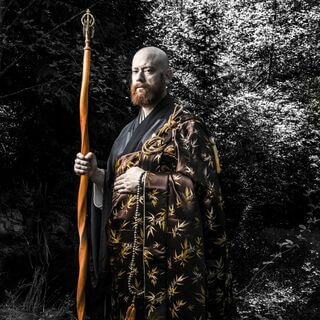
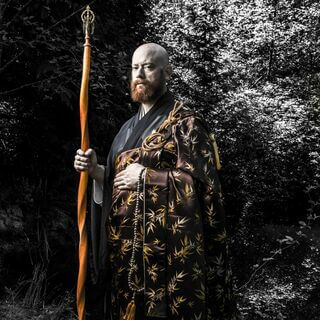
Reading today from The Gateless Barrier.
Wumen Guan.
Case 1.
Zaozu's Dog.
A monk asked Zaozu,
Does even a dog have Buddha nature?
Zaozu replied,
No.
Wumen says,
If you sincerely wish to practice Zen,
You must pass through the barrier of the ancestors.
If you wish to attain genuine insight,
You must abandon the path of conceptual understanding.
If you do not pass through this barrier and do not abandon the path of conceptual understanding,
Then your life will be that of a ghost and you will be distracted and attached to whatever objects you stumble across.
Tell me,
What is the barrier of the ancestors?
It is nothing other than this single word,
No.
It is the front gate to the realization of the origin and so it is called the no barrier gate of Zen.
If you are able to pass through this barrier,
Not only will you meet Zaozu face to face,
But you will also join hands and walk with the successive ancestors throughout time,
Entangling your eyebrows with theirs,
Seeing with the same eyes and hearing with the same ears.
Doesn't it sound wonderful?
Isn't there anyone that wants to pass through this barrier?
Arouse your entire body with its 360 bones and joints and its 84,
000 pores of the skin.
Give rise to a spirit of doubt and investigate this word,
No.
Keep it close to you always,
Both day and night.
Refrain from creating concepts of vacancy or attaching to relative ideas of having or not having.
It will feel like you have just swallowed a red hot iron ball,
One that you cannot spit out even if you try.
All of the illusory ideas and delusive beliefs that you have accumulated and carried with you into the present moment will be extinguished and with natural ease,
The spontaneous unification of inside and outside will be realized.
It will be realized,
But you will be unable to express it like a person who is unable to speak after waking from a wonderful dream.
All of a sudden,
An explosive transformation takes place and you will astonish the heavens and shake the earth.
Taking up the warrior's flaming sword,
No opponent is your equal.
When you meet the Buddha,
You kill the Buddha.
When you meet the successive ancestors,
You kill the successive ancestors.
On the precipice of life and death,
You are completely at ease.
Regardless of where you find yourself or how you arrive,
You enjoy a merry and playful existence.
I ask you again,
How do you manifest this realization?
Employ every ounce of your energy to embrace this null.
If you hold on without interruption,
Behold,
A single spark and the ancestral candle is lit.
Wu Man's verse says,
A dog,
Buddha nature,
The pronouncement perfect and final.
Before you say it has or has not,
You are dead where you stand.
All right,
Three bells.
Before I get started,
I just want to really remind people that we're not just doing stuff.
When we ring bells or gongs,
When we're working in the kitchen or lighting candles,
We're not just ourselves interacting with this other object.
We're investigating a relationship.
I know it's hard.
It's hard all the time,
And we get tired.
And we start these Zen retreats early in the morning,
And we're not used to getting up so early.
And there's all kinds of inconveniences that we all have to go through in order to get here.
And then when we get here,
We've got all of these ridiculously inane tasks to do.
Ringing bells and organizing things and curtains up and curtains down and chant books over here and straps over there.
And the temptation is always for us to kind of go through the motion.
And this is the hook,
The challenge,
The practice of Zen,
Is to be aware of that temptation to sort of check out and go through the motions.
Don't just ring the bells or the gongs.
Don't just whack them.
Don't just whack them.
Don't just look at them as objects outside of yourself.
Recognize them as nothing other than yourself,
And make relationship.
Come to know it.
Come to know the bell intimately.
Come to know the gong intimately.
Come to know the food in your bowl intimately.
How can you not?
We are sharing the space of intimacy throughout the day.
Don't be elsewhere.
Very few people here,
Just five of us,
Very few people in our whole community have made the effort to even crawl out of bed to get here today.
Just us.
And I'm really grateful.
But now that we've all gotten out of bed to get here,
Really be here.
Let's all just really be here.
100%.
Not wishing,
Oh Jesus,
I should have stayed in bed.
I should have just not come today.
Really embrace each period of meditation.
It's a gift.
It really is.
Even when they're awful,
Even when our legs hurt and our minds and our hearts are full of garbage and anger and grief and all of that,
It's a gift.
So I kind of,
I started into the Mumonkan,
The gateless barrier.
This text,
Just,
I don't know when it was.
Before I was sick,
Before my sister became ill and died,
I wanted to get back into the gateless gate.
More and more as I continue to practice and I continue to train with Genjo,
And I continue to engage with this tradition that we have,
The Rinzai Zen tradition,
The more I come to just really value this collection,
This text,
And the practice of koans in general,
Along with this text.
Because it's not just a book,
This is a,
It's like a training manual.
It's one component of our practice in this tradition.
And the more I practice with it,
The more I recognize how kind of difficult it is to uphold this tradition,
Uphold this practice.
We live in a culture that is so immersed in intellectual study.
And it seems to me,
Even in the brief span of my own life,
Is becoming ever more and more separated with what we do with our body.
And I don't know if that's technology,
And I don't know if that's just modern culture,
And I don't know if it just seems that way because I'm starting to get old or something like that.
But for whatever reason,
We become more and more bound in our heads and in our ideas and in our concepts.
Originally,
When this book was first sort of compiled,
It didn't exist as sort of something you could go to a bookstore or a library to collect or get.
It was actually a secret document.
It was a secret document kept by teachers,
And only engaged with,
Piece by piece,
With the disciples.
Not just anyone who came to sit,
But with disciples,
People who had actually shaved their heads for the most part,
And engaged in formal Zen training with a master,
With a roshi.
There were all kinds of scandals around this,
And copies getting loose,
And all kinds of stuff.
Great drama.
But the key to this is that even with the text,
And this is very much the way today,
Even if you can go to the chapters downtown and pick three or four different versions,
And go through them and read all the notes,
You still have to do the koans in sanzen,
Or in dokusan,
In interview.
And so even if you,
What I found is there's actually a text called The Sound of One Hand,
And there's a huge scandal around that text that I probably talked about before,
Where a monk who had sort of,
The practice of koans had kind of become wrote in a lot of ways.
And the practice of Zen,
Becoming a priest,
Was really about inheriting the parent's temple.
And in the Rinzai tradition,
You didn't become a priest until you had at least completed the mumonkan,
This text.
And so there was a priest who,
The quality of training had become very much like just going through the motions.
And he basically wrote down a text with all of the answers to the koans.
This koan,
Go in and do this,
And this koan,
Go in and do that.
And for a while,
The teachers were really baffled by this,
Because all of a sudden these these students that didn't really seem to have much insight were able to come and and sort of get these koans right,
Quote-unquote,
Give the correct answer.
But it was partly because the teachers themselves had gotten complacent,
And they weren't looking for the insight that underlied the response.
They too were looking for the right answer,
Kind of like a standardized test for Zen as a problem.
Anyway,
This is all sort of.
.
.
My point is,
I suppose,
That this practice that we engage in isn't just this seated meditation.
It's not just this practice of getting together and sitting on a Sunday.
It's a matter of pushing ourselves into sort of awkward circumstances,
Grounding ourselves first in our practice,
Grounding ourselves first in Zazen,
Allowing ourselves to sort of become spread out and even.
Through our practice,
Our day-to-day sort of interactions in the formal environment,
Or even at home when we really apply ourselves,
Becoming what we call mindful.
It's a big word these days.
Becoming more aware of the relationships that we're making with objects,
With our circumstances,
With people in our lives.
Really pressing that sort of openness and awareness that we develop through our seated meditation,
Our walking meditation,
Applying it,
Not in a forceful way,
But in a very sort of like pervasive,
Steeping kind of way to more and more aspects of our lives.
This is a big part of practice,
And it takes a long time to really get that happening consistently.
I guess one way of really looking at it is that this is a sort of the dissolving side.
There's a way of allowing ourselves to really absorb or be absorbed into the activity of our life,
And that's one aspect.
And this Kuan Mu I want to talk about today,
Because I don't.
.
.
There's often this assumption that we have some idea of what's going on when we start reading Koans.
We've got five people,
Three of us are monks,
But I don't assume that anyone knows what's going on in this case.
And I think it's important to sort of bring it back to the basics,
Because the case itself is two sentences.
Two sentences.
A monk asked Zaozu,
Does even a dog have buddha nature?
Zaozu replied,
No.
This is Mu in Japanese,
And I think it's Wu in Chinese.
Is that right?
No?
Wu?
I think there is an ancient noun that's Wu.
It's a very simple sort of interaction,
And it comes from this teaching of buddha nature.
So I want to talk a little bit about buddha nature.
I talk about buddha nature all the time,
But I don't use the term because it's kind of a.
.
.
Well,
It's kind of something we try to avoid,
I think,
In the Zen school,
But I think in Buddhism generally,
I think it's an important thing that we understand what's being pointed to when we say buddha nature.
The Buddha's birthday is coming up,
Our celebration of it's coming up.
The actual day that's usually celebrated in the Japanese tradition,
April 8th,
Was last week.
And I spoke a little bit about it at the Tuesday sit.
But this general principle,
Buddha nature,
Buddha,
The one who is awake,
That's what the word means,
Buddha,
The one who is awake.
And so buddha nature is awakened nature.
The Buddha,
When he had his great realization under the Bodhi tree,
Exclaimed wonder of wonders.
Fundamentally,
We are all already awake,
But we don't realize it.
This is the foundation point of sort of the Buddhist teaching.
Generally,
In our everyday lives,
In this culture,
At least the way that I've grown up in this culture,
Our tendency is to always have this kind of dualistic view of things.
There's inside,
And there's outside.
And there's good and evil,
And there's right and wrong.
And there's holy people,
And there's bad people.
There's all these sort of pure and impure,
Sort of like binary discriminations that we make on ourselves,
On the world.
And so the foundation or the great contribution that the historical Buddha Shakyamuni made was to expound this teaching that already we have everything that is required.
Already we are complete.
Already we are awake.
Already this nature,
This awakened nature is within us.
It's ours.
It's our birthright,
Or our natural state,
Or however you want to express it.
And this alone,
This single realization,
If you can grasp this in practice,
This is something that I think would be so wonderful if I could just go into the university and sort of like touch people and say,
You know,
You're okay.
You've got everything you need.
Just as you are,
You're complete.
Already you have the wisdom which is full and complete.
And if they could understand that,
I'd be really happy,
Just if that alone.
We're so full of self-doubt.
We're so full of self-loathing and neediness and hunger about the things that we need or that we want or should have to be complete.
Or that some kind of impurity or problem or badness that we have that we would just be so,
We wouldn't,
We won't be complete until we're rid of it.
And this fundamental teaching of Buddha nature is that already,
Just as we are,
We are complete with all of that ugly stuff,
All warts and all.
That's part of it.
There's a another circumstance where the same teacher as Aozu,
Who is a legend in Zen,
Really considered one of the greatest Zen masters in Zen.
Circa,
I think around the 8th or 9th century in China.
Another monk came and asked him,
Does even a dog have the Buddha nature?
And his response is yes.
Yes,
Even a dog has this Buddha nature.
This is the perspective that I'm talking about right now,
Just this sort of what the Buddha taught about Buddha nature from our perspective of subject and object.
Does everything in this cosmos have Buddha nature?
Do the trees have Buddha nature?
Do the stones have Buddha nature?
Does the water have Buddha nature?
Do the bells have Buddha nature?
Do the drums have Buddha nature?
Does our hair have Buddha nature?
Do our cars have Buddha nature?
Does Enbridge have Buddha nature?
And according to this perspective of the Buddha,
Yes,
All of these things are unified,
Are one,
In that they have Buddha nature.
This investigating,
This teaching,
This principle is a very powerful tool.
And as we approach practice,
To really question this,
To really say,
Oh,
How do I go about living my life when all things have the Buddha nature?
This is one,
This is where we have to start with this case,
Mu or no.
Because this monk,
This other monk,
In another circumstance,
In another time,
And maybe in another place,
Comes and asks,
Zaozu,
Does even a dog have the Buddha nature?
And Zaozu replies,
No,
No,
No.
Why?
The Buddha taught that all things in this cosmos are imbued,
Or arise,
Or are made of this Buddha nature.
So why,
When this monk asks,
Does even a dog have the Buddha nature?
Why does Zaozu reply,
No?
I think up until the point when we are investigating this thing called Buddha nature,
We can say to some degree we're practicing Buddhism.
But Buddhism is not a revealed teaching.
It's a practice that human beings have engaged in.
And as we engage,
The nature of being human,
The nature of living in this life becomes manifest,
And we make mistakes.
We fixate.
Wumen is the Chinese monk who compiled these cases of the mumonkan,
Or the wumen guan,
The gateless barrier.
And its object was to be used as a training device for people like you and me to deepen our practice.
So when we look at how we engage in practice here at Zen West,
I think it's really good to really understand how this is used,
Or when this is used,
Or why it's used.
We have these activities where it's open to the public.
Anyone can come to the Tuesday sits,
And anyone can check out our activities online,
And anyone can sit with us in the izendo.
It's open.
And I give talks about posture,
And how to sit,
And things come up in practice.
And I give talks about our nature,
Realizing the fundamental nature.
It's when we really start to strike into koans,
When we start to sit down and say,
Now I've been meditating for some time,
And I feel differently,
And things in my life have become more and more clear.
When the sort of weeds have been pulled out of our life,
To some degree,
It's a great opportunity to start getting into koan practice,
The investigation of koans.
The mumonkan,
This gateless barrier,
Begins with this first case mu,
Or no.
And when we begin to grapple with it,
We really begin to get into the essence,
Or the spirit of the Zen school.
Because we do kind of an about face.
Up until now,
We talk about,
I am this person,
And how wonderful that I too am possessed,
Or embody,
Or arise from this Buddha nature.
I too,
Along with the stones,
And the birds,
And the food that I eat,
And the bells that I ring,
I too,
All of us,
Have this Buddha nature.
One of the ways that we can really understand this is,
And I think many people do,
In our culture,
Is like a spirit,
Common spirit.
Each of us is filled with,
Embodies,
Has the Buddha nature.
The pointer of Zaozu's dog is that to perceive or conceive of the cosmos in this way is already already making a mistake.
How?
Wu Men says,
If you sincerely wish to practice Zen,
You must pass through the barrier of the ancestors.
Yeah,
Please be comfortable.
I'm going to prattle on for a while here.
So,
If you wish to attain genuine insight,
Genuine insight is another way of saying right view,
Which is the first of the steps or folds in the eightfold noble path.
Right view.
So,
If you really want to attain this,
If you really want to understand or embody right view,
Genuine insight,
You must abandon the path of conceptual understanding.
This alone,
This one single step,
Is something that we not just point at in Zen,
But it's something that we practice over and over and over again in the Zen school.
This is not a big mystery.
I'll explain a point where this happens over and over again.
When we engage in koan practice,
We are often asked questions,
And sometimes those questions seem very strange to the conceptual mind,
To our sort of ordinary mode of functioning.
Bring me the temple bell is a koan.
How do you manifest as a flower is a koan?
Bring me the Olympic mountains is a koan.
How do you manifest as a butterfly flying in the garden is a koan?
These are simple sort of prefatory kind of cases.
Their function is to really see how able we are to let go of the path of conceptual understanding.
When we go down into the interview room,
When we're grappling with a case like this,
How do I manifest as a flower,
Or how do I bring the temple bell?
Now this is an old case where the temple bell is this big several hundred pound bronze monstrosity,
And the teacher says,
Bring me the temple bell.
So how do you do that?
The conceptual person would first,
I think,
Maybe say,
Well,
How can I do that?
The temple bell is so big.
Obviously he doesn't want me to physically move the temple bell.
That's ridiculous.
So how do I do this?
And we get the idea,
Usually most people get the idea very quickly,
That I'm supposed to become the temple bell.
I'm supposed to be the temple bell.
So how do I become the temple bell?
So the conceptual idea is already there.
I must become the temple bell.
I have to bring the temple bell.
And from what I've seen in my limited experience as a Zen teacher,
We hit a wall here.
How do I bring the temple bell?
I need to become the temple bell.
And there's a wall between knowing what needs to happen,
Knowing where things are pointed,
And being able to do it.
The whole setup is an obstacle.
You go downstairs into this closed room where you have an audience of one,
And you might be totally wrong,
And you could totally embarrass yourself.
How embarrassing would that be to stick yourself out there to be a bell,
To try to be a bell,
Or a flower,
Or a bird,
Or a butterfly,
Or a wave,
Or a tree,
And get it totally wrong.
And the consequences are so terrible,
Maybe the teacher's going to laugh at you,
Or ring the bell and tell you to go away,
Or boring,
Or you're completely off the mark.
There's this huge pressure that's created in the interview,
And it's horrible for most people.
But it's intentional.
Its whole function is to carry you to this precipice between conceptual understanding and experiential realization.
Because that,
In our life,
That barrier between knowing and doing,
Between being clear about how things,
I want to say,
Ought to go,
Or what's clear,
What's straightforward,
How things should unfold naturally,
Seeing it right in front of you,
And being able to step across entirely dependent on that wisdom,
That deeper knowing.
Oh,
It's very difficult.
So we begin with these simple cases.
How do you manifest?
How do you bring the temple bell?
It's not so difficult.
Stepping outside,
Stepping outside of this idea of who I am,
Or what people will think of me,
Or how I will be judged.
This is a crucial component of freedom.
Consider this deeply as you go through your life.
Consider,
Feel your way through your life,
And feel those boundaries when we know what we should do.
We know the way forward.
From our guts,
We know the way.
From our guts,
We know the way.
Become aware of that boundary,
That limitation that our conceptual thinking mind creates for us,
The barrier.
If you do not pass through this barrier and do not abandon the path of conceptual understanding,
Then your life will be that of a ghost.
You will,
And you will be distracted and attached to whatever objects you stumble across.
This is a big statement about how we go about living our lives for the most part.
Even when we're engaged in Zen practice,
Even when we're engaged in Koans,
And we've been practicing Zen for a long time,
It's a constant challenge for us to stay on that edge,
On that precipice,
To be able to step across into the realm of experiential realization.
Tell me,
What is this barrier of the ancestors?
It is nothing other than this single word,
No.
It is the front gate to the realization of the origin,
And so it is called the no-barrier gate of Zen.
What is this barrier,
This obstacle,
Between where we know to go and whether we are able to do it,
Whether we're able to manifest transparently and harmoniously and clearly?
What is that that holds us,
A prisoner,
Holds us back?
If you're able to pass through this barrier,
Not only will you meet Zaozu face-to-face,
But you will also join hands and walk with the successive ancestors throughout time,
Entangling your eyebrows with theirs,
Seeing with the same eyes,
And hearing with the same ears.
Doesn't it sound wonderful?
Wumen is telling us that this single act,
This single practice of moving beyond that conceptual limitation,
The boundary,
Is entirely the business of our school.
So,
Who is it whose eyebrows we are entangling with?
Who are these ancestors?
In what time do they occupy space?
Isn't there anyone that wants to pass through this barrier?
I ask this question more and more as I practice with different people all over the place,
And listen to people talk about practice and how it's impacted their lives,
And how sitting once a week has such a huge transformative capacity on their entire week.
I think it's wonderful.
I hear lots of people talk about how they notice that if they sit a little bit more,
It makes a bigger difference.
I always wonder,
If you're able to see that this is a beneficial thing,
Experientially,
If you're able to know this for yourself,
I don't know why people don't want to become more involved with it,
Want to engage with it more,
Want to commit their lives to this realization.
Isn't there anyone that wants to pass through this barrier?
Arouse your entire body with its 360 bones and joints and its 84,
000 pores of the skin.
Give rise to a spirit of doubt and investigate this word,
No.
Keep it close to you always,
Both day and night.
Refrain from creating concepts of vacancy or attaching to relative ideas of having or not having.
This is coming back to the original sentence here,
Does the dog have buddha nature?
Who are you?
Are you just this person,
The subject of cause and condition of your upbringing,
In your environment,
In your society?
Are you completely limited by these things or is the capacity much greater?
Is it possible possible to go beyond those things,
To expand beyond what is known,
To manifest clearly as buddha nature?
Not as something possessing,
What is this thing that we think possesses buddha nature?
So this practice that Wumen is suggesting here,
Arouse your entire body with its 360 bones and Arouse your entire body with its 360 bones and joints and its 84,
000 pores of the skin.
Give rise to a spirit of doubt and investigate this word,
No.
This barrier is with us all the time.
It is the obstacle between this and that.
It is the thing that we bounce off when we become afraid,
Or when we become worried,
Or when we become angry.
It is the boundary,
The limitation,
The difference between manifesting clearly as we know and manifesting as we think we ought to.
Our practice in the beginning is to develop this deep awareness,
This deep mindfulness and clarity and balance,
So that as we go through our lives,
We're aware not just of the external circumstances that we're going through,
But also the internal circumstances that are arising in relationship with the things that we take as external.
We want to always be aware,
Present,
Connected with this barrier,
Seeing it arise when it arises,
Seeing the fear,
Seeing the anxiety,
Seeing the self-concern,
Seeing the anger,
Seeing the desire,
Feeling that bond,
That limitation there,
Allowing it to drop away.
I have to be careful when I talk about it,
Because I don't want you to think like,
Oh,
To grasp Mu means to not have any boundaries at all.
This is a great way to understand or describe what one of my teachers called Mu-sickness.
If we completely allow boundaries to drop,
Then I just take your car,
Because it's okay,
You know,
My car and your car,
There's no me and there's no you,
So how can mine and yours pile up and get in each other's way?
I don't want that.
I don't want it to happen.
Just thank you very much for the car,
And get into trouble.
When I talk about anger and fear coming up,
Desire coming up,
If someone's pointing a gun at you,
Or there's a wild animal that wants to eat you,
You shouldn't try to give that a hug.
But this isn't usually the circumstance that limits us,
Is it?
It's saying that thing,
Even that lovely,
Wonderful thing,
Telling somebody that we love that we love them,
And we can't find our tongue.
Telling somebody who's doing something that we don't like that we don't like it,
Telling somebody who's doing something that we don't like that we don't like it,
We can't find our tongue.
Feeling like we want something,
Being bound to our desire for it,
And our inability to have it,
How can we let go of both of those things and simply be at ease in circumstances?
Not bound by the desire,
Not bound by the circumstances,
Completely letting go.
What happens?
It will feel like you have just swallowed a red hot iron ball,
One that you cannot spit out even if you try.
This is practice.
Practice.
When we become more and more clear about these things as they arise,
These limitations and obstacles as they arise in our lives,
It's tiring.
This is often where people just want to stop Zen practice.
We begin to become more and more clear about how our minds and our hearts and our bodies and how they work and how they interact and how they relate to the world and people and circumstances around us.
We want to stop feeling the suffering that we feel.
We want to stop seeing the mistreatment that we see.
But once we start throwing open this door,
Once we start accepting the gifts that come with insight,
Being able to see the simple beauty in simple things,
Being able to cherish the simple sound of the birds,
The embrace of a loved one,
A good laugh,
We can't give those gifts back.
This is what Wu-Man is talking about.
It's like swallowing a red hot iron ball sometimes,
One that you can't spit out.
You can't stop seeing.
You can't unsee or unfeel or unhear things.
All of the illusory ideas and delusive beliefs that you have accumulated and carried with you into the present moment will be extinguished.
And with natural ease,
The spontaneous unification of inside and outside will be realized.
All of this talk about inside and outside,
Subject and object,
Unification and diversification,
All of this talk disappears into the experiential realization.
Whether we're manifesting as a bell,
Whether we're sitting on our cushion,
As we continue to practice,
If we keep digging into this,
If we keep keep on with practice,
Paying attention,
Being with what we're with,
Then spontaneously,
Sometimes in small ways,
Sometimes in great big ways,
Sometimes just in a small way,
Great big ways,
Sometimes just a glimpse and sometimes we're completely immersed,
Disappear.
Inside and outside,
Unification of inside and outside will be realized.
And I think really likely that there are,
Maybe everybody in this whole room has had some taste of this,
Even just a moment.
We had a question about this experience on Tuesday.
It will be realized,
But you will be unable to express it,
Like a person who is unable to speak after waking from a wonderful dream.
People want to know sometimes what it is to like have an enlightenment experience or to be enlightened.
This is what a woman is pointing to,
Is this awakening experience,
This spontaneous unification of inside and outside,
And it's something that can't adequately be expressed in words.
This is why in Zen we often ask for demonstration,
But I find one of the wonderful things in practicing in community is that even then,
Even right after this kind of experience happens,
It's very difficult to talk about it and it's very difficult to assess as a teacher,
Because there is no way of describing it.
But what happens is that this experience,
This realization,
This immersion,
This spontaneous unification is deeply transformative.
The person who was there before this experience is often markedly different than the person after the experience.
All of a sudden an explosive transformation takes place,
And you will astonish the heavens and shake the earth,
And all these monks lived in monasteries,
So maybe you should say you will astonish your wife and a partner and shake up the household or something like this,
Because this is often the case.
People come back from this kind of experience or an intensive,
And for many years when I would come back from an intensive,
That's very much what happened.
There's big fights,
Big changes,
I'm doing things differently now,
Not out of some aspirational sort of idea like,
Oh I need to eat less meat or I need to do more exercise,
But out of this much deeper realization or seeing,
I can't continue to function the way that I've been functioning,
Because it was fundamentally mistaken.
And the depth and strength of these kinds of changes is remarkable and noticeable.
Taking up the warrior's flaming sword,
No opponent is your equal.
My son quoted this next line to me last week,
When you meet the Buddha,
You kill the Buddha,
When you meet the successive ancestors,
You kill the successive ancestors.
What is that about?
What is that about?
Over and over in our tradition,
This comes up,
Killing Buddhas.
I often worry,
When it comes to multi-faith discussions with the people in Islam or in Judeo-Christian religions,
People often pick up their scriptures and talk about how really violent they are.
And here,
In the first case of the Wuman Khan,
It's like,
If you meet the Buddha,
Kill the Buddha,
If you meet the successive ancestors,
Kill the successive ancestors.
And this is just pointing to our ideas about inside and outside.
And it is acknowledging that we have this concept of the historical Buddha,
And the awakened Buddha,
And this image on the Butsudan.
But if we're really practicing Buddhism,
Our practice is not to emulate the Buddha,
Our practice is not to worship the Buddha.
Our practice is to awaken,
To manifest as Buddha.
Not as the old Indian guy,
But this Buddha.
This Buddha,
In this moment.
And it's not to emulate or worship the ancestor,
But to become,
To manifest as this ancestor.
And it's not to admire or worship the Buddha or the ancestors as these remarkable beings because of the circumstances and situations of their personal lives,
But to acknowledge the manifestation or the realization of that capacity in each of them,
Which is your capacity in each of us.
And to the degree that they are able to get out of their own way,
To manifest that clear wisdom,
The ability that they were able to step through this gateless gate,
This is what we acknowledge in them and in ourselves.
On the precipice of life and death,
You're completely at ease.
Regardless of where you find yourself and how you arrive,
You enjoy a merry and playful existence.
This is one of my favorite lines in all of Zen literature,
Harmonious samadhi.
Regardless of where you find yourself and how you arrive,
You enjoy a merry and playful existence.
I ask you again,
How do you manifest this realization?
Employ every ounce of your energy to embrace this no,
Move.
If you hold on without interruption,
Behold,
A single spark and the ancestral a single spark and the ancestral candle is lit.
Just as I was saying,
This experience,
This practice of koans and engaging with a teacher and doing these things,
It can be terrifying,
Crushing sometimes in the beginning.
But when we finally step across,
When we finally let go of this conceptual understanding and step across,
The feeling or the experience is one of being born,
One of great liberation.
I want to say enlightenment,
But not in the way that it's usually turned,
Like a lightening of being,
An unburdening.
A single spark and the ancestral candle is lit.
We just glimpse this clarity,
Glimpse this letting go,
Glimpse this going beyond,
Through this gateless barrier,
And the rest of our lives has a light.
Wu Men's verse says,
A dog,
Buddha nature,
The pronouncement perfect and final.
Before you say it has or has not,
You are dead where you stand.
A monk asked Zao Du,
Does even a dog have the Buddha nature?
Zao Du replied,
No.