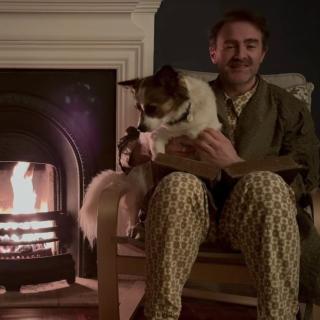
Hi there,
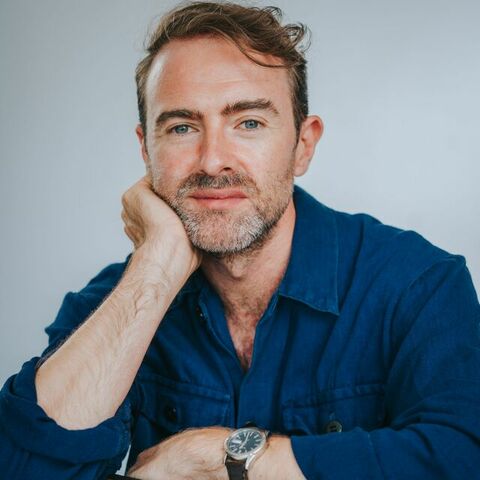
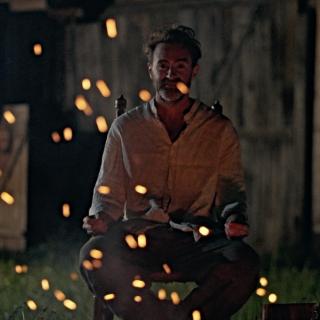
This is Steven.
Before my sleep stories,
These days I like to let people know that I'm a real human being.
I'm a trained actor,
And this is my voice,
As human as anything.
And this is my art,
And my passion.
I love to bring these stories to you,
And I put a huge amount of time and effort into them.
And I hope the humanity comes across.
In what I say.
And how I say it.
With that,
Hello my friend.
Welcome to your sleep story.
My name is Stephen Dalton.
I'm an Irish storyteller,
And it's my great privilege to be the voice that you listen to as you go to sleep tonight.
Tonight we will visit a man called Mr.
Fergus Crumb.
He lives in a little town called Knottbury,
And it's an incredibly slow-moving place,
As is Mr.
Crumb.
And that's kind of the whole point of the story,
That nothing good comes from hurrying.
So you will hear about Mr.
Crumb tonight and how he makes a very positive change on someone who needed some slowing down.
But first,
Let's do the relaxation session,
Which will take a few minutes,
Before tonight's sleep story.
I'm going to count down from 10 to 1,
And as I do,
Allow yourself to let go more and more.
Feel the support.
Of the bed beneath you.
Or the floor.
Or whatever you lie upon tonight.
Beneath all of that.
Feel the support.
Of the Earth.
Our home.
Our constant support.
And as you become aware of that,
Grounding.
Calming support.
See if you can let go a little more now.
Just.
.
.
Ease into this moment.
A little more now.
You.
Are safe.
Tonight.
Allow my voice.
To be a friend.
To be an anchor of safety.
Knows this.
My voice will never take you to anywhere unsafe.
It will only ever take you to safe places.
Places of coziness and comfort.
Places where stories are told.
With a spirit of kindness.
And human understanding.
And allow that vacuum.
To enable you.
To just.
.
.
Be here.
And listen.
And move closer and closer to sleep.
Become aware of your body now.
Feel into your body.
Where are you holding tension?
Where do you perhaps feel pain?
Maybe it's in your feet.
Maybe in your lower legs?
Your size.
Yips.
Your belly.
Your chest.
Your butt.
Maybe your neck or shoulders.
Your arms.
Your hands.
Or maybe you're like me.
Do you hold tension in your face?
Or in the top of your head.
Wherever you're holding tension.
Wherever you're feeling pain,
If you are.
See if becoming aware of it.
Help ease it a little.
Seven.
The day is.
Whatever has been.
Has been.
Whatever will be.
Will be.
Whatever thoughts you might be having.
About the future or the past.
Know this.
Neither of those places exists.
Or that you have.
Is now.
Is this moment.
So choose to be kind to yourself in this moment.
And begin to let go.
If a sword arrives.
Don't fight it.
Welcome it.
It is a part of being human.
See it for what it is.
A thought.
Then don't follow it.
Let it float away.
Like leaves floating away on a moonlit river.
Were clouds passing by.
Through a starlit sky.
6.
Peace.
Lives within you.
I promise you it does.
It is always there.
It is always just.
Waiting to be found.
Wishing.
To be felt.
To see if you can find that peace tonight.
Ask yourself.
Where does it live within me?
Sometimes I think I find it in my chest.
Sometimes in my head.
When you find it.
It can have an immediate effect on your whole body.
Sometimes it can be found.
Through a simple,
Deep breath.
Let's take one now,
Together.
Breathe in through your nose.
And out through your mouth.
Maybe you've found your peace.
Maybe you're on the way to.
Don't force it.
It will come.
If it hasn't already.
Five.
This is your moment.
This is your time.
I love that fact.
To enable you.
To let go completely.
You have nowhere to be.
Nowhere to go.
Allow yourself to indulge in this moment.
For it.
Perhaps allow a little gratitude now.
Gratitude for the simple things.
Are the ones who love you.
And who you love.
The roof over your head tonight.
The breath in your body.
The ability to lie here tonight.
And listen to a sleep story.
Begin to engage with your imagination now.
Begin to see.
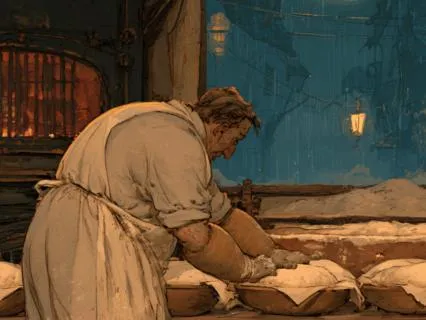
A little rainy village.
An incredibly slow-moving village.
It's night time.
And all you can see is a little bakery.
The warm amber glow from the window.
The baker is inside working.
Mr.
Crumb is ready to welcome you.
Checking in with your body one more time now.
Your body has worked hard for you today.
It's time to give it rest.
End.
Completely letting go now.
As I tell you.
Tonight's sleep story.
In the little town of Knottbury,
Where the streets go up and down like a sleeper's breathing,
And the rain falls soft and often,
There is a bakery.
On Puddle Lane.
Cold.
The rising sun.
Which is a good joke.
If you think about it slowly.
And in that bakery works the slowest baker in the world.
And his name.
Is Mr.
Fergus Crumb.
Everything about Mr.
Crumb is slow.
And always has been.
He is a lord.
Calm.
Flowery man.
With forearms like rolling pins and a walk like a barge coming into moor.
He talks slowly,
In a deep,
Comfortable rumble,
With long pauses in the middle of his sentences.
During which you can hear.
The rain.
He drinks his tea so slowly that it is usually cold by the end,
Which he says is the correct temperature for the end of a cup of tea.
When Mr.
Crumb crosses Puddle Lane,
Traffic does not have to stop for him,
Because in Knottbury,
There is no traffic.
But if there were,
It would have time to go round.
He fitted his town,
Mind you.
Knotbury has always been a slow place.
And proud of it.
The river takes the long way round.
The town clock runs two minutes behind,
And has for a century,
And nobody has ever corrected it,
On the grounds that those are the two most comfortable minutes of the day.
Even the rain comes down without hurrying.
As though it has been told,
Quite rightly,
That there is plenty of sky where that came from.
In most trades,
Being the slowest in the world would be a drawback.
In baking.
It is the whole secret.
For Mr.
Crumb had understood something that hurried bakers never learn.
And it was this.
Bread cannot be rushed.
Because bread.
Like everybody else.
Does its best growing while it is asleep.
That is what rising is,
You see.
When the dough sits quiet and warm under its cloth,
Getting slowly bigger and softer and fuller of tiny,
Dreaming bubbles.
That is the doe,
Sleeping.
And Mr.
Crumb was of the firm opinion that you should never,
Ever wake it before it is ready.
Wake a dough too soon,
And you get a small,
Silky,
Disappointed loaf.
Let it sleep its full sleep all night long.
And in the morning it comes out of the oven golden and enormous and delighted with itself.
Sleep,
Mr.
Crumb liked to say slowly.
Is where the rising happens.
Then you would have some more cold tea.
Because of all this,
The Rising Sun was a bakery that worked at night.
Every evening as the lamps came on down Puddle Lane.
And the rain settled in for its usual performance.
Mr.
Crumb would light the great ovens.
Two of them.
Deep and black and old,
With iron doors and a slow red roar inside.
Begin.
Lighting the ovens was the first ceremony of the night.
And he gave it its full due,
First the kindling.
Laid in a careful lattice.
Then the long match.
And the small new flame,
Nursed along with a word or two of encouragement.
Then the good dry beach logs,
One at a time.
Never two.
Until the deep black throats of the ovens filled up with that slow red roar,
And the iron doors began to tick and creak as the warmth got into them.
And the whole back wall of the bakery,
The wall where the dough would sleep.
Grew gently,
Thoroughly,
Dependably warm.
It took an hour.
Mr.
Crumb would not have mind it,
If it took two.
And oh,
The beginning was a lovely thing to watch.
The flower came down into the big wooden trough like indoor snow.
The water went in.
Warm as a bath.
The East went in.
One careful spoonful to give it something to dream about.
And then Mr.
Crumb rolled up his sleeves and kneed it.
And the needing was the heart of it all.
Push,
Fold and turn Push,
Hold and turn.
Slow and steady.
Over and over.
The doe sighing softly.
Under his big hands.
The oven's crackling.
The rain going pat pat pat.
And the dark shop windows.
He needed the way the sea comes in.
Nobody who watched it ever stayed wound up for long.
And when the kneading was done.
Mr.
Crumb did the thing that he was famous for.
The thing that people in Knottbury told visitors about in lowered voices.
He put his dough.
Along the warm back wall of the bakery stood a long oak shelf.
On the shelf stood a row of round wooden boars.
Like little cuts.
Into each bowl went a soft,
Pale pillow of dough.
Over each bow,
Went a clean cloth.
Tucked in around the edges.
Snoke is a blanket.
And Mr.
Crumb went down the road.
Tucking them in one by one.
Hurting each class.
With one flowery finger.
And saying,
Every night,
To every bull.
In his deep,
Slow rumble.
Good night.
Rise well.
He had done it every night for thirty years.
He did it when he was tired.
He did it when the rain came down sideways.
And he did it on his own birthday,
With the condos waiting in the parlor.
Because a routine is a promise.
And Mr.
Crumb kept his promises.
At the same speed he did everything else.
Completely.
Then he turned the lump down low.
And sat himself in the old armchair between the two ovens.
In the warm red glow.
And let the night do the work.
Such was the rising sun.
And so it had gone on peacefully for years and years.
Until the spring.
When?
Tim Scurry came.
Tim Scurry arrived from the city on the morning bus.
To be Mr.
Crumb's apprentice.
He arrived at a trot,
Because Tim did everything at a trot.
Was a thin,
Quick lad with quick eyes and quick feet,
And he came up puddle lane through the rain like a whippet.
Rat-a-tat-tatted on the bakery door,
Shook hands at high speed,
And said he was ready to start at once.
And where was the bread?
And how fast could they make it?
Mr.
Crumb looked at him for a long,
Slow moment.
Friendly moment.
The way you might look at a kettle.
That has come to the boil.
Rather earlier than expected.
We start,
" he said.
This evening.
This evening.
Said Tim.
What do we do until this evening?
Sharpen Hour.
Patience.
Said Mr Crump.
And went back to his tea.
Tim spent that first afternoon discovering what Mr.
Crumb did between mornings and evenings,
Which turned out to be everything.
Slowly.
Watched him sweep the shop floor at the speed of a minute hand.
He watched him mend a flower sack,
One unhurried stitch at a time.
And sharpen his knives on the doorstep.
Looking out at the rain.
And feed crumbs to the robin,
Who tapped at the window at three o'clock precisely.
As though she had an appointment.
Which she did.
Twice Tim asked whether there was anything that needed doing quickly.
And twice Mr.
Crumb.
Considered the question.
From every side.
Taking his time.
End.
Sad.
No.
Tim's first night in the bakery was,
By his own standards,
A disaster of slowness.
When they mixed,
He whisked like a windmill in a gale,
And was gently relieved of the whisk.
When they kneaded,
He pummeled his dough as though it owed him money,
At triple speed.
Until Mr.
Crumb laid one big hand over his two quick ones and slowed them down.
The way you slow a clock that is running fast.
Push,
" rumbled Mr.
Crump.
Fold and turn.
The dough sets the pace,
Lad.
We just keep it company.
And when at last the bowls were filled and cloth covered,
And tucked in along the shelf,
And Mr.
Crumb had gone down the row,
Saying his good nights,
Tim lasted exactly eleven minutes before tiptoeing back and lifting the corner of a cloth to see how the dough was getting on.
Ah-ah,
" came the deep voice from the armchair.
Without opening its eyes.
Never wake.
A sleeping dove.
I was only checking it,
" said Tim.
It doesn't need checking.
Said Mr Crumb.
It needs.
Believing in.
Sit down,
Lad.
Of some tea.
That's the other half of baking.
And the harder have to learn.
The waiting.
So Tim sat down in the small chair on the other side of the oven mouth.
Jiggling his knee.
And awaited.
And this is what the waiting was like.
The ovens breathed their slow,
Red warmth into the room.
Crackling quietly.
Settling now and then.
With a soft,
Collapsing whisper of embers.
The rain went on and on against the windows.
Sometimes lice as fingertips.
Sometimes thick and steady.
Hushing down the dark lane outside.
Clock above the door tick.
The kettle on the oven top.
Murmured to itself.
Always nearly singing.
Never quite.
Somewhere under the cloths.
Twelve does slept and swell.
Secretly.
Slower than anything.
And in the middle of it all.
Such Mr.
Fergus Crumpet.
With his eyes half closed.
And his hands folded on his apron.
Entirely happy.
Saying nothing at all for half an hour at a stretch.
And then saying something like this.
Reigns changed its mind again.
And then saying nothing.
For another half an hour.
Once in the second week.
Tim asked him what he thought about during all those hours in the chair.
Mr.
Crumb considered the question for the length of one whole log's burning.
The bread,
Mostly.
He said at last.
And the rain.
How the two of them are getting along.
And the strange thing was that once you had sat there long enough yourself,
This turned out to be a perfectly full answer.
And plenty to be going on with.
At some point in the deep middle of the night.
There came a soft knock.
And Constable Potts put his dripping head round the door.
The constable's night rounds were timed with great professionalism to pass the rising sun at the warmest part of the night.
And he stood by the ovens and steamed.
And had a mug of tea.
And reported that Notbury was asleep and behaving itself.
And went out again into the rain.
Buttoned up to the chin.
Leaving a puddle the shape of a small constable.
And Tim Scurry's knee,
Somewhere in all of this,
Stopped jiggling.
You didn't notice it stuck.
That is how that kind of thing goes.
First his knees slowed.
And then his breathing slowed.
Then it starts.
Which had been going rat-a-tat-tat since the day he was born.
They started to space themselves out,
Like lamposts.
But I do.
Further apart.
Until somewhere between one tick of the clock and the next,
With the rain hushing and the ovens glowing.
And twelve does rising invisibly in the dark.
Tim fell fast asleep in his chair.
For the first time in years.
Properly asleep.
Deep and easy.
And Mr.
Crumb looked over at him and nodded once.
Slowly.
Like a man watching a loaf come along nicely.
Tim works.
To the smell of heaven.
The bakery was full of gold.
It was five in the morning.
And Mr.
Crumb huts the oven doors open.
And he was sliding the risen loaves in on a long wooden peel.
One after another.
Unhurried.
As the heat rolled out.
And the rain.
Going grey now,
It's morning.
Streamed down the windows.
The does had slipped themselves twice the size.
Plump and proud under their cloths.
And into the ovens they went.
And out of the ovens in their own slow time.
Came breath.
Round golden loaves with crackling crusts.
Whole rows of them.
Set out on the counter with the steam curling off them.
Into the lamplight.
In slow,
Warm ribbons And then the town came.
They came up Puddle Lane through the morning rain In ones and twos.
Under umbrellas and hoods.
Following their noses.
Because the smell of the rising sun at dawn went down every street in Knottbury like a warm rumour.
In under doors and through letterboxes.
And it was better than any alarm clock ever made.
Which went up sleepy hill.
And a long church row.
And in at the window of the schoolhouse.
The teacher had learned to close the arithmetic books ten minutes early,
On the days the wind was right.
It found Mrs.
Puckett before her kettle did.
There are tones that wake to bells.
And towns that wake to roosters.
And then there is not break.
Which wakes to bread.
Considers itself much the luckiest of the three.
Mrs.
Puckett was always first.
Always.
A small round woman in an enormous Macintosh,
Who had bought the day's first loaf every morning for thirty years.
Had it half eaten by the time she reached her own gate.
Beginning,
As all sensible people do,
With the crusty end.
Then the milkman.
Trading a pint for a bun.
As he had done since before anyone could remember the arrangement starting.
Than the school teacher.
And the two sisters from the wool shop.
And Constable Pott coming off his rounds,
Pink and rain-washed,
For the loaf that Mr.
Crumb had set aside for him.
Without either of them ever having discussed it.
Old Mr.
Tench from the almshouses came for the small brown loaf.
And stayed for the work.
Standing by the window.
With his hands round a mug.
Watching the rain.
In no hurry at all.
He was never once charged for the stunding.
And last of all.
Every morning.
Came the children.
On their way to school.
Splashing up the lane in their macks and boots for the penny buns,
Which Mr.
Crumb handed over the counter,
One at a time.
Slowly.
So that's the choosing,
Current or cinnamon.
Could be given the seriousness it deserved.
To every single one of them.
Mr.
Crumb said good morning.
Slowly.
As though they were all the time in the world.
And there was.
Now that,
" said Tim Scurry,
Watching the warm loaves go out the door into the rain,
Was worth waiting for.
Everything is,
" said Mr.
Crumb.
That's the trade.
Well,
The nights went by and the rain went on.
And Tim's scurry slowed down The way a swing slows down a little less every time.
Comfortably or by itself.
Is needing found the rhythm.
Bold and turning.
Until Mr.
Crumb could hear from across the room without looking.
That it was right.
He learned to make the tea.
And then he learned to drink it slowly.
And Zen.
Artist of all.
He learned to let it go cool.
He learned the waiting.
How to sit in the oven glow with his hands quiet.
And let the night pass through the bakery like a wide,
Slow river.
And how good thinking gets done in that kind of sitting.
And how,
Quite often.
The finest thing to do with the waiting hours.
Is to sleep through them.
Which is exactly what the doe was doing.
And nobody ever called the doe lazy.
He learned the small hours work too.
Which is the tenderest part of the trade.
Sometime after two.
When the does had slept themselves full.
And were beginning to peep over the rims of their bowls of their own accord.
The two of them would go down the road.
Turning each one out.
Onto the flowered board.
Plump and warm and yawning.
And shape them into their proper loaves.
Round it.
And a rose.
Tucked underneath.
And set them out for their first little nap.
The one bakers call the final rise.
Which is just what it sounds like.
Forty winks before the big moment.
The shaping had to be done kindly,
Mr.
Crumb said.
With warm hands and no sudden opinions.
Because a doe shaped in a hurry remembers it.
And soaks in the oven.
And comes out across.
Tim wrote to his mother in the city.
One letter a week.
Going out with Tuesday's post.
The letters got slower and rounder as the weeks went by.
And the fourth one said,
Dear Mum.
I have learned to sit still.
You will not believe me.
So here is proof.
This letter took me three evenings to write.
Loved him.
And there came a night.
At the end of his first month.
When Mr.
Crumb stood back from the long oak shelf.
And nodded at the row of filled bowls and said,
Tuck them in,
Lad.
They're yours tonight.
So Tim went down the row with the cloths.
Tucking each one snug.
All round the edges.
Passing each one with a flowery finger.
Though he could not have told you why.
That this was the proudest job.
He had ever been given.
And at the last bow he paused and glanced at Mr.
Crump.
And Mr.
Crumb looked back at him.
Slow and steady.
Waiting.
Good night,
Said Tim scurry to the doe.
A little shy?
Rise well.
That's the whole of baking,
" said Mr.
Crump.
Settling into his armchair in the red glow.
The rest is flower.
If you should ever pass through Knottbury.
Take the slow road.
There isn't a first one.
The people there will tell you that crumbs bread is the best bread in the world.
They will tell you why.
And the why is the part worth carrying home.
Nothing good can be hurried.
Bread rises in its sleep.
And so do gardens.
And so do children.
And so,
As it happens,
Do quick thin lads from the city.
The rising happens in the resting.
All you have to do is keep warm.
Keep quiet.
And believe.
In the morning.
And mourning.
In Notbury.
Smells better than anywhere on earth.
It is the deep middle of the nice on Puddle Lane now.
The rain is falling small and soft and endless.
Silvering down past the one-lit window of the rising sun.
And inside.
The lump is turned down low.
The two great ovens glow and crackle quiet.
Breathing their warmth into the room.
And the kettle murmurs on the oven-top.
Always nearly singing.
All along the warm back wall.
The row of little cloth-covered bowls sits in the half-dark.
And underneath the cloths,
The does are fast asleep and rising.
Slower than slow.
Fuller and softer.
With every passing hour.
Dreaming their tiny bread dreams for the morning.
Mr.
Fergus Crumb is asleep in the big armchair.
Flower on his forearms.
Hands folded on his apron.
Rumbling faintly on the long notes.
Tim's curry is asleep in the small chair opposite.
Still and easy.
His quick feet quiet at last.
The ovens settle.
With a whisper of embers.
The rain goes.
Pat,
Pat,
Pat on the glass.
And all through the sleeping bakery.
In the warm red dark.
The bread.
Rises and rises.
Taking all the time it needs.
Because mourning.
Will wait.
And everything worth having.
Does its rising.
In it.
Sleep.