Hello and welcome.
I'm Phyllis.
This is yoga for nervous system regulation.
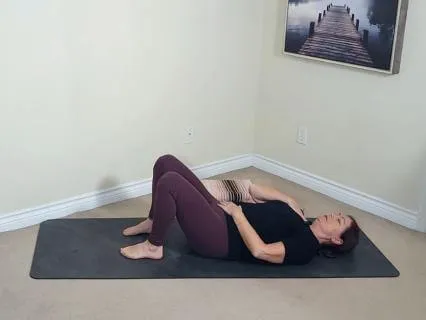
We will do this one all lying down.
So join me on your mat.
You can have a support underneath your head.
If you like,
I'm going to start on her back.
So option to always keep the legs bent here.
You don't have to straighten them out if that causes you any low back discomfort or pain.
Let's settle in with our breath here first.
Just notice the breath moving in and out of the body.
Without any effort.
Notice the belly moving,
The ribcage.
Moving a breath of gently moving the body And then you can place one hand on your belly,
One hand on your heart.
And your upper chest here.
We'll move into a three-part breath.
So the first part.
As you inhale,
Just feel the belly.
Rising on the exhale,
It softens.
One more that way,
Belly rises on the inhale.
Exhale,
It softens.
Two parts,
Inhale,
Belly rises.
And can you feel the lower ribs?
The ribcage expanding.
And then exhale,
Ribcage softens,
Belly softens.
Again that way inhale belly rib cage.
Exhale,
Ribcage,
Belly.
Moving into three parts,
Inhale,
Belly.
Ribcage And now into the upper chest right below the collarbones where the hand is.
And then exhale,
Upper chest,
Rib cage,
Belly.
Two more breaths that way.
Inhale,
Belly.
Ribcage,
Upper chest.
Exhale,
Upper chest.
Rib cage,
Belly.
One more that way at your own pace.
And then just release the arms back down by your side.
Notice how this feels in your nervous system,
In your whole being.
Any effects that it has.
And then we'll pick up one knee,
Bring it in towards the chest,
Give it a little hug,
And then just allow that knee to circle.
Just getting some movement in our hips.
Whenever we move our body,
We are helping to produce synovial fluid.
And when we move our joints like this,
Go the other way.
This is helping to produce synovial fluid in your hip joint.
And then just bring the knee in towards the chest.
Take the leg,
Extend it up perhaps.
Hand can go behind the thigh.
You could also use a strap.
Is flex and point that foot.
And now flex the foot,
Release the arms down by the side and take the opposite arm up.
And you're gonna flex that hand as the foot flex,
And then point the fingers as you point the toes.
So opposite arm,
Opposite leg.
One more.
And then bring that knee in,
Lower it down.
Take the other knee in towards the chest,
Give it a hug.
And then start to circle that knee around.
Notice this side compared to the other side.
Try to stay with that interoception using breath,
Interoception of what we sense within our body,
Knee in towards the chest.
Leg extends up to the ceiling.
Hands go behind the thigh,
Flex and point.
Interoception is what we sense within our body.
Using breath,
Interception,
And gentle movement.
In a regular practice daily can help to regulate our nervous system.
All right,
And now if you want,
You can release the arms down,
Then one arm,
Opposite arm comes up.
Keeping that foot flexed,
You're going to flex that hand and then point the fingers,
Point the toes.
Flex the hand and the foot.
Notice this does take a little bit of core work,
Too,
Holding that leg up.
If it gets too much,
Just bring the leg down.
You can do it with the leg bent.
Last one here.
And then release down.
All right,
This time take the right leg up into a tabletop position.
We're going to take the right hand and press it into the thigh.
As you press the hand into the thigh,
You're going to press the thigh into the hand.
We're going to feel the core start to activate.
Our hips start to activate.
And then just release,
Relax that.
Do that again,
Leg goes into that tabletop,
Hand presses into the thigh.
Thigh into the hand.
You could take an exhale here to help activate the core.
Pull the belly down.
And then relax that.
One more time,
So activating the core.
This also activates our deep front line of fascia.
And then relax that down,
Lower that foot down,
Take the other leg up.
Same hand can go on the thigh.
You could also use opposite hand if you like.
And then again,
We're going to take an exhale,
Push the hand into the thigh.
Notice that you have to use that core to help to activate everything here.
Pull the belly down.
Inhale,
Relax that.
Exhale,
Pushing in to the thigh,
Thigh into the hand,
Pull the belly down.
Make sure the shoulder's not creeping up towards the ear and then relax it down.
Do one more.
Exhale.
And then release down.
All right,
Relax that down.
We're going to keep both feet down now.
And then do a little bridge.
We're just gonna go up into a little bridge.
So if.
You're feeling any pain in your back as you do this,
You're just going to push your feet into the floor and not even lift your hips up.
Otherwise,
You're going to push your feet into the floor.
Can you feel around the big toe mound,
The baby toe mound,
The inner heel and the outer heel?
If you had something underneath your head,
Just take that away from underneath your head.
So you don't have to go very high.
We're just going into a little bridge.
And then lower yourself down.
If you have osteoporosis,
You might not want to round the spine to come up.
You can come up in just one long lever,
So that's always an option.
You don't have to round the spine up.
And then lowering down.
All right,
This next time we're gonna leave the hips up there.
So let's take an exhale as we open up.
Bridge up into whatever amount.
Now inhale arms float up.
And then exhale,
Arms float down.
Inhale,
Arms float up.
Feel the strength of the back body.
Exhale,
Arms float down.
I've just got to move my mic here.
Now,
One more time this way.
Inhale.
And then exhale,
Arms float down.
And then lower your hips all the way down.
Take a moment there,
You might want to bring the knees in towards the chest,
Give a little rock side to side.
All right,
This time we're going to bring the legs into tabletop position.
So knees are over your hips.
You might even want something between your thighs.
If you have a yoga block,
You could do that.
That just helps to activate,
Keep the legs active.
And then we're gonna just move the arms.
So on the inhale,
You're going to float the arms up.
Keep the legs still.
See if you can take them behind you.
If not,
Just leave them wherever they can go.
You're just going to bring the arms right back up.
So just going to whatever range.
If you turn the palms to face in towards each other,
That helps for your shoulders.
So don't worry,
My arms are not going all the way down.
If I do take my arms all the way down,
I find I'm going to want to arch my back.
So I'm not going to do that.
I'm going to take an inhale.
And then exhale,
Let's change the breath now.
So take an inhale while you're here.
Now exhale,
Can you pull the belly in as the arms go back?
Inhale,
Arms come up.
One more here.
And then coming all the way up.
Bring the knees in,
A little hug,
Rock side to side.
Lower the feet down.
We're going to roll over onto one side.
So you're going to want a head support for underneath your side.
I find it's helpful,
Keeps the neck more neutral than our head just dropping down.
You could even have it supported underneath your head here.
Or underneath your,
Have your head supported on your arm.
All right,
Let's take that top arm first though.
And then relax the arm bone into the socket.
So let the fingers relax,
The arm bone,
Feel how that feels.
Weight of the arm bone drops into the socket and then you're going to let that arm start to circle.
You can go big or small.
This can be nice if you have frozen shoulder,
Just keeping the movement small.
Nice and slow.
Again,
What do you sense within your body?
Sometimes we can get used to just rushing through a movement.
You do my classes,
You'll find there.
Slow.
.
.
Mindful,
Mindful movement.
Alright,
This time we're going to bend that elbow.
Let the elbow bend and now allow your head to roll with that arm as you go into a little twist.
So you don't have to go all the way.
You're just going to take an inhale there.
And then exhale coming right back.
Let's keep going with that.
Sorry,
It's moving my mic.
So inhale.
You let the head roll and the body can move too,
This is the upper body.
Now you can keep that arm bent the whole time if that feels better for you,
Or you can straighten the arm.
Sometimes that adds a little more strain to the shoulder,
So if that doesn't feel good,
You're going to bend that arm.
Next time,
We're going to add that top leg.
So when that arm comes back behind you,
Then that top leg maybe goes in front of you.
That doesn't feel good for your back.
You're going to not use that top leg.
Now,
The next time the arm comes in front of you,
You're going to let the leg go behind you.
And then don't worry if the leg doesn't go straight at all.
We're just getting a twist in the body.
Again,
Always opting out on any of the movements.
The wall's in my way,
So I'm not straightening my leg behind.
I'm keeping it bent.
All right,
One more here.
And then coming back.
And then relaxing that down on that side.
And then switch over to the other side.
I'm just going to face this way here.
So make sure your head feels supported,
Legs are bent.
Take that top arm up.
And then really relax the arm bone into the socket.
Relax the fingers.
Keep the elbows soft.
Allow that arm to start to circle.
Notice how that feels.
In this shoulder compared to the other one.
Go the other way.
Hmm.
All right,
Now you're going to bend the elbow.
You could keep the fingers on the shoulder the whole time too.
And you can even go just a teeny bit,
Maybe where you're just even looking up to the ceiling.
So if that feels enough for you,
Then that's what you're going to do.
Try not to force your body.
So we're trying to work with our body,
Not against it.
So if you want to go further back,
You're making sure the head rolls with that arm.
Now,
If you want to add a straight arm,
You could straighten that arm out.
So my wall's in the way,
So I'm going to keep my arm bent.
And then the next time that the arm goes back,
Head goes back,
You can take that top leg and extend it forward.
And then top leg back,
Top arm forward.
And then Inhaling And exhaling,
Let's do one more here.
So if this doesn't feel good for your body,
For whatever reason,
Please omit some of the part you want this to feel nice.
And then you're going to come right back to center.
All right,
And then we're going to push ourselves up.
And then just maybe sitting up on your prop here.
Or you can sit in a chair if you want to.
Wiggle the shoulders around first.
Maybe tipping the head a little side to side and then just tipping the head over to one side.
Take the opposite hand and walk the fingers a little bit away.
You're just stretching out that arm a little bit and then you're going to turn your head towards that armpit.
Ear goes back to the shoulder.
And then let the arm come in as the head comes up.
Other side,
Gently tipping your head over.
Opposite hand,
The fingers walk out.
If you're sitting in a chair,
You could walk your fingers down the chair maybe.
Turn your gaze or nose down towards the armpit.
Ear back to the shoulder.
And then walking back in as the head comes up.
And now take the palms,
You're gonna bring them together,
You're gonna rub the palms together.
And cupping the palms over the eyes,
Take a nice deep inhale here.
And an exhale out through the mouth.
And then you're going to take the fingers and you're going to make a little You can either do.
.
.
Spock hands or just peace fingers here.
We're going to take the fingers just by the ears and we're going to start to gently rub down.
So we have the vagus nerve.
I like to do it with all my fingers here gently.
Vagus nerve runs from the brainstem through the ear down the side of the neck.
So we are helping to activate,
Giving ourselves even a nice self-massage.
This is good for the lymph as well.
There's lymph glands that come down.
The side of the neck.
One more here.
And now take your two fingers together.
You're just going to take them just above the eyebrows.
Do a nice gentle massage across.
Just a nice gentle massage across,
Nice light pressure.
And then take the fingers to the temples.
Gently circling around.
And then start to go down in front of the ear.
Nice little gentle circles.
And then let the fingers run along the chin.
And do that again,
Just let the fingers run along the chin.
And then release the arms down.
Notice how this practice feels for you.
Notice any effect.
And thank you so much for joining me.