It's good to be back,
Good to see the sun's going down,
So we're returning to the normal conditions of the friend's meeting house.
Yeah,
A couple times ago that I,
It must have been January,
I think it was January when I shared here,
I think I mentioned that I wanted to call into this space one of my teachers.
Her name is Venerable Panyawati,
And I called her kind of into this space,
Summoned her because I had found out a couple of days earlier that she went into hospice.
And so she passed away,
I guess about a month ago,
So a little bit more than three weeks ago.
And so it feels a little bit appropriate to not only,
You know,
Call her into the space again,
But to actually just offer a talk in her honor.
Maybe this talk is a little bit of a ritual for me,
You know,
Some way of,
Like making her an ancestor,
Something like that.
So I'll offer a little bit of a biography,
And then,
I'm feeling emotional already,
You know,
A little biography and then a little bit about,
You know,
What I learned from her,
What I saw in her.
So,
She was born in 1950,
Obviously died in 2026.
She was born with the name Diane.
I don't know if I ever heard her last name.
And I know she grew up in the South and eventually at some point grew up in Washington,
D.
C.
,
And I don't know in what order these things happen.
I know D.
C.
Is technically the South,
Right,
But she grew up in D.
C.
And spent a lot of time also in North Carolina.
Grew up in a very Christian household and had a very deep Christian faith herself.
She was like musically inclined.
So I think she became the church organist,
You know,
At like 10 or 11 years old,
Something like that.
But I'm calling her Venerable Panyawati because she was also a Theravada nun.
So obviously something happened in between,
Right?
But she was a Theravada nun.
She was ordained in the Chan tradition.
She was a lineage holder for the Zen peacemakers.
She had Vajrayana empowerment.
And she spent the first half of her life as a Christian pastor.
So there's a whole lot to Venerable Panyawati.
Yeah,
So when she was 13 years old,
She was in Henderson County,
North Carolina,
With her aunt.
And so this would have been,
If she was 13,
This would have been 1963.
Henderson County is a very white county.
And Panyawati,
Or Diane,
Is black,
Was black.
And as a 13-year-old,
She was walking down the sidewalk and failed to step aside when a white man walked by.
She didn't step off the sidewalk.
And this resulted later on that day in a visit from the KKK to her aunt's house.
And the Klansmen showed up and scolded young Panyawati,
Scolded her aunt,
And made her spank her for having disrespected a white man this way.
And 13-year-old Panyawati said,
I'm never coming back to Henderson County ever again.
Little did she know that—probably not a good time to do math—40-something years later,
She would establish a monastery in Henderson County,
North Carolina.
But she wasn't thinking about Buddhism then.
She followed the Christian path.
She had a very layperson life.
She had three husbands,
A bunch of kids,
Owned a business,
Became a Christian pastor,
Got a Ph.
D.
In religious studies.
And sometime in the 1980s,
So in her 30s,
She had a crisis of faith.
And it wasn't so much a crisis with Jesus,
So much as a crisis for her with Christianity.
In fact,
If she were to tell the long story,
She would actually say that Jesus is who led her to the Buddha.
It's just kind of not your typical trajectory when you think of things like this.
But she went through what she characterized as kind of like a deep searching and a dark night of the soul for 10 or 15 years,
Eventually found the Dharma.
So the dates are a little blurry here.
But she eventually was ordained as a Theravada nun.
And if you read some of the earlier articles about her interviews,
They call her the only black nun and certainly the only black Theravada nun.
And she would kind of like put her hand up and go like,
Hold on,
I'm not the only one.
I think there's been other black women who became nuns,
But none of them stuck around.
Right.
So I wasn't the first,
But I'm the only one currently,
Is what she used to say.
And of course,
That's changed in the years since.
So she did something relatively rare.
For those of us familiar with the Theravada tradition,
She found her way to getting full ordination.
And I'm not sure how familiar everyone is in here with kind of like the patriarchal,
The sexism,
The stuff that exists in the structure of the monastic Sangha and the Theravada tradition.
But in a lot of countries,
It's very difficult,
If not completely illegal,
For women to gain full ordination in the same way that men can.
And there's a history to it and a precedent to it.
And we don't need to go down that rabbit hole.
The point is,
Is that the patriarchy in certain places has made it very difficult to re-establish the women's Sangha.
But she found her way to get ordination as a bhikkhuni,
And eventually became kind of like a champion for women's ordination.
But I'm getting ahead of myself a little bit.
Because she did return to Henderson County in 2004 and founded a monastery in this very white town of Hendersonville in Henderson County,
North Carolina,
The very county where she had this encounter with the clan many years earlier.
In fact,
When she founded the monastery,
Local clansmen parked their car outside the monastery during the daytime for a couple of years just to let them know that they were there.
And they were scared to put the Buddha statue outside the monastery for fear that it would get defaced.
And they didn't do that for a couple of years.
Until the community kind of got used to them.
Who are these people dressed strange?
And eventually the community started to embrace them there.
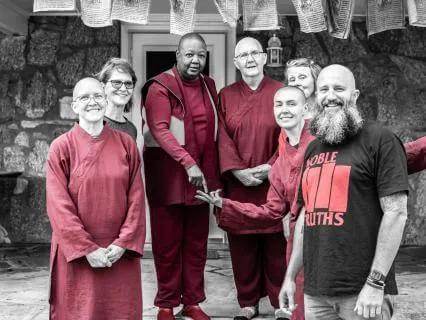
Now this monastery that she founded initially was just called the Embracing Simplicity Contemplative Order.
And eventually would become Heartwood Refuge,
Which was a meditation center and retreat center there in Hendersonville in North Carolina.
And as part of her training people,
She ordained more than 100 lay ministers and what we call Dharmacharyas.
Myself and Noelle,
My wife,
Happened to be two of those people.
In 2008,
She won the Women in Buddhism Award in Thailand.
But I feel like even that doesn't tell the whole story because it's like,
Why is she getting the award?
So this is where really talking about what Panyawati did is important.
Because as I mentioned,
She did all this advocacy for women monastics.
And so she went to Thailand where women could not get ordained.
And found monks who are willing to serve as preceptors and whatnot.
And managed to get in a country where women were not allowed to get ordained.
Got 50 full ordinations for Thai women.
And then went to Cambodia,
Where women were not allowed to get ordination.
And got 10 ordinations of Cambodian women.
And so that's some of why she won this award as Women in Buddhism in 2008.
But that's not actually just it either.
Because when she first founded this monastery in North Carolina,
Nobody stayed there.
There was like nobody living there.
It was just her and a couple of the nuns and her partner,
A monk whose name was Panyawati.
Also one of my teachers.
But he had all these empty rooms and all this empty space.
And she kind of became aware that there were all these homeless kids in this area of Henderson County.
Hendersonville,
All the way up to Asheville.
And she said,
Well,
Why don't we just house them then?
And so in the early days of the monastery,
She started to house all of these kids.
You know,
Foster youth who'd been,
You know,
Kind of like left the system or run away.
Kids pushed out of Christian communities because of their sexual or gender identities.
Victims of abuse,
Physical,
Sexual.
Kids with addiction issues all came to live with Panyawati and Panditipa.
And at the beginning,
It was just kind of like a housing project.
And next thing you know,
She's got a whole apprenticeship program.
And they're teaching them how to bake.
And now they've got like a licensed apprenticeship to teach them how to become bakers.
And now they've got this whole program that becomes a thing called My Place.
So they're supplying gluten-free goods for bakeries and stores and restaurants.
And it's like supporting itself.
And it kind of like went off on its own and it started,
It became its own organization,
Doing good in the world.
And she kind of like,
Well,
What's next?
What's the next challenge?
And right around that time,
She got a letter from a Dalit village in India.
And if you don't know what a Dalit is,
It refers to what are called the untouchables.
These are folks within the traditional,
Very traditional Indian caste system,
Who were considered the very bottom.
Like not really even within the framework of the caste system,
Kind of like outside the caste system.
They're so low,
So low that if their shadow crossed like a Brahmin,
Then they could be harmed or worse.
And she got a letter from some folks in these Dalit villages,
Like,
Would you like to sponsor us?
Would you like to help us?
We looked you up on the internet.
You seem like the right person.
So that's what she did.
She started sponsoring these Dalit villages and provided education,
Sanitation,
Water,
And toilets,
And helped them establish these egalitarian communities,
Kind of built on Buddhist principles.
The folks in the Dalit villages were like perfectly willing to give up their quote unquote,
Like Hindu kind of lineage,
Because to them,
It hadn't done anything for them.
And so she started actually offering the refuges and the precepts to the folks in these Dalit villages that she sponsored,
And then ordained the first Dalit nun.
Right?
And now maybe we know a little bit about why she got the Women in Buddhism Award in 2008,
You know.
But that's like the bio part,
You know,
Like that's the Matt's version of Wikipedia part,
You know.
The first time I heard her speak was in this room,
And I feel like Vicky,
You and I were talking about this somewhere around 2012 or 13,
Somewhere in that realm.
And it would have been in the Thursday night group here.
There used to be a Thursday night group that sat here.
And she was kind of making a circuit,
I think visiting like Spirit Rock and other insight tangent groups.
I was just struck by like the way that she talked about the Dharma,
The way that she talked about herself,
Was not something that was familiar to me.
She had this unique voice,
And it was unique because it was just her voice.
You know,
She had this Southern accent,
And she was just this tiny,
Tiny person,
You know,
Like this tiny person with like this,
Like just so much power and so much energy,
But like so much clarity,
And like so much willingness to just talk truthfully about her own past.
I remember being struck by the fact that she was talking about her life with her three husbands,
And the way she was acting a fool back in the day,
And the way that she talked about her own sexual assaults,
And the way that she talked about all of these things and wove it all into the Dharma as like a life of the Dharma,
You know,
A Dharma life.
And I didn't think anything other than like,
That was a really cool talk I heard tonight,
And I wouldn't come to study with her until many years later.
If I was to like characterize her teaching,
I would call it,
And this is a phrase she used often,
And I would say full spectrum Dharma.
And this means like so many different things,
But I think the first thing that comes to mind is just the fact that she was willing to draw upon her Theravada tradition,
Her Chan tradition,
Her Vajrayana tradition,
The Zen tradition.
And if you ever sat for Dharma talks,
She knew she brought Jesus into it sometimes too,
Right?
Like there was a,
Whatever was the Dharma was the Dharma to her.
It didn't matter if it like came from a particular lineage.
And so I think she would characterize herself as a non-sectarian Buddhist teacher,
You know?
A quote from her,
She says,
There's 84,
000 Dharma doors.
And she's speaking about all these different lineages and the different practices within each one.
She says,
There are 84,
000 Dharma doors.
In our Sangha,
There are some people who are digging the foundation for the house.
There are some people who are building the house,
And there's some people who are adorning it.
And that all these different practices and this whole spectrum within the different lineages of the Dharma are just things that are meant to meet different people's needs or stages of the path.
And they're all welcome.
Because we got to build a house.
We got to dig the foundation.
We got to adorn the house.
We got to do all those things.
And we need people doing all those things.
But full spectrum Dharma,
Like also kind of refers in addition to lineages,
It refers to the way that she didn't believe in censoring the Dharma.
She didn't believe in like silently omitting parts of the Dharma because it might make people in the Sangha uncomfortable,
Right?
So she would not hesitate to talk about rebirth.
She would not hesitate to talk about big karma,
Like karma beyond this lifetime.
She would not hesitate to mention that she had talked to Deva last night.
She would never tell us the content of those talks that she would have with Devas,
But she let us know that one visited last night.
And sometimes those things can make folks,
Myself included,
You know,
Thinking,
Oh,
There's a little discomfort around it.
Because like I found as many people who are in like convert Buddhist communities probably find things like the insight tradition kind of welcoming in a way because it doesn't necessarily have all of the,
We'll call it the fluff or the woo,
Right?
And so sometimes when I encounter the woo,
There's like a little friction there,
But she's like,
Just because it makes you uncomfortable doesn't mean it's not there,
You know?
And so she was kind of like become open to this full spectrum Dharma,
Tried to become open to it.
And another way this full spectrum Dharma would show up is when I started training with her in her Dharmacharya program,
I remember the first time I got on Zoom and there was like all these different faces and I met them for the first time.
I'm like,
This is a really motley crew I'm doing a training with,
Right?
Like these folks were from so many different walks of life and I was a little judgy,
Like a little bit of judgment in there and not like in a negative sense,
Like judging,
Like looking down on people,
But when it was her that would say this and it was in this capacity of like working with these people and working with her that I started to see that there are as many ears for the Dharma as there are mouths for the Dharma.
And then it's each individual's lived experiences and the way that they can uniquely express the Dharma that makes them uniquely positioned and situated to share the Dharma with at least one other person on this earth,
You know?
And I started to see that the people that were in this training with me were folks who needed to be there and they're the folks that the Dharma needed to have.
And so the Dharma needs a full spectrum in terms of the way it's shared with people.
So kind of back to that non-censorship thing,
You know,
We were,
I was in a small group,
It was a small group of people and we were with Panyawati and she was talking about big karma and she was talking about rebirth.
You could tell that there was a little bit of resistance in the room.
And I think I probably offered a little resistance.
Like,
Can it just be,
You know,
This lifetime,
You know,
Can it just be like whatever I do today,
You know,
Like tomorrow,
That sort of thing,
You know?
And she could sense this view that I was clinging to,
Right?
And she said,
Matt,
You don't have to believe anything but you absolutely must stop disbelieving everything.
Because disbelief itself was the problem.
And she said something like,
Your disbelief that you carry with you is a view itself and it will stop you from progressing on the path.
That disbelief will prevent further progress.
And she didn't like mince words about things like that.
You must let go of your disbelief.
Another thing I think I would characterize her in addition to this full spectrum dharma is that,
You know,
We all come through this door and look at the first noble truth.
And so we all kind of come through the Dukkha door,
Right?
We're coming through the door of suffering.
But she was not about that.
She was like,
Sure,
There's suffering.
Sure,
We need to understand it.
But can we leave the Dukkha door behind and walk through the Sukkha door?
Can we talk about joy?
Can we talk about happiness?
Can we talk about contentment?
Let go of the suffering,
She would say.
Sure,
We suffer.
But we suffer because we are clinging to things that are unreliable.
She assured us that there was a reliable source of happiness.
There is definitely an unreliable source of Dukkha.
And there is a reliable source of Sukkha.
There is a reliable source of happiness.
And she emphasized joy.
She emphasized that this is a path towards freedom and a path towards joy and a path towards contentment.
Not a path just of avoiding suffering.
Not a path of just like,
Woe is me.
We're all gonna die in permanence.
You know,
That's just the first half of the four noble truths.
There's a second half,
Which is we don't have to do that anymore.
And we can enjoy that here and now before we're awakened too.
We don't have to be enlightened to like stop suffering a little bit,
You know.
She said,
It isn't just about being here now.
But recognizing that there is an end game.
You have to know where you're going.
Otherwise,
You will never recognize it when you get there.
And the thing is,
Is we sometimes get there all the time.
But because we don't like pay so much attention to the end game,
We might not recognize when the joy,
The wholesome joy and the wholesome qualities arrives.
You know,
Like when the paramis arrives.
And so she really stressed a lot of the time this idea of assessing your progress.
As part of the training,
She would have us go through and like,
You know,
Stream entry,
Once returner,
Non-returner.
Like,
Where are you?
And then like the different personality types.
Like,
Where are you in the Vishuddhi Magga?
Like,
Who are you?
Where are you?
Like,
How do you walk in the world?
How do you meet the world?
What accomplishments do you have?
These are things we don't talk too much about often in the insight tradition,
But like,
They're there.
And she encouraged us to,
You know,
Assess where we're at.
She encouraged us to study the Dharma,
Listen to the Dharma,
Share the Dharma.
And then perhaps like most controversially is that she thinks that meditation,
When you start,
If you come to the practice and you start meditating,
She calls that beginning at the back of the book.
She's like,
That's backwards.
She stressed the importance of conduct,
Of learning the Dharma,
Of getting in touch with what we think of as right view,
And learning ways of practicing right view with your bodies,
In the world,
With action in the world,
So as to change the mind.
She called meditation pleasant abiding,
Which is sometimes you see that mentioned in the suttas as well.
She called it that because when you act in the world as best you can,
As an expression of the virtues we talk about in the Paramis or in the precepts,
Then meditation becomes pleasant abiding.
She says,
We need to be extremely clear about what cultivation is and why we are doing it.
The Buddha Dharma can only be obtained through virtuous conduct.
That's what she says and invites us to actually practice generosity and practice kindness.
And as strange as it sounds,
Practice joy,
Practice love.
Don't wait for the meditation to change you.
You can act your way and eventually the meditation will change too.
One of her favorite things to say when it comes to like the way we meet the world is to overlook a slight and tolerate a fault.
You don't have to react to the world all the time.
What if he met all that with kindness anyhow?
So she called herself a cultivator and not a practitioner.
And that she cultivated her mind through good action and good works.
She even like felt that way about some of the more dense topics we think of in the Dharma,
Like selflessness or anatta.
You know,
We can all,
If we want to drink like some mean cups of coffee and have some intense conversations about what non-self means,
Right?
And dependent origination.
And we can get like really nerdy about all these things.
And she'd be like,
Settle that aside.
What does selfless look like in action?
What does selflessness look like in action?
I think I shared here a year,
It might've been a couple of years ago now,
But a story about when there were those fires in 2020.
And I was working with her at the time and we had those fires up in the Santa Cruz mountains and I used to firefight.
And I went up there and I joined like a little rogue firefighting crew.
And on my way up into the fire,
It was very scary.
You know,
Like the sky was black and it was still daytime.
And I didn't turn the recirculating thing on in my Prius.
So I was,
The smoke was coming through the vents and like my body had that physiological reaction and there was fear.
And they're like,
Should I be here?
And of course,
Fear like that is very selfish,
You know?
And then I found the people that I was gonna be doing this with and all the fear disappeared.
The danger didn't disappear.
The fear did.
Like when we are in community and we are acting this way or this is like a selfless action.
And this is what she encouraged us to get in touch with.
Find selflessness by acting selfless.
When things are going well,
She says,
It's all good to sit on the cushion.
But when things are not going so good,
We have to get up.
We have to do something.
You can interpret that however you wish because I think there's like lots of different ways of interpreting that.
I think you can interpret that to be when things aren't going so well on the cushion,
It probably means things aren't going so well in your life either.
But it could also mean if things aren't going well in the world,
Get off the cushion and go do something about it.
Because that's certainly how she was.
She was very boots on the ground kind of Dharma.
I almost called her a practitioner,
Sorry.
She also said,
The monkey mind is gone when I do work for others.
When your generosity is getting perfected,
There is no thought of I.
There's just doing.
And that's very Zen,
That last part.
And finally,
She loved talking about dying.
She had a lot of joy in it.
But there was a joy in her in talking about death,
At least since I was working with her.
I don't know if she was always that way,
But maybe the latter stages of her life,
She thought about death a little bit more.
So she really liked talking about it.
She was always telling us she was on her way out,
Which,
As we know,
Is true for all of us.
So I guess she wasn't lying there,
But it always felt like every time you saw her,
Like,
I ain't gonna be living much longer.
She was always saying stuff like that,
You know?
So I had a heart surgery in 2021,
And she just was so tickled by this,
Right?
Like,
Because it was the first time my heart was gonna stop since it had started.
So like,
To her,
This was like really exciting,
You know?
And she's like,
How many procedures are you having?
I had these various procedures I was gonna have to take care of leading up to the surgery where I would go under.
She's like,
This is fantastic,
Man.
You get to practice dying every single one of those times,
You know?
Like,
What if going to the hospital was like,
That was your last drive every time?
What was that like?
And I had to report to her what it was like,
You know?
Like,
Going to the hospital on my way to dying and then do it again,
Going to the hospital on my way dying.
And I still remember one of those drives.
And the memory that stands out the most is a picture of a man who was struggling to put his ladder up on top of a work van,
And that somebody walking down the street noticed that he was struggling and came over and helped him put the ladder up.
It's like,
That's what stands out,
Like this kind of helpfulness.
And then when I had the surgery,
You know,
And we talked afterwards,
She's like,
Did you talk to any Devas?
And I,
She was so excited about him.
And then like a year and a half and ago,
I had like a cardiac event,
Climbing a sand dune out in Death Valley.
It was kind of terrifying,
Right,
Noel?
It was a little terrifying because,
You know,
There was no rescuing where we were.
And it turns out that Panyawati had a heart attack the same day.
And so we,
When I got home and we had this conversation on the phone,
She was so excited to talk about our near-death experiences,
You know.
We both shared this interesting experience of like getting in touch with the part of the mind that clings to life.
And then at that moment,
We weren't quite ready.
But per usual,
Last year,
She said,
I'm on my way out.
And this one felt more real,
Mostly because all the nuns that lived with her told us,
Told me it was like a little bit more real this time,
You know.
So I did fly out to North Carolina last spring to visit her for,
With the intention of seeing her for the last time,
You know.
And we had lunch.
We talked about the Dharma.
We talked about dying.
And we talked about a fellow dharmacharya,
Another person who'd done the training.
Her name was Christy Bates.
And we talked about her.
And because she had died maybe a month earlier.
And we talked about like how uncomfortable we are when folks are dying around us to say the words goodbye.
Because we have the discomfort with the finality of it.
Like,
Well,
Even if we know we won't see someone again,
We kind of go like,
Toodaloo,
See you tomorrow,
Or something like that,
You know.
It's very hard to just say goodbye.
And then we were out on the porch of the monastery and she was in her rocking chair and we kept talking the Dharma.
And we kept talking dying,
You know.
And then I knew it was my time to go.
And so I stood with her on the porch of the monastery and I gave her a big hug.
And I held her shoulders like this.
And I said,
Thank you.
I love you.
Goodbye.
And that's the last time I saw her.
I'm not sad.
You know,
Even when she died,
I'm not sad.
I'm not sad now.
I think the emotions are just more around like the beauty she brought into my life.
But no coming,
No going,
She said.
So I will close with something that would be very Panyawati.
You know,
When she was talking about the bhikkhunis living,
Or I guess we'll just say they weren't even bhikkhunis yet,
The women who wanted to become full-fledged members of the monastic sangha.
So living in this,
With this desire to be full-fledged nuns,
But having like the oppression of the patriarchy within the sangha there.
And when she talked about the dalits living in this oppressive caste system.
And she talked about how,
Like in their capacity,
When they were oppressed,
They were kind and they were gentle and they were loving and they were all those things.
And she related that to,
There's a story in the suttas where the Buddha talks about a servant and a master and a servant being kind and generous.
And like basically knowing what the master needs,
Right?
And true to Panyawati form,
She would go and she would like blend this with like maybe something from the Bible.
And she would say,
Yes,
Be kind,
Be generous,
Meet people's needs.
And then from 1 Corinthians 7.
21,
But if you can find your freedom,
Seize it.
And this is what she did for other people.
Be kind,
Be generous,
Be thoughtful,
Meet other people's needs.
And then when it's time to find your freedom,
You seize it.
And so I'm going to ring this bell.
And in some capacity,
For me at least,
Panyawati is my ancestor.