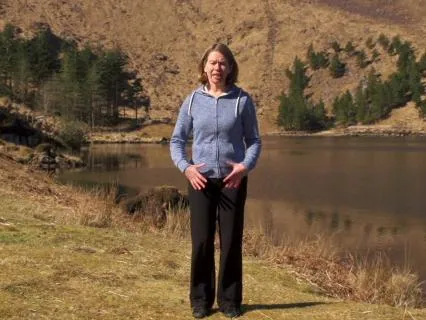
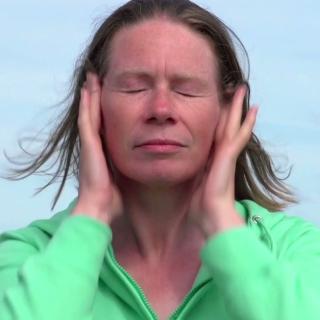
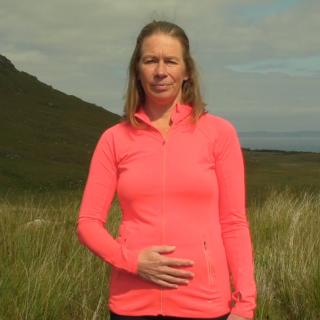
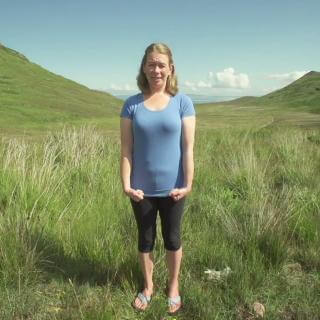
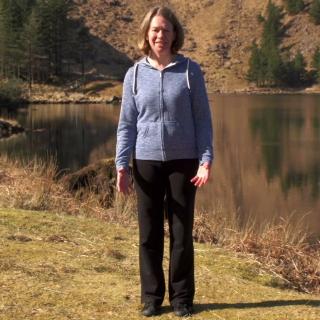
Today we're going to talk about the standing position in Qigong and this is very important because it's the basis of most of the standing exercises that I'll be taking you through during this program.
So we'll do that first and then I'll talk to you about something else a little bit later in this video as well.
Okay,
So the first thing we need to look at is the position of your feet.
So your feet are very important to give you that grounding and what you might want to do is just have a look down and check and see are your feet parallel?
If you look at my feet now they're dead parallel,
They're not facing out like this,
They're not in like this,
I haven't got one foot out to the side so that's very important to give you that real stable grounding for your standing position and then your knees are just very slightly bent,
There's softness in the knees so that the knee joints are not locked out.
The next thing you want to check is the position of the hips and the lower back area.
Now for this,
The easiest way to do it is just to place one hand on the lower back and one of your hands in on your belly.
And then what I'd like you to do is just stick your bum out and round the spine as much as you can.
And see for yourselves how tight that feels just in the back here,
In the vertebral area.
You can feel all the vertebrae of the spine being crushed.
Now what I'd like you to do is move from that position and tilt the pelvis forward so you're tucking your bottom under and flattening the back and as you do that what you'll feel is that the whole spine starts to open up and you feel that the space there and that allows the energy or allows the chi to flow up and down the spine much more freely.
Then for the upper part of the body,
The shoulders are just nice and relaxed and the hands just dangling down.
From the shoulders,
Just loose and relaxed by the sides.
The next area that's quite important to have nice and open is the vertebral area in the neck.
So again,
With the neck you want to make sure your head's not tilted completely down.
Or right back like this so the way in which you do that is just imagine that your head from the very top of your head is being pulled up by a string right from the top and that will give you that little bit of length in the back of the neck and at the same time as that's happening what you'd like want to do is just tuck the chin in very slightly so just dipping the chin in and you'll really feel the neck then opening up at the back so again that's promoting the free flow of chi and of energy up and down the whole of the spine and going into the head.
That's the position for the stance,
So nice and relaxed.
And just now for a couple of seconds,
Just close your eyes.
And just practice your abdominal breathing.
Which you learned in the last video.
So just breathing in and out through the nose.
And making sure that the mouth is closed.
The tongue is resting against the roof of the mouth.
And the tip of the tongue is resting against the back of the upper teeth.
So as you breathe in.
Your belly expands.
And as you breathe out.
Your belly.
And remembering to combine.
The breath.
And the mind together.
So breathing in and catching the head of the breath.
First bit of the breath as it comes in through the nostrils,
Following it down with your mind.
And then breathing.
Back out as you exhale.
Following.
Back up and out.
Through the nostrils.
And consciously letting that breath go.
Out of the nostrils.
And what you might find is that now you're in the correct position for the smooth flow of qi and of energy.
Then you might find as you start to do the abdominal breathing that you start to move or be pulled in one direction or the other.
So this could be swaying from side to side as I'm actually doing now or it could be due to it could be one being pulled in one direction or the other so to the right or to the left Or it could be that you feel like you're going around in circles.
So it's different for everybody and all it is,
Is it's showing you that you're nice and relaxed and that three different things are happening.
So my energy is flowing around freely.
So.
That's causing part of the movement.
The second thing that can cause this movement to happen is just the circulation of blood.
Around your body so your heart is beating there's movement going on even though you think you're standing still there's movement going on on the inside so that can cause this as well.
And the third thing that can cause this to happen is the rotation of the Earth,
Just the movement of the Earth.
So when you get into a nice relaxed position like this.
You'll find that you start swaying.
And sometimes people get so relaxed that they lose their balance and they fall over.
So that would be something to be very careful of.
So just try and stay with it and do a little bit of swaying,
But not so far,
Obviously,
That you fall over.
So this is really just getting you into the correct position for some of the exercises which will be following this.
But this exercise of standing in the qigong stance is an exercise in itself.
And again,
From the point of view of integrating it into your day,
You can do this while you're standing in a queue,
You can do this when you're standing anywhere that's quiet.
You may not want to do all the swaying,
But you can certainly make sure that you have that openness in the lower back area,
The softness in the knees and the openness in the neck as well.
Standing up nice and tall as though the head's been pulled up by that string.
From the very top of the head there and then just tucking the chin slightly in.
So this is an exercise you can practice and just at the same time combine that with the abdominal breathing that you've learned already.