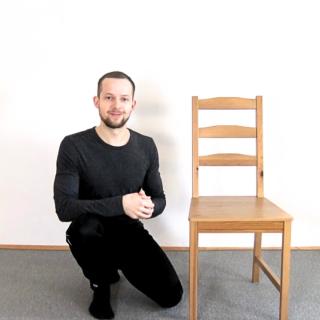
In today's Feldenkrais lesson.
I'm going to guide you through a somatic movement sequence.
That will help you to improve your turning.
And to reuse neck and back paint.
Make sure you feel comfortable all the time.
So feel free to take as many breaks as you like.
And please make the movements as small and as slow as you want to.
You might want to close your eyelids once in a while.
To improve your sensations of yourself even further.
It will not be necessary to watch the video.
Just let my voice guide you through the movements.
If you are new to the Feldenkrais method.
I also recommend reading the video description before getting into the session.
Please find yourself a comfortable spot on the floor.
And enjoy.
Please sit down on your back.
Rest with long arms and legs.
And sense the overall contact that you are making with the floor.
Sense the parts of yourself that are touching the floor.
And also sense the parts of yourself that are not in contact with the ground.
Now slowly.
Roll your head to the left and back to the middle.
And then to the right and back to the middle.
And notice.
.
.
Is it easier to turn to one side?
You can roll your head a few times.
To sense the differences.
And then bring the movement to a stop.
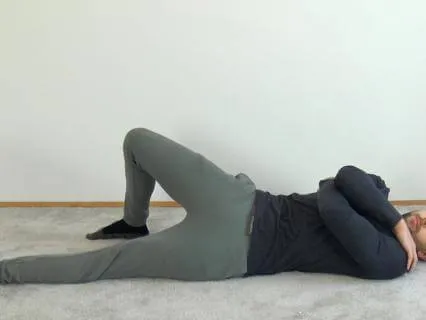
And bring your right leg to standing so your right foot is flat on the floor and the knees pointing towards the ceiling.
And now start to gently press the foot into the ground.
And roll your pelvis to the left.
Then bring the pelvis back again and reduce the pressure with your foot.
Repeat this movement a few times.
And sense how is this movement traveling throughout yourself.
So you press the right foot into the ground.
And this will lead to.
The rolling of the pelvis to the left.
And this rolling of the pelvis might also affect your spine.
So you might notice that your spine kind of wants to join into the turning movement as well.
You might notice that your left shoulder has more contact with the ground.
And the right shoulder less contact as you're doing the movement.
And maybe even your head.
Might react to the movement.
So sense doesn't have a role in any way.
What is your long left leg doing?
Is it also rolling to the left a little bit?
And then please take a short break.
And you can lengthen your right leg again.
Now put your right hand onto your left shoulder.
So your right arm is kind of crossing the midline.
And you place the right hand on your left shoulder and the elbow is bent.
Then bring your left arm under your right arm and put the left hand somewhere close to your right armpit.
Or the right reefs on that site.
So it's the right arm that is on top and the left arm is on the bottom.
Both elbows are bent.
This is a position that we often call the self-hug in Feldenkrais,
So self-hugging.
This is what the position looks like.
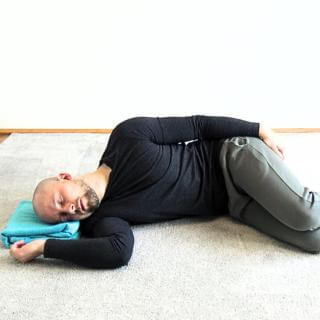
Usually called like so the arms are not crossed it's one arm on top of the other one in this case it is the right arm on top of the left arm slowly start to roll your chest to the left and back to the middle.
And you can do this by.
Sort of thinking about your elbows.
So the elbows are going to the left and back to the middle.
And the left hand that is somewhere in contact with your ribs on the right side.
The left hand can actually kind of pull.
Ribs a little bit so it's easier for the chest to roll to the left.
So repeat this movement a few times.
Notice how you're breathing.
Breathe softly while doing the movement.
Allow your ribs to be soft.
Notice what your head is doing.
If you allow the head to roll to the left side as well it will probably be easier.
Also allow your face to remain soft.
And where else can you reduce the effort in this movement?
And then slowly bring it to a stop.
And place your arms on the ground again.
Slowly bring your right foot to standing again,
So the right knee is pointing towards the ceiling and the right foot is standing on the ground.
Repeat the first movement of this lesson.
So you press the foot into the ground,
You roll the pelvis to the left and notice Is this movement already different than before?
Is it easier for the chest,
For the upper part of yourself to engage in the movement?
Just a few repetitions.
And notice if there are any changes.
And then bring the movement to a stop but leave your leg standing.
Bring your arms back into the self-hug position.
The same way as before.
So it's the right arm that is on top,
The right hand is touching your left shoulder and the left arm is on the bottom.
And the fingers of your left hand.
Are close to your right armpit and they are somewhere touching the ribs on your right side.
Now combine both movements.
So you press the leg into the floor.
Roll the pelvis to the left and at the same time you also roll your chest to the left.
You kind of imagine pulling the ribs on the right side with the fingers of the left hand.
And you also allow the heads to roll to the left.
And then bring everything back to the starting position again.
Allow your left leg to be soft,
The long left leg.
So it can roll to the left side as well.
Breathe freely while doing the movement.
You might want to breathe in or breathe out as you're doing the movement.
And well,
It's going to reduce the effort.
And in general if we combine the rolling of the chest with the leg Can you roll further to the side now?
Take another break.
Bring your arms back down.
And lengthen your right leg.
And just notice where your attention is going.
Maybe you can already feel differences in the way your body is making contact with the ground.
And then one last time,
Bring your right leg to standing again.
Bring your arms back into the self-hugging position.
In the same configuration as before,
So it's the right hand,
The right arm on top.
Left arm on the bottom.
And then press the foot into the ground.
Roll everything to the left except for the head.
So face the spot on the ceiling,
You can open your eyes if you want to.
Face the spot on the ceiling and leave the head in the middle.
Everything else rolls to the left,
But the head remains in the middle.
So start with a small movement.
Make it slowly.
To be clear about the directions.
So everything is rolling to the left except for your head.
The head is facing the ceiling.
And after a few repetitions.
Let your head join in again.
So now everything rolls to the left.
And the head rolls to the left as well.
And see,
Has the movement become even easier?
Can roll even further.
Bring it to a stop and then take one last rest with long arms and legs.
While resting.
Sense if the contact with the ground has changed.
And then gently roll your head to the left.
And back to the middle.
And see?
Is this rolling movement easier than before?
Can you roll your head further?
And also roll your head to the right and back to the middle.
And notice,
Is there a difference between the two sides?
You can rest as long as you like and if you want to you can watch the whole video again and repeat the movements on the other side.