Good evening,
It's Gina here.
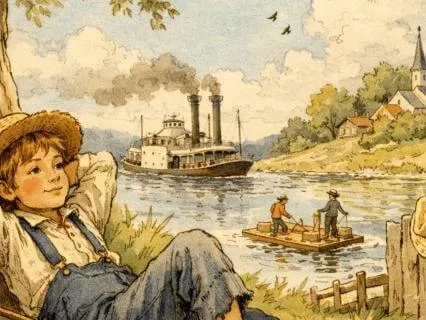
Tonight we'll be reading some of Tom Sawyer by Mark Twain,
One of my favourite childhood stories.
I'll be reading to you a modernised version that's easy to understand.
Chapter 1.
Tom.
No answer.
Tom.
No answer.
What's going on with that boy,
I wonder?
You Tom.
No answer.
The old woman pulled her glasses down and looked over them around the room,
Then she pushed them up and peered beneath them.
She almost never looked through them for something as small as a boy.
They were her formal pair,
The pride of her heart,
Made for appearance rather than usefulness.
She could have seen just as well through a pair of stove lids.
She looked puzzled for a moment,
Then said,
Not angrily,
But loud enough for the furniture to hear.
Well,
If I get my hands on you,
I'll.
.
.
She didn't finish,
Because then she was bending down and jabbing under the bed with a broom,
And she needed her breath to time the jabs.
She brought up nothing but the cat.
I've never seen the like of that boy.
She went to the open door and stood there,
Looking out over the tomato vines and the gypsum weeds that made up the garden.
No Tom.
She lifted her voice at an angle meant to carry a long way and shouted,
You Tom.
There was a faint sound behind her,
And she turned just in time to grab a small boy by the loose back of his jacket and stop his escape.
There.
I should have thought of that closet.
What were you doing in there?
Nothing.
Nothing?
Look at your hands,
And look at your mouth.
What is that mess?
I don't know,
Aunt.
Well,
I do.
It's jam,
That's what it is.
I've told you 40 times that if you didn't leave that jam alone,
I'd skin you alive.
Hand me that sandwich.
The switch hovered in the air.
The danger was serious.
Oh,
Look behind you,
Aunt.
The old woman spun around and yanked her skirts out of harm's way.
The boy took off instantly,
Scrambled up the tall broad fence,
And vanished over the other side.
Aunt Polly stood there in surprise for a moment,
Then broke into a gentle laugh.
That boy.
Will I ever learn?
Hasn't he tricked me enough times for me to be on guard by now?
But old fools are the worst fools there are.
You can't teach an old dog new tricks,
They say.
Still,
Goodness knows he never plays the same trick twice,
And how's a person supposed to know what's coming?
He seems to know exactly how long he can bother me before I lose my temper,
And he knows that if he can stall me a minute or make me laugh,
It all calls off again,
And I can't bring myself to hit him.
I'm not doing my duty by that,
Boy,
That's the plain truth.
Spare the rod and spoil the child,
As the good book says.
I'm storing up sin and suffering for both of us,
I know.
He's full of mischief,
But mercy me,
He's my poor dead sister's boy,
And I just don't have the heart to whip him.
Every time I let him off,
My conscience hurts me,
And every time I punish him,
My old heart nearly breaks,
Well,
Well.
Man that's born of woman is short-lived and full of trouble,
The scripture says.
And I reckon that's right,
He'll skip school this afternoon,
And I'll just have to make him work tomorrow to punish him.
It's hard making him work Saturdays when all the other boys are off,
But he hates work more than anything,
And I have to do my duty by him,
Or I'll ruin the child.
Tom did skip school,
And he had a very good time.
He'd gotten home just in time to help Jim,
A young black boy,
Saw the wood for the next day and splint kindling before supper.
At least he was there in time to tell Jim all about his adventures while Jim did three quarters of the work.
Tom's younger brother,
Or rather half-brother Sid,
Had already finished his share,
Picking up chips,
Because he was a quiet boy and didn't have Tom's adventurous,
Troublesome nature.
While Tom was eating supper and sneaking sugar whenever he got the chance,
Aunt Polly questioned him with great craft and depth,
For she meant to trap him into giving himself away.
Like many simple-hearted people,
She took pride in believing she had a gift for clever and mysterious diplomacy,
And she enjoyed admiring her most obvious tricks as an example of subtle cunning.
She said,
Tom,
It was pretty warm at school today,
Wasn't it?
Yes ma'am.
Very warm,
Wasn't it?
Yes ma'am.
Didn't you feel like going swimming,
Tom?
A flicker of fear ran through Tom,
A touch of uneasy suspicion.
He studied Aunt Polly's face,
But it gave nothing away,
So he said,
No ma'am.
Well,
Not very much.
The old woman reached out and felt Tom's shirt and said,
But you aren't too warm now,
Though.
She was pleased with herself for having discovered that her shirt was dry without anyone knowing that was what she was checking,
But despite her,
Tom now understood what she was after,
So he cut her off before the next move.
Some of us pumped water all over our heads.
Mine's still damp,
See?
Aunt Polly was annoyed to realise she had overlooked that piece of evidence and missed a trick.
Then she had a new idea.
Tom,
You didn't have to unbutton your collar when I sewed it just to pour water over your head,
Did you?
And did you unbutton your jacket?
The worry vanished from Tom's face.
He opened his jacket.
His shirt collar was firmly stitched.
Well,
I declare,
You can now go along with you.
I'm sure you skipped school and gone swimming,
But I forgive you,
Tom.
I reckon you're a bit like a singed cat.
Better than you look.
This time.
She was half sorry for her cleverness had failed,
And half glad that Tom had behaved obediently for once.
But Sid spoke.
Well now,
I thought you'd sewed his collar with white thread,
But that's black.
Why I did sew it with white,
Tom.
Tom didn't wait to hear the rest.
As he went out the door,
He said,
Sid,
I'll get you for that.
Once safe,
Tom examined two large needles stuck in his jacket lapels,
Wrapped with thread,
One white and one black.
He said she'd never had noticed if it hadn't been for Sid.
Blast it.
Sometimes she uses white,
Sometimes black.
I wish she'd stick to one or the other.
I can't keep track,
But I'll get Sid for this.
I'll teach him.
Tom was not the model boy of the village.
He knew the model boy very well and hated him.
Within two minutes or even less,
He'd forgotten all his troubles,
Not because they felt any lighter to him than a grown man's troubles do to a man,
But because of a new and powerful interest pushed them aside for the moment,
Just as an adult's worries fade in the excitement of something new.
This new interest was a special way of whistling that he had just learned from a black man,
And he was eager to practice it without interruption.
It involved a bird-like trill,
A sort of liquid warble,
Made by tapping the tongue against the roof of the mouth during the tune.
The reader probably remembers how to do it if they were ever a boy.
With practice,
Tom quickly mastered it,
And as he walked down the street,
His mouth full of music and his heart full of gratitude.
He felt much like an astronomer who had discovered a new planet,
Though when it comes to pure,
Deep,
Uncomplicated pleasure,
The advantage probably belongs to the boy.
The summer evenings were long.
It wasn't dark yet.
Suddenly,
Tom stopped whistling.
A stranger stood before him,
A boy a little larger than himself.
A newcomer of any age or gender was an impressive curiosity in the poor,
Shabby village of St.
Petersburg.
The boy was well-dressed,
Well-dressed on a weekday,
No less.
That alone was astonishing.
His cap was neat,
His buttoned blue jacket was new and tidy,
And so were his pants.
He wore shoes,
And it was only Friday.
He even had on a necktie,
A bright ribbon.
He had a city air that made Tom feel it deep inside.
The more Tom stared,
The higher he lifted his nose at the boy's fine clothes and the shabbier his own outfit seemed to become.
Neither spoke.
If one moved,
The other moved too,
Sidewards,
Circling,
Keeping face to face and eye to eye.
At last,
Tom said,
I can beat you up.
I'd like to see you try.
Well,
I can.
No,
You can't.
Yes,
I can.
No,
You can't.
I can.
You can't.
An awkward pause followed.
What's your name?
Tom asked.
That's none of your business.
Well,
I'll make it my business.
Why don't you?
If you keep talking,
I will.
Talk,
Talk,
Talk.
There.
Oh,
You think you're pretty smart,
Don't you?
I could beat you up with one hand tied behind my back if I wanted.
Then why don't you do it?
I will if you keep pushing me.
Oh,
Sure.
I've seen whole families stuck like that.
Smart mouth.
You think you're something special,
Don't you?
What a ridiculous hat.
You can knock it off if you don't like it.
I dare you.
And anyone who won't take a dare is a coward.
You're a liar.
So are you.
You're the fighting liar and you're afraid to prove it.
Get lost.
Say,
If you give me much more attitude,
I'll bounce a rock off your head.
Oh,
Of course you will.
I will.
Then why don't you do it?
Why do you keep saying it for?
You're scared.
I'm not scared.
You are.
I'm not.
You are.
They paused again,
Circling and staring.
Soon they slithered shoulder to shoulder.
Tom said,
Get out of here.
You get out.
I won't.
Neither will I.
They planted their feet and shoved with all of their strength,
Glaring with hatred,
But neither gained ground.
After struggling until both were hot and flushed,
They relaxed cautiously.
Tom said,
You're a coward and a punk.
I'll tell my big brother on you.
He can beat you with one finger.
What do I care about your brother?
I've got one bigger than yours and he can throw him over that fence.
Both brothers were imaginary.
That's a lie.
Just saying it doesn't make it true.
Tom drew a line in the dirt with his toe and said,
I dare you to step over that and I'll beat you till you can't stand.
The new boy stepped over immediately.
Now do it.
You said you would.
Don't crowd me.
You better watch out.
You said you'd do it.
Why don't you?
For a couple of cents,
I would.
The new boy pulled two copper coins from his pocket and held them out mockingly.
Tom slapped them to the ground.
In an instant,
They were rolling in the dirt,
Tangled like cats,
Pulling here,
Tearing clothes,
Punching and scratching,
Covering themselves in dust and glory.
Soon the chaos cleared and Tom appeared on top,
Standing over the other boy and pounding him.
Say enough.
The boy struggled,
Crying mostly from anger.
Say enough.
At last,
The boy gasped out and muffled enough and Tom let him up.
That'll teach you.
Next time,
Be careful who you mess with.
The new boy walked off,
Brushing dust from his clothes,
Sobbing and sniffing.
To threaten what he'd do next time,
Tom mocked him and walked away proudly.
As soon as Tom turned his back,
The boy grabbed a stone,
Threw it and it hit Tom between the shoulders,
Then ran off fast.
Tom chased him home and learned where he lived.
He stood at the gate for a while,
Daring him to come out,
But the boy only made faces from the window.
Eventually,
The boy's mother appeared,
Called Tom a bad,
Nasty,
Vulgar child and ordered him away.
Tom left,
But he said he planned to lie in wait for that boy.
He got home late that night,
And when he climbed carefully through the window,
He found Aunt Polly waiting for him.
And when she saw the condition of his clothes,
Her resolve to turn his Saturday into a hard labour became completely unshakable.