You are here,
And that all by itself is enough.
There is nothing to do tonight,
Nothing to figure out,
Nothing to get right.
Whether you drift off in the next few moments,
Or whether you simply lie here quietly,
Comfortably resting in the warmth of this voice,
And the weight of the covers across your body,
Your mind and your muscles are already doing exactly what they need to do.
You may notice,
As you settle in,
That your shoulders have already begun to soften,
Just a fraction,
Just enough,
And that the surface beneath you is holding you,
Completely,
The way it always does,
Steady and solid and warm.
You are entirely safe in this quiet space,
And tonight,
We are going to step back in time,
Far from the noise,
Into a world where everything is soft,
Misty and remarkably still.
So let the present grow,
And let the past drift in.
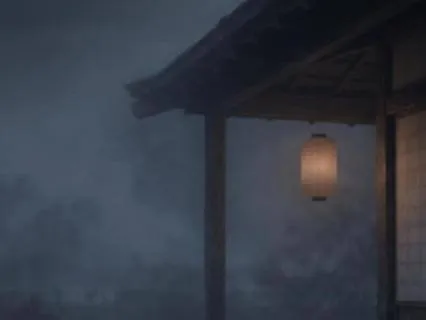
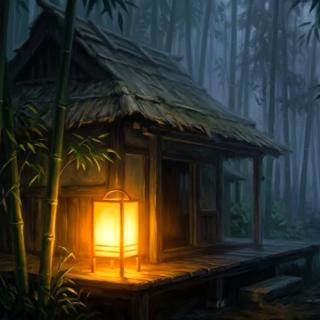
We arrive tonight in a small cedar tea house,
On the northern edge of Edo,
In the autumn of 1643,
Where the rain has been falling steadily and heavily,
And without interruption since late afternoon,
And shows no sign,
No sign at all of stopping.
The tea house sits at the end of a narrow stone path that winds through a garden you can no longer see.
The rain and the dusk and the low autumn mist have erased it,
Dissolving every shrub and every lantern and every mossy stepping stone into a single deep blue-grey wash of shadow and water.
And so,
The little building appears to float in its own private darkness,
Unattached to any road or any city or any century,
Just a wooden room glowing faintly from within,
Surrounded on every side by the sound of rain falling on leaves,
On stone,
On earth,
On water,
On the broad cedar planks of its own sloping roof.
Each drop lands with a soft,
Hollow,
Resonant tap that is immediately swallowed by the next and the next and the next,
Until the sound is no longer a collection of individual drops,
But a single,
Continuous,
Living hum.
A hum that fills the air so completely and so evenly that after a while it stops being something you hear and becomes something you feel.
A vibration that enters through the skin and settles somewhere deep behind your ribs,
Somewhere warm,
Somewhere heavy,
Somewhere very,
Very still.
And perhaps you can already feel it,
That heaviness beginning to gather in your own body in the same places where the sound of rain would gather if rain could fall inside a person.
In the chest,
In the belly,
In the soft,
Tired muscles of the shoulders and the jaw.
Not a weight that presses down,
A weight that holds.
The way the earth holds a root,
The way a river holds a stone,
Patiently and gently,
With no intention of letting go.
You are inside now,
You have been inside for some time.
The room is small,
Perhaps 8 tatami mats in total,
And this smallness is not a limitation but a kindness because it means that everything you need is close and everything you do need not need is far away,
Hidden behind the paper walls,
Behind the rain,
Behind the thick blue grey curtain of mist that has drawn itself around this building like a sleeve.
The floor beneath you is covered in tatami,
Tightly woven rush grass bound over a core of compressed rice straw and even through the silk of the thin cushion on which you are seated.
You can feel the texture of it,
The fine,
Parallel ridges of the weave pressing gently against your legs,
Against your ankles,
Against the soft arches of your feet,
And the smell of it,
That clean,
Dry,
Faintly sweet,
Grassy smell that is unlike any other smell in the world,
Rises from the floor in slow invisible waves,
Mixing with the deeper,
Darker,
Richer scent of the cedar walls and ceiling.
And together these two fragrances create something that is not perfume and not incense,
But atmosphere – the olfactory equivalent of a room with the curtains drawn and the lamps turned low and the door closed against the weather.
And it is interesting,
Isn't it,
How a scent can do what words sometimes cannot,
How the smell of cedar and rush grass can reach past the busy surface layer of the mind and speak directly to something older and something quieter,
Something that does not think in sentences but in sensations.
And that part of you is listening now,
Even if the rest of you is still catching up,
And that is perfectly fine,
Because there is no schedule here,
No pace to keep,
No moment you need to arrive at by any particular time.
The walls of the teahouse are made of two things.
The lower portions are cedar,
Wide unvarnished planks fitted together without nails.
Their surfaces are planed so smooth that they feel when your fingers brush them,
Like the skin of a river-polished stone,
And their colour in this low light is a deep reddish umber,
The colour of dark honey and of autumn leaves after the first frost,
Of something that has been alive for a very long time,
And carries its age not as a burden but as a warmth and a depth and a richness that new wood simply does not possess.
The upper portions of the walls are shoji,
Wooden lattice frames covered in translucent paper,
Made from the inner bark of the mulberry tree,
And these panels glow very faintly with the last remnants of the daylight outside,
A glow that is not white and not gold,
But the palest,
Most exhausted shade of indigo,
As though the sky itself has been steeped in dye and is slowly,
Slowly bleeding its colour through the paper,
And the effect is that of being inside a lantern,
A lantern that is running out of light,
A lantern that is not going dark,
But going soft and going deep,
Going the particular shade of blue that the world turns just before sleep arrives.
It has not paused,
It has not shifted,
It has not done anything at all except exactly what it was already doing,
Which is falling steadily and heavily and endlessly on the above your head,
And the sound of it from inside this room is extraordinary because the cedar planks are thick and hollow-sounding and slightly resonant so that each drop does not simply strike the surface and stop,
But rings very faintly,
Very briefly,
Like a finger tapped against the rim of a wooden bowl,
And because there are thousands of these drops arriving every second,
The ringing blends into a deep,
Warm,
Continuous tone that fills the room from floor to ceiling and from wall to wall.
It wraps around you the way warm water wraps around a body lowered slowly into a bath,
And you may notice,
Without needing to do anything about it,
That the edges of your thoughts are beginning to soften in the same way that the edges of the garden outside have softened under the rain and the mist,
Blurring gently and losing their sharpness,
Their urgency,
Their insistence on being examined right now,
Right this moment.
And perhaps this is simply what happens when a mind is placed inside a sound as steady and as ancient as rain on wood.
It stops trying to organise the world and begins instead to rest inside it.
In the centre of the room,
Set into a square opening in the floor,
There is an irori,
A sunken hearth lined with a bed of fine pale grey ash,
And resting on the ash are a few pieces of binchotan charcoal,
The white charcoal of the Kishu region,
Which burns without flame,
Without smoke,
And without even the faintest crackle,
Producing only heat.
A deep and steady and radiant,
Nearly silent heat that rises from the hearth in slow invisible columns and spreads across the room at the level of your chest and your hands and your face,
So that the lower half of the room remains cool,
Pleasantly cool,
The way the air above a forest stream is cool and the upper half is warm,
And the border between the two,
That thin exquisite line,
Where coolness meets warmth,
Is the most perfectly calibrated sensation of temperature you have ever felt.
A sensation that your body does not resist or adjust to,
But simply accepts.
The way it accepts the pull of gravity,
And the way it accepts the weight of the blanket that is covering you now in this bed,
In this room,
In this particular moment of your particular,
Beautiful,
Exhausted life.
It is still here,
Resting across your chest,
Your hips,
Your legs,
And the warmth of the charcoal hearth,
And the warmth of the blanket,
Have become somehow the same warmth.
Continuous,
Borderless,
Total,
And you are inside it now.
Completely inside it.
The way you are inside the sound of the rain,
And the way you are inside the scent of cedar.
The way you are inside this slow,
Indigo,
Dissolving hour.
Beyond the shoji screens in the garden you cannot see,
A bamboo sozu,
The deer scarer,
Fills with rainwater,
Tips,
And strikes the stone beneath it,
With a single,
Hollow,
Resonant knot.
And then,
Writes itself,
And begins filling again slowly.
One raindrop at a time.
And the interval between each knot is perhaps 30 seconds,
Or perhaps 40.
And it is this interval,
This long,
Patient,
Empty space between sounds,
That gives the room its deepest quality of stillness.
Because each knot is followed by a silence that is not silence at all,
But the rain.
And the silence inside the rain,
And the silence inside the silence,
Opening outward,
Like the rings of a stone dropped in water.
Growing wider,
And softer,
And thinner,
Until the next knock arrives,
And the pattern resets,
And the waiting begins again.
And there is something about this waiting that is not tense,
And not anticipatory,
But deeply,
Physically,
Involuntarily relaxing.
Because it teaches the body,
Without words,
And without effort,
That the next moment will come on its own.
That nothing needs to be reached for.
That everything,
The sound,
The warmth,
The rain,
The rest,
Is arriving now.
Already arriving,
Without your help.
The light behind the shoji has faded further.
The indigo has deepened to something almost black,
And the paper panels have gone from glowing to merely present.
Pale rectangles in the dark wall,
Holding the faintest memory,
Of a sky that has moved on.
And the room now is lit only by the charcoal,
That deep orange-red heatless glow from the sunken hearth.
And this light does not illuminate so much as it suggests the curve of a ceramic bowl,
The edge of the tatami,
The near wall,
The near corner,
While everything beyond arm's reach dissolves into soft,
Warm,
Indigo shadow.
And in this half-light on the tatami beside you,
There is a charkin,
A small square of white linen,
Dampened and folded once,
And next to it,
A set of tea vessels that have been used this afternoon,
And are waiting patiently without urgency to be wiped clean.
Your only task,
The only thing this evening has left for you to do,
Is to lift each vessel,
Hold it in your hands and wipe it slowly and gently with the damp cloth,
Turning it in your palms,
Feeling its weight,
Feeling its shape,
And feeling the warmth it still holds from the tea that was poured from it hours ago.
And you reach for the first.
It is a chawan,
A tea bowl,
And it is heavy,
Heavier than you expected,
Made from thick,
Rough-glazed stoneware that was shaped by hand on a slow wheel,
So that its walls are not perfectly even but subtly irregular.
And subtly asymmetric.
And as your fingers close around it,
You can feel every ridge and every undulation and every small imperfection in the clay pressing into your skin.
And the sensation is grounding,
Deeply grounding,
Because it is specific and it is real,
And it is here in your hands asking only to be held.
You press the dampened linen against the rim of the bowl,
And you draw it slowly along the curve,
Following the lip of the clay with the pad of your thumb.
And the cloth moves across the surface with a faint,
Soft friction that you can feel more than hear,
A whisper of wet fabric against fired earth.
And you turn the bowl slowly,
A quarter rotation,
And wipe again,
And turn,
And wipe.
And the motion settles into your hands the way a familiar song settles into the muscles of the throat,
Effortless,
Automatic,
And calming.
The inside of the bowl still carries a faint stain of matcha,
The palest and softest green,
Barely visible in this low light.
And you draw the cloth across it in slow,
Widening circles,
Starting from the centre and spiralling outward toward the rim.
And the green dissolves into the white linen,
And the surface beneath is clean and smooth and warm.
And you set the bowl down gently beside your knee,
And the tatami receives it without a sound.
And you reach for the next vessel,
And Natsume,
A small lacquered tea caddy,
Light and round and perfectly smooth.
Its surface is so finely coated that it feels almost liquid under your fingers,
Like touching the surface of still dark water.
And you turn it in your hands slowly,
Admiring the way the orange glow of the charcoal slides across the black lacquer in long,
Molten streaks.
And you wipe it with the cloth,
Gently and barely touching,
And the lacquer gleams.
And you turn it and wipe it again,
And the rhythm is the same as before,
The same unhurried circular breathing rhythm.
Turn and wipe and turn and wipe.
And your hands know exactly what to do,
And your mind is free to simply watch them.
The way you might watch the rain on the window,
Or the charcoal in the hearth,
Or the slow,
Blue-grey mist moving through a garden you can no longer see.
And the next is the charsan,
The bamboo tea whisk,
And you hold it upright by its thin handle and wipe each delicate tine with the damp cloth,
Drawing the linen slowly down the curve of each bamboo finger.
And there are perhaps 80 of them,
Perhaps more,
And each one is as thin as a pine needle.
And the motion of cleaning them is so small and so precise and so repetitive that it becomes a kind of meditation in your hands.
A tiny,
Perfect gesture,
Repeated and repeated and repeated until the gesture itself dissolves,
And there is only the feeling of it.
The soft resistance of bamboo,
The coolness of the damp cloth,
And the steady warmth of the room around you.
Wipe.
The sozu knocks once in the garden.
The rain answers.
And everything.
Your hands slow.
The cloth rests in your lap.
The vessels are clean.
And the task,
Like the day and like the light and like the last pale trace of sky behind the paper walls,
Is finished.
The room is very dark now.
Only the hearth glows.
A deep,
Fading,
Ember orange light.
Low in the floor.
Warm against the underside of your hands.
The rain has not stopped.
The rain will not stop.
It is a sound that has no beginning and no ending.
And you are inside it,
The way a stone is inside a river.
Held and smoothed and still.
Your body is heavy.
Not with effort.
With rest.
With a particular,
Full-earned heaviness of a body that has set everything down.
The bowl.
The cloth.
The caddy.
The whisk.
And has nothing left in its hands.
Nothing at all except warmth.
The blanket is here.
Your blanket.
Holding its patient,
Familiar weight across your chest and your ribs and your stomach.
You have stopped noticing where the blanket ends and the warmth of the room begins.
Because there is no difference now.
It is all one thing.
One continuous,
Borderless,
Amber warmth.
And you are inside it.
The Sozu knocks.
And the silence opens.
And the rain fills it again.
Your breath is slow.
So slow.
So slow.
Each exhale is longer than the last.
Longer than you expected.
And longer than you are trying for.
Because you are not trying for anything.
You are simply breathing the way the rain falls.
Without decision.
And without effort.
The cedar is breathing too.
You can smell it faintly.
That dark,
Sweet,
Resinous warmth.
And it mixes with the tatami and the ash and the rain.
Until the air itself feels like something you could sleep inside.
Something soft and dense and blue.
The shoji screens have gone dark.
Just shapes.
Just the faintest memory of a rectangle.
Or of a frame.
Or of a wall that was here a moment ago.
And may still be here.
Or may not.
It does not matter.
Steady and ancient and endless.
Holding this small wooden room and holding you inside it.
The way a cupped hand holds water.
Gently and completely.
With nowhere for it to go.
And no reason to go there.
You are warm.
You are here in this old,
Dark,
Rain-filled,
Cedar-scented room.
And there is nothing more to clean.
And nothing more to reach for.
And nothing more to do.