And the weight of the covers across your body.
You may notice as you settle in that your shoulder have already begun to soften,
Just a fraction,
Just enough,
And that the surface beneath you is holding you completely.
Your sandaled feet move slowly along the softened surface of the high road through the Kiso Valley,
And the year 1788 gives over its last hours of pale,
Retreating light.
The Nakasendo stretches before you and behind you,
The old post road between Kyoto and Edo,
Narrow black pines whose branches bend low beneath their burden.
Each step is met by a deep,
Gentle hush,
As if the snow itself were welcoming you home.
You wear a heavy padded winter robe across your shoulders,
And a tera quilted thick with cotton wadding rests upon you the way a hand rests on a friend's shoulder.
That weight settles deeper into you with every soft footfall,
And you may notice how the weight of the robe begins to feel like the only weight you have left to carry.
The world here is painted in muted ivory and faint amber,
The tonalist palette of an Edo winter dusk.
Distances dissolve into vapour.
The pines are not quite green,
And not quite black,
But a slow brushed shadow against the mist.
Where the road curves around an outcrop of dark stone,
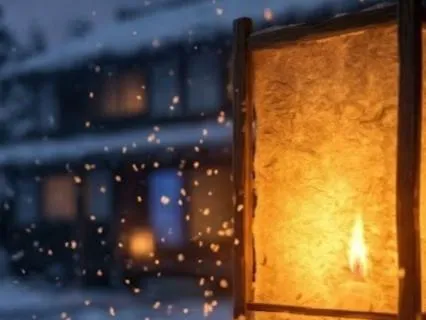
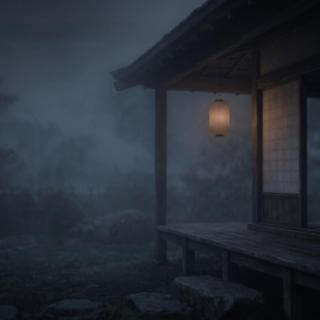
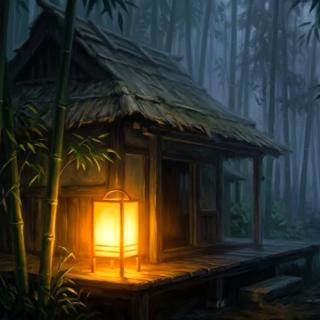
A single paper lantern hangs from the eaves of a Hatago,
A small post station inn,
And its glow is no brighter than a held breath against the falling snow.
That gentle amber pulse is your destination,
And you have been walking towards it for some time,
Unhurried,
And what remains is only this last quiet stretch through deepening dusk.
As you take these final steps through the muffled snow,
You can let the weight of the modern world slide off your shoulders,
As a flake of snow slips from a pine bough.
The way air becomes mild inside a fall of heavy snow,
And your breath rises in soft,
Slow plumes that join the larger mist of the valley.
Somewhere far off,
Beyond the trees,
The mountain wind moves in long,
Low currents through the bamboo groves,
A sound less like wind and more like a slow,
Patient breathing of the land itself.
Your own breath finds,
Without effort,
A rhythm.
It is a rhythm that has been waiting for you.
The lantern grows nearer,
The light is amber and soft and full of welcome.
The eaves of the Hatago rise gradually out of the falling snow,
The heavy,
Thatched roof rounded at its edges by the winter's accumulation.
The dark wooden beams blurred into the same tonalist grey that holds everything else.
The weight of the robe across your shoulders is steady and warm,
And that warmth is becoming the only thing you need to feel.
Your sandals make their soft last presses into the snow.
You stand at the threshold.
The journey is done.
The wooden door slides open under your hand with a low,
Drawn-out rumble in its old,
Grooved track.
The sort of sound that has been the same sound for two hundred winters,
And the warmth of the inn meets you like a cupped hand against your face.
Inside,
The air carries the slow scent of cedar smoke,
A dry rice straw,
And the faintest trace of pickled plum.
A scent that has soaked into the wooden beams over generations,
And now belongs to the building itself.
The lowered earthen entryway,
And there you slip your snow-dampened straw sandals from your feet.
The wooden step up to the main floor is worn smooth in two pale ovals,
Where countless travellers have placed their hands before you,
And you place yours in the same hollows now.
The wood is cool and polished,
And almost soft.
You rise into the room.
The Hatago is small and very old.
The ceiling beams are dark with the smoke of a hundred winter hearths,
And the floor is laid with thick tatami matting,
Whose rice straw breath fills the air with a slow,
Earthen calm.
Across the room,
A low sunken hearth,
The Irori,
Holds a small fire that has burned down to red coals and white ash,
And a heavy iron kettle hangs above it on a blackened hook,
Breathing out a thin,
Steady ribbon of steam.
A small paper lantern stands waiting on a low shelf near the hearth.
It has not yet been lit.
This is the small task that asks for you.
You kneel before it on the tatami,
The heavy padded robe shifting around you with the soft sound of cotton against cotton,
And you take the lantern carefully into your hands.
The frame is bamboo,
Light as a bird's bones,
And around it is stretched a single layer of washi paper,
That handmade paper of the Edo countryside,
Fibrous and warm toned and faintly translucent.
Inside the lantern sits a small ceramic dish,
And in the dish is a pool of vegetable oil,
With a short cotton wick floating at its centre.
You take up the small flint and steel from beside the hearth.
The flint is a piece of dark,
Smooth riverstone,
Cool against your fingertips.
The steel is a curved sliver,
No longer.
You hold them at the height of the wick,
And you draw the steel along the flint in one slow,
Unhurried motion.
A single soft spark falls.
The wick takes it gently.
A small flame rises,
A tall one at that.
The amber glow blooms slowly outward through the fibres of the paper,
And the small lantern fills with light,
The way a slow exhalation fills a room.
The light is soft.
It is the colour of stored sunlight.
You set the lantern back upon its low shelf,
And you sit back on your heels,
And you allow yourself simply to look at it for a long moment.
The lantern is a small contained sun,
And its light reaches no further than a few feet around it,
Before dissolving softly into the larger grey of the room.
That is the way light moves here.
That is the way everything moves here.
Nothing reaches too far.
And as you sit kneeling there,
In the soft amber wash of that single paper lantern,
Your eyes may begin to drift outward,
Slowly taking in the wider sanctuary of the room.
The shoji screens that line the far wall are translucent and pale,
And beyond them the snow continues to fall in its endless quiet way,
Each flake a small softness against the paper,
Leaving no mark.
The shadows on the shoji are slow and long and indistinct,
The silhouettes of pine branches moving without urgency.
The corners of the room are deep and dim,
The kind of dim that does not feel like absence,
But like the gentle folding of a heavy cloth around something precious.
The wooden beams above your head are the dark,
The tatami beneath you is the muted gold green of dried summer grass.
The whole room is painted in a single tonalist palette of soft amber and ivory,
And the deep grey blue of dusk through paper.
And there is no edge in it that is not gentled,
No surface that is not softened,
No shape that is not cloaked in the slow blur of a winter evening settling air.
Of the weight of the heavy padded robe across your shoulders,
It is steadier now.
You may notice that you are not cold,
To wrap you in a warmth that asks nothing of you in return.
But its sound when it reaches you is not a sharp thing,
It is a long hollow low note,
The breathing of the canes against one another,
An instrument one might make if it were played by the slow exhale of the mountain.
Beneath it,
The iron kettle gives its faint sustained whisper of steam.
These are the only sounds,
And they are not so much sounds as the audible texture of the silence itself.
You may notice that your shoulders have loosened,
You may notice that your breath has slowed,
And that is perfectly fine.
There is no schedule here.
The Hatago has known travellers like you for nearly two centuries,
And it has held all of them with the same patient,
Unjudging warmth.
Now,
In just the same way,
You are exactly where you are supposed to be.
The paper lantern moves across the wall in the slowest of pulses,
The small flame within breathing very gently.
Each pulse is the length of a long even breath.
The amber light rises and holds and settles and rises again.
The walls themselves seem to be breathing in this rhythm.
And the snow outside is falling in this rhythm.
And your own breath,
Without any decision on your part,
Has begun to keep this rhythm too.
You may notice now,
As your eyes drift,
That beside the Iroi,
A low wooden shelf holds a stack of pale washi sheets,
Perhaps fifty in all,
Drying through the long evening from the warmth of the coals.
The washi has been made earlier in the season by the village women,
Drawn from the inner bark of the Kozo mulberry,
Beaten and pressed and laid out in thin,
Fibrous rectangles upon wooden boards.
Now it has dried nearly to readiness.
It waits in its modest pale stack to be smoothed and folded and set into the larger pile that the innkeeper will sell at market when the snow at last gives way to spring.
This small task of smoothing the washi is a task you have offered to do in exchange for your night's lodging.
And it is a task that has been done in this very room for a hundred winters,
By hands no different from yours.
There is no urgency.
The night is long and the lantern's amber light is steady and the kettle's faint steam will continue without supervision and the snow outside will continue without supervision.
In this small,
Kneeling space beside the Iroi,
Nothing in the world more pressing than this slow,
Gentle work.
You shift slightly and the weight of it across your shoulders settles in a new,
Deeper way against the warmth that the room has given you.
Dense and soft and slightly heavier where it gathers at the seams,
Pressing down with the kind.
There is nothing else to do with it.
The washi sheet is warm in your hands.
It is a warmth that has come slowly and it carries with it the faint,
Dry scent of mulberry bark and rice paste.
An old,
Clean scent that belongs to nothing in the modern world.
The paper is the size of a folded letter and when you hold it up against the amber light of the lantern you can see the soft shadow of the long mulberry fibres running through it like a slow current beneath the surface of still water.
You lay the sheet flat upon a smooth wooden board placed before you on a tatami.
With the open palm of your right hand,
You smooth the paper from its centre outward.
The paper makes a soft,
Dry whisper beneath your hand.
A sound no louder than a single exhaled breath and the small wrinkles that the drying has left on its surface flatten beneath the patient pressure of your palm.
Then with both hands,
You take the lower edge of the sheet.
The fold is a long,
Deliberate motion.
The paper bending without protest.
The crease pressed into place with the side of your thumb in a single,
Quiet stroke.
You lift the folded sheet.
You turn slightly to your left and you set it down gently upon the smaller stack that has begun to grow there.
You take the next sheet from the warm pile.
The motion is small and the motion is the same and the motion will be the same a hundred more times before the pile is finished.
There is no skill required here that you do not already have.
There is no decision left to make.
The hands have learned the rhythm in only two repetitions and the surface of your mind having been given this small,
Steady task to hold holds it gently and asks for nothing more.
The paper is cool at first touch and grows warm under your hand.
Each sheet is very slightly different in weight from the last some lighter than a fallen petal some heavier,
Where the kozo fibres have settled more thickly through the press.
The variations are small and you do not need to count them and you do not need to remember them.
Your hands feel them.
The paper lantern moves softly across the wooden board as you work.
Sometimes the light brightens by the slightest measure as the wick within the lantern adjusts and sometimes it dims by the slightest measure and through these long,
Slow pulses of light the white of the washi sheets shifts gently between cream and ivory and the deep gold of late autumn honey.
The colours in this room are very few.
There is nothing here that is bright.
The kettle above the irori releases its slow ribbon of steam and the steam catches the amber light as it rises and it dissolves into the dim of the high beams without sound.
The wind in the bamboo grove outside continues its long,
Hollow,
Sustained note low enough that you feel it more than hear it.
The snow against the shoji makes no sound at all only the very faintest dry whisper as it accumulates in soft drifts along the wooden frame outside.
You may notice that you have stopped tracking how many sheets you have smoothed and folded.
You may notice that the small stack to your left has grown but you do not need to look at it.
The weight of the heavy padded robe across your shoulders has become so familiar that it is no longer a separate thing.
It is not the robe pressing on your shoulders.
It is your shoulders being held in the steady,
Warm shape of the robe.
It is a small kind weight that has begun to feel like part of the body itself and it has begun to feel like the body itself has been folded carefully into a quiet warmth the way each sheet of washi is folded and set down to rest having sat closest to the fading coals of the irori.
Its warmth passes from the paper into the palm of your hand and from the wrist into the long muscles of the arm.
The way warmth passes through a stone left in the afternoon sun.
You do not chase the sensation.
You only notice it.
Then you let it go.
Let the sheet go when you set it onto the stack.
The lantern is very steady and whatever may have once seemed important in some other place,
In some other hour is no longer here.
It did not follow you onto the snowy road.
It did not follow you across the threshold.
It is not in this room.
This room contains only the warm paper the soft amber light the heavy robe and the slow sustained breathing of the mountain wind.
You may notice that the hands have grown slower.
There is no instruction to slow them.
They have simply chosen their own pace the way water chooses its own path down a hillside and the pace they have chosen is the pace of an evening that has all the time in the world.
Each smoothing is longer than the last.
Each fold is gentler.
Each set and down is softer.
The tatami beneath your knees is warm where the heat of the irori has reached it and your weight rests evenly across it and the dried summer grass within the matting gives off its faint clean scent of fields that were cut a long time ago in a season that was very different from this one.
The summer that made this tatami is held inside it still very quietly the way a small flame is held inside the paper lantern.
Both warmths remain even when the season that made them is long past.
You may begin to notice that the boundaries of things in the room are becoming softer.
The far corners are deeper now becoming dim and unreaching.
The shoji screens have lost some of their definition their pale shapes blurring into the dimness around them.
The amber glow of the paper lantern reaches a smaller and smaller circle and beyond that circle the world of the room is a slow beautiful blur.
The way a tunnelist painter would paint a winter evening very gently your mind has begun to settle into a quiet that has no edge in.
There is nothing for it to do there is nothing for it to solve.
The hands have the work the lantern has the light the robe has the warmth the mountain has the night nothing is held by you.
The pile of finished washi has grown quietly to your left a small patient stack of pale sheets each one rested into its place by a hand that no longer needs to think about the placing.
The pile that remains to be smoothed is smaller now than the pile that has been finished but it does not matter which is larger you are not trying to finish.
The rhythm is keeping you the amber lantern light has dimmed by the smallest measure the wick within has drawn a little of its oil the room around the lantern has grown by the smallest measure dimmer still.
The snow outside is deeper the robe across your shoulders is heavier in the soft way that a settled blanket is heavier than the same blanket newly laid down.
Your eyes have grown heavier too by no decision of your own simply in the natural course of an evening that has done what evenings do.
The hands have slowed the way breath softens against a cold window pane or perhaps the room has grown around it it is hard to tell.
The kettle continues its slow faint breath of steam the bamboo continues its long low note the snow continues its silent settling against the shoji These sounds have become one sound the shoji screens have dimmed the corners of the room have folded themselves into the soft grey of a winter evening that no longer needs to be seen.
Tonalism is the art of the unseen edge the amber circle of the paper lantern has drawn itself smaller until it is no larger than a held breath of light around the wooden board the board itself is dissolving into the dim the lantern's light has become the colour of memory the colour of long evenings remembered without sorrow settling like snow upon the exactly where you are supposed to be the mountain holds the inn