Welcome,
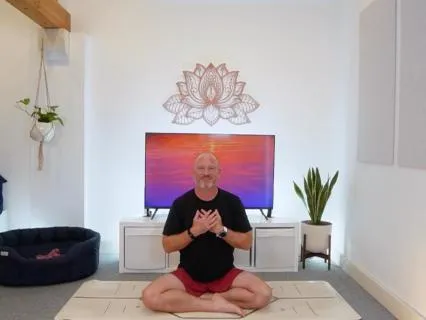
My name's Christian and I'm going to guide you through this hummingbee practice.
Encourage you to read the description for this particularly if you have any mental health issues you'll be medicated for or that are being currently treated to see whether this practice is suitable for you.
Going to find that it is accessible to most people and it's a fantastic way of basically stimulating your vagus nerve.
The same way if you're a singer,
If you enjoy singing and you find that it brings you deep relaxation from singing.
That vibration that we're going to create,
Which will stimulate your autonomic nervous system,
Taking you into a state of rest and digest.
For this practice we're going to hum.
We'll take a deep inhale through the nose,
Breathe into your belly,
Then your chest.
And then as you exhale,
You're going to hum to release the breath.
So it's going to sound like.
You empty the whole of your lungs during that process.
So you may find that if you're doing this on your own with me,
You don't feel the need to stick to my timings because my breath may be different to yours in terms of my breath capacity.
So think of it more of us being like a mini swarm and if you're practicing at home with other people as well and they're humming along as well,
Enjoy that vibration that they will be giving off.
There's ways in which to intensify this.
Starting point is just to simply hum with your eyes closed and enjoy the vibrations.
You can also just allow the bottom jaw to hang,
And you may find that the teeth almost rattle,
Increasing that feeling of vibration going through,
Helping to,
Again,
Stimulate the vagus nerve and relax you.
If you want to intensify it further,
You're welcome to use your fingers just to close the ears gently,
And that,
Again,
Will intensify the vibration going up into your crown.
Alternatively,
And the final option is to use your thumbs to close off the ears and then use your fingertips and your palms to close off your eyes.
But if we're doing this for a long period of time,
You might find it difficult.
You can always use eye pillows if you want or just simply close your eyes.
But you don't have to do any of those options.
And if this is your first time doing it,
I'd encourage you to try the different variants and see what it is.
If it becomes too much whilst you're doing it,
Then just simply stop and return to your natural breath.
Before we start just close the eyes or have a soft gaze.
Just settle yourself into any seated posture that's going to work for you.
Before we start,
Just take a few moments to feel.
Notice how the breath is moving.
Notice the sensations within the body.
Ultimately what we're doing is just starting to understand where we're starting from today before we start our practice.
Allowing ourselves to arrive.
To become present.
And when you're ready.
Invite to take a big breath in through the nose into your tummy then your chest.
Let's begin.
As you continue.
Maybe try the different techniques.
The fingertips and your ears.
The thumbs in your ears and your eyes over,
Or any combination.
You don't have to,
Just continue.
You Last round.
Hmm.
Now just release your breath back to its natural rhythm.
And feel.
Feel the sensations of calm.
And peace.
When you're ready.
Slowly bring yourself back.
Keep flickering your eyes open.
And savouring that feeling of harmony.
And peace.
That you can now take forward into the rest of your day.
The light to me sees and salutes the light within you.
Namaste.
Thank you so much for joining me.
And I look forward to seeing you again soon.