Greetings.
Today I bring you a calming tale called The Clockmaker's Garden.
It's a timeless fable about patience.
Endurance.
And the quiet acceptance.
That comes when we learn to move with life's natural rhythm.
In a world ruled by precision.
A humble clockmaker discovers harmony.
In a wild garden that keeps its own measure of time.
A reminder that not everything meaningful can be counted.
Let your breath settle into a steady rhythm.
And allow this tail to move through you like the turning of gentle gears.
Climb into bed.
Get cozy.
And allow your body to relax.
As we begin.
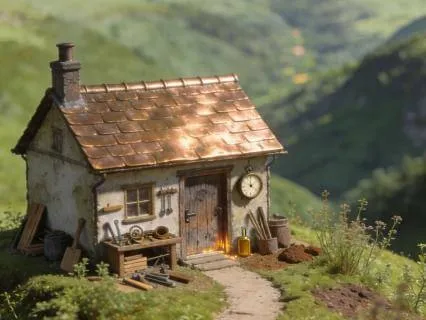
The clockmaker's home stood on a small rise at the edge of a green valley.
It was an ordinary dwelling from a distance.
A roof tiled in copper.
A lean chimney.
A narrow path folded through wild herbs toward a weathered door.
But if one stepped closer.
The air carried a hush.
Both metallic and alive.
A mingling of oil,
Cedar,
And earth.
Inside the workshop.
Morning always began the same way.
Light crept through the high-paned windows,
Glancing off rows of brass gears.
The clockmaker moved carefully among his work tables,
Winding Polishing Aligning.
As if greeting each instrument in turn.
The sound that rose from his touch.
Came gentle.
A collection of ticking hearts,
Warming the silence.
For most of his years,
He had trusted these sounds above all others.
They spoke of precision.
Of a world tamed into rhythm.
But some quiet part of him had begun to wonder whether perfection might also be a kind of impatience.
Behind the house stretched a narrow garden he had built as a reprieve from the exactness within.
It had begun as a patch of soil,
Meant only for herbs.
Yet season after season,
He had found himself tending fewer clocks and more green.
The garden had its own tempo.
Unmeasured.
Changeful.
Forgiving.
You couldn't rush a bud to open or a root to deepen by turning any key.
Each morning before his work began,
The clockmaker stood by the back door and listened.
Rain dripped from leaves at its own unhurried pace.
A breeze carried the low murmur of bees in the time.
Even the rocks seem to breathe under the gathering warmth of light.
Here,
Everything kept time,
Though none of it kept schedule.
He never announced the rule aloud.
Yet some instinct told him that balance lay between these two worlds.
Mechanism,
And meadow.
Tick and pulse.
When he polished a gear,
He left the window open so that birdsong might join the sound of turning metal.
When he sowed seed,
He carried with him the faint ticking from a pocket watch that swung at his side.
Visitors to his shop thought the mixture odd.
Order beside apparent wildness.
They would see polished brass gleaming toward the garden.
And wonder why vines were allowed to climb the outer wall,
Threading through cracks between shutters.
But the man only smiled.
He had come to think of the vines as apprentices who worked in their own medium,
Drawing time in curls and tendrils instead of numbers.
Inside,
Each clock obeyed its coil and wheel.
Yet even they seemed to drift toward the garden's mood.
He noticed it in the afternoon,
When sunlight warmed the metal casings.
And a fine dust of pollen found its way inside.
The ticking softened.
Took on the steady hush of falling rain.
On such days,
He set aside his tools to watch.
The garden shimmered through the window,
Dew still clinging to stems like tiny lenses.
Bees traced gold paths between blossoms.
The air itself appeared to pulse with quiet life.
As if unseen pendulums guided everything that moved.
He thought often of endurance.
What it truly meant.
A clock endured by resisting.
It held tension inside a spring,
Turning that strain into motion.
A flower endured by yielding.
Bowing under weather and righting itself again.
Each taught its own version of patience.
The old man had begun to believe.
Both were necessary.
As morning lengthened,
He turned from window to table.
He steadied a small timepiece beneath gloved palms and began to wind.
Metal teeth engaged with a sound like whispering rain.
He leaned close to listen.
Not to verify accuracy,
But to hear the life awakening within.
The hand moved forward.
Slower than breath.
Tracing invisible circles through the hours.
Outside.
A petal unfurl.
A mirror gesture.
The clockmaker smiled.
A thin,
Contented curve of recognition.
In his heart,
He knew he would spend the rest of his life keeping both worlds in motion.
The one that counted.
And the one that simply moves.
He no longer distinguished which was truer.
As sunlight crossed the floorboards,
Dust turned through it,
Like drifting pollen,
And the combined tick of many clocks filled the workshop.
From the path beyond the door.
The sound might have been mistaken for water running over stones.
A rhythm too natural to be man-made.
And perhaps it was.
The clockmaker rested his tools and let the moment continue without his hand.
The garden breathed.
The clocks breathed back.
And time seemed to listen.
Afternoons were the garden's domain.
The clockmaker would leave his bench once the light turned gold,
And the air began its slow descent toward evening cool.
He walked the path with unfurled steps,
Pausing often.
A small brush of dust on his sleeve,
The only trace of hours spent among brass and gears.
Beyond the door,
The hum of ticking faded into the hush of leaves.
The garden had grown into a miniature world.
Rows of herbs giving way to a scatter of color.
Where wildflowers and moss met.
Each plant kept its own relationship with time.
The marigolds woke first each morning.
The moonflowers waited until darkness to breathe.
He had long stopped trying to regulate them.
There had been a year early on when he placed small copper dials beside the roots.
Measuring sunlight in careful increments.
He recorded the openings and closings of each blossom.
Compared them as he would compare the movement of minute hands.
The data meant nothing.
The garden didn't keep to measures written by human hands.
It had its own mathematics,
Written in warmth and weather.
In the distance of clouds rather than calendars.
So now he came only to listen.
At the back of the plot stood a row of glass domes,
The traces of an experiment he had never quite finished.
Inside one dome lived a plant that bore no name.
Its leaves shimmered faintly as they turned towards sound rather than light.
Sometimes,
When the clocks inside the workshop struck the hour in chorus,
The little leaves would shiver as though stirred by wind unseen.
He found comfort in that.
Proof that sound could guide growth as surely as sun.
The clockmaker knelt to weed near the old rosemary hedge.
The earth felt cool under his palm,
Grainy with the scent of rain still held below the surface.
He placed his ear near the soil.
And almost believed he could hear the inaudible movement of roots threading through loam.
This,
He thought,
Must be what patience sounds like.
Slow certain.
Without hurry.
Nearby,
The pond reflected a sky draped in cloud.
Small insects skated its surface,
Etching loops that vanished before completion.
A dragonfly hung over the water,
Its wings vibrating with a sound somewhere between metal and silk.
The clockmaker watched,
Fascinated by the delicate balance between stillness and motion in such a fragile body.
He compared it to a pendulum inside one of his oldest clocks.
Not for study but for kinship.
Both found endurance and repetition.
Peace within continuous movement.
He straightened,
Resting his back against a wooden gate and letting the light move across his face.
Each breath arrived slower than the one before,
As if the garden had taken charge of his lungs.
It occurred to him then.
That all his years of measuring were,
In their quiet way,
A search for belonging.
Each gear turned not to conquer time,
But to understand its texture.
The garden,
Generous and wordless.
Offered the same lesson without metal or math.
A breeze swept through the lavender and carried its cool scent over the path.
The movement rippled outward until every stalk bent.
Creating a wave that shimmered in gold and violet.
Watching them.
The old man whispered to himself.
Each note in its own measure.
The phrase lingered,
Becoming part of the air like mist.
He wandered deeper among the rows until he reached the far corner,
Where the garden met the slope of a hill.
Here stood the tallest tree.
Birch with bark pale as dawn.
He had fixed a tiny clock to its trunk.
Years ago.
A simple device to test whether wood could carry vibration through its rings.
The clock had long since stopped.
Its hands frozen at a forgotten hour.
But the tree thrived.
Its leaves trembled when he approached.
Silver undersides flashing in greetings.
Time it seemed.
Had chosen to continue on its own.
He ran a hand along the rough grain of bark.
Warmth met his fingertips.
Sap moved somewhere within.
The contrast filled him with quiet joy.
A bell tone drifted from the workshop,
The soft announcement of twilight arriving across a dozen clocks.
The sounds mingled with the rustle of branches.
The wingbeat of a bird leaving its perch.
The sigh of the earth settling toward night.
He stood there a while,
Listening to them blend into a single voice.
If patience had a sound.
This was it.
Not silence.
Not stillness.
But many small movements agreeing to move together.
The sky deepened.
Blue thinned into indigo.
Smell of mint brushed the air where he walked back.
A faint trail of pollen dusted his sleeve,
Shining briefly under the lantern light of the doorway.
The workshop welcomed him with its warm ticking.
Steady as before,
Yet humbler,
Quieter against the grander rhythm outside.
He left the door open so both worlds could touch.
Clocks and crickets answered one another until the boundary between them dissolved.
When he finally sat at his bench The old clockmaker felt something he had never been able to measure.
A kind of ease that had endured through all the moving parts of his life.
Outside,
The garden breathed in time with him.
Night returned with its calm certainty.
The valley had cooled to a deep hush.
The kind of quiet that belongs to late evening,
When the last color drains from the sky.
And air turns the shade of charcoal.
And rain.
Inside the workshop,
The clocks carried the hush forward.
Each one reading in its own way.
A small heartbeat of breath and patience.
In daylight,
Their ticking filled the room.
At night,
It seemed to melt into the air,
A faint pulse that the dark treated gently.
The clockmaker sat near his workbench.
Lantern turned low.
He rarely worked after sunset now.
It was enough to listen.
The hands that had once chased precision through every hour had grown lined and careful,
Yet steady.
He ran a finger across the arc of a pendulum,
Feeling its soft momentum like the breath of a sleeping creature.
Beyond the open door.
The garden breathed in long,
Quiet measures.
The scent of damp earth mixed with oil and cedar.
Near the hedge,
A tiny chorus of night insects began its slow rhythmic song.
Their voices rose and fell with the subtleness of a tide.
He liked when their music found its way into the house.
It reminded him that time could hum as well as tick.
Every life kept a meter suited to itself.
His own head simply changed tempo.
For a long while he remained still.
Studying the play of lantern light on the brass casings.
Their surfaces no longer glowed with brilliance.
They gleamed in softened tones as if they too had mellowed with the years.
One o'clock.
The oldest.
Stood near the window.
He had built it when his hands were quicker.
Each gear cut with precision finer than dust.
It had accounted for the phases of the moon.
The turning of the month.
The leap of an occasional summer day.
But this evening.
.
.
When he looked closely.
The clock's pendulum hung motionless.
He didn't mind it.
He only listened to the stillness surrounding it.
Wondered if perhaps silence could be part of its design.
The garden insisted that rest belonged to every living thing.
Why should machines be different?
So he lifted the small tool from his pocket.
And unwound the spring halfway.
Just enough to ease the tension held inside.
Metal relaxed with the faintest sigh.
What once strained for perfect measure now rested in quiet release.
The gesture seemed to pass through the walls.
Outside,
A wind rose over the field.
Moving through lavender and birch.
Leaves responded with soft applause.
The pond accepted a trickle of air and rippled against moonlight.
The world continued,
Untroubled by the stopping of one mechanism.
The clockmaker felt a warmth travel through him,
The same warmth carried by the blood of trees and soil.
He understood then.
That endurance.
Was not continual motion.
It was the grace to pause without breaking rhythm.
He left the unwound clock by the window and stepped out onto the porch.
The boards creaked once,
Then settled.
Clouds shifted,
Parting to reveal the slow silver arc of moon above the valley.
Mist gathered at the roots of the hill.
Laying down soft light where the garden waited.
Every leaf.
.
.
Every petal.
Shown faintly.
Holding dew-like fragments of stars.
He stood watching.
Until even watching felt heavy.
Then he sat upon the steps.
Wood was cool beneath his palms.
Air smelled of mint and quiet rain.
From his seat,
He could see the faint trail he had worn through the grass,
Between workshop and garden.
Two worlds connected by simple footsteps.
A clock inside gave one last sleepy chime.
The sound drifted outward.
Folded itself into the wind.
And was gone.
He breathed until breath grew wide and even.
The pulse in his chest matched the hidden rhythm under the earth.
The slow rise and fall shared by all things that endure.
A whisper of contentment filled him.
So light it was almost weightless.
Tomorrow he would tend the garden again.
Perhaps tighten a few screws.
Oil a few springs.
But for now.
Everything had reached its right measure.
A ticking turned to heartbeat.
A heartbeat resting in Earth.
The valley wrapped him in its quiet embrace.
A night bird turned once in its sleep.
He closed his eyes and joined the rhythm he had spent a lifetime trying to understand.
The clocks within the house held the night in time with the garden's breath.
Study.
Forgiving.
Hole.
And when the lantern's flame leaned low,
The clockmaker let darkness take the place of counting.
Time continued.
Kind.
And endless.
Whispering through leaf and gear alike.
See ya and.
.
.
Before you drift into sleep.
Take a slow,
Easy breath.
The clocks have all rested now.
With their hands unwound.
Their purpose complete for the night.
Somewhere beneath the surface of your own thoughts.
Calm begins its work in the same way.
Subtle.
Patient.
And kind.
Endurance doesn't mean motion without pause.
It means knowing when to let the rhythm change.
When to yield.
And when to rest.
Let yourself rest too.
Let the patterns of the day fade back into the soil of the hours that made them.
Time will keep itself while you sleep.
Good night!