Namaste Yoga Mamas.
I'm Emma from Becoming Mummy Yoga.
And this is 360 degree breathing for preconception,
Pregnancy and postnatal recovery.
It is safe for all stages,
Especially when done just as the breath practice.
At the end,
We'll do a couple of extra things to help you encourage more breath into some places that it might be lacking,
And those might not be suitable for pregnancy,
But the seated breath is fine.
So meet me in a comfortable seat of your choice and you could sit on a chair if that is easier for you.
You can learn to do this standing,
Laying down anywhere because it's just playing with your breath.
But for now,
We'll do it seated.
The benefits of 360 degree breathing are just tremendous.
If I could only,
As a yoga teacher,
Pick one thing to teach all my mama friends,
Then it would be this one.
Optimized breathing,
Which encourages more oxygen into your system.
So from a respiratory point of view alone,
There's fantastic benefit.
And then with the diaphragm moving down and allowing that air to expand the whole body,
You also get stimulation of the vagus nerve,
Which is responsible for rest and digest.
And that's really helpful for calming and soothing the nervous system,
But also for the actual digestive system itself.
It encourages.
Optimal digestion of the food which also has flow-on effects for overall well-being and immune function and so many other things.
But the main benefit that I want to focus on for our preconception,
Prenatal and postnatal mamas is in the control of the intra-abdominal pressure.
Because what we're doing when we breathe all the way around the body is we manage the pressure that builds up with the breath and we stop it from blowing out the front and down the bottom.
And that's super important because a pregnancy is going to expand and pull muscles of the belly apart.
It's called a diastasis recti.
Every woman has it by the end of pregnancy.
Breathing alone can help to start reducing that gap and then any exercises you layer onto it are just even better.
The pelvic floor is the other sort of path of least resistance that the air would like to just blow out because all pressure wants to go to the path of least resistance.
So the more we encourage it into those other areas,
The more we loosen off through the back,
The more we encourage the muscles of the deep core,
The deep,
Including the ones that stabilize the back,
And even the ribcage to take some of the load so that we're getting less out the front and less down low.
Instead of me rabbiting on about all the benefits all day long,
Let's see if you can feel them.
So if you are in that comfortable seat,
Maybe just close the eyes if you're comfortable too.
And we'll.
Start with a body-mind-breath check-in.
It's a practice in non-judgment.
And in finding out where you are right this moment in time.
So just bring the attention over the whole body.
And on a scale from one to ten,
Just let a number arise where one would be the worst the body has ever felt.
And 10 is the best it's ever felt.
And we're not judging the number.
It's neither good nor bad.
It's just how things are right now.
And there's no need to overthink it either,
Just the first number that comes to mind.
And then we move the attention to the mind.
And in the mind it might be more like the weather and maybe a one is a super stormy day with lightning and thunder and wind and rain.
And a 10 is a super crystal clear,
Calm,
Sunny day where all is well.
Just let a number arrive anywhere between 1 and 10.
And then,
For the breath.
Notice once again on that same scale,
So we'll end up with three numbers.
One for body,
One for mind,
One for breath.
Where one is the worst it's ever felt.
Maybe for the breath,
That's.
Intracted,
Shallow.
Erratic.
Uneven.
And a 10 would be really.
.
.
Just natural and calm and Easy.
And then when you're ready,
Now that our focus is on our breath.
We're going to tune into this idea of 360 degree breathing and you can either have the eyes open or closed for this part of the exercise.
We'll start at the top at the shoulders.
What are they doing when you breathe in?
Are they rising up towards your ears or are they sort of moving a tiny bit but maybe with equal focus on the front,
The two sides and the back.
Tune in.
And C.
What's happening and whether any areas are missing.
When we breathe up into our shoulders,
We create this shallow breathing pattern,
Which has the opposite effect of calming.
Doesn't really help us to achieve our goals.
Optimal.
Pattern and optimal benefit from the breath.
So we'll just see if we can sort of loosen those shoulders back down and together a little.
And encourage the breath.
Equally into the front.
The left and right sides.
And the back.
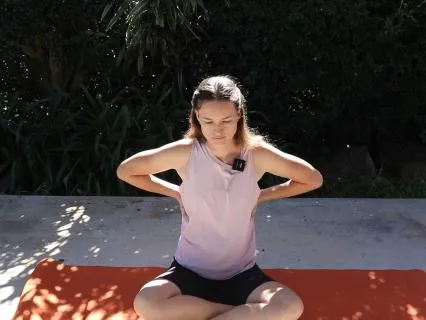
And then maybe you use your hands to help you with the next part.
You can come onto the ribcage just wherever is comfortable.
And see what happens when you're breathing in.
By just letting the exhale take care of itself.
The focus is on the inhale.
Where is moving?
And if your hands are there.
Are there places that are not lifting?
When you inhale.
If that's the case.
See if you can gently encourage a little more expansion.
And often it's the back of the body.
Ends up with the missing pieces,
Especially with pregnancies and birth.
So you could always turn the hands up the other way so all the fingers come around the back and the thumbs are to the front.
And you've got more surface area to encourage the breath into the back of the body.
And be sure to check in with the left side too.
And then the right side.
And then the torso as a whole.
They'll focus mostly on the ribcage area.
We're going to move down again shortly.
And then you can slide your hands down to the waist.
Put them however is comfortable.
Fingers to the front is fine.
And once they're on the waist,
Just do the same thing.
Breathing in and noticing where you feel the movement.
Is it all coming out the front midline?
Is there anything coming into the left side?
Or the right side.
Or the back of the body.
If the back is what's missing,
Then you could even put the hands,
Two hands to the back and see.
If you can encourage a little more expansion into the back of the body.
And then the final place to note is the pelvic floor.
And it's actually very important that the pelvic floor be allowed to move and relax with the breath cycle,
Because a muscle that cannot fully relax also cannot fully contract,
Which means that it's not able to do its full job.
So what we'd like to see is as we inhale,
The diaphragm moves down,
It displaces abdominal organs,
And in doing so,
It needs to expand into that pelvic floor.
So the pelvic floor muscles give a little.
Yes,
It's subtle,
But it's there.
If our breathing is optimized,
Then we'll get a little bit of expansion down into the pelvic floor as well.
And then on the exhale it just naturally recoils.
And when it can do that,
It's usually doing its job just fine in movement as well.
And it does need maintenance.
It does need intentional exercises.
But the breath is the first and most important step.
And it's this beautiful practice that you can learn to do anywhere.
It doesn't have to take this long.
Doesn't have to be sitting on your mat.
You can do it while you're peeling the vegetables or in line at the shop.
While you're feeding your baby.
You can do this anywhere because it doesn't need any equipment.
Or a lot of time.
Just you and your breath.
Tune in.
And adjustment.
And then when you're ready.
Maybe close the eyes again if they were open.
And tune back into that body,
Mind and breath check-in.
How's the body feeling now?
On a scale from 1 to 10.
One's the worst it's ever felt.
Ten is the best.
What's happened with the mind?
Is that a 1,
A 10,
Somewhere in between?
And then finally,
The breath.
1 to 10.
Three more numbers at the end of your breathing practice.
Any differences?
It's interesting to notice.
It's all just information.
Try to be more like a curious scientist than someone judging good or bad.
Huh,
I wonder why my breath changed like that.
I wonder.
That's a really good approach to take.
For your whole life,
Really.
And now,
As promised,
I'm just going to mention a couple of ways you can get more breath into the back and sides of the body,
Because postnatal recovery especially,
You will find more of a tendency for the breath to just naturally want to move out.
It's the path of least resistance when the pressure builds in the abdomen through the breathing.
And so it's going to come out the front or it's going to go down through the pelvic floor.
And we'd just really like to encourage it more around the back.
But in doing this,
We're going to compress the abdomen.
So it's just not that suitable for pregnancy.
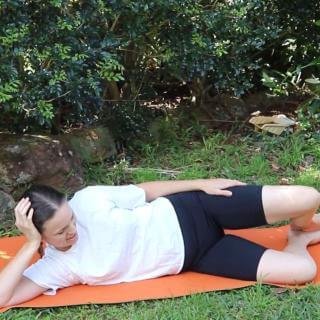
Let's start by bringing the knees up,
Feet flat to the mat,
And then just hug the knees right into the body.
And you can do this lying down as well,
But if you lay on your back to do it,
Then you're compressing the back a little bit.
You might not get as much air back there.
So you're making yourself into this tiny little ball.
And then just breathing.
Into the back and you can make that a more significant breathing effort than you would normally and that's okay.
The point is really just to encourage a loosening of the back muscles.
And it can just feel really nice for someone who's.
.
.
Maybe breastfeeding or cradling a baby a lot and putting them to bed and just getting really tight in that lower back,
Those ropey muscles.
And just notice the shoulders too,
Just try to check in that they're not coming up too close to the ears because once again that's setting up that shallow upward breathing pattern and what we want is down and out through the back.
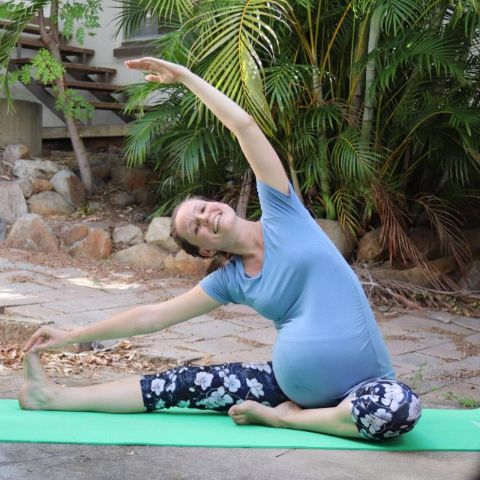
And you can also use the same posture to get more expansion through the sides of the body.
But for that you can also do a side stretch where you would bring the right hand to the mat You can loosen the knees or you can keep them in.
That's just probably easier if you cross your legs again and then inhale the left arm up and exhale over to the right.
This one actually isn't compressing the abdomen.
So pregnant women are very welcome to do this and it can really help with comfort,
Especially in the third trimester with the really big bump and less space for your lungs.
So we're opening up through the ribcage there.
And then you would just swap over.
So that you also do the right-hand side.
Try to anchor the opposite,
Sorry,
If we're bending over to the left,
We're anchoring the right bone into the mat.
That bony point of your bottom.
And on the left we were anchoring them.
Sorry,
When we're bending over to the right,
We're anchoring the left.
Now,
The final one I wanted to show you was Child's Pose.
And this one can be modified for pregnant women,
Just so long as the bump isn't going to bottom out on the mat.
You can just widen the legs.
So you're not compressing the bump.
So actually I do have more prenatal options than I thought I did.
And isn't that wonderful?
Because this one also is sort of like an anti-gravity thing.
You know how you just really want to lay on your belly and it's the one thing you can't do,
Especially in advancing pregnancy.
So you can widen the knees.
You can prop a few pillows or bolsters underneath you and walk the hands forward and sink the buttocks onto the heels.
Just taking care that there's no pressure on the abdomen itself.
And you could just go less into it the bigger you get.
So you could maybe just have your elbows on the mat in front of you instead of walking the hands out.
See how you go with that.
And then you can breathe into the back body.
Everybody else who's not pregnant is going to have the knees in close together.
And same thing,
Walk the hands forward.
Until you can come down.
And breathe more easily into the back of the body now that you've basically taken a lot of the weight of just being upright off it.
And you've also compressed the front of the body to prevent the air escaping out through the front.
Another thing you can do with that if you're still not feeling it enough is you could get like a little yoga ball or a rolled up towel or something and just pop it against your midline there and lean forwards onto that.
I hope this has helped.
Namaste