Namaste Yoga Mamas,
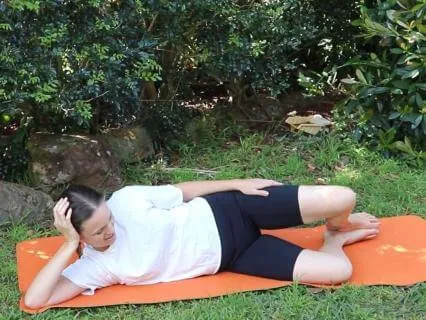
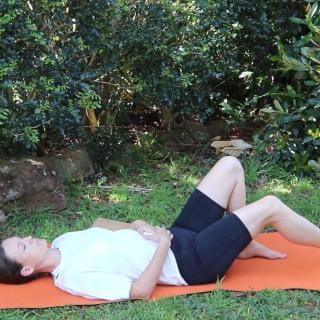
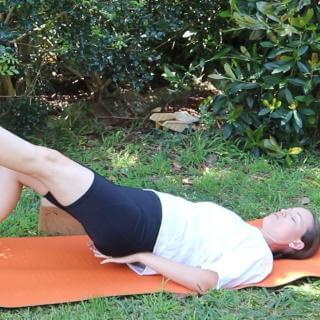
I'm Emma from Becoming Mummy Yoga and this is a prenatal side-lying clamshell.
We'll start with the pose and then I'll get into some of the benefits of it.
You do not need any props but if you have either a block or more preferably a thin pillow like one off your lounge,
That would come in handy.
Once again,
Completely optional.
Whenever you're ready,
Just come down onto one side,
Any side.
I'm starting with the right,
So that's how the directions will be oriented to begin with.
You can rest your head on a hand.
So that you're kind of propped up a little bit or you can lower the head all the way to the mat,
It could be on an arm,
It could be on the mat,
You could roll up a towel even and pop it under there for some stability if you like.
Lengthen through the spine.
And then bend the nape.
So that you've brought the feet roughly in line with your buttocks and you've come into this nice aligned pose ready for your clamshell.
Before you start,
Just check in with the rib cage.
You can use your hands to help you if you like and just make sure that you haven't rotated that top set of ribs forward or back compared to the bottom set.
We're ideally trying to stack them so that the two sides are even.
Same with the pelvis,
Especially important for people with pubic symphysis dysfunction or SPD.
And also with sacroiliac joint pain.
We want to make sure that the two sides are stacked very neatly on top of each other for ultimate stability.
We're going to move this out of the way.
The two feet are also stacked and the knees are stacked and then whenever you're ready you can place a hand on the hip if it helps you to sort of be guided with the the gentle activation of your transverse abdominals during the pose.
If bump is in the way of that,
Or it's not comfortable otherwise,
Then it's fine to just rest the left hand anywhere that's comfortable.
When you're ready,
We're just going to inhale,
Expand the whole body,
Exhale,
A light contraction,
So a hugging in of the belly area,
Just gently because we're not trying to compress baby,
We're just lightly activating the deep transverse abdominals there,
And then lift that top leg just to wherever's comfortable.
The more SPD or SIJ pain that you have,
The less you're going to lift.
And you shouldn't be too likely to exacerbate this,
But pay attention right now,
Pay attention for the next 24 hours or so.
And if you notice increased pain after doing this pose,
Then maybe it's not for you right here and right now.
But if you can do it without making any symptoms worse,
It can be a really good strengthener for the muscles that are needing some extra support when we've got those signs of dysfunction.
So just keep lifting.
And lowering the leg.
Option to put the pillow or the block in between the thighs so that you can squeeze every time you come down and that activates the inner thigh,
The adductors a little bit.
So then you've got almost all of the muscle groups working here that are important for pelvic stability to avoid the exacerbation of the symptoms that tend to progress as a pregnancy goes on and gets heavier in your body.
So we're just lifting and lowering,
Nice and slow and gentle.
To wherever is comfortable you can increase the size of the lift if it's not hurting you and you're just working the glute medius especially a bit of glute max but mostly glute medius and the external rotators of the hips here and then if you squeeze something between the thighs even if you squeeze if you don't have anything in there to give you that feedback you're still activating those adductors as well and then we've just got so much goodness going on for us strengthening in our lower body which is carrying an increasingly heavy load throughout a pregnancy.
While you do it the more intense the workout for those muscles so be encouraged to go nice and slow and when you're ready you can use the hands to help you sit Swing around to the other side,
Just keep those legs acting like they're velcroed together if you do have SPD or SIJ pain to avoid making it worse.
If bump is in the way you could always come onto hands and knees to help you to shift over to that other side.
And then lay down once again.
Resting the head on whatever's comfortable for you.
Aligning so that our knees are bent,
Feet are in line with the buttocks,
Ribs are stacked,
Hips are stacked,
And taking care as you lift and lower that you are not accidentally bringing those hips out of alignment.
We still want them to be stacked throughout the whole movement,
So sometimes taking a hand around to the back there and just resting it on the back of the pelvis right about where the sacroiliac joints are,
So that's one on each side of the spine and as you lift and lower just check in that you're not rocking the whole pelvis back and forwards,
It's only that leg that's moving.
Once again,
If you ever get any exacerbation of pain or any compression of bumps,
You can just come to rest.
Either orange or red lights,
Depending on how you look at it.
If you think of everything we do as a bit of a traffic light system,
You would be on green.
If you can keep a nice,
Even breath going,
If you could talk normally,
If you could work muscles,
Yes,
But without tension,
Without pain,
Then you're on green.
And once you start to lose a little bit of that control,
You're going more towards an orange light.
Bump over into pain or you really can't keep your breathing even or you're getting tension,
Tightness,
Especially around the jaw and neck.
They can all be signs that you're going a little bit hard for what your body is able to cope with right now.
So once you get to red,
You definitely want to stop.
If it's not easing after you have stopped,
Then probably seek some medical advice.
I wouldn't anticipate that for this particular pose,
But but it's just good to keep in mind so that you're always tuning in to your body.
The more we tune in,
The better it is for our pregnancy,
For our birth,
For our recovery.
And just remember you can have the intention of a little bit of hugging in of the baby in and up towards the spine as you do this.
It's usually easiest to do on an exhale and that'll lift the pelvic floor a little.
As well as activating those deep transverse abdominals and help the whole body's muscles to sort of function and pull their own weight,
So to speak.
Functioning as well as they possibly can.
When you feel like you've had good even movement on both sides,
You can Use those hands once again to help push you back up to sit.
I hope you enjoyed.
Namaste.