Namaste,
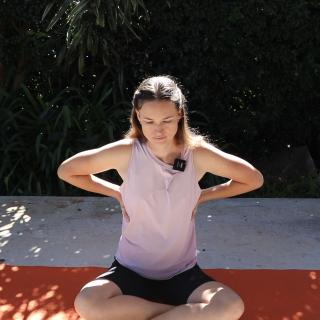
I'm Emma from Becoming Mummy Yoga and this is a postnatal reconnection sort of pose.
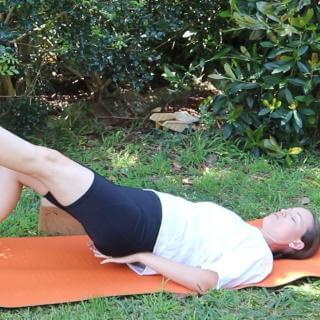
We're going to do some heel slides.
Usually best for most women if you wait until closer to two months postnatally before you start these sort of exercises.
Definitely after a C-section,
After a vaginal birth,
You can see how you're feeling.
Maybe err on the side of caution.
So if anything starts to feel a little bit like strain or increased pressure,
Then just wait a little longer before you get going with this.
If in doubt,
You can always check in with a pelvic floor physio because they tend to be really good at helping you to assess for your individual body what poses it's ready to cope with right now.
When you're ready,
Just lower gently down onto the back.
You could do this with baby if you wanted to.
They could do a bit of tummy time up on top of you,
Or they could rest on the mat beside you.
Wherever they are,
Just make sure they're comfortable.
If they're off having a nap and this is your rest time,
Then I hope that you enjoy getting down on your back because Just don't spend enough time horizontal.
In the postnatal days.
Or at least the first year really,
If not more.
Anyway.
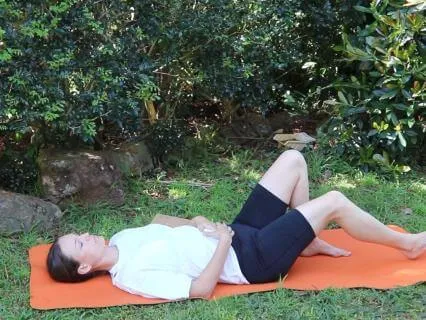
Once you're down on your back,
Knees high,
Feet flat on the mat,
Almost as though we were going to go into our bridge pose.
But what we're going to do first is just.
Connect with the breath.
Inhaling deeply through the nose if you can.
Seeing if we can get a 360 degree expansion,
So if you're imagining the core as a bit of a cylindrical container,
What you're doing is expanding the whole thing to accommodate the increased pressure by increasing the air coming in.
So the whole thing expands,
The front,
The left,
The right,
The back.
Even up and down,
The whole thing expands and then contracts naturally on the exhale,
Just creating a little lift through the pelvic floor as it does so.
And this is a great breathing exercise in and of itself.
And you can continue here even if you're quite early postnatal.
That should never cause harm.
So even if you are early post C-section,
You can do whatever breathing exercises feel comfortable to you.
And then.
See how you go with this idea of taking a little bit of weight into the left foot and gently sliding the right foot away from you.
Just go gently and easily,
Especially if you're early postpartum.
Once you're more than two months,
You tend to be able to do this easier and easier,
But always pay a lot of attention.
We're tuning in deeply and reconnecting our bodies and then building up the strength.
So begin to slide that right heel away from the body just to wherever is comfortable and check in either with your hands or by lifting the head to make sure you're not getting either a triangle doming or a bread loaf sort of appearance at the midline of the body because that is an indication that you're starting to push hard enough that your body's not coping with maintaining the pressure and it's no longer able to hold at the front.
And that's usually a result of diastasis recti,
Which is.
.
.
Such a big thing to explain.
I don't want to dwell on it too much today,
But the muscles of the abdomen have to lengthen and separate to accommodate the baby growing in there,
Right?
So after the birth,
It takes time to close,
To heal,
To reconnect,
To rebuild.
So we're just going gently and carefully,
Making sure we're not getting that sort of pooching out.
And then bringing the heel back in and just repeating that.
Again and again,
Just as many times as is comfortable,
Resting any time that you need to.
See if you can get to full extension without any raising of that midline or any extra pressure down through the pelvic floor.
I wouldn't anticipate it for this particular pose,
But you just never know how your body is going to go on any given day.
So always tuning in deeply,
Paying lots of attention and just working to your own comfort level.
And if that is okay for you,
You can always,
If you get to the full extension,
You can start to lift the heel a little and bring those movements up.
Off the mat so that you're getting a little bit more activation.
The benefit of this pose is transverse abdominals which are the deepest layer.
Of the abdominals there,
And the one that we're most needing to heal,
Because the others will kind of follow along.
And what we're doing here is we're activating them with the heel slide,
And then we're just increasing the intensity if we lift the heel off the mat.
And you could even add a whole leg lift if you can manage that intra-abdominal pressure.
So remember that idea of the core as a canister,
Or the whole torso as a canister,
Really.
The whole thing should be able to expand and contract losing pressure out through the midline or down through the pelvic floor.
If you're beginning to lose pressure on either of those fronts then you've moved from,
If it's traffic light system right,
It's green if everything's moving well and as it should without any extra pressure.
Through any of the weakened areas of the body.
And you start to move to amber when you start to lose that.
So you would modify the pose,
You would bring those movements a little bit smaller and work wherever you are today.
And whenever you're ready,
You can swap sides too.
So take more weight onto the right foot and then begin to do the heel sides with the left-hand side.
Remember to only go as far as is comfortable because once we come into that orange light territory,
Where we're starting to lose that connection to our core and that ability to maintain our pressure without it escaping through the midline,
Through the pelvic floor,
Orange light,
Scale back or modify.
And if you can't do those things,
You're starting to get towards pain,
Pressure,
Tension that can't be alleviated by modifying your pose to be more gentle,
Then that's a red light and you're going to need to stop and just go back to resting for now.
Postnatal recovery is not linear anyway.
So even if you could do this yesterday and you're struggling with it today,
That's totally fine,
Totally normal,
Very common.
And the most important thing to do is to do all of these poses well with maintenance of that pressure,
That internal pressure,
So that you're not causing any extra harm.
And then you can continue to progress day by day and week by week.
Whereas if you push too hard too soon,
Then you're going to have more problems with continuity of your exercises and doing them regularly.
Enough to make a difference.
Remember you've got that option for the lift and lower.
I would probably say that most women are not going to start out with that from that two-ish months mark.
They're going to work up to it after doing the heelsides for some time.
And I know that it took me months and months to be able to lift the leg without.
.
.
Any doming at the midline.
Pay careful attention for through every part of this movement.
And trust that you're benefiting your body just by being here,
Just by doing some things to help it.
And if you need a rest,
You can always pop those knees together,
Walk the feet out a little bit wider and take whatever rest you need.
Not a race.
When you've had enough balance movement on both sides,
You can come to stillness.
If you've got more time to lay on your back,
That's awesome.
You could always pop your legs up the wall if you've got one handy or onto a chair.
Even any form of getting the legs up while you're laying on your back tends to be really good and nourishing and restorative for the nervous system.
So I would encourage as much rest as possible.
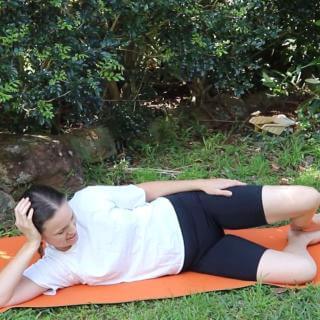
If you have to go about your day,
Just roll to one side.
And use the hands that come to them.
Namaste.