I invite you to briefly find a seated position to close your eyes.
Feel your breath,
Just the regular way your body is breathing right now.
Just feel the inhale,
Feel the pause.
Feel the exhale.
Feel the pause and just stay with however your body wants to breathe feel where it's going where it's restricting just observe you do not need to change anything and with that Feel how you seat it and arrive on your mat.
For today.
And then briefly check in with your body.
Skin from your feet,
Over your legs,
Over your hips,
Over your upper body,
All the way up.
Via your arms to the top of your head.
Just very breathy in your own way.
Very,
Possibly very sensitive area,
Whether you already know that you've got tension there or even if you don't know that you have tension there.
But it can be very sensitive in that matter.
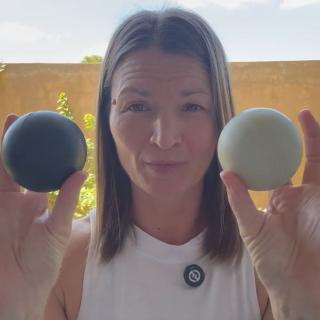
So we will only work with one ball,
Actually.
We work one side after the other.
And all you have to do initially,
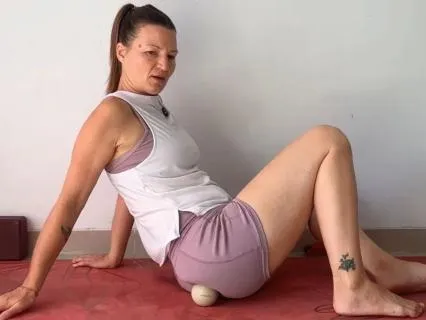
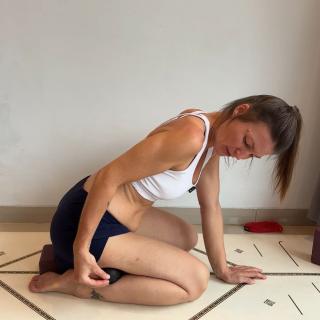
Just come into a seated position and place that ball under one of your glutes to start with.
Then position your arms behind you and have your knees point to the ceiling so that you can lift your hip off the floor.
Big round.
And then you can gently just.
.
.
With little weight initially.
Just do a little bit of a discovery.
What we find here in the glute region.
You may want to go a little bit further down so that you can also come to the upper region of the glute.
This is just a bit of a discovery.
And once you feel there's a.
.
.
Kind of interesting spot,
Then I invite you to stay there and allow your hip to lower back down to the floor again so that you're adding the weight to that particular point.
And at that time you may want to come down to your elbows.
And maybe even straighten out that leg.
That may soften or increase the tensity that you feel here.
So if you think the bent knee is better and it gives you the right amount of weight here,
You can do that.
Or if you feel it's too much,
You can also come down to the floor.
And just have.
Your upper back totally relaxed at this position.
Sometimes that's already big enough,
It depends where you position the ball.
And you can either,
Even if you're laying here,
Just manually reposition the board gently anywhere near back.
In your glutes.
Or you can continue using your hips.
To navigate different areas and even come to the side body if you wanted to.
What I like the most on the glutes is really the upper part of it.
So you stay on your back,
But it's like when you find your sacrum bone in the center.
And you find this other rim here,
Just the top part of the glutes that come to this outside area as well.
I find there is most tension that we hold here and the easiest for me to position our work there is course position.
The ball right there.
But ideally you can also come into a figure four position with your leg.
Meaning you just bend that left leg over the right one.
And then you have a bit more.
Range of movement with your hip as well so you can really Nicely glide.
Over the ball and be at the upper corner.
The upper rim of that glute.
If you feel that is still good,
You can breathe very smoothly,
There's no pain and we never want to have pain.
Ascend,
We're looking for that sweet spot of you feeling the pressure.
But feeling that it is relaxing.
It's not irritating your system.
So if you're still here and you're like,
Hmm,
Yeah,
You can do a bit more of pressure,
You can come back up.
Onto your elbows and with that you're adding a bit more weight or maybe even onto your arms.
So the higher up your upper body is,
The more weight you will have onto your glutes here.
Onto the ball in particular.
And that will define how intense you feel.
The pressure.
I haven't mentioned it yet,
But it's important that you really pay attention to your breath here.
Meaning I encourage you to always breathe in through your nose.
And out through the mouth.
Ideally you exhale a little bit longer than you inhale.
Because that gives your system an extra signal that yes,
We are releasing the pressure and feeling is safe,
It is okay,
It's under control.
It's within the range of acceptable.
And your body is able to release whatever it's holding on to.
If at any point you feel your breath is not smooth,
Your breath is becoming shallow,
Or you're holding your breath,
Then please reduce the intensity of the pressure.
Because these are indicators that your body is already in protection mode,
Meaning it's stiffening up.
In order to protect the area that you actually want to release.
And it can only do the one or the other,
So never both.
So you are in full control at any given point,
So whenever you're slowly.
.
.
To a different point.
Adjust your position of the body,
Your placement of the body,
So that it works for that new spot.
And ideally,
You're able to stay in one spot that is sensitive for you for around half a minute.
Maybe a bit longer so my bow is like Still at the upper region of the glutes,
But a bit more on the outside corner at the moment.
Bit bad that you don't see it,
But it's like right here.
And ideally,
You always stay for a certain moment.
You're not just constantly rolling and rolling and rolling and rolling.
Because the magic of myofascial release,
The opening of the tissue,
Really happens over time.
So the tissue needs for a certain period of time and that can be between half a minute,
Two minutes,
Sometimes even longer if it feels right for you.
In that time it needs just the right pressure.
It needs your breath to be supporting the release in through your nose.
I would lower free your mouth.
And then just giving it a space to grow.
Open up gently.
There's no pressure.
That you force,
There is pressure,
But you don't force the release.
You can't force the release.
That's the important point.
You can only create the environment for that point in order to change the open up itself.
All right,
And we're coming to the last minute here.
And it doesn't matter if you've been to the entire glutes.
Or do just one point or two points,
That's perfectly fine with fascia tissue.
We are always working in the entire body anyway.
So if you just work on one or two points and you stay Two minutes each and you just focus on those two points within your region of the glutes.
You still done the entire glued and more than that.
So don't get hung up of needing to achieve a certain number of points,
A certain number of points.
Places to stay on or constantly needing to run around.
It's more targeted.
And that's where most of the benefits actually happen.
Okay,
And then gently roll off the board.
Come into a brief rebound moment,
Maybe just a.
.
.
Gentle tapping for the region where you have mostly worked on,
Giving that part some love.
Maybe just the chain two.
Circling,
Pressuring.
You might still feel the ball because the.
.
.
Tissue here is very sensitive to pressure and can be very tensed up.
And before we go to the other side just briefly give it a quick check in left and right.
If you already feel a difference,
Maybe you feel there's a bit of a.
.
.
Softening a bit of a opening maybe your left glute feels a bit bigger in a positive way,
Just a bit more spacious.
Maybe you feel some warmth coming back in.
Maybe you feel it radiating into your leg or into your back.
And the brief rebound moment just gives you a check in.
Point as well to see what is shifting in five minutes.
And it gives the tissue we just worked on the opportunity to reabsorb liquids that we have just pressed out.
And it's now restructuring.
And then we'll come over to the other side.
So same thing here,
Just place it under one glute first.
And we're not yet working on the sacrum,
So I don't work on the sacrum.
On bones very often,
Myofascial by definition is more working on the fascia tissues,
On the soft tissue.
But I do have a recording actually here on the platform.
That helps you for the sacrum as well.
And the sacrum is really interesting because it It's not very mobile.
But it holds a lot of unnerves going through.
There's a lot of supporting systems that are happening with it.
And especially.
.
.
Tension in the glutes obviously also fixate the sacrum bone.
And if you go through the recording,
You will notice that once you stand up,
You start walking after the practice,
That it has shifted how you walk.
And it's very immediate.
It might be a good practice right after this class here to do that.
As we are now on the second side,
Play with the angle of your upper body to define how much pressure you want to have.
And you can also relax.
Straighten the right leg.
If needed to reduce it further.
Or you come back into the figure four position.
That figure four position really works best if the bow is really further up.
The upper region of the glutes.
Especially if you're working on the outside here a little bit as well because the figure 4 position activates this part.
Of the glutes.
So feeling the pressure here will be very different.
In a figure four position compared to just relaxing.
And you can try and see how it's different for you.
And because it's more intense doesn't necessarily mean it is better.
So check in with your mindset here.
Feeling it more doesn't mean you're doing.
Better job for your body.
So check in where you're pushing yourself and where you're not.
Less,
But longer.
Might be more useful for that particular point.
Always come back to your breath.
Always just deep exhales.
Because when you're working here at the edge of,
You know,
Irritating,
Maybe sometimes a little bit of pain,
It can also itchy date our nervous system and with our breath out through the nose,
Out through the mouth.
We're signaling to our nervous system that everything is okay.
We are releasing.
It's safe.
You can relax.
And that deepens the relaxation in that point.
So play with your breath as you hear.
You may notice the difference if you're really conscious about it,
You're tuning in,
You will feel the difference in your body.
I'm moving to a different pine.
I'm also adjusting my body weight again.
My body position.
So I'm giving a little instructions here because it's really about you exploring your glute and feeling into where do you want to stop.
And then in that one point,
How do you want to position your body?
Is it higher up to add more body weight?
Is it lower?
Closer to the floor to reduce the intensity of the weight.
There is no.
.
.
One way To do it for all of you,
It's really for you to explore what feels right and what is accessible for you in this particular moment.
It might be different next time you work on the glutes.
Most likely it will be if this is your first time.
So just go with whatever is there right now.
We have another minute here on the second slide.
And whether it's the outside corner of the glute.
You don't want to be on the hip bone but just below if you're working on the sides.
And you can also just see a bit more on the back here as well.
And if you're sick of moving with your hips,
You just manually reposition the ball wherever you want to have it.
Hmm.
Important to notice as well as we're here in the hips and the hips are known for holding a lot of tension meaning they're also holding a lot of emotions that is the same thing just The one is in the emotional body,
The other is in the physical body,
But they are interlinked.
So as you're working here to release the tension that you're feeling,
It can also happen that memories are coming up,
That emotions may come up.
Maybe,
You know,
Some faith is needed.
Showing itself or a certain person or whatever possibilities there might be on a release.
If any of that is happening,
Don't be surprised and just acknowledge it.
Allow that to happen without suppressing it.
So just give it a space to flow through.
Don't overthink it,
Don't try to analyze it,
Just allow it to pass.
Because that means you are really on a deeper layer.
Of a release,
Not just physical anymore.
And that's actually a compliment.
If that happens in your practice,
That's a compliment to your body,
Because your body feels really safe in how you're approaching your practice.
This practice.
If it's opening up emotionally,
That means you're holding yourself very carefully and your body notices that you're here to support it and not to fix it,
Not to push through attention to ease it up.
So your body responds in different ways depending on how you approach this practice.
All right,
Last few breaths here on this side.
This has been a long time.
And then again also here,
Just coming off the ball.
A little bit of tapping.
Or maybe shaking,
You might feel exactly the pressure points.
Of the balls where you rested on the most.
And just feel into how.
.
.
May notice a bit of a warmth coming back in,
A bit of a Softening here.
If it feels good,
You can also make some movement.
And then maybe just say it or come down into your Sebastian offline moment.
To allow your hips to just not needing to do anything right now,
Just allow the aftermath of this rebound to happen.
I feel into.
If you're feeling warmth coming in,
That is typically the blood and the intercellular fluids that we have pressed out while we worked in the region.
That's all now coming back in and it's nourishing the tissue.
Which is why it's so important for this rebound moment.
Because in the remount moment,
When the tissue doesn't need to move,
It has the best.
Opportunity to really nourish itself and restructure the tissue layers,
Because that's what we want to do with the pressure.
We are compressing the tissue,
We are giving it some force to come into a different composition,
But as it's then opening up,
It has the opportunity to find a new way of structure.
And that is best done when it doesn't need to work.
Always have a minute.
A minute is a good time for that to happen.
And then I invite you to either come back into a seated position.
Or maybe you want to stand up already and just shake your hips and see how that feels different.
Can also.
Hype your backside here a little bit.
I hope it was helpful for today and you're feeling a bit relaxed over there.
Sometimes you still need to know a few more minutes to feel back to normal again.
And you can also feel into the lower back.
Especially as you're starting to stand up maybe.
Feel how you're over all.
Paratus moose.