We can think about our lives in two contrasting ways.
We can think about our lives in terms of being and we can think about our lives in terms of doing.
And when we think about life in these two different perspectives,
We can think about our practice and how we find the peace and the happiness at the heart of life under these two heads as well.
Now in our particular lineage there are two great Zen masters.
One is very emphatically about doing and one is very much about being.
And some people find one perspective more helpful than the other.
And I wanted to share with you today a little bit of the work around the Zen master called Bankei who very much emphasized this being aspect of practice.
So what does this being as opposed to doing kind of contrast encapsulate?
So when we think about practice from the doing point of view,
We tend to think about,
Okay,
I start at point A,
My life is on some level unsatisfactory.
There's a certain degree of misery or at least a certain sense of I could do better,
I could actually be happier,
I could be more fulfilled in my life.
And then we view practice as a journey,
As it were,
From that point A through the process of practice to point B to a goal,
To a destination where we actually find the happiness,
The truth that we've been searching for.
And so our view of practice is like a spiritual journey going from from essentially some level of dissatisfaction or unhappiness to happiness.
And there's a deep truth to this process.
This is actually how it is,
We can do exactly this.
And the other great Zen master in our lineage,
Hakuen,
He very much had this view and this way of teaching.
Now Bankei,
The Zen master that we're going to look at today,
As a young person,
He had a very strong drive to find the truth at the heart of things.
His parents both died when he was about 10 years old.
And he had a very strong will.
He was a very determined kind of character.
And so determined that he kind of fell out with his whole family.
And he basically ended up homeless shortly after his parents died,
Probably about 11 or so he was he was homeless.
And he really wanted more than anything else to find the truth at the heart of things to find peace,
To find satisfaction,
To find happiness.
And he threw his whole being into this quest into this search.
And he practiced incredibly assiduously.
There are stories that for example,
He sat in meditation on a rock,
No cushion,
Just straight on a bare rock for a week without moving.
Another time,
He went to a famous shrine in Japan,
Where he did a kind of a week retreat where you neither eat nor sleep for a week,
Just straight through a whole week without any food without any sleep.
He just pushed himself so hard.
Another time for several months,
He got into doing his meditation where he was up to his chest in a river in cold water.
He just tried anything he was he was willing to put his life on the line.
He wanted to find this so much.
And it got to the point that his health started to break down.
And it seems that as far as we can tell from the old accounts,
He gave himself tuberculosis,
He got a very serious lung disease.
And he was carrying on his meditation,
He was getting weaker,
He was getting sicker,
He was approaching death's door,
Really.
And then,
As the old account says,
He he was in kind of deep meditation one morning,
And the scent of plum blossom,
So it must have been in the springtime,
Just came past his nose.
And just as he smelled this plum blossom,
Boom,
Everything turned around and opened up for him.
And he did a huge,
And he spat out all this blood and phlegm from his lungs.
And he felt better,
He felt cured.
And he got up and he went back to his home temple.
And his teacher recognized that he'd found this happiness that he'd been looking for.
But the thing was,
That he realized,
Out of this incredible pressure that he put on himself,
That none of this was necessary.
And he spent a lot of time and energy in the rest of his life,
Really emphasizing to the people who came to study with him,
That you don't need to force yourself,
You don't need to pressure yourself,
That this enlightenment isn't something that you have to earn through a certain amount of forcing or hardship or anything like that.
He said,
It's yours from the beginning.
It always was,
And it always will be.
And it's from this perspective of being rather than doing that he basically made all of his teaching.
And this week with Noriko,
We've been doing a little bit of work to kind of translate a text that's sort of where Banke summarizes his teaching of being,
This being of settling into this truth of your being right now,
Not waiting for anything else right now.
He says,
When your parents gave you birth,
You had the Buddha heart,
There were no defilements.
So right at the beginning,
As a tiny baby,
You were an absolutely perfect tiny baby you had,
It all right there.
You were like a tiny Buddha right there.
There were no defilements.
He says,
This Buddha heart is definitely unborn,
Spiritual and radiant.
In the unborn,
You can understand and harmonize all things.
So if you can settle into this place that you were from the moment you were born,
You have it all,
You can harmonize and understand all things.
You don't need anything else.
It's right here.
He says,
The evidence for this is like this.
If while everyone is looking at me and listening,
A crow or swallow or something else makes a sound behind you,
You can distinguish them effortlessly.
That is unborn listening.
This is an example.
So there's an effortless quality about this.
We just know.
In that sense,
We're just Buddhas right now.
It's not that we do anything or make anything special happen.
In fact,
It's the opposite.
It's when we don't try to make anything special happen,
But here it is.
The person in this unborn spiritual radiance returns to the Buddha heart.
If you confirm this from now on,
You become a living Buddha.
He says,
Being unborn doesn't depend on your previous life.
Also,
Future Buddhahood is irrelevant.
An unborn person is an enlightened person.
You don't need to have Satori or Kensha or an experience of enlightenment because if you're not wandering elsewhere,
You are a living Buddha.
Rather than trying to become a Buddha,
This is the short way to simply be a Buddha.
So when you don't do anything else,
It's like your default place is this radiant,
Spiritual,
Unborn Buddha heart.
You can enjoy this right now.
It doesn't matter how clever you are.
It doesn't matter how much you've suffered in the past.
It doesn't matter really any conditions in your life.
All you need to do is just settle into this place.
He goes on to say,
You people listening to me,
Nobody's unenlightened.
But when you stand up and leave this place and go home to your children or family and something you don't like happens,
You lose your Buddha heart.
Until you changed it into something else,
You had the Buddha heart.
But when you hold on to even a tiny thing,
You become unenlightened.
Everybody is a clever person.
But when you get upset,
You transform yourself into a fighting spirit or a hungry ghost.
Then even if someone offers the truth to you,
You can't hear it.
Even if you're in the presence of truth,
You don't have any sense or wisdom.
Then you move from hell to hell in unlimited suffering,
And everything becomes harder and harder and darker and darker.
So when we don't grab on or hang on to anything in particular,
Then we're in this Buddha heart.
When we grab on to anything or resist anything,
We lose it.
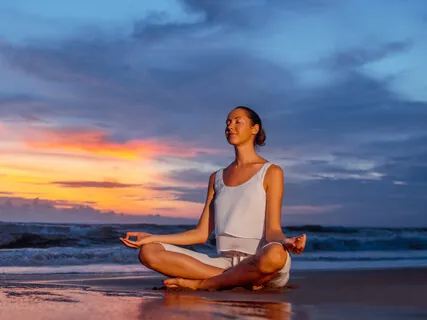
An ancient image that's used for this is the image of the ocean and the waves.
Your nature,
Your true nature,
Is an ocean.
A boundless ocean,
Beginningless,
Endless.
And in this ocean place,
You have no problems.
You always were,
Always are and always will be absolutely perfect.
But we get distracted by the waves on the ocean.
We think about this and that,
And the waves,
The shifting,
Changing patterns of our life that always vary and move can kind of distract us from this ocean quality.
And so we can get lost.
We can get lost into success or failure.
We can get lost into affection and hatred.
We can get lost into the world of the opposites.
But even these opposites themselves are made out of the ocean,
In the same way that the waves are made out of the ocean.
And at any time,
We can just,
As it were,
Broaden our awareness and let go.
And we're in this ocean place,
This Buddha place,
This enlightened place.
You can do this right now.
And you do this all the time.
We all do.
The thing is,
When we get hypnotized by the waves,
We lose the perspective of the ocean.
We lose this unborn reality.
So how do we settle back into this place?
We just don't do anything else.
In Ben-Kez-en-ji,
We also like to use the image of a mirror.
We become like a mirror.
The mirror reflects anything that goes past the mirror,
Whether it's a beautiful lady,
An ugly old dog,
It doesn't matter.
When the reflection is there,
The reflection is there.
When the reflection is gone,
The reflection is gone.
The mirror doesn't grab anything,
Doesn't push anything away.
And in a sense,
The mirror remains unchanged,
Whatever reflections pass by the mirror.
In the same way,
If we don't buy into the reflections in our internal mirror,
Then nothing can actually harm you.
Sometimes people think that this means that you just become like a puddle,
There's nothing to do,
You just become like an inert sort of thing.
But actually,
This isn't true.
The more you settle into this being,
The more you give up trying to become a Buddha and allow yourself to just be a Buddha.
Strangely enough,
The more the impulse to do arises out of this place.
But this impulse to do,
This impulse to action in your life isn't based in the waves and the ocean,
It's not based in a sense of your fundamental inadequacy.
It comes,
By contrast,
Out of your fundamental all-rightness,
Your fundamental okayness.
The more you settle into being actually okay,
As you are right now,
The more there's an impulse to action out of this place.
So the more we settle into being,
The more the impulse to do arises.
The other approach to teaching that we talked about,
The approach where it's based in doing,
Strangely enough,
That brings us to the place of being.
So these two aren't really opposites at all.
They're just mirror images,
Like two sides of a coin,
Inseparable.
Some people actually do best through just this very moment,
Settling into their fundamental okayness.
Just right now,
Allowing yourself to be everything that you really are,
Accepting fully all of it,
And in this sense,
Becoming boundless,
Like the ocean,
And enjoying fully this expansive,
Spacious freedom of being this ocean.
Some people find that this doesn't resonate so much,
And they do better with the other approach,
Where they put the emphasis into step by step progressing on their spiritual journey.
But very often,
People who do this,
As they walk those steps of the journey,
Like Benke himself,
They come to a certain point where they realize,
I had it from the beginning.
I always will have it.
I never actually was lost.
And sometimes,
When people cross this threshold,
Where they realize this,
Sometimes they cry,
Because it's almost like I've been dying of thirst,
Sitting in the middle of a lake of beautiful fresh water my whole life.
From the beginning,
You have it.
Right now,
You have it.
So our work from this perspective becomes the work of acceptance,
The work of allowing yourself to be.
So much of our culture,
So much of our life living in London is about do,
Do,
Do.
Everything's about production,
Success,
Gaining,
All of these things.
Sometimes the kindest thing that we can do is at least give some space every day in which we can allow ourselves to be.
Allow yourself to be absolutely all right,
To be as you are,
Without trying to fiddle or change or adapt anything at all.
From this place of being,
Remarkable things can happen.
You can begin to live as the Buddha that you already are,
The enlightened person that you already are.
And the more that you base your life and your action in this adequacy,
The less you can be led around by the nose,
By society telling you that you're not all right.
And so you become free.
And this great Zen master,
Banke,
In our background,
Is a prime advocate for allowing this quality of being,
Unconditional being,
To become a thread in your life.
So right now,
If you want to explore his way of practicing,
All you have to do is become like a mirror,
Allowing all the thoughts,
The feelings,
The memories,
The sights and sounds to arise and pass,
Arise and pass,
Not trying to stop any of them,
Not trying to change anything,
Just allowing.
And immediately as you allow,
As it were,
Open your hands,
Then you're immediately back in this place of the ocean,
The place of your fundamental adequacy.