So I'm going to offer you some evidence-based tips to deal with anxiety and stress.
And I thought let's start with acceptance and self-compassion.
Especially Nef in 2003,
She found,
Kirsten Nef,
She found that if we practice self-compassion by treating ourselves with kindness and understanding,
Especially during times of stress,
It will alleviate the stress,
It will deal with the anxiety.
So accept your feelings without judgment and remind yourself that it's okay not to be perfect.
Now,
I have to be honest,
This was actually one of the most difficult things I needed to learn.
When I did this in meditation,
I needed to repractice and repractice this again.
It felt a little bit off in the beginning.
And what I normally do in my meditations is give yourself an actual hug.
There is also somatic healing besides that,
And sometimes it's also helpful to place,
And I'm doing that right now,
That's why you hear the sound,
Placing your hands on your heart.
So some bodily movements might help with that.
And it's okay if it doesn't happen in one go.
This really needs some practice,
Especially if you were,
For example,
You came from a bad childhood.
This might feel unfamiliar,
This might feel not familiar.
So that's my first tip,
Acceptance and self-compassion.
You can do this by saying and acknowledging,
I'm having a bad time,
I'm struggling.
Another thing which I like to incorporate as well,
Is to engage your senses.
And this is a typical mindfulness practice you see,
Besides breathing,
Where you practice sensory mindfulness,
Where you pay focus to sight,
Sound,
Touch,
Smell and taste.
So according to Ludwig and Kabat-Zinn 2008,
This can help you bring into the present moment and calm anxious thoughts.
Now,
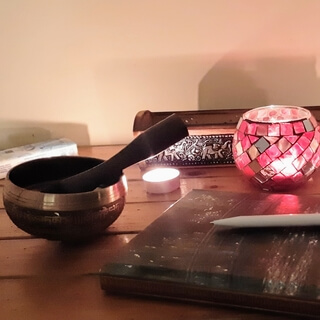
I always start off with a singing bowl.
And if we dive further into engaging your senses,
There are some studies that suggest that listening to singing bowls may offer various benefits for your mental health,
Well-being,
Including stress reduction,
Relaxation,
Mood improvement,
For some even pain management,
And an enhanced sleep quality.
I will use the singing bowls in meditation today.
I will focus on it a little bit more than I normally do.
And another tip,
An evidence-based tip,
Is to practice gratitude,
One of my favorite things to incorporate.
So cultivate a sense of gratitude by focusing on things you are thankful for in your life.
Try to do this every day.
Some people keep a gratitude journal,
They write it in the morning or in the evening.
Or some just simply,
And this is what I do daily,
Reflect on moments each day on what you appreciate.
This can be the smallest things,
But this has been shown by Emmons and McCullen in 2003,
To help shift your mindset and reduce stress.
And then another tip,
My final one for today,
I'm going to keep it short,
And I've been practicing this typical breathing technique more often lately,
Is the 4-7-8 breathing technique,
Where you try to sit with a comfortable position with a straight back,
So that it's really easier for you to breathe,
Where you breathe in for the count of 4,
You hold it for 7,
And then out through the mouth to pursed lips for 8.
According to Weil,
W-A-E-L,
2021,
This technique can help you calm your nervous system and induce relaxation.
So let's practice a meditation with these tips.
I invite you to sit with a straight spine.
Your hands closed in your lap,
So that you can turn inwards,
Sit with a straight spine.
And we're going to breathe in for 4 seconds,
And then hold it for 7,
We breathe in through the nose by the way,
Hold it for 7,
And breathe out for 8 through the mouth with pursed lips.
If you don't feel comfortable doing it,
I found another research article that even paced breathing can already help with relaxation.
But the 4-7-8 breathing technique is also helpful to reduce anxiety.
So you can join me by breathing in for 4,
Pause for 7,
And breathe out for 8.
In for 4,
Pause for 7,
Out for 8.
In,
Pause,
Out.
In,
Pause,
Out.
And you can return to your normal breath.
You might want to open your eyes if you've closed them,
And try to focus on one object in front of you,
Where you really look at the shape of that object.
And try to get a sense of how it would feel like.
Would it feel cold,
Warm?
And look at this texture,
Its color,
And have a good look at that object.
Now you can move on to your next sense of taste.
Is there some taste left in your mouth?
Shall we move on to the next sense of smell?
Perhaps you can sense a smell around you,
A fragrance.
And now I want you to focus on touch.
Perhaps you feel your hands in your lap,
Or the clothes on your body.
Pay attention if you feel a certain breeze,
Or maybe you don't feel anything at all.
And now I want you to listen,
The final sense of listening.
Do you hear sounds nearby,
Or far away?
And I want you to pay attention to the singing bowls,
And keep focusing on whether or not the sound is distant,
Or nearby.
And there is another one.
Keep listening.
Wonderful.
Now you can take a deep breath in through the nose,
And release through the mouth.
Keep your eyes closed,
And try to feel what you are feeling,
If you have any stress or anxiety.
If we want to accept it and show self-compassion,
We first need to acknowledge it.
So you might say it out loud,
What you feel,
And say,
But that's okay.
For example,
I feel anxiety,
But that's okay.
And try to keep breathing through those feelings.
Keep hugging yourself.
Might feel a little bit weird,
That's okay.
We're trying to comfort ourselves.
If you don't like the hug,
You can also place your hands on your heart.
And again,
Keep acknowledging what you feel.
I feel weird,
But that's okay.
I am struggling,
But that's okay.
And please state out loud with me.
I feel this way,
But I am not alone.
Other people struggle with this as well.
It is okay.
I am not alone.
You can let go,
Breathe in,
And release.
Drop your hands.
And I'm very grateful that you are here today,
Taking time and practicing this meditation.
I'm grateful that you're not alone.
What are you grateful for today?
I thank you.
You can take a final deep breath in and let that go,
And open your eyes.