Welcome,
This is Daphne.
You've arrived for this night of rest,
And I'm glad you're here.
This is a National Park Sleep Story,
Part of my Ranger's Guide to Rest series.
Tonight we'll visit a high plateau in Yellowstone that I came to know well as a park ranger,
Where frost gathers even in late summer,
And steam rises from the earth before the sun appears.
Before the story begins,
Take a moment to settle your body in whatever way feels most comfortable tonight.
Notice the surface beneath you,
The way it receives your weight.
You might feel the back of your body surrendering gently into support.
Your weight is fully received.
There's nothing you need to hold up right now.
The bed doesn't ask anything of you.
It simply supports you.
The day is finished now.
Anything that remains can wait until morning.
Whatever you were carrying,
Whatever you were managing today,
You're allowed to set it down now.
You don't need to solve anything tonight.
There is nothing else you need to do.
Your room is familiar.
The walls around you are steady.
You are supported from below.
Your breath can move at its own pace.
You might even notice one gentle breath arriving.
And then leaving again without any effort at all.
And as your body begins to soften,
You may notice a subtle shift.
Like the moment before sunrise,
When it seems as though the world is holding its breath When I lived in the middle of Yellowstone,
Mornings often began long before most visitors were out on the roads.
Even in summer,
Those early hours could be surprisingly cold.
I might pull on a fleece and a warm hat before heading outside.
My binoculars were always close at hand,
Because in Yellowstone,
You never knew what you might see.
Sometimes wildlife appeared out in the open while I was driving or hiking.
Sometimes there were no animals to be seen,
And then a dark shape would emerge from the edge of a meadow.
At other times before seeing anything,
You would hear it.
An elk bugling.
Coyotes calling across a valley.
Or the long-distance sound of wolves howling from somewhere you couldn't see at all.
In the cold morning air,
Those sounds seem to travel a very long way.
You could stand bundled against the chill,
Listening into the open space without knowing exactly where the animals were.
Above you,
The sky might still be deep indigo,
With a few fading stars overhead.
Mountains were mostly silhouettes,
Their shapes just beginning to separate from the darkness as the eastern sky gradually changed.
Across the open basins and meadows,
Frost had gathered overnight.
It outlined grasses in silver,
And rested along the edges of sagebrush and willow.
Near streams and rivers where colder air had settled close to the ground,
The meadow could look almost white.
And then there was the air itself,
The kind of cold that brushes against your cheeks and slips into your lungs clean and almost metallic in those hours before sunrise.
It carried the scent of earth,
Lodgepole pine,
And sage.
If your boots brushed against the sage,
Its fragrance rose up to meet you.
And somewhere mixed with all of that might be another scent entirely.
Mineral-rich,
Coming from one of the many thermal areas scattered across the high volcanic landscape.
Before much of Yellowstone had become visible in the early morning light,
You could sometimes see its steam.
Pale columns rising against the darker land,
Some lifting almost straight upward in still air.
Others bending,
Spreading,
Becoming translucent before disappearing into the sky.
Beyond the meadows and valleys,
Distant mountains form the outer edges of the plateau.
Giving shape to all that openness without closing it in.
And the ground beneath your boots might be covered in frost,
While somewhere not far away,
Water warmed deep beneath the earth was already sending steam into the morning.
Cold above.
Warmth below,
Frost and steam sharing the same landscape.
As the darkness gradually thins,
A ridge takes shape.
Then a line of trees,
A meadow.
Willow tracing the path of a river.
What seemed flat in darkness begins to gain depth.
There's a hill beyond the meadow,
And another beyond that.
Sagebrush spreads across open ground.
The river bends and disappears behind the willow,
Before returning farther downstream.
Nothing has suddenly appeared.
It was all there before you could see it.
Morning simply reveals the landscape a little at a time.
I lived in the canyon area of Yellowstone,
Not far from Hayden Valley.
So this was one of the landscapes I returned to again and again.
Hayden is broad and open,
A place where your gaze can travel a long way across grassland before reaching the darker forests and hills beyond.
In the half-light of morning,
Some of the first things you notice may be shapes scattered across the meadow.
At first,
They could almost be rocks.
Then one of them moves.
A massive head lowers towards the grass.
Another shifts forward.
A broad shoulder catches the growing light bison.
A herd spread loosely across the valley.
There's something about seeing bison against such a large landscape that can make their size difficult to judge from a distance.
From far away,
They become part of the meadow.
But when you have been close enough to see them moving along a yellowstone road or passing beside a vehicle,
You understand how substantial they really are.
Here,
Across the frosted grass,
Their bodies seem dense and dark.
Heavy shoulders moving forward as they walk.
Hooves press into cold ground,
Their thick coats hold the morning chill around them,
And faint clouds of breath appear and disappear in front of their faces.
One lowers its head and pulls at the grass.
Another takes several deliberate steps before grazing again.
Farther away,
Several others are clustered loosely together.
Each animal follows the grass in front of it.
Shifting here and there.
While somehow remaining part of the larger group.
A head lowers.
Grass tears free.
A few steps.
Another mouthful.
Warm breath into cold air.
Bison have crossed this country for generations,
Their hooves pressed into soil that has felt this weight countless times before.
Compacted by generations of movement.
Softened again by spring melt.
Drying beneath summer sun,
And receiving them once more when autumn frost returns.
This morning,
Frost gives the meadow a temporary brightness,
Beneath it is the same earth that has carried bison season after season.
The bison don't seem concerned with the beginning of a new day.
The grass is here,
So they graze.
There are other bison nearby,
So the herd remains loosely gathered.
Morning arrives around them.
The eastern sky grows lighter.
What was silver begins to show traces of green and gold.
Willow along the river takes on more color.
The dark backs of the bison become textured now.
Fur catching light.
Shoulders moving beneath it.
Somewhere beyond them,
An elk calls.
A long bugle rising through the cold air.
The sound travels across the valley and seems to hang there for a moment before fading into the hills.
Then there is only morning again.
Whatever.
Grass.
Bison.
Frost.
There were many mornings in Yellowstone when wildlife watching meant simply being willing to look for a while.
You could scan a hillside with binoculars and see nothing.
Lower them.
Look again.
Notice what seemed like an oddly shaped rock.
Lift the binoculars again and discover that the rock has ears or legs or has begun walking away.
The landscape asked for attention,
But not urgency.
There was always more happening than could be seen at first glance.
Eventually we let the bison remain where they are,
Some still grazing,
Some standing,
Their dark shapes becoming smaller as the valley widens around them.
We don't need to wait for anything else to happen.
The morning is already enough.
Farther northeast in Yellowstone lies Lamar Valley,
Known as the Serengeti of North America.
I often made the drive there specifically because it was such extraordinary wildlife country.
The valley opens broadly between long hillsides,
With the Lamar River winding through grass and willow below.
Here too the land gives your eyes room to travel.
And when wolves have been seen nearby.
People might stand quietly along the roadside with binoculars and spotting scopes,
Searching miles of open country for movement.
There was always a particular excitement when wolves appeared.
No matter how many times I saw them,
I never found them ordinary.
A dark shape.
Moving along a distant slope could suddenly bring the whole landscape into sharper focus.
This morning,
Somewhere near the river,
A pack has traveled through the valley and begun to rest.
At first,
They are only small shapes against an enormous backdrop.
One lies stretched in the grass,
Another remains sitting upright for a while,
Head raised,
Taking in the valley.
A younger wolf moves between two adults,
And then lowers itself nearby.
There may be another wolf farther away,
Appearing almost separate from the group.
But after watching wolves for a few years,
I came to understand that seeing one wolf alone did not necessarily mean it was truly alone.
The rest of the family was often nearby.
Beyond the rise along the river.
Resting in grass,
Or simply outside the narrow piece of landscape I could see.
The more time I spent watching wolves,
The quieter and more relational they seemed than the wolves I had learned about from stories.
So many of those old stories gave us a lone wolf.
A threatening wolf.
A creature moving at the edge of darkness.
But what I often found myself watching was family.
Adults attentive to younger wolves,
Pack members remaining connected with older ones,
Young animals learning how to move through the world by being among those who already knew.
Communication that could be surprisingly subtle,
A shift in posture,
A glance or nip a tail moving differently.
One wolf approaching another and briefly touching shoulder to shoulder,
Then separating again.
Sometimes that connection remained visible even after the wolves themselves had moved on.
Across frosted ground,
Their tracks might travel in loose,
Parallel lines,
One set joining another.
Separating for a while.
Than meeting again farther ahead.
Not one perfectly ordered trail,
But the traces of several animals moving through the same country together.
They didn't need to be doing anything dramatic to be fascinating.
Much of wildlife watching was like this.
Animals eating or resting.
Waiting.
Watching their surroundings.
Conserving energy.
Living long stretches of life that would never become a nature documentary.
And perhaps that was part of what made watching them feel intimate.
For a while,
You were not watching a symbol or a storybook animal.
You were watching living creatures simply going about their lives,
Being themselves.
One of the younger wolves rises.
It stretches its front legs forward,
Lowers its chest briefly toward the ground,
And then stands.
It walks several yards through the grass,
Pauses,
Looks back toward the pack,
And then circles toward them again.
Another wolf lifts its head.
For a few seconds,
Two pairs of ears are upright above the grass.
Then one disappears as the wolf lies down again.
The younger animal finds another place near the family and settles there.
Above the valley,
A raven crosses the sky,
Its wings open wide,
Catching the air as it glides over the meadow.
Then comes the rough,
Resonant call of the raven,
A sound that hangs briefly in the cold air before dissolving into the distance.
Ravens were often part of the same landscapes where wolves moved.
So were coyotes,
Although they kept their distance.
And somewhere farther across the sage,
A coyote appears now,
Small compared with the wolves.
It follows the edge of the willow for a while before vanishing behind a low rise.
The raven continues overhead.
The wolves remain near the river.
And across the enormous valley,
Other lives continue beyond our ability to see them.
Perhaps there are elk in the willows,
A pronghorn standing on an open sage flat.
Bison farther down the river.
A bear moving at the edge of a forest.
None needs to come closer.
It's enough to know that they share this country.
One wolf rolls slightly onto its side.
Another's head disappears into the grass.
The family begins to blend into the landscape.
And eventually the excitement of first seeing them gives way to something quieter.
You realize they may remain right here for quite a while,
Resting in the morning.
And we can leave them that way.
As the sun climbs,
Frost begins to disappear first from the places touched by light.
In shaded depressions,
It remains silver.
Across open slopes,
It becomes tiny droplets catching the sun.
The character of the valley changes almost without notice.
The cold blue of early morning gives way to warmer color.
Sagebrush becomes gray-green Dry grasses turn pale gold.
Willow follows the river in darker bands.
A hillside that looked nearly featureless before sunrise now contains patches of rock,
Grass,
Shrubs,
And shadow.
The land has not changed,
Only the light.
Near a bend in the river,
Several elk graze among the willow as late summer begins leaning toward autumn.
One bull lifts his head,
His breath briefly visible in the cool air.
Then a bugle rises from somewhere farther up the valley,
Carrying across the frost and following the contours of the hills before slowly dissolving into the morning.
For a moment,
The sound seems to fill the open country.
Then it fades.
The elk lower their heads again.
A raven answers with a voice entirely its own.
And the valley is spacious enough to absorb both sounds.
Across the open sagebrush flats,
Pronghorn stand scattered in small clusters in the growing light.
Their pale coats catch the sun differently from the darker bodies of the bison and elk.
They're lighter in frame than elk,
Slender and alert,
But not tense.
Pronghorn have lived on this plateau longer than almost any other large mammal here.
They evolved with speed in their bodies,
Capable of running vast distances across open land.
But in this moment,
They are still.
Heads,
Lifted briefly,
Then lowered.
Occasionally one shifts weight,
Or takes a few careful steps,
But most remain steady.
There are no hidden corners here,
Only the horizon stretching in every direction,
Uninterrupted and clear.
And within that openness,
A kind of quiet certainty.
From here you can look a long way in almost every direction,
Across grass and sage,
Toward the river,
And far off mountain ridges.
Near the edge of the forest,
Movement appears among berry-laden shrubs.
A grizzly bear is foraging.
Its head disappears among the leaves,
Then rises again,
Dark berries staining the fur around its muzzle.
Branches brush against its shoulder as it works along the slope,
Following the late summer food from one patch to another.
For a few moments,
The broad curve of its back is visible above the vegetation.
Then it moves deeper into the shrubs until leaves and branches close around it again.
Wildlife comes and goes from view this way.
A wolf disappears behind a rise.
An elk moves into willow.
A bear becomes part of the forest edge.
Pronghorn becomes little more than a pale shape against the open sage.
The landscape is always revealing something,
And concealing something else.
Farther up a slope,
The meadow meets lodgepole forest.
The transition is gradual.
The landscape changes from grass to trees.
Then trunks gather more closely.
The open sky narrows between branches,
And the quality of the morning changes again.
From a distance,
Yellowstone's lodgepole forests can appear dense and dark.
But once you enter,
There are places where the trunks rise with surprising space between them.
The forest floor is covered in fallen needles.
Your steps become quieter here.
The ground gives slightly beneath your feet,
Cushioned by years of pine needles and forest debris.
The air carries the scent of resin and earth.
It feels different from the open valley.
Out there,
Wind and sound had room to travel for miles,
But here the forest holds them closer.
Sunlight enters in pieces.
A narrow band falls across several trunks.
Another reaches the forest floor.
Tiny particles drift through the beam of sunlight,
Briefly visible,
Then disappear when they move beyond the light.
A squirrel moves somewhere overhead.
More sound than something you see.
A woodpecker taps against a trunk.
Several quick knocks,
Then silence again.
The forest doesn't need to be completely quiet to feel restful.
There are small movements everywhere.
Branches shift in the breeze.
Needles stir.
An insect passes through a patch of light.
A bird calls once from somewhere deep among the trees.
Each sound appears for a moment,
And is absorbed back into the forest.
As we continue,
You may find that you are no longer holding every part of the story The bison may be little more than dark shapes in your memory.
The wolves may have blurred into grass and distance.
You don't need to bring any of it back.
For now,
There are only lodgepole trunks rising into the morning light.
Needles beneath your feet.
The smell of pine in the air.
A patch of blue sky between branches.
The forest goes on without needing us to know exactly where it ends.
And somewhere beyond the trees,
Yellowstone changes character again.
Another part of Yellowstone I came to know especially well was Norris Geyser Basin.
I worked there as an interpretive ranger,
And led visitors on walks around the basin,
Following the boardwalk through a landscape that felt almost otherworldly.
Mornings could be cold at Norris.
I might arrive bundled in a fleece,
The air still carrying the chill of the night while steam rose from many different parts of the basin.
Then the sun would climb higher,
And the temperature could change quickly.
A morning that began with cold hands and a warm hat.
Might soon feel bright and warm beneath the open sky.
And all around you the basin seemed alive,
Steam lifted from the earth in thin ribbons and broad,
White clouds.
Water bubbled and moved through channels in the mineral-rich ground.
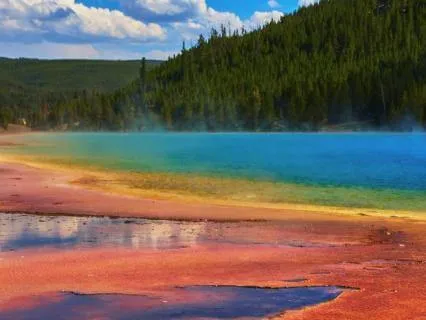
Pools appeared in colors that seemed almost unreal beside the muted greens and browns of the surrounding forest.
Bright yellow,
Rust and orange,
Emerald green.
Milky blue.
And everywhere,
White steam,
Drifting through the colors.
One of my favorite parts of the interpretive walks I led at Norris was a stretch when I would invite everyone to put their cameras away.
There wasn't much phone service in those days,
So for a while there was nothing to document or check.
I would ask the group not to talk until we reached our next stop.
Just walk.
And notice their surroundings with all of their senses.
The children would often make their way toward the front and walk beside me,
While the rest of the group stretched quietly along the boardwalk behind us.
And afterward,
Someone would almost always tell me how much they had enjoyed that quiet part of the hike.
I think Norris invited that kind of attention because there was so much to experience once you stopped trying to capture it in pictures.
Taking it in not only with your eyes,
But with your whole body.
So for this part of our walk,
We can do something similar.
There are no names you need to remember.
No geology lesson to follow,
Just the experience of being here.
As you move along the boardwalk,
A narrow plume of steam curls upward beyond a low ridge of pale mineral ground.
Farther away,
A larger cloud drifts across the basin,
Briefly veiling the forest behind it.
Sunlight catches another rising plume,
Turning it almost luminous at the edges before it thins into the cooler air.
Between the steam are unexpected pockets of color.
Yellow gathered close to one thermal feature.
Deep rust spreading through mineral-rich earth.
Green appearing bright in water.
And beyond that,
A pool of cloudy,
Milky blue.
White mineral ground beside the dark lodgepole forest.
Your eyes can wander from one to another without needing to know why any of it looks the way it does.
And around those colors are sounds you may not have noticed at first.
Water bubbling somewhere nearby.
The faint hiss of steam.
Runoff moving through a shallow channel.
Wind crossing the open basin.
Perhaps a bird calling from the forest beyond the boardwalk.
Some sounds are easy to locate.
Others seem to come from somewhere inside the steam itself.
They appear for a moment,
Then disappear back into the larger sound of the basin.
In some areas,
The unmistakable smell of sulfur hangs in the air,
Earthy and mineral,
A little strange if you aren't accustomed to it.
A shift in the breeze carries it more strongly towards you,
And takes it away again.
At times it mixes with damp earth and the scent of forest at the basin's edge.
And sometimes that mineral-rich air seems to reach beyond smell alone,
Leaving almost a sense of taste at the back of the mouth.
You're not simply looking at this landscape from a distance,
You are inside it.
Your feet meeting the wooden boardwalk beneath you cool air against your face.
Sunlight warming your shoulders.
And every so often,
A current of warm,
Moist air passing over your skin as steam crosses the walkway.
This was one of the things I loved about Norris.
The place met you from every direction,
And for a little while on those ranger walks,
No one needed me to explain it.
People could hear the water for themselves,
Smell the sulfur in the air.
Feel the warmth and coolness meeting against their skin.
And see colors they might not have expected to find here.
They could simply experience the place.
Ahead of you,
A larger cloud of steam drifts across the boardwalk.
The landscape gradually disappears behind white vapor.
The colors become indistinct.
The far side of the basin fades.
Even the next stretch of boardwalk becomes hazy.
For a few moments,
There is very little to see.
Then the breeze shifts,
The steam begins to thin.
First the boardwalk returns,
Then a patch of mineral earth.
Green water,
The dark edge of the forest.
Open sky.
Everything appearing again,
A little at a time.
Farther along,
Water trembles at the surface of a pool.
A narrow stream catches the sun as it moves through the basin,
And somewhere beyond it another plume of steam rises.
The landscape continues changing even when you stop watching closely.
And by now,
Perhaps you can stop watching quite so closely.
Just walking quietly.
Water moving.
Warmth rising from the earth.
Color beneath the open sky.
The sounds of the basin blending into the background.
The boardwalk continues ahead.
The forest remains along the edge of the basin.
The sun is higher now.
Behind you,
Another cloud of steam rises and drifts into the morning.
You don't need to turn around to see where it goes.
Norris continues.
Water moving.
Earth warming.
Steam dissolving into the air.
Colors resting beneath the open sky.
Now the places we've visited,
Hayden Valley.
Lamar Valley,
A lodgepole forest.
Norris Geyser Basin.
They're all pieces of a much larger place.
Yellowstone remembered across many mornings.
I remember standing at the edge of a valley,
With my binoculars resting against my chest,
And frost still clinging to the grass around my boots.
And feeling how Yellowstone could somehow seem vast and intimate at the same time.
There was the enormous sweep of the land around me.
And also whatever small piece of it I happen to be noticing.
A wolf through my binoculars,
A raven passing overhead.
Steam rising in the distance.
Frost around my boots.
When I lived there,
I was often aware of just how much landscape extended beyond whatever I happened to be looking at.
A valley disappeared around a bend.
A forest continued over the ridge.
A river moved beyond sight.
Animals crossed distances I would never follow.
Thermal water moved through places beneath the ground I couldn't see at all.
There was always more Yellowstone beyond the edges of the moment.
Perhaps somewhere in Hayden,
Bison are still grazing,
And the wolves in Lamar are sleeping more deeply now.
The raven has traveled somewhere else.
An elk has moved into a stand of willow.
Bear has disappeared into the shrubs.
And at Norris,
Steam continues to lift from the basin.
The lodgepole forest holds its shadows.
The river goes around another bend.
None of it needs to stay fixed.
Bison can move.
The wolves can disappear behind a rise.
Steam can dissolve into air.
Frost can become water.
Morning can become day.
And the story can begin to loosen too.
You don't need to remember where we started.
You don't need to picture a map.
There's nothing to keep in order.
Only a few images now.
Cold air before sunrise.
A dark bison crossing silver grass.
Wolf tracks pressed into frost.
A pack resting somewhere near the river.
Behind trunks holding morning light.
Steam rising from colorful earth.
The sun has climbed higher now.
Frost remains only in cooler shadows.
Across the open meadows,
The grass has warmed.
The river catches a thin line of brightness and carries it downstream.
Bending light along its curves as though holding it for a moment before letting it go.
Steam that looked pale silver before sunrise catches the higher sun now,
Turning briefly golden and translucent before thinning into the morning air.
It rises,
Spreads,
And disappears.
An eagle crosses the sky far away,
Smaller and smaller.
Until there is only sky The forest stands along the hillside,
Dark trunks,
Green needles,
Patches of sunlight Somewhere beyond the trees,
Water moves.
Somewhere beyond the valley,
Another ridge rises.
And somewhere out of sight,
An animal rests.
You don't need to know where.
Perhaps you're barely following the story now,
And that's perfectly alright.
There is no ending you need to reach.
The landscape does not need your attention in order to continue.
The river moves whether we watch it or not.
Steam rises from the basin and disappears into the air.
Bison graze beyond the edge of our view.
The wolf pack rests somewhere in the grass.
You Pine needles move in a light breeze.
Water slips around stone.
Morning light travels across the hillside.
There's nothing to follow,
Nothing to remember.
Only the sense of a wide landscape continuing around you.
Cold earth warming in sunlight.
Steam rising.
Water moving.
Animals resting.
Your own breath is moving too.
Coming in.
Going out.
There's no need to anticipate the arrival of morning.
No need to hold the landscape together.
It knows how to continue.
The river bends out of sight.
Steam fades into the open air.
The mountains remain along the horizon.
And somewhere across Yellowstone,
Mourning continues.
There's nothing more you need to follow.
Nothing more you need to remember.
Just the river moving somewhere beyond the meadow.
Steam rising into open air.
Light.
Resting across the high plateau.
The land continues its rhythm.
And you rest within it.