So today we're looking at step 11.
So this is yoga and the 12 steps.
I'm guiding you through satsang talks on the essence of what we cover in the course.
The course is much more in depth,
But we touch upon this and look at how do yoga and the 12 steps work together?
How do the principles within the 12 steps?
What does yoga have to offer and how does yoga approach that principle?
So step 11,
And this is from AA's 12 Steps in 12 Traditions.
Step 11.
Sought through prayer and meditation to improve our conscious contact with God as we understood Him.
Praying only for knowledge of His will for us and the power to carry that out.
The principle is inner communion.
Right,
That's the spiritual principle.
So we're seeking through prayer and meditation,
Conscious contact with the divine.
In that we are listening for,
We're asking and we're listening for guidance for how to carry out God's will for us in our life.
If you've been following along with the series or you happen to know step three,
Is the spiritual principle is attunement.
And in step three,
We make a decision to align our life with the divine.
We make a decision to turn our will and our life over to the care of God.
So we are building upon that.
When we get to step 11,
Now we're really deepening our experience with the divine.
This is a time where we make it more personal,
More individual,
And that's part of.
.
.
The beauty of our spiritual practice.
So the title of today's talk is Inner Communion,
Cultivating Our Spiritual Life.
I know that when I came to yoga,
Or rather yoga came into my life,
However,
Both happened at once,
I was delighted to discover all the ways in which yoga offered for me to deepen my inner life and that inner communion with God.
So I wanted to talk a little bit about that today,
Of what does yoga offer us?
Yes,
Prayer and meditation principally,
That is what we're looking at with Step 11.
That being said,
There are lots of ways to deepen prayer and deepen meditation.
In our meditation teacher training for Ananda Yoga and Ananda Meditation,
One of the things we look at is the aspect of getting there and being there in meditation.
Ananda meditation has a very specific way of meditating based on the teachings of Paramahansa Yogananda.
So there's phases of the meditation practice.
And the getting there part,
There is relaxation.
So learning how to relax and open ourselves to the flow of grace,
How to become quiet in the body,
In the heart,
In the mind,
And go inward with our focus and our awareness,
How to lift that up.
All of these principles to the spiritual eye,
All of these are part of.
The inner life and what yoga teaches us.
So some of the tools and practices of yoga I thought I would mention today,
Maybe touch upon a little bit.
There's affirmations,
And affirmations are positive statements of truth that call forth our ability to heal the mind,
Body,
And spirit.
So what Yogananda said is the spiritual practice of affirmation.
It's more than positive thinking.
It's a statement that is based in truth,
And it's the truth of our highest self.
As Swami Kriyananda has written many beautiful affirmations,
Yogananda As well,
There's a book called Whispers from Eternity of prayers that Yogananda wrote and Affirmations for Self-Healing from Swami Kriyananda.
All of the yoga postures in Ananda Yoga,
Swami wrote affirmations for these.
And each one of the affirmations speaks to and points to a higher reality within us.
So when we say the affirmation,
We are aligning our energy with divine energy.
And these affirmations have been practiced and Yogananda said about his scientific healing affirmations,
Impregnated with divine energy.
This is true of prayers of saints that they have been infused with divine energy.
So when we're practicing affirmations,
We are training the mind,
We're giving the mind something to focus on that is filled with a very high vibration.
And part of what we want to do when we're practicing affirmation is to choose something That is beyond where I'm standing in terms of my awareness,
Because if I'm practicing affirmation,
I'm wanting generally to lift my energy and lift my consciousness.
So I'm choosing something that I feel helps me do that.
That's one thing.
And then not so far beyond where I am that I'm able to commit my energy and my consciousness to it.
If it feels too far beyond where you're standing,
The subconscious mind will fight it.
You'll have an internal voice that's like,
That's not really true.
So you find your way with it.
You find your way.
Which when you say it you notice a lift in energy you notice a lift in consciousness and the more that you practice it it becomes a One of the things that happens is it becomes a habit of thought but it's a habit of thought that's based in truth So it has great power and it it's a doorway to inner experience of the divine very very powerful there are In Raja Yoga,
We go into all the tools that I'm talking about are covered in the Raja Yoga course.
So this fall,
There'll be a Raja Yoga course.
If you want to know more,
And if you've taken Raja,
And you're feeling like,
You know,
It's been a while,
You might consider retaking it.
People take the course many,
Many times.
So that's affirmations.
The next tool that I want to mention is pranayama.
Pranayama means life force and yama is control.
Pranayama is learning to direct energy or life force to support health and wellness on every level.
We learn to work with the cosmic energy.
Most people have heard of pranayamas as breathing techniques and they're very effective.
In both the yoga classes,
Meditation classes,
We often teach pranayamas as part of that.
And in either of the trainings,
Yoga teacher training or meditation teacher training,
We cover the pranayamas.
So,
Very effective way of working with the flow of energy consciously and beginning to have,
A sense of mastery over that energy.
So that's pranayama.
Then prayer and meditation,
Talking to and listening to God.
So that's something,
A subtlety I want to mention,
That prayer is our conversation,
Our dialogue,
Our speaking to God,
Finding a way to talk to the divine that feels intimate and personal and comfortable for you.
Asha recently was giving a talk where she had attended,
She was asked to come and give a workshop and for a number of clergy.
This is many years ago,
But when one of them went to pray,
They prayed so formally that it startled her because it was so different than the prayer she had come to experience through Ananda,
Which was a more intimate prayer,
A more personal prayer,
Even formal prayers.
We often say either the same or similar construct of prayer that we learned from Yogananda,
But there's a personal intimacy to it.
So prayer is talking to the divine,
Talking to God,
And meditation is a practice of listening deeply for God's response.
Yogananda encouraged us in lifting the gaze here bringing the energy to the point between the eyebrows.
Broadcasting,
This is where we would broadcast our affirmations,
Sending out the thought,
So speaking to God.
And then opening the heart to listen for God.
Yogananda said that in the heart we hear God,
We hear intuition,
We'll receive an insight,
An awareness,
An idea that has a quality to it that feels I'm inspired,
It feels inspired.
So that's part of the journey to is understanding intuition,
Right?
There's courses and classes on that.
So prayer and meditation.
Asana.
Asana in Ananda Yoga is specific movements of the body that are therapeutic and revitalizing physically,
Mentally,
Emotionally,
And spiritually.
And they're healing and renewing for the body,
Mind,
And spirit.
So Ananda Yoga,
Based on Yogananda's teachings,
Based on Raja Yoga,
Is a beautiful series of practices that are physically based with a focus on awakening the flow of energy,
Working with that flow of energy,
Lifting our consciousness.
And what I often feel and what I learned from my very first experience of Ananda Yoga is bringing the body to prayer.
So that is really my experience of Ananda Yoga practice.
The body becomes,
It is a spiritual practice.
There's a beautiful book.
I think I might have it.
I wonder if I brought it with me today.
I often do.
It's called Spiritual Yoga.
Yeah,
It's not handy,
But I carry it.
I think it's in my bag,
But I won't dig for it.
Gyandev McCord.
Wrote this book.
It's a lovely resource for Ananda Yoga.
So if you're looking for a resource on the postures,
I highly recommend it.
There's some nice routines in there.
And also right now I'm teaching,
Offering through the Palo Alto Sangha on Mondays and Fridays,
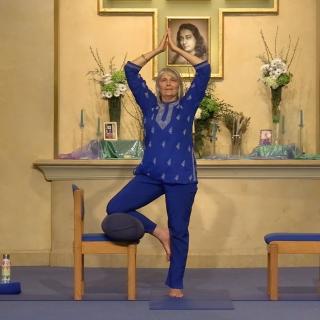
A 30 minute yoga class of Ananda Yoga.
So that's free.
You're welcome to attend that and you can find that on our website or go to the Face Ananda Palo Alto Facebook page.
On Friday will be chair yoga.
So if you haven't practiced it and you're If you're at all intrigued,
I invite you to join me on Friday for that.
Satsang is keeping good company.
This is cultivating a community of support and spending time with other truth seekers.
So these are tools of yoga.
And Satsang is also referred to as being in the company of truth seekers.
So bringing into your life the practice of having others in your life that are also seeking truth.
They are also seeking the divine.
And with this step of inner communion,
I would add to that those who are seeking inner communion.
The more that you have people in your life who this is a priority for,
The more it will help you to deepen your experience of dedication to the practice and the fruits of the practice.
There really is something of the osmosis of being vibrationally in the community of others who have a spiritual and active spiritual life.
And then they're also there as a resource for you to ask them,
Well,
How do you pray?
How do you meditate?
We offer through the Ananda Sangha meditation classes.
And right now,
Even though everything's online,
You can find that through,
You can look,
You can go to anandapaloalto.
No.
Yes.
And then click on classes and events and click on meditation.
It'll guide you to see.
And this is a way that you can get support for your meditation practice and then if there's a class happening,
You can also have the experience of Satsang.
Raja Yoga,
Our course is very much in my mind because it's coming up in the fall and really Raja Yoga course covers meditation and they provide Satsang there.
So anyway,
Just find myself inspired to be talking to you about it today for anyone who that's resonating with.
Environment,
Let me take a sip of water here.
Environment is something we really consider to be a tool of yoga.
The idea here when we're talking about inner communion.
Is to take a look at your life and ask yourself the question,
Is my life supporting inner communion?
So what does that mean?
What does it mean?
I would say to have some space in my life for stillness.
To have some space in my life where I can be.
.
.
Listening for God.
Yes,
In prayer and meditation,
But what I began to find and I still find this to be true,
Is that prayer and meditation become a way of life.
The pillow or in the chair or on the bench for meditating and prayer.
There's our formal time set aside for sadhana.
And then there's living sadhana.
And to live our sadhana is to move through our life in such a way that we can continue to hear God.
To move through our life in such a way that we can continue to talk to God.
And that can be an inner,
Quiet,
Silent dialogue.
An inner quiet,
Silent listening.
One of the things that I began to do as part of my Um.
.
.
Practice throughout the day was to have periods where I could pause and silently pray and ask God to be with me,
To pause and ask for guidance.
And that's part of how we expand this relationship where inner communion ultimately eventually becomes what we are experiencing all the time.
This is the promise of self-realization.
So the masters,
Yogananda in particular,
I'm saying that because he's the recent guru on the path of Self-Realization and Ananda Yoga that we follow.
Yogananda set the example of what it looks like to live in inner communion and to show us that this is possible.
And then the practice of all of the tools of yoga is to cultivate.
And part of the cultivation is the affirmation that we live in the consciousness that we are self-realized already.
And this was Yogananda's message to all of us,
That we are divine souls.
And our journey is one of remembering who we are and remembering this truth.
Each time we dip into the experience of God within us,
Of that Divine Presence within us,
We are able more and more to bring that out into every moment of life.
So environment.
Is a practice of noticing.
Of noticing,
Is there space in your day?
Is there space in your work life?
Is there space in your relationships for you to speak to God and hear God?
And sometimes that comes through the practice of seeing God in the other.
So you're saying,
Yes,
I.
.
.
God is here with me right now.
I'm looking at God,
And I'm listening for God,
And I'm inviting God to speak to me.
I don't know if you've had that experience where someone is speaking and you think,
That's God.
That's God speaking to me.
One of my first visits to Ananda Village,
They have their retreat center there,
And this is where Ananda was founded.
So they have the meditation retreat,
And then Ananda Village is a beautiful,
Beautiful place to visit.
When shelter in place has been lifted,
I encourage you to visit there.
I was there,
And Savitri,
One of the senior ministers and teachers,
I had the great privilege and honor of having many classes with her.
And I was in a class,
And she was one of the teachers.
And afterward,
We were having satsang.
A meal together and talking.
And,
You know,
I don't remember what she said,
But I remember feeling that I knew every word that she was speaking to me was God answering a prayer.
Literally answering a prayer.
And so the next day when I saw her,
I was so stunned as it was happening.
I was thinking,
God's speaking to me right now.
This is the very thing I was asking.
I was praying for guidance on.
So the next day I found her and thanked her for her time with me and what she had shared.
I said,
You know,
I really felt that God was speaking through you yesterday to me.
And she had just this beautiful,
Very quiet,
I would call it a slightly knowing smile.
And she just said,
I'm glad it was helpful for you.
And I was so strongly wanting to say,
She heard me,
I could tell she heard me.
But it was a beautiful practice of what we would say in Ananda,
Yoga as God is the doer.
And so,
You know,
She was validating that God would speak,
That what my experience.
And I could say,
Even with more time now,
That what I was observing in her was an appreciation for being a channel of God.
That's what I feel I was seeing,
That smile on her face of,
Thank you,
God,
That I could be a channel.
Because she was.
She was God speaking to me.
So the power of environment,
Of creating an environment that supports inner communion.
The next tool of yoga is teacher and guide.
Seeking the support of someone who's gone before you on the journey,
Someone who knows the terrain and can offer insight and understanding that helps you find your way.
Someone who will challenge falsehood and provide comfort and compassion when needed.
This is a very important practice since both in the 12 steps and in yoga,
We learn to seek mentors.
We learn to find others who have traveled the path ahead of us,
Who can guide us in our journey and help us to understand what it means to awaken spiritually,
To understand what it means to build a spiritual life and to lead a spiritual life.
So we find others are representing that to us.
They are a reflection of the Divine.
And in that,
We ask for support.
And both in the Ananda community and both in the Twelve Step community,
That is something that is a practice.
It's understood.
Sometimes it's formal in a class,
And other times it's less formal than that.
But we also have Ananda Ministers,
And the Ananda Ministers are people that you can reach out to to ask for guidance and support.
So this is a tool of teacher and guide.
Ultimately this tool prepares us,
For those who feel called,
It prepares us for discipleship.
It prepares us for the guru-disciple relationship.
It doesn't have to progress to that if that's not right for you.
Swami was asked,
Does everyone need a guru?
And he said,
No,
No.
If you're wanting to grow spiritually,
It's recommended.
He said you do if you want to grow spiritually.
But even that I want to say to you,
It's a personal knowing within yourself.
And you can talk to others about that.
It's helpful to talk to others.
If you're not sure,
I would reach out for support on that question.
But the teacher guide is a representation of the divine.
So we start with that and follow that.
Okay,
So the chakra.
These are other tools that yoga offers for cultivating our inner life.
So the chakras are energy blueprints,
Centers of energy within us that represent different qualities of consciousness.
Both positive and negative.
Utilizing and working with these can help build the qualities we need for growth and awakening.
There's a beautiful,
I was mentioning Savitri,
She wrote a beautiful book on the chakras,
A workbook on that,
Which is rich with information,
And you can find that through Crystal Clarity Publishers.
We offer,
Often,
Classes on the chakras,
So you can look for that.
They're very,
Very helpful.
Again,
We touch upon this in Raja Yoga,
And it's a way to work directly with our energy centers,
The astral body,
How to work with those energy centers to awaken,
How to direct the flow of energy to awaken the positive qualities within the chakras.
And this is part of who we are,
How we're built.
This is the teaching of yoga.
And have access to that.
So very,
Very helpful.
And there's meditations on the chakras.
Okay,
Just two more.
Sacred chants.
So kirtans are an amazing way to deepen your spiritual life and to help with prayer and meditation practice.
Sacred chants.
Yogananda said chanting is half the battle spiritually.
Music bypasses the mind and leads us directly to the heart.
When we chant or listen to sacred music,
It uplifts our consciousness and reconnects us with our soul nature.
So we,
Through Ananda Palo Alto and Ananda Worldwide,
You can find some amazing kirtans that are happening online.
And Swamiji's music.
There's lots of ways in which you can access the music.
Every Sunday,
We sing Swamiji's and Master's chants.
That's another way that you can access the music.
There's lots of sacred music through Ananda.
And I really recommend,
The kirtans in particular,
Are a beautiful way to not only hear the music,
But sing the music.
It isn't about having a beautiful singing voice.
You might have a beautiful singing voice,
But if you feel like you don't and you're nervous about it,
Especially now that it's online,
No one else can hear you unless you're singing with friends,
But it really does powerfully Awaken the energy,
Draw it within and lift it up here to the spiritual eye.
When you go into meditation after chanting,
It's remarkable how helpful that is.
It truly is amazing to me every time I chant,
Even a little chanting.
Has extraordinary power for spiritual life and spiritual practice.
And the last tool is Seva.
So this is joyful service,
Serving the divine through service to others.
And it's a core practice,
All of these really are,
But it's a core practice of Ananda,
Which is God serving God.
And it's this beautiful practice of of bringing God to others.
And in everything that you do,
Feel that you're serving their highest self.
So you're looking,
Whatever service you're doing,
Maybe it's not direct service to a person.
Maybe you're behind the scenes.
Asha does costuming for the plays.
You might be gardening.
It might be something in your own life,
A form of service no one else knows that you're doing.
When you bring the intention to serve God through that.
I know mothers.
I mean,
That's a beautiful form of service.
And when they make it a yoga practice,
And they see,
I am bathing God,
I am feeding God,
I am loving God,
It takes the experience to a whole other level.
And it really is an invitation to touch and know and experience God.
And that's the point of this step to improve our conscious contact with the divine.
I'll end with a quote from Yogananda.
He said,
Mental state.
When bliss comes over you,
You will recognize it as a conscious,
Intelligent,
Universal being to whom you may appeal,
And not as an abstract mental state.
This is from Paramahansa Yogananda,
Taken from Swamiji's book,
Your Sun Sign as a Spiritual Guide.
So I wish you great joy today,
Dear friends,
And I offer you the invitation to focus on your sadhana this week,
Deepening your spiritual life,
Choosing one or more of these tools to help you touch,
Experience,
Expand the inner communion,
Touching God within you.
Many blessings to you.