Journey into nature's moonlit mystery,
In tonight's southern gothic sleep story.
Sleep and Sorcery is a folklore and fantasy inspired sleep series.
My name is Laurel,
And I'll be your guide on tonight's fantastical journey.
Sleep and Sorcery is one part bedtime story,
One part guided meditation,
And one part dreamy adventure.
Follow along with my voice for as long as it serves you,
And when you're ready,
Feel free to let go of the story and relax into sleep.
There is no formal meditation at the end of this story,
But it does contain some meditation and breathing cues,
Which you can follow if you like,
Or simply let the words wash over you.
In tonight's southern gothic inspired sleep story,
You receive an invitation to a mysterious gathering at the home of a prominent resident of your town.
Once a year,
She hosts an intimate,
Late-night get-together to celebrate the rare and brief blooming of a beloved flower,
The night-blooming Sirius,
Also known as the Queen of the Night.
You join the moonlit revel to witness the unfurling of the flower,
Which beckons you into nature's great mystery.
There exists a mortal mystery.
Mortals alone can divine where it lies in each other,
Can find it and prick it in all its peril with an instrument made of air.
I swear that only to possess that one trifling secret,
I would willingly turn myself into a harmless dove for the rest of eternity.
Eudora Welty,
Circe When the summer air crackles like sparks in a fireplace,
And the joints in your body seem to creak like the floorboards of an old house,
It can only mean one thing.
A storm is coming.
One of those fast-gathering summer storms that make such a fuss over the entrance,
Drop a large amount of rain in mere minutes,
Then seem to lose steam.
Such intense,
Short-lived spectacles are a common feature of the region in high summer,
Bringing a fleeting relief to the muggy,
Stifling heat.
You cherish the moments after one of these storms,
When the sky is still an eerie shade of orange or yellow,
And the mist still hangs round,
And the birds are quiet,
And the air is sweetly cool.
On one such afternoon,
Just before the storm clouds roll out and the heat rolls back in,
You sit in the rocker on your screened front porch,
Savoring the delicate moisture in the air,
The afterstorm release of static,
The smell of grass and roses.
You like to watch the storm from start to finish,
The prickling prelude,
The blooming clouds,
The first pitter-patter of rain on the rooftops and the sidewalks,
The towering crescendo of thunder and distant lightning,
And,
Inevitably,
The denouement,
The way it all recedes with a mere whimper.
Sometimes,
Like today,
The storm is so perfectly orchestrated,
So aligned to an archetypal journey,
That it sounds like a sonata in your head.
Your fingers play along on imaginary keys.
The piano in the parlor is long out of tune,
Or else you might sit down and play it.
How long's it been since you played?
Such a shame that the old thing is gathering dust.
Maybe this year,
You'll find your way back to the keys.
Maybe.
You close your eyes,
Letting your other senses enjoy the magic of the afterstorm.
You can hear the plink of the raindrops who lost their way,
Getting trapped in the magnolia tree out front,
Finally becoming too heavy for its leaves,
And dropping joyfully on the ground with a splash.
You smell the citrusy blooms of lantana along the garden gate.
Your skin drinks of the cool dew on the air.
You flutter your eyelids open as a new sound joins the chorus of leftover raindrops,
Footsteps on the sidewalk and the creak of the rusty gate.
George,
The mail carrier,
Is coming up the walk.
By the looks of it,
He was caught in the rain on his route.
His hair and uniform are soaked.
Oh my,
You say,
Standing from the rocker and swinging open the screen door.
Aren't you a mess.
Rain,
Sleet,
Or snow,
George intones,
His voice as cheerful as ever.
Won't you come in and dry off?
I could put the kettle on,
You say,
A note of concern in your voice.
Then add,
You'll catch your death.
Knowing full well,
You sound exactly like an over-cautious grandparent.
I've come through much worse,
He assures you.
Besides,
Already running behind on the route today.
At least take this,
You say,
Pulling a tea towel from the laundry basket,
Just inside the door.
George takes it gratefully and mops his face and hair.
Keep it,
You insist,
In case it's not done raining on you today.
George chuckles,
Then reaches into his bag,
Retrieving a small stack of letters for you.
You give the pile a cursory glance and smile,
As there seems to be a postcard from Lottie in Paris.
You're glad to hear from her,
Bittersweet as it is.
You'd planned to take the trip together.
It was all the two of you talked about for years.
But things change.
At first,
When you told her you weren't coming with,
She tried to call the whole thing off.
But you insisted she go anyway,
And it seems to have been the right decision.
And with every postcard,
You get a small glimpse into the magnificent European adventures she's having.
Among the pile of letters,
Another catches your eye.
The soft pink corner of an oversized envelope.
Before George leaves,
You pull it to the front of the stack,
Feeling the weighty paper between your fingers.
George,
You say quizzically,
What's this?
He angles his head to look at the envelope.
In the center,
Your name and address are written in elegant calligraphy.
But in the upper left corner,
Where a return address should be,
There are five words.
The Queen of the Night.
Intrigued,
You turn the envelope over and break the wax seal.
Inside,
You find a card which reads,
On behalf of Ida Bell Baker,
You are cordially invited to the annual gathering of the Society of the Queen of the Night.
Ida Bell Baker,
George says as you show him the invitation.
The Poet.
Of course,
You've heard of Ida Bell Baker.
Everyone in town has.
She is the Poet Laureate of Louisiana.
She grew up here,
Dirt poor,
Then left as soon as she came of age for New York City.
From what you know,
She did quite well for herself.
She wrote a play that had a good run on a Broadway stage,
And she published a few novels and books of poetry.
You have one,
You think,
On the shelf above the piano.
It's also gathering dust.
But just about five years ago,
Ida Bell Baker came back to town.
No explanation.
Her parents passed a long time back,
So there wasn't much here for her to come back to.
She bought a stately house by the lakes and kept writing.
Her latest book of poems,
According to the stories in the paper,
Is all inspired by her hometown.
You haven't read it.
But the folks in Baton Rouge ate it up,
It seems,
And she got the distinction of State Poet Laureate last year.
Below the opening words on the invitation,
There is an address.
For Baker's house on the lake,
You assume.
A date and time.
And then,
In the same calligraphic script as the envelope,
A short phrase.
Don't take it serious.
Life's too mysterious.
The word serious,
However,
Is spelled C-E-R-E-U-S.
You lift an eyebrow.
It feels like an inside joke,
Of which you aren't privy to the punchline.
It's tonight,
You say.
Whatever this is,
It's tonight.
She gives some wonderful parties,
George says.
You throw him a bemused look,
And he adds,
Sheepishly,
Or so I've heard.
There's a soft rumble of thunder,
Somewhere in the south.
Whether it's coming or going,
The farewell cries of the just-past storm,
Or the stirrings of another on its way,
You can't say for sure.
So,
George says his goodbyes,
And continues on his route,
Anxious to be done for the day,
Before another downpour.
You step inside,
Flipping through the rest of your mail.
When you determine there's nothing else of consequence in the pile,
You take a closer look at Lottie's postcard.
On the front,
There's a photograph of a grand boulevard,
Which,
Judging by the extravagant,
Triumphal arch at its end,
You take for the Champs-Élysées.
You read Lottie's message,
Which,
Though brief,
Absolutely sings of the wonders of Paris.
The beautiful monuments,
The extraordinary museums,
And the explosion of arts and music in the streets.
She signs off,
As she has every postcard,
With a reminder that you must come back here together one day.
And wish you were here.
You place the postcard on the mantle,
Next to a half a dozen others from your friend's travels.
You wonder where she'll write from next.
And then you return to the unexpected invitation in the pink envelope.
Society of the Queen of the Night,
You mutter.
The name of the club,
Or organization,
Whatever it is,
Calls up unsavory imagery.
You think of secret societies,
Underground speakeasies,
And,
Well,
It's hard not to think of the fiendish,
Vengeful villain from Mozart's opera,
The Magic Flute.
It was the first opera you ever heard,
After all.
You can still remember the warm crackle of the record player,
As it spun back the achingly high,
Staccato notes of the Queen of the Night's aria.
All of a sudden,
An amusingly bizarre image rises to the top of your imagination.
Of Ida Bell Baker,
Poet laureate of Louisiana,
Donning jeweled black robes and a crown of stars,
Floating into a backyard party on the edge of a crescent moon,
Joyfully singing opera for a cavalcade of adoring guests.
You can't imagine yourself actually leaving the house to go to this gathering.
You must have been invited by mistake.
But a kind of morbid curiosity tugs at you,
Urging you to go,
If only to see what the eccentric poet and her band of artistic misfits get up to on hot summer nights.
When you look up from this whiff of a daydream,
You find you've absentmindedly drifted toward the upright piano in the corner of the parlor.
You set the invitation down on the music rest,
Next to a yellowing slip of paper you refuse to put away,
Telling yourself you'll sit down to play again any day now.
The page is covered in sloppy marks,
Music notes you scribbled as fast as you could the day they came to you,
As if they were wispy dandelion seeds tossed to the air that you had to catch before they drifted away.
At the top,
There's one word.
Nocturne.
Your fingers move on their own now,
Succumbing to old muscle memory,
Lifting the lid to expose the piano keys.
Your right hand rests on the smooth ivory,
And with the lightest possible pressure,
You press down on three keys,
C,
E,
G.
You snap the lid shut again and withdraw your hand quickly,
As if to trap the notes inside.
But you've already heard the chord.
There's no unhearing it.
You're not sure what's worse,
The thought that your beloved piano has fallen out of tune,
Or the truth,
That those notes rang out with perfect clarity and harmony,
That the reason you don't play anymore has little to do with tuning.
The distant thunder turns out to be another burgeoning storm,
Though this one is quieter overall,
And comes and goes with little ado.
But by the time it passes,
You've made your mind up.
There's a revel to be had tonight at the home of Ida Bell Baker,
And by some mix-up of the post or otherwise,
You've been granted an invitation.
Your usual unwillingness to wander beyond your garden gate finally loses the game of tug-of-war with your curiosity.
Tonight,
You will meet the society of the Queen of the Night.
The sidewalks are still slick with rain when you leave the property,
But the skies are surprisingly clear.
It's near dusk,
And the remaining clouds have a sheer ghostly pearlescence about them.
The full moon has already risen,
And it takes on a reddish tint from the setting sun.
The lakes aren't far,
Nothing in this town is too far apart,
And you've decided to walk.
The trees and fences along the way are covered with the star-shaped flowers of climbing jasmine.
It drips from the eaves of certain houses,
Too,
And the air is redolent of its perfume.
There's a gentle slope down to the valley of the lakes.
You can see the water glistering in the last of the sunlight.
You know the Baker House by its most recognizable feature,
A great and ancient live oak in the front yard.
Its branches,
Which reach both skyward and earthward,
Sprawling broadly,
Drip with Spanish moss that billows in the breeze.
The picturesque arbor obscures the house's facade,
But you can see the shingled roof and a string of automobiles parked in its long drive.
Having strategically arrived a bit later than the time on the invitation,
You might have expected more of them.
Perhaps it's a smaller gathering than you expected.
Clutching the invitation tightly,
As if you expect to be interrogated on arrival and require proof of your purpose,
You make your way to the front door and bang the heavy knocker.
You wait a few moments,
Listening for movement or voices behind the door.
Then you knock again,
A little louder.
There's still no response.
You inspect the invitation,
Even though you've read it over a dozen times,
Just to be sure you haven't gotten the date wrong or missed some detail.
Then you hear something.
Faint,
But unmistakable.
You know the sound in your sleep.
It's the warm,
Light-hearted sound of trumpet music floating over the grass.
And there are voices.
Laughter.
Chatter.
But it isn't coming from inside.
You follow the trail of song under the limbs of the live oak,
Around the back of the house.
The wooden gate is hung with a handwritten sign that reads,
Come on in.
You catch the scent of more jasmine and orange trees,
Which line the garden fence as you enter.
The music is clearer now,
And you realize it's being played on a record player.
It has that familiar crackling quality.
You pass round the citrus trees to reveal a humble and heartening home garden,
Lit only by scattered candles in open jars around the grass.
You're not sure what you were expecting to see.
An extravagant ball.
A dazzling party attended by socialites in tasseled gowns and white gloves.
But what you stumble into is something else altogether.
In the middle of the garden,
Through which rustic paths cut,
Passing unruly hollyhock and coneflower lined with creeping flocks and meadow sage,
Seven people are seated comfortably on outdoor furniture.
The wicker chairs and lounges are arranged in an almost circle on the stone patio,
And the guests are engrossed in a lively conversation.
Straight ahead,
Looking effortlessly elegant,
Draped over a chaise,
Is Ida Bell Baker.
Even in the darkness,
You recognize her from her portrait on the dust cover of her book.
Wide eyes,
Sandy curls that frame her face,
And a toothy,
Almost awkward grin.
You had not imagined such a small group,
Even with the informal atmosphere,
It makes the entire affair seem that much more exclusive,
And makes you feel ever more certain that your invitation was a mistake.
You think about turning around,
Slipping out of the garden before you're noticed,
Heading back to the comfort and security of your home.
But as you begin to back away,
Ida Bell looks up.
She looks right at you.
And then,
Her smile widens.
She calls your name,
Her voice traveling up at the end,
A question.
Then she gestures for you to come out of the shadows,
To join the group,
Chatting in the candlelight.
The other guests regard you as you step forward,
Nervously,
Still clutching your invitation.
How marvelous,
Ida Bell says as you approach.
She embraces you,
Kisses you once on each cheek.
I wasn't sure you'd make it,
But I hoped.
Ida Bell turns you around,
And introduces you to the other guests,
Still lazing on their lounge chairs.
She lists off the names of each of them,
And you feel your heart begin to beat faster.
These aren't just any old residents of your town.
These are playwrights,
Actors,
Painters,
And musicians,
Some up-and-comers and others well-established in their art.
Here,
Ida Bell says,
Making room on the chaise,
You'll sit next to me.
They're all discussing Picasso,
And it's dreadfully boring.
This remark causes a playful uproar among the guests to which Ida Bell responds,
Oh,
Don't be ridiculous,
You all.
This isn't some salon,
And alas,
I am no Gertrude Stein.
We have a humbler purpose,
Do we not?
You are about to ask just what this humble purpose is,
Who or what the Queen of the Night is.
When Ida Bell turns to you and takes one of your hands,
In both of hers,
I hope you aren't nervous,
She says.
Oh,
I imagine you are.
This must all be very unusual.
You let out a half sigh,
Half laugh,
Grateful that your host recognizes the strangeness of the situation.
This break in the tension gives you the courage to ask the question at the top of your mind.
Miss Baker,
You say,
Why did you invite me?
How do you even know who I am?
You mean Lottie didn't say anything,
She says,
Before adding,
Oh,
And please call me Ida.
Lottie,
You ask.
Oh,
That's wicked of her,
Ida says,
With mock indignation.
I thought she would at least give you some idea the invitation was coming.
How do you know Lottie?
Well,
As you might imagine,
I'm a regular at the library,
Ida replies.
Something clicks into place for you.
Lottie took a job at the local library branch last year to help support her brother and parents.
The income gave her just enough extra dough to sock some away each month and save for the trip overseas.
Ida continues,
I've been going in almost every day lately,
Doing research for my next novel,
And after weeks of greeting each other at the desk,
She finally asked if I was who she thought I was.
She helped me get my hands on some helpful volumes and microfilm,
And before we knew it,
We were talking every day.
She never stops talking about you,
You know.
You can feel your cheeks flush.
Of course,
She was so disappointed when you decided not to go with her to Europe.
Ida goes on,
I only knew you through her words,
But it broke my heart.
You seemed like just the kind of person who would blossom in Paris,
Or Amsterdam,
Or Vienna.
Lottie says you play so beautifully,
And your compositions.
A small pang of guilt ripples through you.
Here,
The state poet laureate is praising your musical skills when you haven't played in an age.
But all that is to say,
Ida regroups,
That Lottie seemed to imply you might appreciate some company these days.
And I thought,
You might be just what our little society needs to feel complete.
The society of the queen of the night,
You ask,
Intrigued that you seem closer to understanding the purpose of the gathering.
It's a horribly overblown name,
I know,
Ida says.
It was William's idea.
She throws a playful look at the gentleman seated to her right,
Who returns it in jest.
I'm sure it must sound like we're some kind of vampire club,
Ida laughs.
I was thinking,
Mozart,
You smile,
Though you could still be right about that.
The other guests have quieted down their side conversations now,
And a few of them utter noises of recognition at your remark.
Who is the queen of the night,
Then,
You ask,
Extending your question to the whole group.
Well,
Says Ida,
It's her.
And now she turns her head,
And the other guests as well,
In the direction of the lakeshore.
You half expect to see another person there,
Some priestess form emerging from the shadows,
But all you see is a large,
Unruly potted plant with sprawling,
Tangled branches right in the gap in the circle of chairs,
As if it is another guest.
At the end of one branch hangs a heavy,
Bulb-like protrusion,
Nearly a foot in width.
It soon becomes clear that this unusual flora is,
In fact,
The object of Ida's intention.
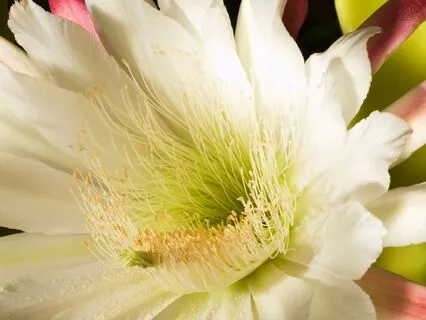
It's a night-blooming Sirius,
She says.
The queen of the night is a flower,
You ask.
A cactus,
Actually,
Which flowers only at night,
And this variety blooms only once per year,
One night only.
Those who are lucky enough to witness the blossoming come to quickly understand why she's nicknamed Queen of the Night by horticulturists.
You think back to the unusual quote written on your invitation.
Don't take it serious.
Life's too mysterious.
Finally understanding the humor of the alternate spelling,
Ida now reveals to you the true nature of the gathering.
It is a kind of vigil,
A group witnessing,
Because the night-blooming Sirius in the poet's garden is going to bloom tonight.
In fact,
The happening,
The unveiling of the Queen of the Night has,
You realize,
Already begun.
You'd be mistaken for not knowing it,
Though,
For just like the unfurling of any flower,
It's hardly visible to the naked eye.
The process will be slow,
Like a lifespan,
Which,
Viewed in sequence from right in its midst,
Contains monumental changes that are nonetheless imperceptible from moment to moment,
And which,
When viewed from some secret place above the trees,
Is a time-lapse of miraculous transformation.
Just now,
The last remnants of daylight are slipping away over the hills and lakes.
The sun passes his crown to the moon and her cloak of glittering stars.
You can feel a sense of anticipatory giddiness settling over the small group of witnesses.
But the gathering carries on,
For now,
In much the same manner as it did before.
Music wafts from the record player,
Mingling with the onset of a cicada symphony.
Ida brings out bite-sized refreshments and pours drinks,
Despite her earlier insistence that this is not an artistic salon.
The guests,
Nonetheless,
Continue to discuss their creative contemporaries and inspirations.
You are beginning to feel more comfortable among them,
This in large part thanks to Ida's warmth and welcoming demeanor.
And you even find yourself chiming into the conversation and holding your own.
You speak with eloquence about classical music and the modern composers reinvigorating the form.
It's the first time,
And you can't remember how long,
That you've had occasion to converse about it.
You also get a hint to the mysterious logic of Ida moving home despite success in New York.
The city,
Busy and breathtaking as it is,
Didn't inspire her.
She wanted to write about family feast days,
The strange customs of her childhood home,
And live oaks dripping with moss.
To do that,
To turn her creative engine back on,
She needed to come home,
To immerse herself in the atmosphere,
However hot and swampy that atmosphere is,
However much grief would greet her upon her return.
Some people,
She laughs,
Just like some flowers,
Can only blossom under certain conditions.
But as the night draws her curtains closer around you,
As the darkness becomes denser,
Forcing the candles to strain against it,
The atmosphere of the party changes.
Though you all remain awake and alert,
Tuning your senses to take in small changes in the brimful,
Serious bulb,
The conversation becomes quieter,
Slower,
More spread out,
As if the conversation itself is falling asleep.
Evermore you find it difficult to hold eye contact with anyone else in the group.
Your gaze drawn inexorably to the burgeoning flower.
Gradually,
Without really noticing it,
You and your fellows slip into a kind of meditative,
Soft-focus state.
There is not total silence between you,
For as if according to some unwritten cadence,
Rhythmic words and expressions still escape your lips.
Sometimes a word or two in response to a question asked moments or minutes ago.
Other times,
Mere sounds,
Vocal gestures,
In response to perceived changes in the flower.
You try to memorize each moment along the Queen of the Night's journey,
Tracking its unraveling like marks along a map,
But the flower defies you at every step.
There are unseen mechanisms within and without,
An assemblage of slow-moving parts and slights of hand.
The change happens so gradually it gives the illusion of speed.
You're always just missing it,
Despite the sharpness of your concentration.
The aperture of the blossom yawns open,
Sliding layers of creamy white petals into place,
Revealing infinite thread-like projections within,
While a coronal of coppery outer petals branch off to frame the masterpiece.
You are reminded,
Not for the first time tonight,
Of opera,
Of Salome,
With her seven swirling veils,
The spinning flute and mysterious violins of Strauss.
And you are also reminded of the ancient goddess Inanna,
Who,
In order to gain access to the underworld,
Had to divest herself of all her finery,
Removing a veil or jeweled ornament at each of the seven gates,
Until at last she stood,
Unadorned and vulnerable,
In the land beyond.
So the flower undrapes,
Unveils,
Granting a glimpse of something that feels secret,
Almost wrong to behold.
The other world,
The inner mysteries of nature,
The human eye,
Isn't calibrated to see.
Ida strikes matches in the dark and passes them amongst you.
You hold yours up to illuminate the naked and complex bloom,
Her white petals dance under the flame and shadow.
And even now,
As you imagine the flower has reached its apex,
Its culmination,
It shows no signs of stopping its wild unfolding.
And then you notice the fragrance,
Twisting round you,
It calls up orange blossom,
Citrus,
Vanilla,
Musk,
And something more complicated,
Ineffable.
The perfume intoxicates,
Making your head swim sweetly.
It beckons you toward sleep,
But at the same time enlivens your mind,
Sparks creativity within.
In the passing of hours,
The candles burn to their ends and the matches run out.
But the queen of the night gathers light from the moon and shines it back upon you.
You gaze into the center of the flower,
Into the miraculous folds and filaments therein,
And you might be gazing into the center of creation,
The origin point of a swirling galaxy,
The fractal heart of imagination itself.
You think,
If you drew near enough,
If you leaned forward without fear,
If you surrendered,
You might fall headfirst into the center of the flower,
Fall further than the deepest wells into the profoundest places imaginable.
You leave your worldly treasures behind and access a mystery beyond comprehension.
And something slips within your mind,
Some veil of time or perception.
You are transposed to the register of the bloom,
To its subtle monumental motion and scale.
It's as if you can see all its stages at once,
The quivering moments before it opens,
The fullest apex of the blossom,
The spent bloom come morning,
All projected onto layered panes of glass.
You are suddenly seized by an unexplained desire to communicate with the open flower,
To shout into the void at its center and listen for an echo.
The desire is so overwhelming that although you try to keep it in for propriety's sake,
After all,
You share this space with near strangers,
Your voice breaks through your restraint.
Like something caged for years and knocking ceaselessly at the door,
It escapes in a resounding hum.
Your body resonates and you could swear the blossom quivers in response.
And as you continue to hum,
Your chest and vocal cords vibrating low,
Another voice joins yours from behind.
Another.
Another.
Together,
The society of the queen of the night becomes a chorus,
Harmonizing with each other and with the choir of insects in the lakeshore trees.
Your song is the song of the night and it is more than the sum of its parts.
For the first time in too long,
You are making music.
And then,
Though such things are impossible in a rational world,
A serious world,
A world dominated by human intelligence,
Another voice joins.
It is a voice you can not only hear,
But see.
The voice of the queen of the night,
A spiral of song,
A hum that climbs a ladder of darkness and the pulses oscillates with inner light.
The flower sings back.
Your voice,
The voices of your fellow watchers,
The voice of the flower,
All these ebb and flow,
Overlapping like waves made of sonic light,
Exchanging energy and information.
Singing together feels like breathing together,
Each of you feeding each other breath in a circle,
A spiral with no beginning or end.
Your heart opens like the night blooming serious,
Crowned and unguarded.
You leave your armor,
Your defenses at the garden gate and you allow the flower,
The queen of the night,
The high priestess,
To behold you,
To softly wrap you in song,
More powerful than any protection.
You surrender to the music of the night,
The queen's nocturne,
Feeling its reverberations in every corner of your body,
In your fingertips and the spaces between your fingers,
In your hands,
Up and down your arms,
Blooming in your chest,
From your heart space,
All the way down to your feet,
Which,
Despite being grounded on the earth,
Seem weightless,
Unbound.
Your whole body feels light,
As if you're floating on a swell of luminous sound.
You're warm,
Vulnerable,
Yet safe,
Buoyed by the voices of your new community,
By the night music.
Your hands fill with light,
With tingling,
Buzzing energy.
You know this feeling,
This sparkling potential,
Its creation,
Desire,
Which can only be sated by the feel of ivory piano keys.
Gently,
Slowly,
With the epic and effortless journey work of dandelion parachutes tossed to the wind,
You begin to float down to earth.
To emerge from the center,
To slide along the spiral,
Back to the mundane experience.
The bloom is closing,
Almost as slowly as it opened.
The layered panes of glass are collapsing into one,
And your perception is cautiously returning to baseline.
Your eyes drink of the softening petals,
The withering threads,
Holding every frame as tightly as you can.
Like the arc of a summer storm,
Which gathers in such grandiosity and bellows its crescendo to the heavens,
The night-blooming Sirius now executes her coy denouement.
Still,
She shrinks,
Sags,
Closes the gate to that unreachable mystery within.
But you have touched something,
Tasted something,
And your fingers still buzz with creative desire.
There is music coursing through your veins,
Humming under your skin,
A song that longs to be written.
Your mind holds the time-lapse of the shrinking flower,
Just as it held the glorious unfolding.
There is quiet tragedy in its ending,
But there is also beauty in the decay,
The aching impermanence of it.
The night transforms around you,
Shifting inky blackness into pearly gray and dusty blue.
When sunrise winks from easterly and the spell between you is weakened,
Not broken,
Speech resumes.
You find your tongues again,
Those registers of your voice not reserved for sacred song.
Eyes remain unfocused,
Glittering still with the nectar of mystery.
Ida serves breakfast and coffee as her garden awakes under the full color of a cadent sun.
The queen of the night,
Withered and wrung on her succulent stem,
Surrenders her crown to daylight.
An unspoken contract,
An invisible tie,
Binds you together with the guests in the garden,
But also with every plant spirit present,
Every buzzing insect in every tree,
Every ripple on the lake.
You are all bound,
A society of the queen of the night,
And you'll meet again,
This time next year.
The journey home is a surreal one,
The short distance from the lakes to your gate feels nonetheless like the return journey of one gone to visit the other world,
The underworld.
Familiar roads and trees take on new context as you go.
You carry a gift from Ida Bell Baker,
A cutting from her night-blooming Sirius,
That you might cultivate such a plant in your own garden,
Bringing flowers to bear.
This you hold close,
Like the fennel stalk in which Prometheus concealed the fire he stole from the gods.
In the same way,
It feels like a secret,
A divine gift,
A vessel for intangible mystery.
The rusty creek of your garden gate is comforting,
Yes,
When you return home,
But it echoes with a melancholy you hadn't noticed before.
You don't usually hear it from this side.
The closer you get to your front door,
The more the exhaustion of your all-night vigil sinks in,
Like you're moving through molasses.
There's a special cocoon of warmth around you,
Too,
From the knowledge that you have built new bonds of friendship,
That there is a space waiting to welcome you,
Yourself,
And your creativity.
And now you know that you are brave enough to break your self-imposed exile,
To leave the house,
To open yourself to connection.
The blooms in your garden greet you,
Candy sweet and mesmerizing in their own right.
At last,
You enter your little house,
The screen door slamming shut behind you.
Though your mind swims,
And your body aches for sleep,
Your fingers still buzz with creative excitement.
You let them lead you to the parlor,
To the upright piano that has lingered so long,
Unplayed.
You take a seat at the bench,
Gently lift the lid,
And behold the spread of black and white keys.
Your restless fingers hover just above the ivory,
Almost shivering.
They are active with the energy of a summer storm,
A crashing crescendo of thunder and rain and static.
With the incalculable register of plant motion,
With the buzz of cicadas and the live oaks,
With the swirling cascade of solomae's veils,
With the beckoning threads of the flower's center,
With the starry cloak of a moon goddess,
With endless iterations of the nocturne.
With mortal mystery,
You breathe in.
Your heart swells.
Your fingers meet the keys.
Good night.