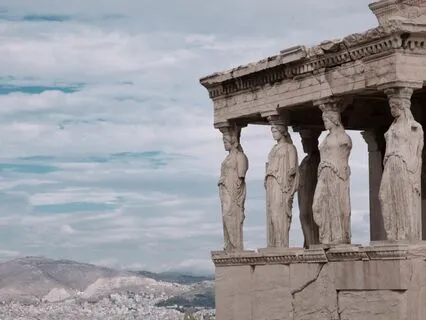
Meet with the Goddesses of Inspiration in tonight's Greek Mythology Sleep Story.
Sleep and Sorcery is a folklore and fantasy inspired sleep series.
My name is Laurel and I'll be your guide on tonight's fantastical journey.
Sleep and Sorcery is one part bedtime story,
One part guided meditation,
And one part dreamy adventure.
In tonight's story,
You are a poet in search of inspiration for your next great work.
You seek the favor of Calliope,
The muse of epic poetry,
So you journey to the Temple of the Muses to meet her.
You are granted audience with all her sisters,
And you come to understand the true nature of inspiration.
Happy is he whom the muses love,
Sweet flows speech from his lips.
Homirik him to the muses and Apollo.
Sweetest breath of larkspur,
Blistering heat softening to mild summer evening,
So you come to the plain of Thebes in search of shelter for the night.
You lean upon your staff and shake the weariness away for one more stretch of travel tonight into the city.
At first light,
You'll make for the sacred spring of Mount Helicon,
The rounded summit now fading into a swath of moody sapphire against the onset of night.
Long have you traveled in search of the one you seek.
You've come across sea in tempest-tossed vessel and over stretches of earth on foot.
In the last gasp of Helios' light on the valley,
You ponder why she has chosen this for her hiding place.
Of all the sublime islands and mysterious shores in this wide world,
Why here?
That is all for the morning,
However.
Early you must find a place to sleep and good food to eat.
This proves not difficult for your name,
If not your face,
Is known in all the great cities,
If not the distant country villages as well.
You are pardoned through the gates with ease,
Bearing the approval of allied kings.
An elderly husband and wife welcome you gladly into their home,
Offering food and wine and warm bedclothes.
If only you'll recite a few lines of your poetry for them.
So,
Just as you've done round the fires of Smyrna,
In the fields of Arcadia,
And on the shores of Ionia,
You deliver your recitations and hymns to the gods,
Dazzling and delighting the small audience.
They praise your talent and memory,
And they gladly reward you with their hospitality.
A great iron pot simmers over a fire.
As the lady dashes in herbs and elegant spices,
Surely procured from the famous Theban markets,
She seems more youthful than before.
A hypnotic aroma rises on the steam.
Swooning to the scent,
You think vaguely of the witches of Thessaly,
With their cauldrons full of herbs and their charms to draw down the moon.
Soon,
A minor feast is laid on the table.
It's fit for a noble house in Athens,
You find.
You inform the considerate couple of your plans to depart at daybreak from Mt.
Helicon to visit the temple there.
You don't wish to wake them as you go,
But it will be an early start for you.
The woman wraps up bread and fruit for you,
Urging you to take it with you on your journey.
You have leagues still to go,
And the mountain is steep.
Once there,
The path to the temple,
So say the devotees who have been there,
Is winding.
Not many seek the temple in question,
However,
She says with a curious looking over.
The god Dionysus,
Of whom you have so finely sung,
Has his grand temple on the hill here within the walled city.
Might you prefer to visit his shrine,
The couple inquire.
But you have your reasons for seeking the sacred spring and the temple on the mountain near the source.
It is a pilgrimage of utmost importance.
With a final goodnight to the pair,
You retreat to the bed they've kindly made up for you.
It takes some time to fall asleep.
Your own hymns run wild through your mind,
Recycling and repeating,
Daring you to seize their ends and string together another cycle of transformative poetry.
You dream fitful dreams,
Which disappear like dust disturbed upon waking.
Dawn appears,
Her fingers blooming on the eastern horizon.
She paints her way across the sky to banish her sister,
The moon,
And herald her brother,
The sun.
Before she can smile on all the stretches of the city,
You rise and take your leave of the lovely couple's home.
The streets of seven-gated Thebes are empty,
Save for the few early risers gone to open their market stalls.
In a few short hours,
You're certain the streets will be bustling with buyers and barterers.
You move past the empty theater,
Which girds the temple of Dionysus,
The deliverer.
A quiet wind rises as you pass,
Prickling your skin.
In such a place,
Your words might climb the wind to the ears of the god on Olympus,
He of transformation,
Ecstasy,
And wine.
You reach the farthest gate and make your departure from the walled city.
You've begun to fear that the wells run dry,
That your elusive muse has forsaken you.
Not long ago,
The words flowed freely and sweetly from your lips.
You composed devotional poetry,
Yes,
But when struck as if by Zeus's lightning,
You sang the stories of great heroes into moving epic triumph.
You sang,
No,
The muse sang through you of rage,
Of war,
Of great love,
And of glory.
She coursed through you like water bubbles through a spring,
Surging from the well of divine inspiration.
You could invoke her name and suddenly swell with words of prayer and pride.
She gave you her favor once,
But now it seems you have lost it.
Have you done something to violate her trust,
You wonder?
Or did she hear the invocation of another,
Worthier poet?
Or did she simply decide you'd tasted enough of the glory of great poetry?
Can you ever regain her indulgence?
With this hope at heart,
You undertake the journey at hand.
Beyond the plain of Thebes,
On the slopes of Mount Helicon,
Lies the Temple of the Muses.
There,
If the gods are good,
You may have your audience with her.
You may prove your worth yet.
Beyond the peak toward which you labor,
Parnassus looms,
Its snow-capped summit glistening in the morning sun.
Somewhere on the breeze comes the crisp yet distant salt of the Gulf and the Ionian Sea.
You savor it along with the memory of the ship that bore you first to these shores.
The thought of wind-blown sails and cool spray on your face is enough to keep the heat and weariness at bay.
You imagine that as your feet fall on rough and rocky plain,
White waves are rising to meet you,
Cresting and carrying you forth to your next step.
And your next.
You daydream of the suns of dawn,
The anemoi,
Wind-made flesh,
Gusting at your back to push you onward.
With such an image in your mind,
You steady your gaze on the peaks that rise ahead,
Lest Zephyrus,
The west wind,
Should blow you off course.
You confess yourself grateful for the gifts of the old Theban couple,
Whose bread and water skins serve you well on the long journey.
You stop to eat near midday when your energy wanes and the mount seems further away than before,
Under the shade of olive trees.
There,
You utter words of praise to Athena,
Bringer of the olive,
In thanks for the tree's many gifts.
You meet travelers on the road from Corinth,
Merchants bound for the markets with their wares.
They know your name,
Of course,
And plead with you for just one verse.
You concede to deliver a few lines before parting with the travelers.
You resume your quest but find at length as the day shivers to purple twilight that you must again pause for the night.
You sleep beneath the stars.
Your time on the sea has brought you knowledge and recognition of their patterns.
You trace the skies for gods and heroes,
And in the empty spaces between the stars,
For the face of the Muse.
Before you fall asleep,
Her name trickles from your lips.
Calliope.
Dawn comes again,
Arising from her throne to light the sky with flowers.
You push on toward the rising slopes,
Now swimming to meet your eyeline and obscure the distant landscapes.
The air tastes sweeter on this sweep of earth,
Scented with the blush of peony.
You cannot be far,
Surely,
From the spring.
You follow the traces of moisture on the breeze and the perfume of larkspur ascending the slope.
Trees grow sparsely for a stretch,
Then give way to open meadows that sway with scarlet anemone,
The flower that sprung from the tears of Aphrodite.
You wind next through thick forest,
Guided by damselflies,
Until at last you step through a parting in the trees to reveal a glittering hollow.
Afternoon light glistens on a pool of water,
In which the green and gold of mountain woods reflect.
You swiftly slip between the prickly oak and mistletoe,
At the sight of three figures around the pool.
They haven't yet seen you.
You watch through crinkled leaves,
A man,
Woman,
And child at leisure by the water.
The boy can be no more than three summers old.
He splashes in the shallows with delight,
His laughter is lively and musical.
The man,
His father you presume,
Reclines near the rocks at the edge of the waters.
He plucks lazily at his lyre and yet,
From such minimal effort come the most elegant melodies.
His hair is golden as the sun's rays,
Falling in curls to his shoulders.
Gradient he is,
So bright and beautiful that you are grateful for the shade that falls across your eyes.
He is almost too much to behold.
The woman swims and splashes with the boy,
But she never turns her face your way.
The child has her raven-dark hair.
The atmosphere is lush and mellow,
Rife with birdsong and effortless harmonies with a harpist tune.
Beaded bubbles wink at the brim of the pool,
Bursting to bless the air with the essence of the source.
This you think is Hippocrene,
The sacred spring.
Here the winged horse Pegasus,
Companion of Bellerophon,
Struck his hoof upon the ground to waken the waters of inspiration.
This spring feeds the voices of poets,
Flowing unbroken through the verses of old.
You once tasted its waters through your relationship to the muse.
Now you thirst for one more drop of its gifts.
You ache for a dip in the pool,
A closeness to the source of art and poetry.
But first you must make the climb to the temple.
The well marks the way,
The house of the muse cannot be much further.
Yet still you linger,
Enwrapped by the lazy loveliness of the scene before you.
There is something about the trio,
Radiant and carefree,
That stirs the heart.
Somehow as if time unfolds on the breath of the wind,
You can see the boy,
Grown,
Bearing his father's lyre.
You can hear his melodies,
Surpassing any the world has ever hearkened to,
Animating the rocks and trees and forest creatures.
Also you can see,
Quivering like harp strings,
The ties that bind the mother,
Father,
And child across time and space.
You can feel between them profound depth and capacity for grief,
Pride,
And forgiveness,
Bound up in the foundations of a family.
Perhaps it's because of your proximity to the spring and their immersion in it,
But they seem to you the very formula for poetry.
Three pillars on which to balance responsibility,
Glory,
And morality.
Three game pieces to shuffle around a board or a map,
Imagining adventures and implications.
Each an individual,
Yet magnified in significance by their relationship to the whole.
Your reverie is broken by the chatter of swifts overhead.
You glance upward to observe their frenetic wingbeats and circles.
Oh,
But look there,
Poet,
To the rising slopes,
And see the sheen of marble twixt the trees.
Through the thicket,
Beyond the well,
And halfway up the mountain,
The temple lies.
Calm,
Tearing yourself from the lyrical vision,
You push on,
To face the muse,
To seek her favor,
And to gain access to the source of divine poetry.
The temple,
Though marble-hewn and pillared,
Is like none you've seen erected to the Olympians.
These pristine,
Palatial monuments,
Works of architectural precision,
Find their footing fair on plains and plateaus.
This temple,
Hidden in the roughs of Heliconian forest,
Might be born of nature.
It clings to the slope like a swift's nest,
Balanced precipitously on the steep incline.
Its steps and columns are overgrown with green,
Through which the marble gleams like moonlight through clouds.
In ascending the stairs,
You tightly grasp your walking stick,
As if the gesture might prevent the temple from sliding into the ravine.
But it is sturdy,
You find,
And the cool shade beyond the columns mysterious and enticing.
What little light finds its way into the temple's atrium through columns,
Clouds,
And canopy is only enough to illuminate the threshold.
But there are unlit torches you observe upon the walls.
From your long travels,
You've learned to light fires with few materials.
You ignite the torches and bring amber radiance to the hall.
The flickering torchlight reveals astonishing cult statuary.
The nine muses,
Chiseled from stone,
Line the interior,
Each with distinct appearance,
Expression,
And iconography.
You trace their faces and the sublime drapery of fabrics that adorn their bodies,
A masterwork of sculpture.
There is Cleo,
With her scrolls of history and heroic trumpet,
Euterpe with her double pipes,
Bright-eyed Thalia with the smiling mask,
Melpomene with the tragic one,
Terpsichore seated,
Strumming her lyre to accompany unseen dancers,
Erato with a wreath of roses,
Polyhemnia in cloak and veil,
Urania with celestial globe and stars in her hair.
The last face your eyes fall upon,
The most exalted muse,
Calliope,
With writing tablet in her hand and crown upon her head,
A face you know from dreams,
A face made of poetry.
At all their feet you place libations,
But your offering to Calliope is the most bountiful,
The most sincere.
You praise her with the sweetest words you can conjure,
Hoping for her touch of inspiration to awaken your verse.
But as your hymn to Calliope concludes,
And your words hang upon the torch-lit air of the temple,
A voice,
Sweet as it is sonorous,
Comes from behind you.
I know you,
Poet,
It says,
Sparkling with recognition.
You turn round to meet the speaker,
And to your surprise,
Find it not another supplicant climbing the temple steps,
But a young woman,
Leaning on the column where before stood the statue of Polyhemnia,
Muse of sacred poetry.
Indeed,
The flesh and blood maid dons the same cloak as the statue,
And wears the same serious expression.
For the first time in your life,
You find yourself at a loss for words.
Are you now in the presence of a goddess?
You drop to your knees at once and cast your eyes down from her wondrous beauty.
You search for words of praise with which to greet her.
Be at ease,
She says,
Observing your manner,
And rise,
I want to look upon you.
You follow her instruction and climb to your feet.
I knew your voice,
And not your face,
Old friend.
Your verses woke me,
Do you remember me?
Polyhemnia with brooding eyes and tender gesture brushes her fingers across your brow.
And once you recall the composition of your first hymns to the gods,
How smoothly flowed your songs to Demeter and Dionysus,
As if channeled from a wellspring of sublime inspiration.
It was she who worked through you then,
Connecting you to the source of sacred hymns and poetic praise.
Then a flash of something mysterious crosses the muse's eyes.
Ah,
She says,
Knowingly,
But you did not come here seeking my favor.
A smirk is on her lips,
And now the marble walls begin to echo with melodic laughter.
You're reminded momentarily of the child laughing by the spring.
This poet comes to seek our most illustrious sister,
Comes a new voice,
Tinged with humor and mischief.
You turn your eyes from Polyhemnia to find another of the statues sprung to life,
Thalia With eyes bright and prankish,
Slinks forward and turns her attention to you.
But I must say,
Dear poet,
I found your latest epic,
Though accomplished,
To be sure,
Rather lacking joy,
All wrath and rage and vengeance.
Where's the fun?
You try not to take Thalia's critique too much to heart.
She is the muse of comedy,
After all.
But perhaps your future works could benefit from a sense of humor.
You might sing of love,
Calls another voice,
Still more musical than the last.
Or set your songs to dancing,
Comes yet another.
And all at once the hall rings with noble voices,
As every statue springs to blushing life and all the muses encircle you.
Their devotee,
Nine muses,
Each eager to bestow their gifts upon you,
To infuse your verses and claim your voice for their own.
An artist could refuse such interest.
No,
Not nine,
You realize,
Taking a full count of the goddesses around you.
Eight.
One statue remains bonded in stone,
Unbending,
Unmoving,
Uninterested in your plea.
Calliope.
So she has forsaken you.
Muse of epic poetry,
She who once wove your words into a great song,
Who once danced your visions to life.
Forswearing your offerings and invocations,
She waits,
All marble and memory,
For a worthier poet.
You speak up at last,
In the presence of the muses.
Forgive me,
Honored ones,
But what do you know of the intentions of your most esteemed sister,
Enshrined here in stone?
You ask,
A marked plea in your trembling voice.
Why does she not appear?
The goddesses appear puzzled,
Or uncertain.
Urania looks away and Thalia audibly groans.
She does not wake,
For most,
Says the sister with the laughing eyes.
Even you,
Dear poet,
Cannot expect her to be at your beck and call.
She is invoked night and day,
Chimes in Cleo,
Muse of history,
By poets who strive to compose great epics,
To write the course of culture into eternity.
I think,
Says Melpomene,
Muse of tragedy,
That if I were you,
I should be honored to have been blessed once by her favor,
To have made such a masterwork,
Touched by her grace,
And one that might persist long after this temple has fallen.
Of course,
She's right.
You should be honored and contented with a single taste of the sacred spring,
That once you find you can hardly bear to be in the temple,
To be in the presence even of a representation of the muse who scorned you,
Nor in the midst of her sisters who pity you so.
Without a word,
You flee from the palace of the muses,
Stumble down the steps and into the solitary wood.
You catch your breath among the feathered mistletoe,
Which comfort you with ample shade.
Feeling foolish,
You sit beside a tree to contemplate your next move.
Surely,
You should return to the temple,
Tender your apologies to the offended goddesses and accept their inspiration with grace and gratitude.
If they'll forgive you,
That is,
For your rudeness.
You let a sigh escape.
You've been so unwise and unfair.
On your waning exhale,
However,
Comes a new sound.
A trickle of water from somewhere through the trees.
You search for the source and find you've come back,
Near to the location of the spring.
Now,
As you approach the well,
You are the only one around.
It's yours alone to experience.
Without the muse's blessing,
You fear you may be unable to draw any nearer,
But you find no barrier,
Physical or spiritual,
To your approach.
You come to the rocks on the edge and kneel beside the reflective waters.
There,
In the bubbling ripples,
Is your face.
The face that,
Without a name or voice,
Is anonymous to most.
Is this,
You wonder,
The same pool in which fair Narcissus was transformed?
Its waters are clear enough,
And you can imagine the meadows alight with daffodil in spring.
Words drip sweetly from your lips,
As if drawn out by the cool clarity of the spring.
Lament for your severed relationship with the sweet muse who once worked through you to the people's delight.
You bid farewell to her in whispered song.
Gaze locked with your own eyes on the surface of the pool.
It takes some time to realize that another face is present in the rippled reflection.
Two sparkling eyes,
Like stars,
Beside yours.
She's come.
Sweet poet,
The muse intones,
Her hand falling softly upon your shoulder.
She takes your arm and lifts you to standing.
She steadies you,
Weak in the knees as you are,
With a lightness like ocean lifting a vessel.
I never left you,
She says.
Have you not felt my presence?
I have been with you on the stormy seas.
I was in the green rolling grasses of Arcadia.
I was in the fire that heated the herbs of your host.
I whispered to you in the winds of Thebes.
I was the face between the stars.
And I was here today in the spring.
I was here with my son,
And with golden-haired Apollo,
Who has cherished your songs all the years,
Child of Ionia.
You hardly notice that tears have sprung to your eyes,
Till they spill over your cheeks.
So it was she,
The woman in the water.
In this spring,
She laughed with her own child and hummed to the tune of Apollo's lyre.
And you were in the presence of the God himself,
The prophetic God,
He of light and song and medicine.
How blind you've been.
Now you recognize the long dark hair,
And there beneath the ringlets is the glimmer of golden diadem.
Come,
Poet,
She says,
Gesturing to the pool at your side.
You are thirsty.
Drink.
You kneel once again beside the sacred spring,
Lowering your hands to the water.
You lift your hands with the reverence of one receiving wine from a king's goblet,
And drink.
How the water,
Cool and smooth,
Clarifies your purpose.
Your heart hums and soars,
Full of a thousand songs as the waters tickle your throat.
You rise to meet the muse.
In the dark fountains of her eyes,
You can see ships sailing.
By her side,
You can feel the caress of the north wind,
The east,
The west,
And the south.
You smell fresh timber,
A crackle in the fire.
You can hear siren song from the deep.
You can taste the salt of the Aegean Sea.
You sense,
As you did before,
The sight of the little family,
The presence of an invisible tether binding together the moments and memories of a community.
In the triangular sanctuary bound by the thread,
You know laughter,
Mystery,
Fellowship,
Measureless sorrow,
Ecstasy,
Music,
And magic.
The song simmers sweetly on your tongue.
Calliope smiles.
She knows what you are thinking.
Indeed,
It was she who planted the verses there.
This,
You think,
Shall be her masterpiece,
Not yours.
It springs from her profound heart.
Still,
You are grateful to give it form and to give it your voice and name.
Before you part,
The muse begs you to exchange your staff for one of Laurel,
Hewn from the tree sacred to Apollo.
Bear it with pride,
She says,
For you are the god's most honored laureate.
Fill your waterskin from the spring that you might recall your encounter here,
That you might never forget how near Calliope is at any moment.
Recite your verses by the fires of Thebes in the halls of Athens to the shepherds of Arcadia.
Sing for the sailors on the great sea and for your kin in Ionia.
Travel on,
Poet,
And sing.
You bow your head to accept Calliope's bidding.
You will be her voice now and always.
Now and always.
But before you depart,
You will return to the Temple of the Muses.
There,
You'll greet the honored eight who once wished to help you.
You'll compose,
Before your epic,
A great hymn to the Muses and to all seeing Apollo.
You'll never doubt their blessings again.
Your eyes climb the forested stair to the temple under chattering swifts and gleams of sunshine between leaves of mistletoe.
Hail,
Children of Zeus.
You lift your voice to the mountain and the unseen stars.
Give honor to my song.