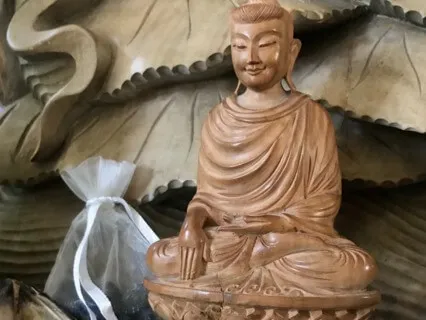
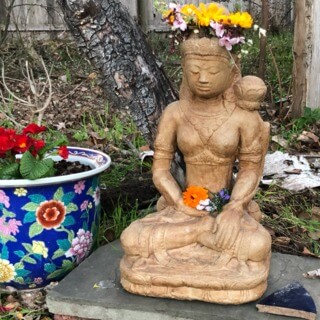
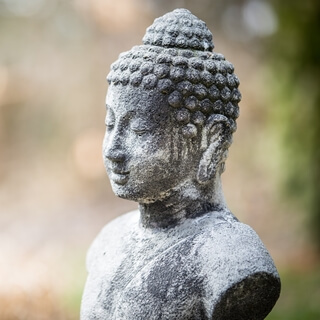
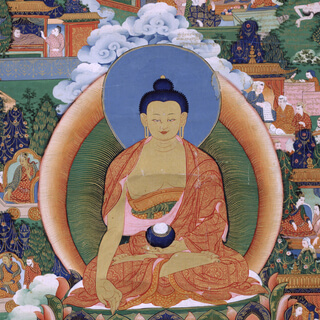
Drawing attention to the whole body in the sitting posture.
To begin a short meditation invoking the quality of compassion,
Of care for ourselves and others,
For every being who suffers and experiences distress.
Often when we invoke the heart qualities of kindness,
Compassion,
Joy,
Balance of heart,
We bring our attention to the center of the chest,
To what we think of as the heart center.
You can do that.
Or you could feel the whole body in a way as an integrated whole.
And imagine for the purposes of this practice that the whole body in a way is the heart center.
Or that the whole body is already permeated by the quality of emotion or feeling that is the sign of our embodiedness,
The sign of our aliveness in this human form,
In this mammal,
Animal form.
We are,
As one teacher says,
We are the emotional species.
There are many in our mammalian family who are emotional bond-oriented animals.
We have that quality woven into everything we do and it expresses through every aspect of our being,
Our relationships,
Our cultures.
And we have this particular quality that you might perceive in a way as ordinary,
But may also be quite extraordinary,
Which is that our minds can extend beyond the immediate circle of our personal loved ones.
And through the force of this strange thing we could call imagination or intuition,
Can actually bring to mind beings far distant from us,
Very different from us.
Even the concept of beings unknown to us on other planets,
Other realms,
Other ways of being,
But even just across town from us in a way that connects us to a much vaster web of life than we have immediate access to.
And so the practice of compassion is to join together the personal feeling that we can know when someone we love is in distress or when we care for someone in their suffering,
And to extend that through the force of mind outward to touch many,
Many more beings or to encompass more beings in the field of our care.
And we do this by generalizing.
Think of a particular suffering.
It might be a suffering of your own,
It might be one of someone close to you,
But think of a personal one.
Oh,
This person I know suffers in this way,
Or I'm suffering in this way.
Just bring the person to mind and see if you can feel some of the tone or quality of that suffering,
What it is.
Is it a wanting of something,
A fearing of something?
Is it the simple painfulness that comes when the body hurts or the heart-mind is in pain?
Have a sense of what that pain is,
And then have a sense of your care for it or around it.
And to do this we,
In a sense,
Put our attention first on the object,
The thing that we're looking at.
This person is in pain,
Including if that's myself.
And then we look at it from the subject of the meditator.
I care about this.
I care about this aspect of my life that's in pain.
I care about this person who I know who is in pain.
And you want to feel both.
Feel the pain that's there.
Feel the quality of your own care.
Sometimes it can feel helpful to go back and forth a little bit,
Because part of what we're doing is we're actually disentangling them.
If we get too lost in the story of what's painful,
We lose sight of the feeling of our own care,
Because they balance,
Or they're meant to balance,
Where the pain is clearly painful,
But our own care is pleasurable.
It feels good to care for someone,
Including ourselves,
Those we love.
Feel this for a moment until you can really get a sense of both sides of this equation,
The one feeling pain and the one feeling the,
Call it satisfaction or rightness or goodness,
The feeling of caring for that.
And then as you get a sense of those two sides,
The pain and the care for the pain,
Or the one who bears witness to that pain,
Then the practice of the Brahma Vihara,
Or the divine state of compassion,
Is to do that and in a sense blow it outward to widen the circle to all beings.
And there's lots of ways to do this.
You can do it in a very stepwise way or in an all-at-once kind of way.
Here's a little bit the all-at-once kind of way.
And it's to generalize from both of those feelings.
Just as this person experiences this particular pain,
So too do all beings who have a body,
Who have perceptions,
Who live in a world of change,
Everyone experiences pain.
And so not all pains are the same,
But everyone has some pain.
And so then you can generalize and feel in a way.
And even generalizing it helps it not be overwhelming.
You can just know that everyone experiences pain,
Dissatisfaction,
And loss.
And then for the one who is compassionate,
Again,
You can blow it wide open.
Just as I,
As an individual,
Care personally for that one person's pain,
So too can this heart care for all beings in their pain,
All different forms of pain,
All the different manifestations,
By understanding that all pain has a related quality.
Because there is pain,
There is compassion,
And the wish for that pain to be relieved.
And the cultivation of compassion is to rest in the spaciousness of the wish for all pain to be relieved,
Not just the personal manifestations of it that we're individually familiar with.
And so we'll sit for a few minutes in silence with this model of developing compassion.
If it's too abstract or formal,
Just rest with the sense of your own body and the reality of discomfort in the world.
But it's really important to not get lost in it,
Which really means to not let the story of it spin out in the mind.
The heart of the practice is just to rest in the quality of care,
The quality of.
.
.
The quality of sincere presence with that which is true,
That which is confronting us all the time in this world where there's difficulty.
So let the heart rest in kindness,
In the presence of pain.
We'll sit for a few minutes together in that way.