Yeah,
You know the Zen story about the empty cup.
Where the teacher is pouring tea into the professor's cup,
And he keeps talking while the teacher keeps pouring.
She keeps pouring in a.
.
.
Pours over onto the table and onto the floor and it spills everywhere and then he stops talking and he says It's going everywhere.
Stop pouring the tea.
And she says,
We'll like this cup.
You are full of your own opinions and speculations.
How can I show you Zen unless you first empty?
So for maybe a certain kind of understanding.
There is a certain emptiness that is required in order to understand.
It.
And I think that also brings up the question like the understanding like emptying the cup,
Then is that understanding coming from outside or from inside,
Which I feel like it can be really valuable to have like the understanding also coming from the teacher because that could also be like,
You know,
Knowledge and not really one's own wisdom.
But maybe that.
That understanding is in the form of like not words but a transmission which I feel would be like more valuable and in which you are kind of soaking in the presence of the teacher but what as you were talking about that what came to me was that this cup with this empty cup it has like a hole underneath it and as we empty the cup or as we empty ourselves this the wisdom or the the you know kind of differentiation between knowledge and wisdom knowledge being from outside and wisdom coming from within that this wisdom comes from within so it's as if like there's a hole you know at the bottom of the cup and the wisdom starts filling in from that hole from within and the cup becomes full so then Knowledge.
To put it into these terms,
Knowledge is something that you get.
And accumulate from the outside and wisdom will be something that you find or access.
Yeah on the inside,
Like so maybe right now.
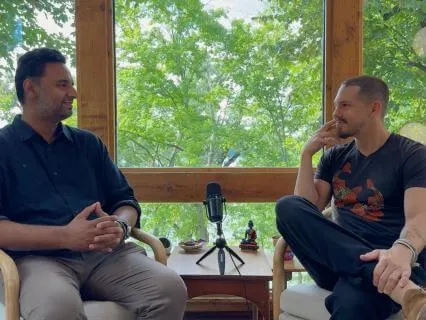
We're talking potentially someone's listening and we might be Providing some knowledge.
Maybe not really.
It's interesting.
I don't know if you relate with this in terms of what you do.
In your work or on insight timer or whatever it might be.
Uh is your intention to provide knowledge or Maybe not.
Maybe it's on the wisdom side,
Because I'm realizing as we're talking,
I think that's mainly what I I'm aiming to do is just I'm trying to find my own wisdom and then maybe that facilitates someone else accessing or finding their own wisdom.
I feel like I'm mainly not attempting to add knowledge or accumulate knowledge,
Not to say that's wrong or bad,
But it's just not.
.
.
I guess what I'm interested in,
In terms of what I am creating.
I've actually had a thought some time ago that mainly what I'm,
I think,
I was like,
Why am I saying any of this stuff?
Why are we recording this right now?
And if there had to be a reason,
I think it is maybe mainly to empty as opposed to fill.
To empty someone's mind,
Including my own,
As opposed to try to fill it with something,
A knowledge,
Or a concept.
Steps to something just The act of emptying is I guess what I'm interested in.
I don't know if you relate.
Yeah,
Absolutely.
That means then that even the knowledge that comes from the outside,
If it helps someone to become empty and tap into their own wisdom,
That would be maybe a quote-unquote good knowledge versus,
I don't know,
I don't want to kind of divide here,
But a kind of better knowledge than just knowledge which is about telling people this is what you should do or this is how you should do it.
Just kind of coming to me that like a wonderful teacher and again like that does not mean that knowledge does not have value it.
Initially you get knowledge and that knowledge guides you to go into your own inner wisdom and I think this is what we are kind of doing that presenting our own wisdom which might be knowledge for someone else but that can turn help them to maybe tap into their own wisdom and I feel like a good quote-unquote like teacher,
You know,
Or any guide or anyone would be who is actually kind of helping the other to turn inward versus like telling them that this is what you should do or follow these steps or but really helping them tap into their own wisdom.
I think that's why I love Zen so much,
Because that's all the.
.
.
The stories of Zen are always the student tends to be looking for knowledge,
And then the teacher seems to point them to wisdom.
Tell me.
I've just arrived at the monastery.
Will you please teach me?
Well have you eaten your rice?
Then wash your bowl.
That's it.
That's the whole teaching.
Why did Bodhidharma move from India to China?
The oak tree in the garden.
The student is often looking,
I think,
For some knowledge to fill their cup,
And then the teacher responds just by emptying.
Their cup,
And then the question is the student.
The question is,
Is the student open to receiving that?
There must be some knowledge that I can accumulate to get this thing.
But maybe the thing is the unplugging of the hole at the bottom of the cup if you're willing to remain empty for long enough and then there's another sort of source that he might call wisdom that arises from that place.
And I wonder why is that though,
Like that why does the mind want that knowledge,
Just craves that knowledge,
Because there's kind of a satisfaction there,
Like intellectually knowing something uh is satisfying that okay now I know this intellectually and it it's kind of a It's an illusion because it makes you feel that you have got it just by intellectually getting knowledge or reading something and you're like,
Yeah,
I got it.
But have I really got it?
Because unless it becomes like a lived experience and It is experienced in a very deep manner.
It's not really helpful.
It's just kind of up here versus lived in my body or in my experience.
And like you said,
I guess it can be helpful,
But maybe oftentimes it actually acts as a hindrance.
Because that was making me think of like,
If I want to go get pizza.
I'll order the pizza or I'll look at the menu.
To order the pizza and the people who made the pizza use ingredients and they have maybe a recipe that works really well and all this stuff is like knowledge.
But the whole point is the experience of eating the pizza.
That's maybe on the side of wisdom that we're talking about,
Like being able to actually eat it,
Versus if I only live on the side of knowledge.
I'm focused on all the various elements of what makes a good pizza and what pizza tastes like.
This can be a description which can be helpful or it would be like i starve because i never actually just like eat it or i can't really taste it because i'm too worried about the the intellectual.
Side of things.
Yeah,
I think that's a good example.
Yeah.
It was fun discussing with you.