Hello dear ones,
And welcome to today's reading of The Railway Children.
As always,
Just take a moment to arrive here,
Whether you be stretched out in your bed,
Getting ready for a wonderful night's sleep,
Or just taking a few moments out of your day to listen to a story about three children and their love of the railway.
Paying some attention to your body and your breath,
And your breath,
And allowing yourself to relax,
So that you may enjoy the story as it continues to unfold.
And when you're ready,
We will begin.
Chapter Three.
The Old Gentleman.
After the adventure of Peter's coal mine,
It seemed well to the children to keep away from the station,
But they did not,
They could not,
Keep away from the railway.
They had lived all their lives in a street where cabs and buses rumbled by at all hours,
And the carts of butchers and bakers and candlestick makers might occur at any moment.
Here,
In the deep silence of the sleeping country,
The only things that went through were the trains.
They seemed to be all that was left to link the children to the old life that had once been theirs.
Straight down the hill,
In front of three chimneys,
The daily passage of their six feet began to mark a path across the crisp,
Short turf.
They began to walk in a straight line,
Began to know the hours when certain trains passed,
And they gave names to them.
The 9.
15 up was called the Green Dragon.
The 10.
7 down was the Worm of Wantley.
The Midnight Town Express,
Whose shrieking rush they sometimes woke from their dreams to hear,
Was the fearsome Fly-by-Night.
Peter got up once,
In chill starshine,
And peeping at it through his curtains,
Named it on the spot.
It was by the Green Dragon that the old gentleman travelled.
He was a very nice-looking old gentleman,
And he looked as if he were nice,
Too,
Which is not at all the same thing.
He had a fresh-coloured,
Clean-shaven face and white hair,
And he wore rather odd-shaped collars and a top hat that wasn't exactly the same kind as other people's.
Of course,
The children didn't see all this at first.
In fact,
The first thing they noticed about the old gentleman was his hand.
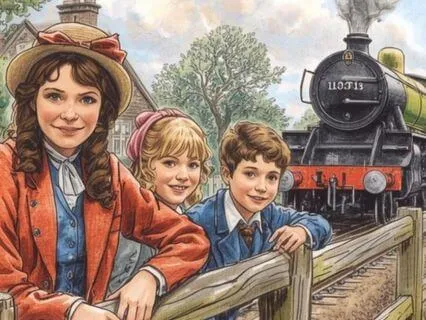
It was one morning as they sat on the fence waiting for the Green Dragon,
Which was three and a quarter minutes late by Peter's Waterbury watch that he had had given to him on his last birthday.
The Green Dragon's going where Father is,
Said Phyllis.
If it were really a Green Dragon,
We could stop it and ask it to take our love to Father.
Dragons don't carry people's love,
Said Peter.
They'd be above that.
Yes,
They do,
If you tame them thoroughly first.
They fetch and carry like pet spaniels,
Said Phyllis,
And feed out of your hand.
I wonder why Father never writes to us.
Mother says he's been too busy,
Said Bobby.
But he'll write soon,
She says.
I say,
Phyllis suggested,
Let's all wave to the Green Dragon as it goes by.
If it's a magic dragon,
It'll understand and take our love to Father.
And if it isn't,
Three waves aren't much.
We shall never miss them.
So when the Green Dragon tore shrieking out of the mouth of its dark lair,
Which was the tunnel,
All three children stood on the railing and waved their pocket handkerchiefs without stopping to think whether they were clean handkerchiefs or the reverse.
They were,
As a matter of fact,
Very much the reverse.
And out of a first-class carriage,
A hand waved back,
A quite clean hand.
It held a newspaper.
It was the old gentleman's hand.
After this,
It became the custom for waves to be exchanged between the children and the 915.
And the children,
Especially the girls,
Like to think that perhaps the old gentleman knew Father and would meet him in business,
Wherever that shady retreat might be,
And tell him how his three children stood on a rail far,
Far away in the green countryside and waved their love to him every morning,
Wet or fine.
For now,
They were able to go out in all sorts of weather,
Such as they would never have been allowed to go out in when they lived in their villa house.
This was Aunt Emma's doing,
And the children felt more and more that they had not been quite fair to this unattractive aunt,
When they found out how useful were the long gaiters and waterproof coats that they had laughed at her for buying for them.
Mother,
All this time,
Mother,
All this time,
Was very busy with her writing.
She used to send off a good many long blue envelopes with stories in them,
And large envelopes of different sizes and colours used to come to her.
Sometimes she would sigh when she opened them and say,
Another story come home to roost,
Oh dear,
And then the children would be very sorry,
But sometimes she would wave the envelope in the air and say,
Hooray,
Here's a sensible editor,
He's taken my story and this is the proof of it.
At first,
The children thought the proof meant the letter the sensible editor had written,
But they presently got to know that the proof was long slips of paper with the story printed on them.
Whenever an editor was sensible,
There were buns for tea.
One day,
Peter was going down to the village to get buns to celebrate the sensibleness of the editor of the Children's Globe when he met the station master.
Peter felt very uncomfortable,
For he had now had time to think over the affair of the coal mine.
He did not like to say good morning to the station master,
As you usually do to anyone you meet on a lonely road,
Because he had a hot feeling which spread even to his ears,
That the station master might not care to speak to a person who had stolen coals.
Stolen is a nasty word,
But Peter felt it was the right one,
So he looked down and said nothing.
It was the station master who said good morning,
As he passed by,
And Peter answered good morning.
Then he thought,
Perhaps he doesn't know who I am by daylight,
Or he wouldn't be so polite.
And he did not like the feeling which thinking this gave him,
And then before he knew what he was going to do,
He ran after the station master,
Who stopped when he heard Peter's hasty boots crunching the road,
And coming up to him very breathless,
And with his ears now quite magenta coloured,
He said,
I don't want you to be polite to me if you don't know me when you see me.
Eh?
Said the station master.
I thought perhaps you didn't know it was me that took the coals,
Peter went on,
When you said good morning,
But it was,
And I'm sorry,
So there.
Why?
Said the station master.
I wasn't thinking anything at all about the precious coals,
Let bygones be bygones,
And where were you off to in such a hurry?
I'm going to buy buns for tea,
Said Peter.
I thought you were all so poor,
Said the station master.
So we are,
Said Peter,
Confidently,
But we always have three penny worth of half pennies for tea,
Whenever mother sells a story,
Or a poem,
Or anything.
Oh?
Said the station master.
So your mother writes stories,
Does she?
The most beautiful that you ever read,
Said Peter.
You ought to be very proud to have such a clever mother.
Yes,
Said Peter,
But she used to play with us more before she had to be so clever.
Well,
Said the station master,
I must be getting along,
And you give us a look in at the station,
Whenever you feel so inclined,
And as to the coals,
Well,
Let's never mention it,
Eh?
Thank you,
Said Peter.
I'm very glad it's all straightened out between us.
I'm very glad it's all straightened out between us.
And he went on across the canal bridge to the village to get the buns,
Feeling more comfortable in his mind than he had felt since the hand of the station master had fastened on his collar that night among the coals.
Next day,
When they had sent the threefold wave of greeting to father by the green dragon,
And the old gentleman had waved back as usual,
Peter proudly led the way to the station.
But ought we,
Said Bobby.
After the coals,
She means,
Phyllis explained.
Phyllis explained.
I met the station master yesterday,
Said Peter.
He expressly invited us to go down any time we liked.
After the coals,
Repeated Phyllis.
Stop a minute,
My bootlace is undone.
It's always undone,
Phyllis,
Said Peter.
And the station master was more of a gentleman than you'll ever be,
Phil,
Throwing coal at a chap's head like that.
Phyllis did up her bootlace and went on in silence.
But her shoulders shook and presently a fat tear fell off her nose and splashed on the metal of the railway line.
Bobby saw it.
Why,
What's the matter,
Darling,
She said,
Stopping short and putting her arm around the heaving shoulders.
He,
He called me ungentlemanly,
Sobbed Phyllis.
I didn't never call him unladylike,
Not even when he tied my clorinda to the firewood bundle and burned her at the stake for a martyr.
Peter had indeed perpetrated this outrage a year or two before.
Well,
You began,
You know,
Said Bobby,
Honestly,
About coals and all that.
Don't you think you'd better both unsay everything since the wave and let honour be satisfied?
I will if Peter will,
Said Phyllis,
Sniffling.
All right,
Said Peter,
Honour is satisfied.
Here,
Use my hanky,
Phil,
For goodness sake,
If you've lost yours as usual.
I wonder what you do with them.
You had my last one,
Said Phyllis,
To tie up the rabbit hutch door with.
But you're very ungrateful.
It's quite right what it says in the poetry book about sharper than a serpent it is to have a toothless child.
But it means ungrateful when it says toothless.
Miss Low told me so.
All right,
Said Peter,
Impatiently.
I'm sorry.
There,
Now,
Will you come on?
They reached the station and spent a joyous two hours with the porter.
He was a worthy man and seemed never tired of answering the questions that began with why,
Which many people in higher ranks of life often seem wary of.
He told them many things that they had not known before,
As,
For instance,
That the things that hook carriages together are called couplings and that the pipes,
Like great serpents that hang over the couplings,
Are meant to stop the train with.
If you could get a hold of one of them when the train is going and pull him apart,
Said he,
She'd stop dead off with a jerk.
Who's she?
Said Phyllis.
The train,
Of course,
Said the porter.
After that,
The train was never again it to the children.
And you know the thing in the carriages where it says on it,
£5 fine for improper use.
If you were to improperly use that,
The train would stop.
And if you used it properly,
Said Bobby,
It would just stop the same,
I suppose.
But it isn't proper use unless you're being murdered.
In such delightful conversation,
The time went by all too quickly.
The station master came out once or twice from that sacred inner temple behind the place where the hole is that they sell you tickets through,
And was most jolly with them all.
Just as if coal had never been discovered,
Phyllis whispered to her sister.
Whispered to her sister.
He gave them each an orange and promised to take them up into the signal box one of these days when he wasn't so busy.
Several trains went through the station,
And Peter noticed for the first time that engines have numbers on them,
Like cabs.
Yes,
Said the porter,
I knowed a young gent as used to take down the numbers of every single one he seed in a green leather notebook with silver corners it was,
Owing to his father being very well to do in the wholesale stationary.
Peter felt that he could take down numbers too,
Even if he was not the son of a wholesale stationer.
As he did not happen to have a green leather notebook with silver corners,
The porter gave him a yellow envelope,
And on it he noted 379663 and felt that this was the beginning of what would be a most interesting collection.
That night at tea,
He asked mother if she had a green leather notebook with silver corners.
She had not,
But when she heard what he wanted it for,
She gave him a little black one.
It has a few pages torn out,
She said,
But it will hold quite a lot of numbers,
And when it's full,
I'll give you a copy of it.
I'm so glad you like the railway,
Only,
Please,
You mustn't walk on the line.
Not if we face the way the train's coming,
Asked Peter,
After a gloomy pause,
In which glances of despair were exchanged.
No,
Really not,
Peter,
Said mother.
No,
Really not,
Peter,
Said mother.
Then Phyllis said,
Mother,
Didn't you ever walk on the railway lines when you were little?
Mother was an honest and honourable mother,
So she had to say,
Yes.
Well then,
Said Phyllis,
But darlings,
You don't know how fond I am of you.
What should I do if you got hurt?
Are you fonder of us than granny was of you when you were little,
Phyllis asked.
Bobby made signs to her to stop,
But Phyllis never did see signs,
No matter how plain they might be.
Mother did not answer for a minute.
She got up to put more water in the teapot.
No one,
She said at last,
Ever loved anyone more than my mother loved me.
Then she was quiet again,
And Bobby kicked Phyllis hard under the table,
Because Bobby understood a little bit the thoughts that were making mother so quiet.
The thoughts of the time when mother was a little girl and was all the world to her mother.
It seems so easy and natural to run to mother when one is in trouble.
Bobby understood a little how people do not leave off running to their mothers when they are in trouble,
Even when they are grown up.
And she thought she knew a little what it must be to be sad and have no mother to run to anymore.
So she kicked Phyllis,
Who said,
What are you kicking me like that for,
Bob?
And then mother laughed a little and sighed and said,
Very well then,
Only let me be sure you do know which way the trains come and don't walk on the line near the tunnel or near corners.
Trains keep to the left like carriages,
Said Peter.
So if we keep to the right,
We're bound to see them coming.
Very well,
Said mother.
And I dare say you think that she ought not to have said it.
But she remembered about when she was a little girl herself.
And she did say it.
And neither her own children,
Nor you,
Nor any other children in the world could ever understand exactly what it cost her to do so.
Only some,
Few of you,
Like Bobby,
May understand a very little bit.
It was the very next day that mother had to stay in bed because her head ached so.
Her hands were burning hot and she would not eat anything.
And her throat was very sore.
If I was you,
Mum,
Said Mrs.
Vinnie,
I should take and send for the doctor.
There's a lot of catchy complaints are going about now.
My sister's eldest,
She took a chill and it went to her inside.
Two years ago,
Come Christmas,
She's never been the same gal since.
Mother wouldn't at first.
But in the evening,
She felt so much worse that Peter was sent to the house in the village that had three laburnum trees by the gate.
And on the gate,
A brass plate with WW Forest MD on it.
WW Forest MD came at once.
He talked to Peter on the way back.
He seemed a most charming and sensible man.
Interested in railways and rabbits and really important things.
When he had seen mother,
He said it was influenza.
Now,
Lady,
He said in the hall to Bobby,
I suppose you want to be the head nurse?
Of course,
She said.
Well,
Then I'll send down some medicine.
Keep up a good fire.
Have some strong beef tea made ready to give her as soon as the fever goes down.
She can have grapes now and beef essence and soda water and milk.
And you'd better get in a bottle of brandy,
The best brandy.
Cheap brandy is worse than poison.
She asked him to write it all down and he did.
When Bobby showed mother the list he had written,
Mother laughed.
It was a laugh,
Bobby decided,
Though it was rather cold and feeble.
Nonsense,
Said mother,
Lying in bed with eyes as bright as beads.
I can't afford all that rubbish.
Tell Mrs.
Vinnie to boil two pounds of scraggins of the neck of your dinners tomorrow and I can have some of the broth.
Yes,
I should like some more water now,
Love.
And will you get a basin and sponge my hands?
Bobby obeyed.
When she had done everything she could to make mother less uncomfortable,
She went down to the others.
Her cheeks were very red,
Her lips set tight and her eyes shone as bright as mother's.
She told them what the doctor had said and what mother had said.
And now,
She said,
When she had told all,
There's no one but us to do anything and we've got to do it.
I've got to get the shilling for the mutton.
We can do without the beastly mutton,
Said Peter.
Bread and butter will support life.
People have lived on less on desert islands many a time.
Of course,
Said his sister.
And Mrs.
Vinnie was sent to the village to get as much brandy and soda water and beef tea as she could buy for a shilling.
But even if we never have anything to eat at all,
Said Phyllis,
You can't get all those other things with our dinner money.
No,
Said Bobby,
Frowning.
We must find out some other way.
Now think,
Everybody.
Think just as hard as you ever,
Ever can.
They did think.
And presently,
They talked.
And later,
When Bobby had gone up to sit with mother in case she wanted anything,
The other two were very busy with scissors and a white sheet and a paintbrush and the pot of Brunswick black that Mrs.
Vinnie used for grates and fenders.
They did not manage to do what they wished exactly with the first sheet,
So they took another out of the linen cupboard.
It did not occur to them that they were spoiling good sheets,
Which also cost good money.
Bobby's bed had been moved into mother's room.
And several times in the night,
She got up to mend the fire and to give her mother milk and soda water.
Mother talked to herself a good deal,
But it did not seem to mean anything.
And once she woke up suddenly and called out,
Mama,
Mama.
And Bobby knew she was calling for granny and that she had forgotten that it was no use calling because granny was dead.
In the early morning,
Bobby heard her name and jumped out of bed and ran to mother's bedside.
Ah,
I think I was asleep,
Said mother.
My poor little duck,
How tired you'll be.
I do hate to give you all this trouble.
Trouble,
Said Bobby.
Oh,
Don't cry,
Sweet,
Mother said.
I shall be all right in a day or two.
And Bobby said yes and tried to smile.
When you are used to 10 hours of solid sleep,
To get up three or four times in your sleep time makes you feel as though you had been up all night.
Bobby felt quite stupid and her eyes were sore and stiff.
But she tidied the room and arranged everything neatly before the doctor came.
This was at half past eight.
Everything going on all right,
Little nurse,
He said at the front door.
Did you get the brandy?
I've got the brandy,
Said Bobby.
In a little flat bottle.
I didn't see the grapes or the beef tea,
Though,
Said he.
No,
Said Bobby firmly,
But you will tomorrow.
And there's some beef stew in the oven for beef tea.
Who told you to do that?
He asked.
I noticed what mother did when Phil had mumps.
Right,
OK,
Said the doctor.
Now you get your old woman to sit with your mother and then you eat a good breakfast and go straight to bed and sleep until dinner time.
We can't afford to have the head nurse ill,
Can we?
He was really quite a nice doctor.
When the 915 came out of the tunnel that morning,
The old gentleman in the first class carriage put down his newspaper and got ready to wave his hand to the three children on the fence.
But this morning there were not three.
There was only one.
And that was Peter.
Peter was not on the railings either,
As usual.
He was standing in front of them in an attitude like that of a showman.
Showing off the animals.
Or a kind of clergyman when he points with a wand at the scenes from the Palestine.
When there is a magic lantern and he is explaining it.
Peter was pointing too.
And what he was pointing at was a large white sheet nailed against the fence.
On the sheet there were thick black letters,
More than a foot long.
Some of them had run a little,
Because of Phyllis having put the Brunswick black on too eagerly.
But the words were quite easy to read.
And this was what the old gentleman and several other people in the train read in the large black letters on the white sheet.
Look out at the station.
A good many people did look out at the station and were disappointed,
For they saw nothing unusual.
The old gentleman looked out too.
And at first he too saw nothing more unusual than the graveled platform and the sunshine and the wallflowers and forget-me-nots in the station borders.
It was only just as the train was beginning to puff and pull itself together to start again that he saw Phyllis.
She was quite out of breath with running.
Oh,
She said,
I thought I'd missed you.
My bootlaces would keep coming down and I fell over them twice.
Here,
Take it.
She threw a warm,
Dampish letter into his hand as the train moved.
He leaned back in his corner and opened the letter.
This is what he read.
Dear Mr.
We-do-not-know-your-name,
Mother is ill and the doctor says to give her the things at the end of the letter.
But she says she can't afford it.
She can't afford it and to get mutton for us and she will have the broth.
We do not know anybody here but you because father is away and we do not know the address.
Father will pay you or if he has lost all his money or anything,
Peter will pay you when he is a man.
We promise it on our honour for all the things mother wants.
Will you give the parcel to the station master?
Because of us not knowing what train you come down by.
Say it is for Peter that was sorry about the coals and he will know all right.
Roberta,
Phyllis,
Peter.
Then came the list of things the doctor had ordered.
The old gentleman read it through once and his eyebrows went up.
He read it twice and smiled a little.
When he had read it twice,
He put it in his pocket and went on reading the times.
About six o'clock that evening,
There was a knock at the back door.
The three children rushed to open it and there stood the friend of the doctor.
It was a friendly porter who had told them so many interesting things about railways.
He dumped down a big hamper on the kitchen flags.
An old gent,
He said,
He asked me to fetch it up straight away.
Thank you very much,
Said Peter.
And then as the porter lingered,
He added,
I'm most awfully sorry I haven't got two pence to give you like father does.
But you drop it if you please,
Said the porter indignantly.
I wasn't thinking about no tuppence.
I only wanted to say I was sorry your mama wasn't so well and to ask how she finds herself this evening.
And I fetched her along a bit of sweet briar.
Very sweet to smell it is.
Two pence indeed,
Said he,
And produced a bunch of sweet briar from his hat.
Just like a conjurer,
As Phyllis remarked afterwards.
Thank you very much,
Said Peter.
And I beg your pardon about the two pence.
No offence,
Said the porter,
Untruly but politely.
And off he went.
And then the children undid the hamper.
First there was straw,
And then there were fine shavings.
And then came all the things they had asked for,
And plenty of them.
And then a good many things they had not asked for,
Among others,
Peaches and port wine and two chickens,
A cardboard box of big red roses,
With long stalks,
And a tall thin green bottle of lavender water,
And three small fatter bottles of cologne.
And there was a letter too.
Dear Roberta and Phyllis and Peter,
It said.
Here are the things you want.
Your mother will want to know where they came from.
Tell her they were sent by a friend who heard she was ill.
When she is well again,
You must tell her about it,
Of course,
But not until then.
And if she says you ought not to have asked for the things,
Tell her that I say you were quite right,
And that I hope she will forgive me for taking the liberty of allowing myself a great pleasure.
The letter was signed GP something that the children couldn't read.
I think we were right,
Said Phyllis.
Right?
Of course we were right,
Said Bobby.
All the same,
Said Peter,
With his hands in his pockets.
I don't exactly look forward to telling mother the whole truth about it.
We're not to do that until she's well,
Said Bobby.
And when she's well,
We shall be so happy,
We shan't mind a little fuss like that.
Oh,
Just look at the roses.
I must take them up to her.
And the sweet briar,
Said Phyllis,
Sniffing it loudly.
Don't forget the sweet briar.
As if I should,
Said Roberta.
Mother told me the other day there was a thick hedge of it at her mother's house when she was a little girl.